
OA系统权限管理设计方案学习
学习之:http://www.cnblogs.com/kivenhou/archive/2009/10/19/1586106.html
此为模型图:
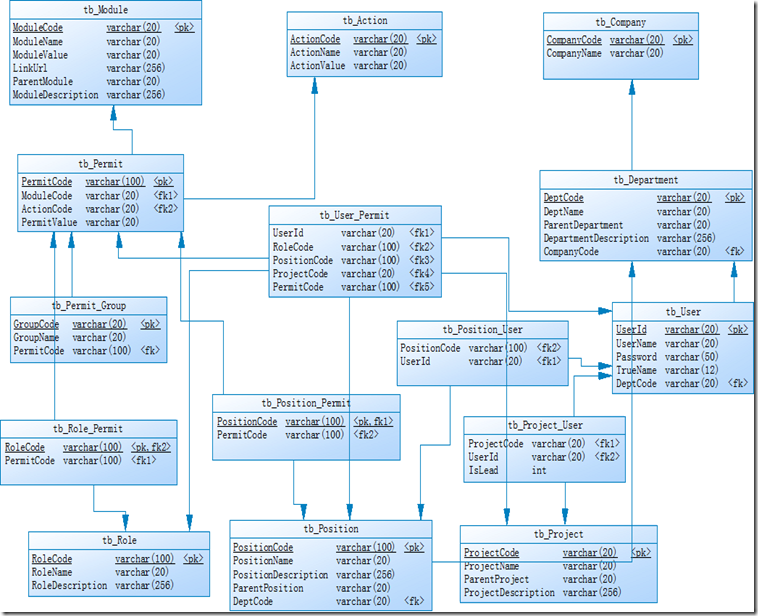
据此写了sql语句:
drop table if exists tb_Permit_Group;
drop table if exists tb_Position_Permit;
drop table if exists tb_Position_User;
drop table if exists tb_Project_User;
drop table if exists tb_Role_Permit;
drop table if exists tb_User_Permit;
drop table if exists tb_User;
drop table if exists tb_Permit;
drop table if exists tb_Action;
drop table if exists tb_Position;
drop table if exists tb_Department;
drop table if exists tb_Company;
drop table if exists tb_Module;
drop table if exists tb_Project;
drop table if exists tb_Role;
/*==============================================================*/
/* Table: tb_Action */
/*==============================================================*/
create table tb_Action
(
ActionCode varchar(20) not null,
ActionName varchar(20),
ActionValue varchar(20),
primary key (ActionCode)
);
/*==============================================================*/
/* Table: tb_Company */
/*==============================================================*/
create table tb_Company
(
CompanyCode varchar(20) not null,
CompanyName varchar(20),
primary key (CompanyCode)
);
/*==============================================================*/
/* Table: tb_Department */
/*==============================================================*/
create table tb_Department
(
DeptCode varchar(20) not null,
DeptName varchar(20),
ParentDepartment varchar(20),
DepartmentDescription varchar(256),
CompanyCode varchar(20),
primary key (DeptCode)
);
/*==============================================================*/
/* Table: tb_Module */
/*==============================================================*/
create table tb_Module
(
ModuleCode varchar(20) not null,
ModuleName varchar(20),
ModuleValue varchar(20),
LinkUrl varchar(256),
ParentModule varchar(20),
ModuleDescription varchar(256),
primary key (ModuleCode)
);
/*==============================================================*/
/* Table: tb_Permit */
/*==============================================================*/
create table tb_Permit
(
PermitCode varchar(100) not null,
ModuleCode varchar(20),
ActionCode varchar(20),
PermitValue varchar(20),
primary key (PermitCode)
);
/*==============================================================*/
/* Table: tb_Permit_Group */
/*==============================================================*/
create table tb_Permit_Group
(
GroupCode varchar(20) not null,
GroupName varchar(20),
PermitCode varchar(100),
primary key (GroupCode)
);
/*==============================================================*/
/* Table: tb_Position */
/*==============================================================*/
create table tb_Position
(
PositionCode varchar(100) not null,
PositionName varchar(20),
PositionDescription varchar(256),
ParentPosition varchar(20),
DeptCode varchar(20),
primary key (PositionCode)
);
/*==============================================================*/
/* Table: tb_Position_Permit */
/*==============================================================*/
create table tb_Position_Permit
(
PositionCode varchar(100) not null,
PermitCode varchar(100),
primary key (PositionCode)
);
/*==============================================================*/
/* Table: tb_Position_User */
/*==============================================================*/
create table tb_Position_User
(
PositionCode varchar(100),
UserId varchar(20)
);
/*==============================================================*/
/* Table: tb_Project */
/*==============================================================*/
create table tb_Project
(
ProjectCode varchar(20) not null,
ProjectName varchar(20),
ParentProject varchar(20),
ProjectDescription varchar(256),
primary key (ProjectCode)
);
/*==============================================================*/
/* Table: tb_Project_User */
/*==============================================================*/
create table tb_Project_User
(
ProjectCode varchar(20),
UserId varchar(20),
IsLead int
);
/*==============================================================*/
/* Table: tb_Role */
/*==============================================================*/
create table tb_Role
(
RoleCode varchar(100) not null,
RoleName varchar(20),
RoleDescription varchar(256),
primary key (RoleCode)
);
/*==============================================================*/
/* Table: tb_Role_Permit */
/*==============================================================*/
create table tb_Role_Permit
(
RoleCode varchar(100) not null,
PermitCode varchar(100),
primary key (RoleCode)
);
/*==============================================================*/
/* Table: tb_User */
/*==============================================================*/
create table tb_User
(
UserId varchar(20) not null,
UserName varchar(20),
Password varchar(50),
TrueName varchar(12),
DeptCode varchar(20),
primary key (UserId)
);
/*==============================================================*/
/* Table: tb_User_Permit */
/*==============================================================*/
create table tb_User_Permit
(
UserId varchar(20),
RoleCode varchar(100),
PositionCode varchar(100),
ProjectCode varchar(20),
PermitCode varchar(100)
);
alter table tb_Department add constraint FK_Reference_5 foreign key (CompanyCode)
references tb_Company (CompanyCode) on delete restrict on update restrict;
alter table tb_Permit add constraint FK_Reference_3 foreign key (ModuleCode)
references tb_Module (ModuleCode) on delete restrict on update restrict;
alter table tb_Permit add constraint FK_Reference_4 foreign key (ActionCode)
references tb_Action (ActionCode) on delete restrict on update restrict;
alter table tb_Permit_Group add constraint FK_Reference_18 foreign key (PermitCode)
references tb_Permit (PermitCode) on delete restrict on update restrict;
alter table tb_Position add constraint FK_Reference_21 foreign key (DeptCode)
references tb_Department (DeptCode) on delete restrict on update restrict;
alter table tb_Position_Permit add constraint FK_Reference_19 foreign key (PermitCode)
references tb_Permit (PermitCode) on delete restrict on update restrict;
alter table tb_Position_Permit add constraint FK_Reference_9 foreign key (PositionCode)
references tb_Position (PositionCode) on delete restrict on update restrict;
alter table tb_Position_User add constraint FK_Reference_11 foreign key (PositionCode)
references tb_Position (PositionCode) on delete restrict on update restrict;
alter table tb_Position_User add constraint FK_Reference_6 foreign key (UserId)
references tb_User (UserId) on delete restrict on update restrict;
alter table tb_Project_User add constraint FK_Reference_22 foreign key (ProjectCode)
references tb_Project (ProjectCode) on delete restrict on update restrict;
alter table tb_Project_User add constraint FK_Reference_23 foreign key (UserId)
references tb_User (UserId) on delete restrict on update restrict;
alter table tb_Role_Permit add constraint FK_Reference_1 foreign key (RoleCode)
references tb_Role (RoleCode) on delete restrict on update restrict;
alter table tb_Role_Permit add constraint FK_Reference_17 foreign key (PermitCode)
references tb_Permit (PermitCode) on delete restrict on update restrict;
alter table tb_User add constraint FK_Reference_20 foreign key (DeptCode)
references tb_Department (DeptCode) on delete restrict on update restrict;
alter table tb_User_Permit add constraint FK_Reference_12 foreign key (UserId)
references tb_User (UserId) on delete restrict on update restrict;
alter table tb_User_Permit add constraint FK_Reference_13 foreign key (RoleCode)
references tb_Role (RoleCode) on delete restrict on update restrict;
alter table tb_User_Permit add constraint FK_Reference_14 foreign key (PositionCode)
references tb_Position (PositionCode) on delete restrict on update restrict;
alter table tb_User_Permit add constraint FK_Reference_15 foreign key (ProjectCode)
references tb_Project (ProjectCode) on delete restrict on update restrict;
alter table tb_User_Permit add constraint FK_Reference_16 foreign key (PermitCode)
references tb_Permit (PermitCode) on delete restrict on update restrict;
OA系统权限管理设计方案学习的更多相关文章
- OA系统权限管理设计方案
(转)OA系统权限管理设计方案 OA系统权限管理设计方案 不同职责的人员,对于系统操作的权限应该是不同的.优秀的业务系统,这是最基本的功能. 可以对“组”进行权限分配.对于一个大企业的 ...
- OA系统权限管理设计方案【转】
l 不同职责的人员,对于系统操作的权限应该是不同的.优秀的业务系统,这是最基本的功能. l 可以对“组”进行权限分配.对于一个大企业的业务系统来说,如果要求管理员为其下员工逐一分配系统操作权限的话,是 ...
- OA系统权限管理设计(转载)
不论什么系统都离不开权限的管理,有一个好的权限管理模块,不仅使我们的系统操作自如,管理方便,也为系统加入亮点. l 不同职责的人员,对于系统操作的权限应该是不同的.优秀的业务系统,这是 ...
- OA系统 权限管理的设计流程
版权声明:本文为博主原创文章,遵循CC 4.0 BY-SA版权协议,转载请附上原文出处链接和本声明. 本文链接:https://blog.csdn.net/u013630349/article/det ...
- Android权限管理知识学习记录
一.Android权限背景知识 在Android 6.0之前,所申请的权限只需要在AndroidManifest.xml列举就可以了,从而容易导致一些安全隐患,因此,在Android 6.0时,Goo ...
- OA(权限管理初步模块)
权限管理:一般指根据系统设置的安全规则或者安全策略,用户可以访问而且只能访问自己被授权的资源,不多不少.权限管理几乎出现在任何系统里面,只要有用户和密码的系统. 根据权限管理的套路,我们一般从这三个角 ...
- 潭州课堂25班:Ph201805201 django框架 第十三课 自定义404页面,auth系统中的User模型,auth系统权限管理 (课堂笔记)
当 DEBUG=True 时,django 内部的404报错信息, 自带的报错信息, 要自定义404信息,要先把 DEBUG=False , 之后要自定义4040页面,有两种方法, 方法1,在创建40 ...
- 使用shiro做权限管理的学习笔记整理
Shiro权限管理 参考:https://www.cnblogs.com/jpfss/p/8352031.html Shiro解决的问题 授权和鉴别的问题:Authenrization(授权) Aut ...
- 2018/09/05《涂抹MySQL》【权限管理】学习笔记(二)
读 第四章<管理MySQL库与表> 第五章<MySQL的权限管理> 总结 1:当配置好 MySQL 数据库后,发现有几个默认的库,他们的意义和作用?(这里只做简单了解,之后用到 ...
随机推荐
- Socket Class中文解释
Socket 类 .NET Framework 4.6 and 4.5 实现 Berkeley 套接字接口. 继承层次结构 System.Object System.Net.Sockets.S ...
- 400. Nth Digit
这个EASY难度的题怎么感觉比H的还难,昨天没做出来,今天才做出来.. 呃啊..我生 气 啦.. 直接看的答案,耻辱. 1 digit: 1~9 总共1×9个 2 digits: 10~99 总共2× ...
- 【JAVA - 基础】之反射的原理与应用
一.反射简介 反射机制指的是程序在运行时能够获取自身的信息.在JAVA中,只要给定类的名字,那么就可以通过反射机制来获取类的所有信息. 1.反射的应用 JDBC编程中的:Class.forName(& ...
- Android 官方命令深入分析
原文:www.libgdx.cn Android SDK包括了多种工具来帮助你创建基于Android平台的移动应用.这些工具一般分成两类:SDK 工具和 platform 工具. SDK 工具是独立的 ...
- HUNNU--湖师大--11409--Skill
Skill Yasser is an Egyptian coach; he will be organizing a training camp in Jordan. At the end of ca ...
- 3高并发server:多路IO之epoll
1 epoll epoll是Linux下多路复用IO接口select/poll的增强版本号,它能显著提高程序在大量并.发连接中仅仅有少量活跃的情况下的系统CPU利用率,由于它会复用文件描写叙述符 ...
- 模拟dispatch_once
dispatch_once dispatch_once可以保证一段代码只被执行一次,因此出现之后使用最多的场景就是实现单例.本文来模拟实现dispatch_once的功能. 模拟dispatch_ ...
- js中offsetHeight、clientHeight、scrollHeight等相关属性区分总结
今天再次遇到了offset***.client***.scroll***的这三类属性的问题,总是混淆,现归纳总结如下: 大体上来说可以这样理解: client***属性(clientWidth.cli ...
- oracle左右连接 完全连接 有效连接 心得总结
左链接 A表 Left join B表 on 条件 示例 A表 B表 SELECT * FROM A left JOIN B ON A.AID = B.BID; 结果: 左链接查询出来的数 ...
- ssh连接超时问题解决方案
方法一: 1.设置服务器向SSH客户端连接会话发送频率和时间 #vi /etc/ssh/sshd_config,添加如下两行ClientAliveInterval 60ClientAliveCount ...