
深入解析vue响应式原理
摘要:本文主要通过结合vue官方文档及源码,对vue响应式原理进行深入分析。
1.定义
作为vue最独特的特性,响应式可以说是vue的灵魂了,表面上看就是数据发生变化后,对应的界面会重新渲染,那么响应式系统的底层细节到底是怎么一回事呢?
Tips:vue的响应式系统在vue2.0和vue3.0版本中的底层实现有所不同,简单了来说就是处理属性的getter/setter部分从Object.defineProperty替换成了Proxy(不过vue3也保留了Object.defineProperty方式用于支持IE浏览器)
1.1.vue2.0实现原理
当一个普通的javascript对象传入vue实例作为data选项时,vue将遍历data的所有属性,并使用Object.defineProperty重写这些属性的getter/setter方法,这些属性的getter/setter对于用户不可见,但是vue可以利用他们来追踪依赖,在属性值被访问和修改时通知变更。每个组件实例都对应一个watcher实例,它会在组件渲染的过程中访问过的属性设置为依赖。之后当属性的setter触发时,会通知watcher对关联的组件进行重新渲染。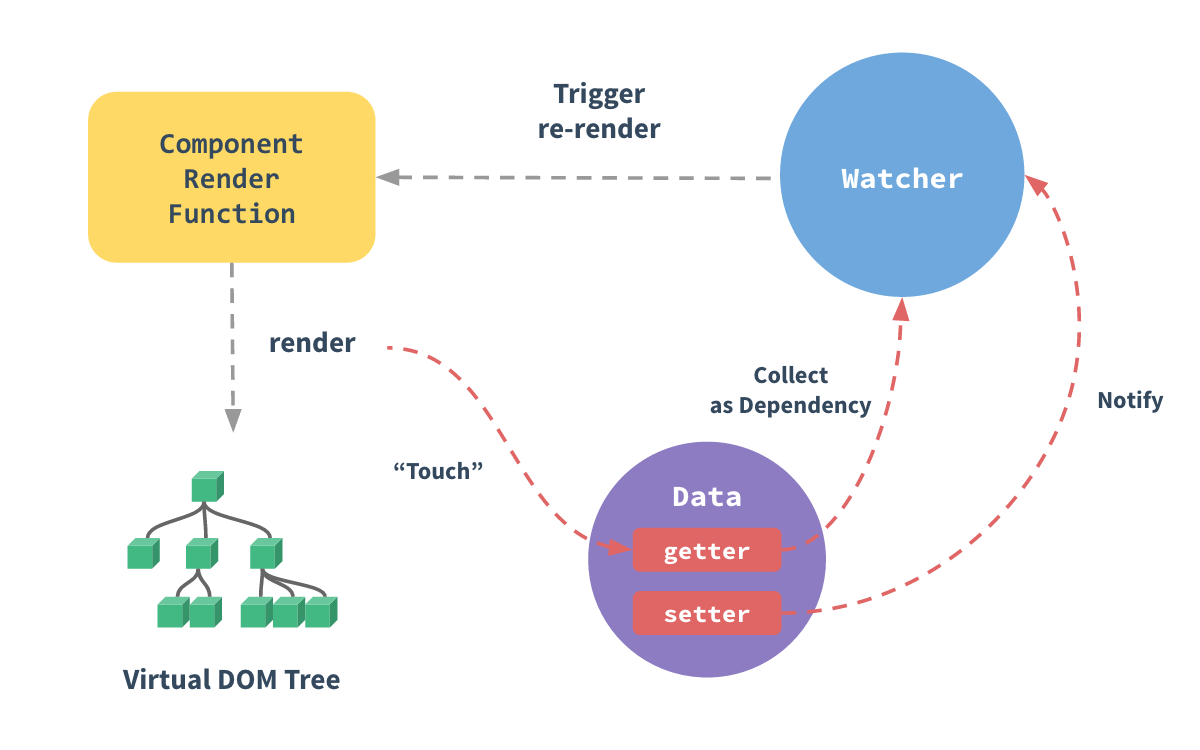
1.2.vue3.0实现原理
当一个普通的javascript对象传入vue实例作为data选项时,vue会将其转化为Proxy。首次渲染后,组件将跟踪在渲染过程中被访问的属性,组件就成了这些属性的订阅者。当proxy拦截到set操作时,该属性将通知所有订阅了它的组件进行重新渲染。
2.源码解析
通过上面的定义可能对于响应式的原理还不够清楚,接下来通过对vue源码的分析进行深入理解。
2.1.vue2.0源码实现
在vue2.0中,vue的响应式系统是基于数据拦截+发布订阅的模式,包含了四个模块:
- Observer:通过Object.defineProperty拦截data属性的setter/getter方法,从而使每个属性都拥有一个Dep,当触发getter时收集依赖(使用该属性的watcher),当触发setter时通知更新;
- Dep:依赖收集器,用于维护依赖data属性的所有Watcher;
- Watcher:将视图依赖的属性绑定到Dep中,当数据修改时触发setter,调用Dep的notify方法,通知所有依赖该属性的Watcher进行update更新视图,使属性值与视图绑定起来;
- Compile:模板指令解析器,对模板每个元素节点的指令进行扫描解析,根据指令模板替换属性数据,同时注入Watcher更新数据的回调方法。

- Observer
import Dep from './dep'

import VNode from '../vdom/vnode'

import { arrayMethods } from './array'

import {

  def,

  warn,

  hasOwn,

  hasProto,

  isObject,

  isPlainObject,

  isPrimitive,

  isUndef,

  isValidArrayIndex,

  isServerRendering

} from '../util/index'

const arrayKeys = Object.getOwnPropertyNames(arrayMethods)

/**

 * In some cases we may want to disable observation inside a component's

 * update computation.

 */

export let shouldObserve: boolean = true

export function toggleObserving (value: boolean) {

  shouldObserve = value

}

/**

 * Observer class that is attached to each observed

 * object. Once attached, the observer converts the target

 * object's property keys into getter/setters that

 * collect dependencies and dispatch updates.

 */

export class Observer {

  value: any;

  dep: Dep;

  vmCount: number; // number of vms that have this object as root $data

  constructor (value: any) {

    this.value = value

    this.dep = new Dep()

    this.vmCount = 0

    def(value, '__ob__', this)

    if (Array.isArray(value)) {

      if (hasProto) {

        protoAugment(value, arrayMethods)

      } else {

        copyAugment(value, arrayMethods, arrayKeys)

      }

      this.observeArray(value)

    } else {

      this.walk(value)

    }

  }

  /**

   * Walk through all properties and convert them into

   * getter/setters. This method should only be called when

   * value type is Object.

   */

  walk (obj: Object) {

    const keys = Object.keys(obj)

    for (let i = 0; i < keys.length; i++) {

      defineReactive(obj, keys[i])

    }

  }

  /**

   * Observe a list of Array items.

   */

  observeArray (items: Array) {

    for (let i = 0, l = items.length; i < l; i++) {

      observe(items[i])

    }

  }

}

// helpers

/**

 * Augment a target Object or Array by intercepting

 * the prototype chain using __proto__

 */

function protoAugment (target, src: Object) {

  /* eslint-disable no-proto */

  target.__proto__ = src

  /* eslint-enable no-proto */

}

/**

 * Augment a target Object or Array by defining

 * hidden properties.

 */

/* istanbul ignore next */

function copyAugment (target: Object, src: Object, keys: Array) {

  for (let i = 0, l = keys.length; i < l; i++) {

    const key = keys[i]

    def(target, key, src[key])

  }

}

/**

 * Attempt to create an observer instance for a value,

 * returns the new observer if successfully observed,

 * or the existing observer if the value already has one.

 */

export function observe (value: any, asRootData: ?boolean): Observer | void {

  if (!isObject(value) || value instanceof VNode) {

    return

  }

  let ob: Observer | void

  if (hasOwn(value, '__ob__') && value.__ob__ instanceof Observer) {

    ob = value.__ob__

  } else if (

    shouldObserve &&

    !isServerRendering() &&

    (Array.isArray(value) || isPlainObject(value)) &&

    Object.isExtensible(value) &&

    !value._isVue

  ) {

    ob = new Observer(value)

  }

  if (asRootData && ob) {

    ob.vmCount++

  }

  return ob

}

/**

 * Define a reactive property on an Object.

 */

export function defineReactive (

  obj: Object,

  key: string,

  val: any,

  customSetter?: ?Function,

  shallow?: boolean

) {

  const dep = new Dep()

  const property = Object.getOwnPropertyDescriptor(obj, key)

  if (property && property.configurable === false) {

    return

  }

  // cater for pre-defined getter/setters

  const getter = property && property.get

  const setter = property && property.set

  if ((!getter || setter) && arguments.length === 2) {

    val = obj[key]

  }

  let childOb = !shallow && observe(val)

  Object.defineProperty(obj, key, {

    enumerable: true,

    configurable: true,

    get: function reactiveGetter () {

      const value = getter ? getter.call(obj) : val

      if (Dep.target) {

        dep.depend()

        if (childOb) {

          childOb.dep.depend()

          if (Array.isArray(value)) {

            dependArray(value)

          }

        }

      }

      return value

    },

    set: function reactiveSetter (newVal) {

      const value = getter ? getter.call(obj) : val

      /* eslint-disable no-self-compare */

      if (newVal === value || (newVal !== newVal && value !== value)) {

        return

      }

      /* eslint-enable no-self-compare */

      if (process.env.NODE_ENV !== 'production' && customSetter) {

        customSetter()

      }

      // #7981: for accessor properties without setter

      if (getter && !setter) return

      if (setter) {

        setter.call(obj, newVal)

      } else {

        val = newVal

      }

      childOb = !shallow && observe(newVal)

      dep.notify()

    }

  })

}

/**

 * Set a property on an object. Adds the new property and

 * triggers change notification if the property doesn't

 * already exist.

 */

export function set (target: Array | Object, key: any, val: any): any {

  if (process.env.NODE_ENV !== 'production' &&

    (isUndef(target) || isPrimitive(target))

  ) {

    warn(`Cannot set reactive property on undefined, null, or primitive value: ${(target: any)}`)

  }

  if (Array.isArray(target) && isValidArrayIndex(key)) {

    target.length = Math.max(target.length, key)

    target.splice(key, 1, val)

    return val

  }

  if (key in target && !(key in Object.prototype)) {

    target[key] = val

    return val

  }

  const ob = (target: any).__ob__

  if (target._isVue || (ob && ob.vmCount)) {

    process.env.NODE_ENV !== 'production' && warn(

      'Avoid adding reactive properties to a Vue instance or its root $data ' +

      'at runtime - declare it upfront in the data option.'

    )

    return val

  }

  if (!ob) {

    target[key] = val

    return val

  }

  defineReactive(ob.value, key, val)

  ob.dep.notify()

  return val

}

/**

 * Delete a property and trigger change if necessary.

 */

export function del (target: Array | Object, key: any) {

  if (process.env.NODE_ENV !== 'production' &&

    (isUndef(target) || isPrimitive(target))

  ) {

    warn(`Cannot delete reactive property on undefined, null, or primitive value: ${(target: any)}`)

  }

  if (Array.isArray(target) && isValidArrayIndex(key)) {

    target.splice(key, 1)

    return

  }

  const ob = (target: any).__ob__

  if (target._isVue || (ob && ob.vmCount)) {

    process.env.NODE_ENV !== 'production' && warn(

      'Avoid deleting properties on a Vue instance or its root $data ' +

      '- just set it to null.'

    )

    return

  }

  if (!hasOwn(target, key)) {

    return

  }

  delete target[key]

  if (!ob) {

    return

  }

  ob.dep.notify()

}

/**

 * Collect dependencies on array elements when the array is touched, since

 * we cannot intercept array element access like property getters.

 */

function dependArray (value: Array) {

  for (let e, i = 0, l = value.length; i < l; i++) {

    e = value[i]

    e && e.__ob__ && e.__ob__.dep.depend()

    if (Array.isArray(e)) {

      dependArray(e)

    }

  }

}
总结:Observer通过重写data上各个属性的setter/getter方法,对每个属性都维护一个Dep,用于收集依赖该属性的所有Watcher,当该属性触发setter时,派发更新的通知。
- Dep
import type Watcher from './watcher'

import { remove } from '../util/index'

import config from '../config'

let uid = 0

/**

 * A dep is an observable that can have multiple

 * directives subscribing to it.

 */

export default class Dep {

  static target: ?Watcher;

  id: number;

  subs: Array;

  constructor () {

    this.id = uid++

    this.subs = []

  }

  addSub (sub: Watcher) {

    this.subs.push(sub)

  }

  removeSub (sub: Watcher) {

    remove(this.subs, sub)

  }

  depend () {

    if (Dep.target) {

      Dep.target.addDep(this)

    }

  }

  notify () {

    // stabilize the subscriber list first

    const subs = this.subs.slice()

    if (process.env.NODE_ENV !== 'production' && !config.async) {

      // subs aren't sorted in scheduler if not running async

      // we need to sort them now to make sure they fire in correct

      // order

      subs.sort((a, b) => a.id - b.id)

    }

    for (let i = 0, l = subs.length; i < l; i++) {

      subs[i].update()

    }

  }

}

// The current target watcher being evaluated.

// This is globally unique because only one watcher

// can be evaluated at a time.

Dep.target = null

const targetStack = []

export function pushTarget (target: ?Watcher) {

  targetStack.push(target)

  Dep.target = target

}

export function popTarget () {

  targetStack.pop()

  Dep.target = targetStack[targetStack.length - 1]

}
总结:Dep一方面用数组收集与属性相关的Watcher,另一方面遍历数组通知每个Watcher进行update。
- Watcher
import {

  warn,

  remove,

  isObject,

  parsePath,

  _Set as Set,

  handleError,

  noop

} from '../util/index'

import { traverse } from './traverse'

import { queueWatcher } from './scheduler'

import Dep, { pushTarget, popTarget } from './dep'

import type { SimpleSet } from '../util/index'

let uid = 0

/**

 * A watcher parses an expression, collects dependencies,

 * and fires callback when the expression value changes.

 * This is used for both the $watch() api and directives.

 */

export default class Watcher {

  vm: Component;

  expression: string;

  cb: Function;

  id: number;

  deep: boolean;

  user: boolean;

  lazy: boolean;

  sync: boolean;

  dirty: boolean;

  active: boolean;

  deps: Array;

  newDeps: Array;

  depIds: SimpleSet;

  newDepIds: SimpleSet;

  before: ?Function;

  getter: Function;

  value: any;

  constructor (

    vm: Component,

    expOrFn: string | Function,

    cb: Function,

    options?: ?Object,

    isRenderWatcher?: boolean

  ) {

    this.vm = vm

    if (isRenderWatcher) {

      vm._watcher = this

    }

    vm._watchers.push(this)

    // options

    if (options) {

      this.deep = !!options.deep

      this.user = !!options.user

      this.lazy = !!options.lazy

      this.sync = !!options.sync

      this.before = options.before

    } else {

      this.deep = this.user = this.lazy = this.sync = false

    }

    this.cb = cb

    this.id = ++uid // uid for batching

    this.active = true

    this.dirty = this.lazy // for lazy watchers

    this.deps = []

    this.newDeps = []

    this.depIds = new Set()

    this.newDepIds = new Set()

    this.expression = process.env.NODE_ENV !== 'production'

      ? expOrFn.toString()

      : ''

    // parse expression for getter

    if (typeof expOrFn === 'function') {

      this.getter = expOrFn

    } else {

      this.getter = parsePath(expOrFn)

      if (!this.getter) {

        this.getter = noop

        process.env.NODE_ENV !== 'production' && warn(

          `Failed watching path: "${expOrFn}" ` +

          'Watcher only accepts simple dot-delimited paths. ' +

          'For full control, use a function instead.',

          vm

        )

      }

    }

    this.value = this.lazy

      ? undefined

      : this.get()

  }

  /**

   * Evaluate the getter, and re-collect dependencies.

   */

  get () {

    pushTarget(this)

    let value

    const vm = this.vm

    try {

      value = this.getter.call(vm, vm)

    } catch (e) {

      if (this.user) {

        handleError(e, vm, `getter for watcher "${this.expression}"`)

      } else {

        throw e

      }

    } finally {

      // "touch" every property so they are all tracked as

      // dependencies for deep watching

      if (this.deep) {

        traverse(value)

      }

      popTarget()

      this.cleanupDeps()

    }

    return value

  }

  /**

   * Add a dependency to this directive.

   */

  addDep (dep: Dep) {

    const id = dep.id

    if (!this.newDepIds.has(id)) {

      this.newDepIds.add(id)

      this.newDeps.push(dep)

      if (!this.depIds.has(id)) {

        dep.addSub(this)

      }

    }

  }

  /**

   * Clean up for dependency collection.

   */

  cleanupDeps () {

    let i = this.deps.length

    while (i--) {

      const dep = this.deps[i]

      if (!this.newDepIds.has(dep.id)) {

        dep.removeSub(this)

      }

    }

    let tmp = this.depIds

    this.depIds = this.newDepIds

    this.newDepIds = tmp

    this.newDepIds.clear()

    tmp = this.deps

    this.deps = this.newDeps

    this.newDeps = tmp

    this.newDeps.length = 0

  }

  /**

   * Subscriber interface.

   * Will be called when a dependency changes.

   */

  update () {

    /* istanbul ignore else */

    if (this.lazy) {

      this.dirty = true

    } else if (this.sync) {

      this.run()

    } else {

      queueWatcher(this)

    }

  }

  /**

   * Scheduler job interface.

   * Will be called by the scheduler.

   */

  run () {

    if (this.active) {

      const value = this.get()

      if (

        value !== this.value ||

        // Deep watchers and watchers on Object/Arrays should fire even

        // when the value is the same, because the value may

        // have mutated.

        isObject(value) ||

        this.deep

      ) {

        // set new value

        const oldValue = this.value

        this.value = value

        if (this.user) {

          try {

            this.cb.call(this.vm, value, oldValue)

          } catch (e) {

            handleError(e, this.vm, `callback for watcher "${this.expression}"`)

          }

        } else {

          this.cb.call(this.vm, value, oldValue)

        }

      }

    }

  }

  /**

   * Evaluate the value of the watcher.

   * This only gets called for lazy watchers.

   */

  evaluate () {

    this.value = this.get()

    this.dirty = false

  }

  /**

   * Depend on all deps collected by this watcher.

   */

  depend () {

    let i = this.deps.length

    while (i--) {

      this.deps[i].depend()

    }

  }

  /**

   * Remove self from all dependencies' subscriber list.

   */

  teardown () {

    if (this.active) {

      // remove self from vm's watcher list

      // this is a somewhat expensive operation so we skip it

      // if the vm is being destroyed.

      if (!this.vm._isBeingDestroyed) {

        remove(this.vm._watchers, this)

      }

      let i = this.deps.length

      while (i--) {

        this.deps[i].removeSub(this)

      }

      this.active = false

    }

  }

}
总结:Watcher是一个依赖于数据的订阅者,当数据发生变化时,Dep调用notify方法,触发这些Watcher的update方法。
- Compile
class Complie {

  constructor(el, vm) {

    this.el = this.isElementNode(el) ? el : document.querySelector(el)

    this.vm = vm

    if (this.el) {

      // 1.获取文档碎片对象,放入内存中,会减少页面的回流和重绘

      let fragment = this.nodeFragment(this.el)

      // 2.编译模板

      this.complie(fragment)

      // 3.追加子元素到根元素上

      this.el.appendChild(fragment)

    }

  }

  isElementNode(node) {

    return node.nodeType === 1

  }

  nodeFragment(el) {

    el.firstChild

    // 创建一个内存碎片对象

    const fragment = document.createDocumentFragment()

    let firstChild

    while ((firstChild = el.firstChild)) {

      fragment.appendChild(firstChild)

    }

    return fragment

  }

  // 遍历获取并区分元素节点还是文本节点,然后进行相应的处理

  complie(fragment) {

    // 1.获取到每个子节点

    const childNodes = fragment.childNodes

    childNodes.forEach(child => {

      if (this.isElementNode(child)) {

        // 是元素节点

        // 编译元素节点

        this.complieElement(child)

      } else {

        // 文本节点

        // 编译文本节点

        this.complieText(child)

      }

      if (child.childNodes && child.childNodes.length) {

        this.complie(child)

      }

    })

  }

  // 编译元素

  complieElement(node) {

    const attributes = node.attributes

    Array.from(attributes).forEach(attr => {

      const { name, value } = attr

      if (this.isDirective(name)) {

        // 表明是一个指令

        const [, dirctive] = name.split('-')

        const [dirName, eventName] = dirctive.split(':') // text html model on

        /*

          node(整个节点)

          value(msg)

          this.vm(相当于整个 MVue实例对象)

          eventName(v-on:click='btnClick') 中的事件名btnClick

        */

        // 更新数据 数据驱动视图

        compileUtil[dirName](node, value, this.vm, eventName)

        // 删除有指令的标签上的属性

        node.removeAttribute('v-' + dirctive)

      } else if (this.isEventName(name)) {

        // @click='handleClick'

        let [, eventName] = name.split('@')

        compileUtil['on'](node, value, this.vm, eventName)

      }

    })

  }

  isEventName(eventName) {

    return eventName.startsWith('@')

  }

  // 检测字符串是否以 v- 开头

  isDirective(attrName) {

    return attrName.startsWith('v-')

  }

  // 编译文本

  complieText(node) {

    const content = node.textContent

    if (/\{\{(.+?)\}\}/.test(content)) {

      compileUtil['text'](node, content, this.vm)

    }

  }

}
blockquote { border-left: 3px solid rgba(128, 128, 128, 1) }
p { line-height: 1.8 }
h3 { margin-left: 0 !important; padding-left: 0 !important }
pre { color: rgba(255, 250, 250, 1); font-family: "Courier New"; background-color: rgba(45, 45, 45, 1); border: 1px solid rgba(128, 128, 128, 1) }
深入解析vue响应式原理的更多相关文章
- 深度解析 Vue 响应式原理
深度解析 Vue 响应式原理 该文章内容节选自团队的开源项目 InterviewMap.项目目前内容包含了 JS.网络.浏览器相关.性能优化.安全.框架.Git.数据结构.算法等内容,无论是基础还是进 ...
- vue响应式原理解析
# Vue响应式原理解析 首先定义了四个核心的js文件 - 1. observer.js 观察者函数,用来设置data的get和set函数,并且把watcher存放在dep中 - 2. watcher ...
- Vue源码--解读vue响应式原理
原文链接:https://geniuspeng.github.io/2018/01/05/vue-reactivity/ Vue的官方说明里有深入响应式原理这一节.在此官方也提到过: 当你把一个普通的 ...
- 详解Vue响应式原理
摘要: 搞懂Vue响应式原理! 作者:浪里行舟 原文:深入浅出Vue响应式原理 Fundebug经授权转载,版权归原作者所有. 前言 Vue 最独特的特性之一,是其非侵入性的响应式系统.数据模型仅仅是 ...
- vue响应式原理,去掉优化,只看核心
Vue响应式原理 作为写业务的码农,几乎不必知道原理.但是当你去找工作的时候,可是需要造原子弹的,什么都得知道一些才行.所以找工作之前可以先复习下,只要是关于vue的,必定会问响应式原理. 核心: / ...
- 深入Vue响应式原理
深入Vue.js响应式原理 一.创建一个Vue应用 new Vue({ data() { return { name: 'yjh', }; }, router, store, render: h =& ...
- 浅析Vue响应式原理(三)
Vue响应式原理之defineReactive defineReactive 不论如何,最终响应式数据都要通过defineReactive来实现,实际要借助ES5新增的Object.definePro ...
- 浅谈vue响应式原理及发布订阅模式和观察者模式
一.Vue响应式原理 首先要了解几个概念: 数据响应式:数据模型仅仅是普通的Javascript对象,而我们修改数据时,视图会进行更新,避免了繁琐的DOM操作,提高开发效率. 双向绑定:数据改变,视图 ...
- 手摸手带你理解Vue响应式原理
前言 响应式原理作为 Vue 的核心,使用数据劫持实现数据驱动视图.在面试中是经常考查的知识点,也是面试加分项. 本文将会循序渐进的解析响应式原理的工作流程,主要以下面结构进行: 分析主要成员,了解它 ...
随机推荐
- C# 好代码学习笔记(1):文件操作、读取文件、Debug/Trace 类、Conditional条件编译、CLS
目录 1,文件操作 2,读取文件 3,Debug .Trace类 4,条件编译 5,MethodImpl 特性 5,CLSCompliantAttribute 6,必要时自定义类型别名 目录: 1,文 ...
- 初始化CentOS7
安装CentOS7 配置网络 # 修改网络配置 vi /etc/sysconfig/network-scripts/ifcfg-ens33 TYPE="Ethernet" PROX ...
- springmvc中ModelAttribute注解应用在参数中
可以用@ModelAttribute来注解方法参数或方法.带@ModelAttribute创建的参数对象会被添加到Model对象中.注解在参数上时,可以从Form表单或URL参数中获取参数并绑定到mo ...
- css 17-CSS3的常见边框汇总
17-CSS3的常见边框汇总 #CSS3 常见边框汇总 <!DOCTYPE html> <html lang="en"> <head> < ...
- 怎样用Python自制好看的指数估值图
对于以定投指数的方式理财的朋友,最需要关注的指标便是各个指数的估值,在指数低估时买入,高估时卖出,那如何制作一张估值图来跟踪指数的估值情况呢?本文就从0到1介绍如何用 Matplotlib 画一张漂亮 ...
- Entity Framework 更新失败,调试后发现是AsNoTracking的原因
public override int SaveChanges() { var changedEntities = ChangeTracker.Entries().Where(e => e.St ...
- Error:(18) error: '#FFFF782' is incompatible with attribute android:endColor (attr) color. --Android
android studio 编译是报如下错误: Error:(18) error: '#FFFF782' is incompatible with attribute android:endCol ...
- Redis 设计与实现 5:压缩列表
压缩列表是 ZSET.HASH和 LIST 类型的其中一种编码的底层实现,是由一系列特殊编码的连续内存块组成的顺序型数据结构,其目的是节省内存. ziplist 的结构 外层结构 下图展示了压缩列表的 ...
- JPDA 远程调试方法记录
一.JPDA概念 JPDA(Java platform debugger architecture)是java平台调试架构的简称,由java虚拟机后端和调试平台前端组成. 1.java虚拟机提供了ja ...
- idea中Server returns invalid timezone. Go to 'Advanced' tab and set 'serverTimezone' property manually.
我本机安装的mysql版本是5.7的,那么IDEA要连接mysql也应该匹配下驱动版本.把Driver改成MySQL for 5.1就可以了 在点击Test Connection测试下,成功啦!