
AI - TensorFlow - 示例03:基本回归
基本回归
回归(Regression):https://www.tensorflow.org/tutorials/keras/basic_regression
主要步骤:
数据部分
- 获取数据(Get the data)
- 清洗数据(Clean the data)
- 划分训练集和测试集(Split the data into train and test)
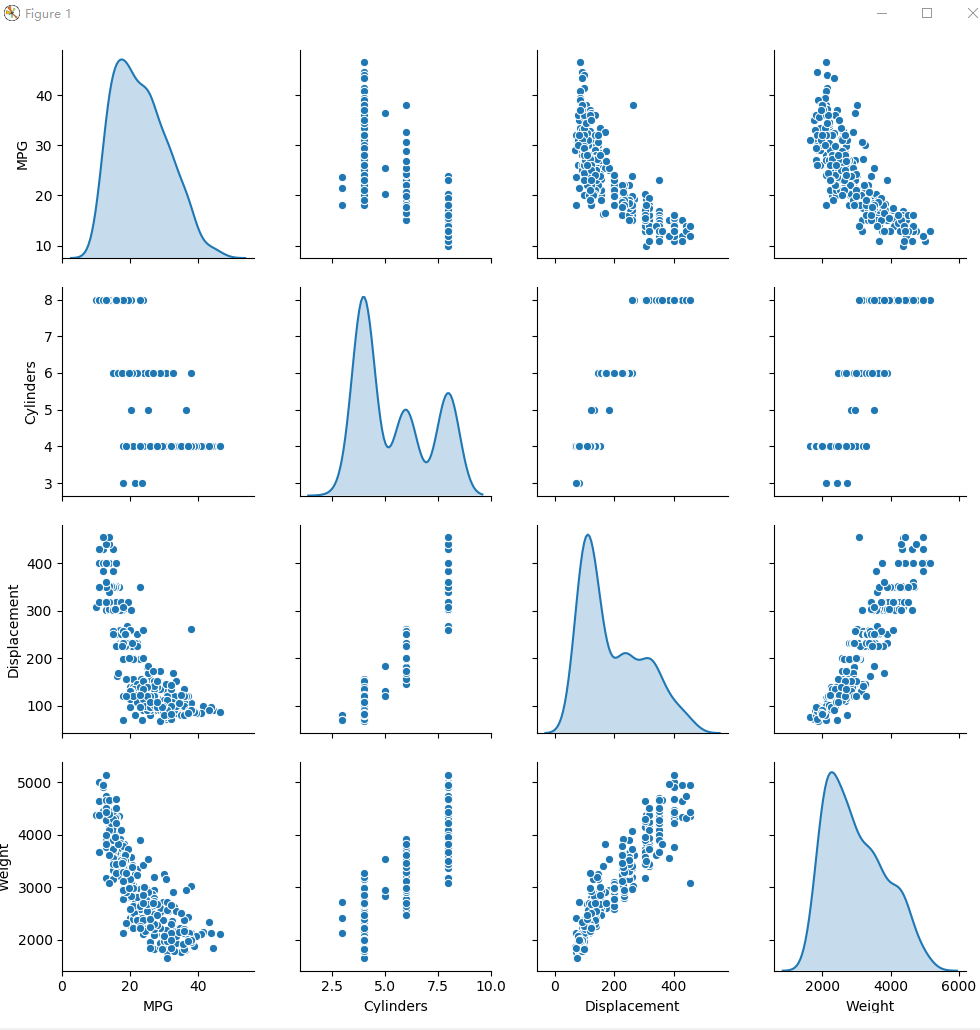
- 检查数据(Inspect the data)
- 分离标签(Split features from labels)
- 规范化数据(Normalize the data)
模型部分
- 构建模型(Build the model)
- 检查模型(Inspect the model)
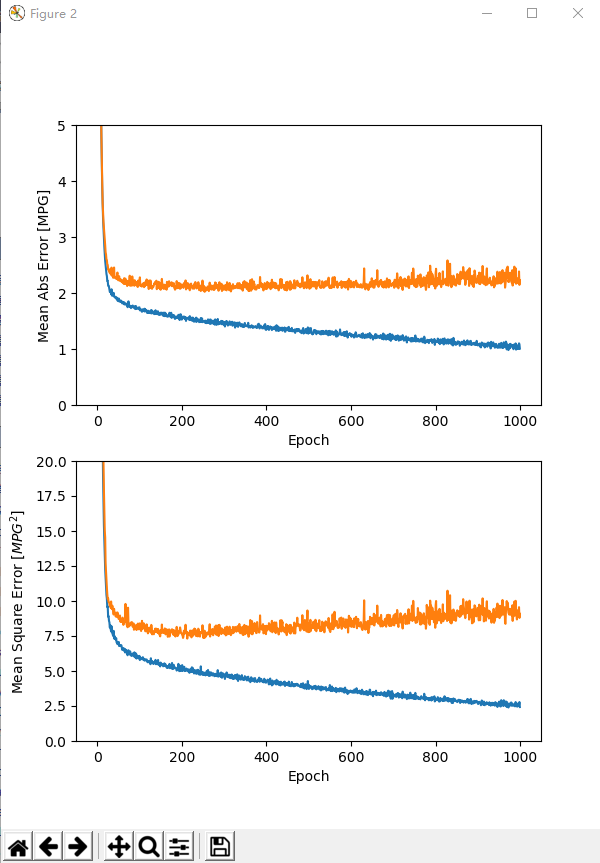
- 训练模型(Train the model)
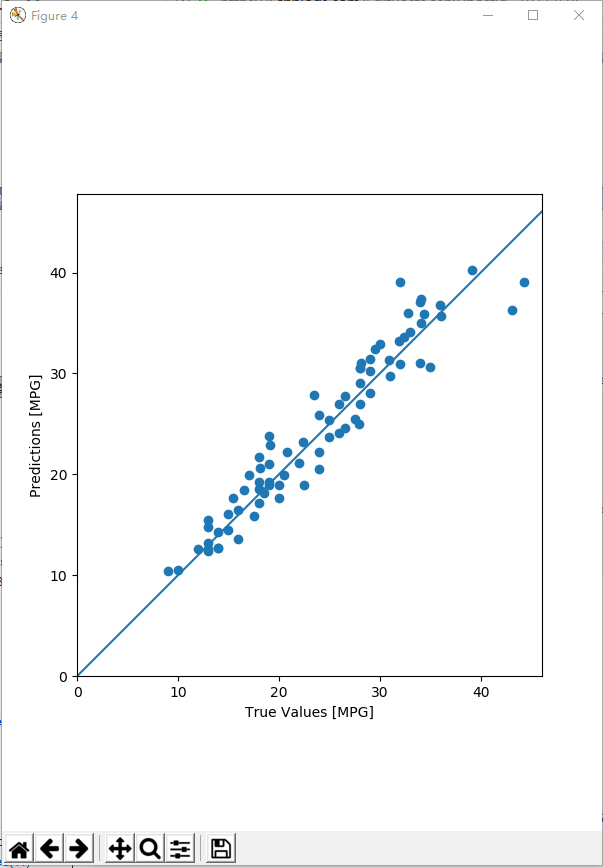
- 做出预测(Make predictions)
Auto MPG Data Set (汽车MPG数据集)
- mpg(miles per gallon, 每加仑行驶的英里数)
- https://archive.ics.uci.edu/ml/datasets/Auto+MPG
- https://archive.ics.uci.edu/ml/machine-learning-databases/auto-mpg/
Attribute Information:
- 1. mpg: continuous
- 2. cylinders: multi-valued discrete
- 3. displacement: continuous
- 4. horsepower: continuous
- 5. weight: continuous
- 6. acceleration: continuous
- 7. model year: multi-valued discrete
- 8. origin: multi-valued discrete
- 9. car name: string (unique for each instance)
一些知识点
验证集
- - 通常指定训练集的一定比例数据作为验证集。
- - 验证集将不参与训练,并在每个epoch结束后测试的模型的指标,如损失函数、精确度等。
- - 如果数据本身是有序的,需要先手工打乱再指定,否则可能会出现验证集样本不均匀。
回调函数(Callbacks)
回调函数是一个函数的合集,在训练的阶段中,用来查看训练模型的内在状态和统计。
在训练时,相应的回调函数的方法就会被在各自的阶段被调用。
一般是在model.fit函数中调用callbacks(参数为callbacks,必须输入list类型的数据)。
简而言之,Callbacks用于指定在每个epoch开始和结束的时候进行哪种特定操作。
EarlyStopping
EarlyStopping是Callbacks的一种,可用来加快学习的速度,提高调参效率。
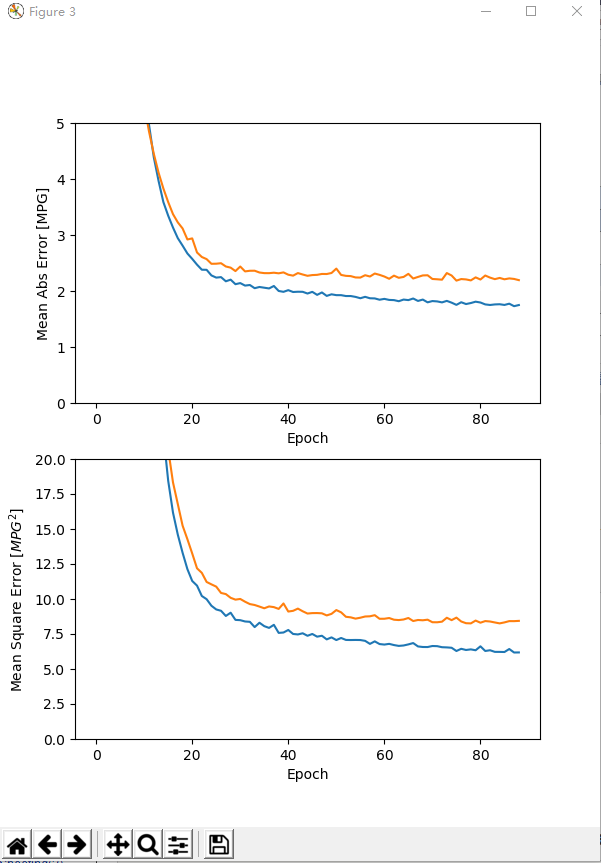
使用一个EarlyStopping回调来测试每一个迭代的训练条件,如果某个迭代过后没有显示改进,自动停止训练。
- https://keras.io/zh/callbacks/#earlystopping
- https://www.tensorflow.org/api_docs/python/tf/keras/callbacks/EarlyStopping
结论(conclusion)
- - 均方误差(MSE)是一种常见的损失函数,可用于回归问题。
- - 用于回归和分类问题的损失函数不同,评价指标也不同,常见的回归指标是平均绝对误差(MAE)。
- - 当输入的数据特性包含不同范围的数值,每个特性都应该独立为相同的范围。
- - 如果没有太多的训练数据时,有一个技巧就是采用包含少量隐藏层的小型网络,更适合来避免过拟合。
- - EarlyStopping是一个防止过度拟合的实用技巧。
示例
脚本内容
GitHub:https://github.com/anliven/Hello-AI/blob/master/Google-Learn-and-use-ML/3_basic_regression.py
 # coding=utf-8

 import tensorflow as tf

 from tensorflow import keras

 from tensorflow.python.keras import layers

 import matplotlib.pyplot as plt

 import pandas as pd

 import seaborn as sns

 import pathlib

 import os

 os.environ['TF_CPP_MIN_LOG_LEVEL'] = ''

 print("# TensorFlow version: {}  - tf.keras version: {}".format(tf.VERSION, tf.keras.__version__))  # 查看版本

 # ### 数据部分

 # 获取数据(Get the data)

 ds_path = str(pathlib.Path.cwd()) + "\\datasets\\auto-mpg\\"

 ds_file = keras.utils.get_file(fname=ds_path + "auto-mpg.data", origin="file:///" + ds_path)  # 获得文件路径

 column_names = ['MPG', 'Cylinders', 'Displacement', 'Horsepower', 'Weight', 'Acceleration', 'Model Year', 'Origin']

 raw_dataset = pd.read_csv(filepath_or_buffer=ds_file,  # 数据的路径

                           names=column_names,  # 用于结果的列名列表

                           na_values="?",  # 用于替换NA/NaN的值

                           comment='\t',  # 标识着多余的行不被解析(如果该字符出现在行首,这一行将被全部忽略)

                           sep=" ",  # 分隔符

                           skipinitialspace=True  # 忽略分隔符后的空白(默认为False,即不忽略)

                           )  # 通过pandas导入数据

 data_set = raw_dataset.copy()

 print("# Data set tail:\n{}".format(data_set.tail()))  # 显示尾部数据

 # 清洗数据(Clean the data)

 print("# Summary of NaN:\n{}".format(data_set.isna().sum()))  # 统计NaN值个数(NaN代表缺失值,可用isna()和notna()来检测)

 data_set = data_set.dropna()  # 方法dropna()对缺失的数据进行过滤

 origin = data_set.pop('Origin')  # Origin"列是分类不是数值,转换为独热编码(one-hot encoding)

 data_set['USA'] = (origin == 1) * 1.0

 data_set['Europe'] = (origin == 2) * 1.0

 data_set['Japan'] = (origin == 3) * 1.0

 data_set.tail()

 print("# Data set tail:\n{}".format(data_set.tail()))  # 显示尾部数据

 # 划分训练集和测试集(Split the data into train and test)

 train_dataset = data_set.sample(frac=0.8, random_state=0)

 test_dataset = data_set.drop(train_dataset.index)  # 测试作为模型的最终评估

 # 检查数据(Inspect the data)

 sns.pairplot(train_dataset[["MPG", "Cylinders", "Displacement", "Weight"]], diag_kind="kde")

 plt.figure(num=1)

 plt.savefig("./outputs/sample-3-figure-1.png", dpi=200, format='png')

 plt.show()

 plt.close()

 train_stats = train_dataset.describe()  # 总体统计数据

 train_stats.pop("MPG")

 train_stats = train_stats.transpose()  # 通过transpose()获得矩阵的转置

 print("# Train statistics:\n{}".format(train_stats))

 # 分离标签(Split features from labels)

 train_labels = train_dataset.pop('MPG')  # 将要预测的值

 test_labels = test_dataset.pop('MPG')

 # 规范化数据(Normalize the data)

 def norm(x):

     return (x - train_stats['mean']) / train_stats['std']

 normed_train_data = norm(train_dataset)

 normed_test_data = norm(test_dataset)

 # ### 模型部分

 # 构建模型(Build the model)

 def build_model():  # 模型被包装在此函数中

     model = keras.Sequential([  # 使用Sequential模型

         layers.Dense(64, activation=tf.nn.relu, input_shape=[len(train_dataset.keys())]),  # 包含64个单元的全连接隐藏层

         layers.Dense(64, activation=tf.nn.relu),  # 包含64个单元的全连接隐藏层

         layers.Dense(1)]  # 一个输出层,返回单个连续的值

     )

     optimizer = tf.keras.optimizers.RMSprop(0.001)

     model.compile(loss='mean_squared_error',  # 损失函数

                   optimizer=optimizer,  # 优化器

                   metrics=['mean_absolute_error', 'mean_squared_error']  # 在训练和测试期间的模型评估标准

                   )

     return model

 # 检查模型(Inspect the model)

 mod = build_model()  # 创建模型

 mod.summary()  # 打印出关于模型的简单描述

 example_batch = normed_train_data[:10]  # 从训练集中截取10个作为示例批次

 example_result = mod.predict(example_batch)  # 使用predict()方法进行预测

 print("# Example result:\n{}".format(example_result))

 # 训练模型(Train the model)

 class PrintDot(keras.callbacks.Callback):

     def on_epoch_end(self, epoch, logs):

         if epoch % 100 == 0:

             print('')

         print('.', end='')  # 每完成一次训练打印一个“.”符号

 EPOCHS = 1000  # 训练次数

 history = mod.fit(normed_train_data,

                   train_labels,

                   epochs=EPOCHS,  # 训练周期(训练模型迭代轮次)

                   validation_split=0.2,  # 用来指定训练集的一定比例数据作为验证集(0~1之间的浮点数)

                   verbose=0,  # 日志显示模式:0为安静模式, 1为进度条(默认), 2为每轮一行

                   callbacks=[PrintDot()]  # 回调函数(在训练过程中的适当时机被调用)

                   )  # 返回一个history对象,包含一个字典,其中包括训练期间发生的情况(training and validation accuracy)

 def plot_history(h, n=1):

     """可视化模型训练过程"""

     hist = pd.DataFrame(h.history)

     hist['epoch'] = h.epoch

     print("\n# History tail:\n{}".format(hist.tail()))

     plt.figure(num=n, figsize=(6, 8))

     plt.subplot(2, 1, 1)

     plt.xlabel('Epoch')

     plt.ylabel('Mean Abs Error [MPG]')

     plt.plot(hist['epoch'], hist['mean_absolute_error'], label='Train Error')

     plt.plot(hist['epoch'], hist['val_mean_absolute_error'], label='Val Error')

     plt.ylim([0, 5])

     plt.subplot(2, 1, 2)

     plt.xlabel('Epoch')

     plt.ylabel('Mean Square Error [$MPG^2$]')

     plt.plot(hist['epoch'], hist['mean_squared_error'], label='Train Error')

     plt.plot(hist['epoch'], hist['val_mean_squared_error'], label='Val Error')

     plt.ylim([0, 20])

     filename = "./outputs/sample-3-figure-" + str(n) + ".png"

     plt.savefig(filename, dpi=200, format='png')

     plt.show()

     plt.close()

 plot_history(history, 2)  # 可视化

 # 调试

 model2 = build_model()

 early_stop = keras.callbacks.EarlyStopping(monitor='val_loss',

                                            patience=10)  # 指定提前停止训练的callbacks

 history2 = model2.fit(normed_train_data,

                       train_labels,

                       epochs=EPOCHS,

                       validation_split=0.2,

                       verbose=0,

                       callbacks=[early_stop, PrintDot()])  # 当没有改进时自动停止训练(通过EarlyStopping)

 plot_history(history2, 3)

 loss, mae, mse = model2.evaluate(normed_test_data, test_labels, verbose=0)

 print("# Testing set Mean Abs Error: {:5.2f} MPG".format(mae))  # 测试集上的MAE值

 # 做出预测(Make predictions)

 test_predictions = model2.predict(normed_test_data).flatten()  # 使用测试集中数据进行预测

 plt.figure(num=4, figsize=(6, 8))

 plt.scatter(test_labels, test_predictions)

 plt.xlabel('True Values [MPG]')

 plt.ylabel('Predictions [MPG]')

 plt.axis('equal')

 plt.axis('square')

 plt.xlim([0, plt.xlim()[1]])

 plt.ylim([0, plt.ylim()[1]])

 plt.plot([-100, 100], [-100, 100])

 plt.savefig("./outputs/sample-3-figure-4.png", dpi=200, format='png')

 plt.show()

 plt.close()

 error = test_predictions - test_labels

 plt.figure(num=5, figsize=(6, 8))

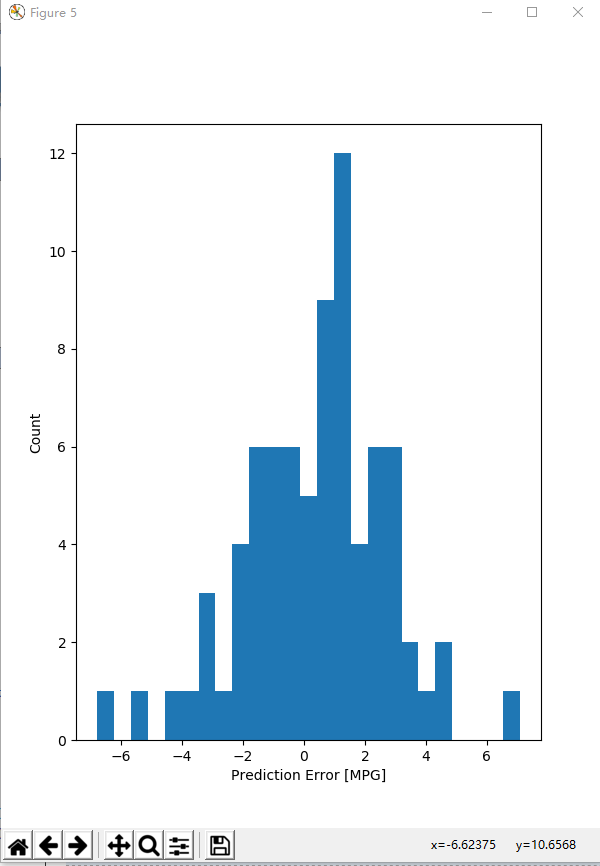
 plt.hist(error, bins=25)  # 通过直方图来展示错误的分布情况

 plt.xlabel("Prediction Error [MPG]")

 plt.ylabel("Count")

 plt.savefig("./outputs/sample-3-figure-5.png", dpi=200, format='png')

 plt.show()

 plt.close()
运行结果
C:\Users\anliven\AppData\Local\conda\conda\envs\mlcc\python.exe D:/Anliven/Anliven-Code/PycharmProjects/Google-Learn-and-use-ML/3_basic_regression.py

# TensorFlow version: 1.12.0  - tf.keras version: 2.1.6-tf

# Data set tail:

      MPG  Cylinders  Displacement   ...    Acceleration  Model Year  Origin

393  27.0          4         140.0   ...            15.6          82       1

394  44.0          4          97.0   ...            24.6          82       2

395  32.0          4         135.0   ...            11.6          82       1

396  28.0          4         120.0   ...            18.6          82       1

397  31.0          4         119.0   ...            19.4          82       1

[5 rows x 8 columns]

# Summary of NaN:

MPG             0

Cylinders       0

Displacement    0

Horsepower      6

Weight          0

Acceleration    0

Model Year      0

Origin          0

dtype: int64

# Data set tail:

      MPG  Cylinders  Displacement  ...    USA  Europe  Japan

393  27.0          4         140.0  ...    1.0     0.0    0.0

394  44.0          4          97.0  ...    0.0     1.0    0.0

395  32.0          4         135.0  ...    1.0     0.0    0.0

396  28.0          4         120.0  ...    1.0     0.0    0.0

397  31.0          4         119.0  ...    1.0     0.0    0.0

[5 rows x 10 columns]

# Train statistics:

              count         mean         std   ...       50%      75%     max

Cylinders     314.0     5.477707    1.699788   ...       4.0     8.00     8.0

Displacement  314.0   195.318471  104.331589   ...     151.0   265.75   455.0

Horsepower    314.0   104.869427   38.096214   ...      94.5   128.00   225.0

Weight        314.0  2990.251592  843.898596   ...    2822.5  3608.00  5140.0

Acceleration  314.0    15.559236    2.789230   ...      15.5    17.20    24.8

Model Year    314.0    75.898089    3.675642   ...      76.0    79.00    82.0

USA           314.0     0.624204    0.485101   ...       1.0     1.00     1.0

Europe        314.0     0.178344    0.383413   ...       0.0     0.00     1.0

Japan         314.0     0.197452    0.398712   ...       0.0     0.00     1.0

[9 rows x 8 columns]

_________________________________________________________________

Layer (type)                 Output Shape              Param #

=================================================================

dense (Dense)                (None, 64)                640

_________________________________________________________________

dense_1 (Dense)              (None, 64)                4160

_________________________________________________________________

dense_2 (Dense)              (None, 1)                 65

=================================================================

Total params: 4,865

Trainable params: 4,865

Non-trainable params: 0

_________________________________________________________________

# Example result:

[[0.3783294 ]

 [0.17875314]

 [0.68095654]

 [0.45696187]

 [1.4998233 ]

 [0.05698915]

 [1.4138494 ]

 [0.7885587 ]

 [0.10802953]

 [1.3029677 ]]

....................................................................................................

....................................................................................................

....................................................................................................

....................................................................................................

....................................................................................................

....................................................................................................

....................................................................................................

....................................................................................................

....................................................................................................

....................................................................................................

# History tail:

     val_loss  val_mean_absolute_error  ...    mean_squared_error  epoch

995  9.350584                 2.267639  ...              2.541113    995

996  9.191998                 2.195405  ...              2.594836    996

997  9.559576                 2.384058  ...              2.576047    997

998  8.791337                 2.145222  ...              2.782730    998

999  9.088490                 2.227165  ...              2.425531    999

[5 rows x 7 columns]

.........................................................................................

# History tail:

    val_loss  val_mean_absolute_error  ...    mean_squared_error  epoch

84  8.258534                 2.233329  ...              6.221810     84

85  8.328515                 2.208959  ...              6.213853     85

86  8.420452                 2.224991  ...              6.427011     86

87  8.418247                 2.215443  ...              6.178523     87

88  8.437484                 2.193801  ...              6.183405     88

[5 rows x 7 columns]

# Testing set Mean Abs Error:  1.88 MPG

Process finished with exit code 0
问题处理
问题1:执行“import tensorflow.keras import layers”失败,提示“Unresolved reference”
问题描述
在Anaconda3创建的运行环境中,执行“import tensorflow.keras import layers”失败,提示“Unresolved reference”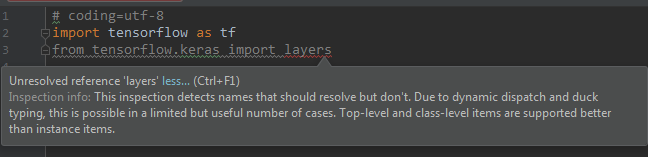
处理方法
改写为“from tensorflow.python.keras import layers”
导入包时,需要根据实际的具体位置进行导入。
确认TensorFlow中Keras的实际位置:“D:\DownLoadFiles\anaconda3\envs\mlcc\Lib\site-packages\tensorflow\python\keras\”。
实际上多了一层目录“python”,所以正确的导入方式为“from tensorflow.python.keras import layers”。
参考信息
https://stackoverflow.com/questions/47262955/how-to-import-keras-from-tf-keras-in-tensorflow
问题2:执行keras.utils.get_file()报错
问题描述
执行keras.utils.get_file("auto-mpg.data", "https://archive.ics.uci.edu/ml/machine-learning-databases/auto-mpg/auto-mpg.data")报错:
Downloading data from https://archive.ics.uci.edu/ml/machine-learning-databases/auto-mpg/auto-mpg.data

Traceback (most recent call last):

......

Exception: URL fetch failure on https://archive.ics.uci.edu/ml/machine-learning-databases/auto-mpg/auto-mpg.data: None -- [WinError 10060] A connection attempt failed because the connected party did not properly respond after a period of time, or established connection failed because connected host has failed to respond
处理方法
“网络”的原因,导致无法下载。手工下载,然后放置在当前目录,从当前目录地址导入数据文件。
AI - TensorFlow - 示例03:基本回归的更多相关文章
- AI - TensorFlow - 示例02:影评文本分类
影评文本分类 文本分类(Text classification):https://www.tensorflow.org/tutorials/keras/basic_text_classificatio ...
- AI - TensorFlow - 示例01:基本分类
基本分类 基本分类(Basic classification):https://www.tensorflow.org/tutorials/keras/basic_classification Fash ...
- AI - TensorFlow - 示例05:保存和恢复模型
保存和恢复模型(Save and restore models) 官网示例:https://www.tensorflow.org/tutorials/keras/save_and_restore_mo ...
- AI - TensorFlow - 示例04:过拟合与欠拟合
过拟合与欠拟合(Overfitting and underfitting) 官网示例:https://www.tensorflow.org/tutorials/keras/overfit_and_un ...
- 学习笔记TF024:TensorFlow实现Softmax Regression(回归)识别手写数字
TensorFlow实现Softmax Regression(回归)识别手写数字.MNIST(Mixed National Institute of Standards and Technology ...
- springmvc 项目完整示例03 小结
利用spring 创建一个web项目 大致原理 利用spring的ioc 原理,例子中也就是体现在了配置文件中 设置了自动扫描注解 配置了数据库信息等 一般一个项目,主要有domain,dao,ser ...
- 利用TensorFlow实现多元逻辑回归
利用TensorFlow实现多元逻辑回归,代码如下: import tensorflow as tf import numpy as np from sklearn.linear_model impo ...
- AI - TensorFlow - 分类与回归(Classification vs Regression)
分类与回归 分类(Classification)与回归(Regression)的区别在于输出变量的类型.通俗理解,定量输出称为回归,或者说是连续变量预测:定性输出称为分类,或者说是离散变量预测. 回归 ...
- AI - TensorFlow - 起步(Start)
01 - 基本的神经网络结构 输入端--->神经网络(黑盒)--->输出端 输入层:负责接收信息 隐藏层:对输入信息的加工处理 输出层:计算机对这个输入信息的认知 每一层点开都有它相应的内 ...
随机推荐
- 自定义用户认证(继承django的)
1.在app下创建一个自己用户认证文件,文件名随意,记得为.py文件 2.编辑该userauth.py文件 #!/usr/bin/env python #coding:utf-8 from djang ...
- unity零基础开始学习做游戏(五)看看你的完成度,进度条了解一下?
-------小基原创,转载请给我一个面子 上回书说道,英雄和魔王都做完了,子弹也能发射了,就是不知道啥时候能干死魔王.那小基得做个血条来展示一下,他离死不远了(•౪• ) 其实血条也可以看作是进度条 ...
- JAVA库函数总结【持续更新】
生成随机数: Math.random()是令系统随机选取大于等于 0.0 且小于 1.0 的伪随机 double 值. Random rand = newRandom(); rand.nextInt( ...
- Angular4.x通过路由守卫进行路由重定向,实现根据条件跳转到相应的页面
需求: 最近在做一个网上商城的项目,技术用的是Angular4.x.有一个很常见的需求是:用户在点击"我的"按钮时读取cookie,如果有数据,则跳转到个人信息页面,否则跳转到注册 ...
- 20岁少年小伙利用Python_SVM预测股票趋势月入十万!
在做数据预处理的时候,超额收益率是股票行业里的一个专有名词,指大于无风险投资的收益率,在我国无风险投资收益率即是银行定期存款. pycharm + anaconda3.6开发,涉及到的第三方库有p ...
- Html5的表单元素
表单是HTML中获取用户输入的手段,,对于web应用系统及其重要,文字是不能说明问题的: 直接上代码把: <!DOCTYPE html><html lang="en&quo ...
- 如何利用Python网络爬虫爬取微信朋友圈动态--附代码(下)
前天给大家分享了如何利用Python网络爬虫爬取微信朋友圈数据的上篇(理论篇),今天给大家分享一下代码实现(实战篇),接着上篇往下继续深入. 一.代码实现 1.修改Scrapy项目中的items.py ...
- 单片机开发——01工欲善其事必先利其器(Keil软件安装破解)
本文是博主<单片机开发>博客第一篇文章,主要讲述51单片机编程软件Keil uVision4的安装及破解过程. 1. Keil uVision4安装包文件 PATH:链接 ...
- js基础--浏览器标签页隐藏或显示状态 visibility详解
欢迎访问我的个人博客:http://www.xiaolongwu.cn 前言 在工作中我们可能会遇到这样的需求,当浏览器切换到别的标签页或着最小化时,我们需要暂停页面上正在播放的视频或者音乐,这个需求 ...
- QT5:C++实现基于multimedia的音乐播放器(一)
上一篇里简略的描述了一下播放器的实现,这一篇开始具体描述一下过程. 环境配置:Qt Creator 打开Qt Creator,创建一个new project,项目名称随你喜欢(我的是MusicPlay ...