
Introduction to pointers in C
The basic purpose of developing a C programming tutorial for this website – CircuitsToday – is to make it useful for people who wish to work with embedded systems. Really good C programming skill is an essential to work with embedded systems and “Pointers” is the most important concept in C that should be mastered by an embedded systems programmer. “Pointers” are so important because it enables a programmer to work directly with memory of the system. Memory of a system is organized as a sequence of byte sized locations (1 byte = 8 bits). If the total memory of the system is 128 bytes then there will be 128 accessible locations of 1 byte each. Each of these 128 locations are numbered from 0 to 127 in a special manner like 0000, 0001, 0002 …etc. The number associated with a byte is known as the address of the memory location.
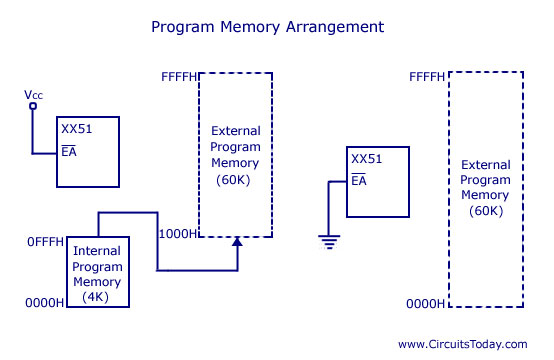
You may refer the figure below to get an idea – how memory is organized with in 8051
A pointer is an entity which holds the address of a memory location. So if the address of a location is 2050H, pointer is used to hold this particular address.
Note:- Address of a memory location is always a positive integer. The range of address is from zero to a positive integer constant (which is the address of the last memory location ).
Pointer variables
We can use variables to hold address of a memory location and such variables are known as pointer variables. We have seen before that normal variables are used to store data items of a particular data type (char, int, float etc). Before using a variable in a program, we declare it at the beginning. Similarly we need to declare a pointer variable too in a special way – to let the compiler know we have declared a variable as a pointer (not as a normal variable). To do this we have the *operator – known as indirection operator in C.
Pointer variable declaration
The syntax to declare a pointer variable is
(data type) *(variable name);
Ex:- int *ptr ;
Here we have declared a pointer variable of name ‘ptr’ and it is of type integer (int).
Why we need data types in pointers ?
The first doubt that may come to many is, why we need data types to declare a pointer variable. Well, here is the explanation. The address of a memory location will contain a data – rite? And it can be of type char, int, float etc. The difference between all these data types is in the size allocated to each data type. Char – is 1 byte where as int – is 2 byte and float is 4 bytes. Memory is allocated to all these data types as sequential blocks.
Just consider a scenario like this:-
char a ;
int b;
float c;
Lets start memory allocation from 2000H.
Now the character variable ‘a‘ will be allocated 2000H (1 byte), where as integer variable ‘b’ will be allocated 2 bytes using 2001H and 2002H. Finally the float variable ‘c’ will be allocated 4 bytes using 4 consecutive locations – 2003H, 2004H, 2005H, 2006H. Now you might get an idea of why we need data types to declare pointer variables. It is because memories are allocated in sequential blocks according to the type of data holded in those locations.
So when we declare a pointer variable as float *ptr and then assign address of the normal float variable c to ptr – what really happens is – ptr is assigned the sequential block from 2003H to 2006H as a whole. But the variable ptr will hold only the starting address of the sequential block i.e 2003H
So a pointer variable must be declared with a data type. And this data type should be the same data type as of the contents inside the memory location address – which is assigned to the pointer variable. Ex:- If 2000H is assigned to a pointer variable ptr and the contents inside 2000H is a character. In this case the pointer variable ptr should be declared as a character pointer as shown below:-
char *ptr;
Note:- In fact we can actually declare a pointer variable without any data type using the keyword void. It is known as a void pointer. The topic of void pointer has to be explained separately – so I will explain it in my next post.
Assigning address to a pointer variable
To make use of a pointer and it’s capabilities – the address of a particular memory location must be assigned to the pointer. It is possible to assign address of single variable or that of an array or the address of a structure etc to a pointer variable. This capability makes pointers the most powerful tool in C programming. We can literally play with the memory of a system using pointers.
To assign address of an entity to a pointer variable – we use the & operator (address of operator). The operator & fetches the memory location of a variable.
So taking our earlier case as example:-
#include

void main()

{

int *ptr; // Declaring the pointer variable 'ptr' of data type int

int a; // Declaring a normal variable 'a'

ptr=&a; // Assigning address of variable 'a' to pointer variable 'ptr'

}
Dereferencing a pointer (getting the real content from a memory location)
We have seen upto assigning an address to a pointer variable. Now how to get the content inside the memory location using the same pointer variable? For that we use the same indirection operator * used to declare a pointer variable.
Consider the scenario:-
#include

void main()

{

int *ptr; // Declaring the pointer variable 'ptr' of data type int

int a=; // Declaring a normal variable 'a' and assigning value 10 to it.

ptr=&a; // Assigning address of variable 'a' to pointer variable 'ptr'

printf("The value inside pointer is= %d",*ptr); // See the value is printed using *ptr;

}
Introduction to pointers in C的更多相关文章
- Void pointers in C
In this article we are learning about “void pointers” in C language. Before going further it will be ...
- <转>年终盘点!2017年超有价值的Golang文章
马上就要进入2018年了,作为年终的盘点,本文列出了一些2017年的关于Go编程的一些文章,并加上简短的介绍. 文章排名不分先后, 文章也不一定完全按照日期来排列.我按照文章的大致内容分了类,便于查找 ...
- Introduction of OpenCascade Foundation Classes
Introduction of OpenCascade Foundation Classes Open CASCADE基础类简介 eryar@163.com 一.简介 1. 基础类概述 Foundat ...
- Introduction of Open CASCADE Foundation Classes
Open CASCADE Foundation Classes Open CASCADE基础类 eryar@163.com 一.简介 1. 基础类概述 Foundation Classes Overv ...
- Brief introduction to Scala and Breeze for statistical computing
Brief introduction to Scala and Breeze for statistical computing 时间 2013-12-31 03:17:19 Darren Wilk ...
- Introduction the naive“scull” 《linux设备驱动》 学习笔记
Introduction the naive "scull" 首先.什么是scull? scull (Simple Character Utility for Loading Lo ...
- Reading task(Introduction to Algorithms. 2nd)
Introduction to Algorithms 2nd ed. Cambridge, MA: MIT Press, 2001. ISBN: 9780262032933. Introduction ...
- Introduction to Parallel Computing
Copied From:https://computing.llnl.gov/tutorials/parallel_comp/ Author: Blaise Barney, Lawrence Live ...
- [中英对照]Introduction to DPDK: Architecture and Principles | DPDK概论: 体系结构与实现原理
[中英对照]Introduction to DPDK: Architecture and Principles | DPDK概论: 体系结构与实现原理 Introduction to DPDK: ...
随机推荐
- MYSQL获得查询记录的行号
对于获得查询记录的行号这一功能,Oracle 中可以使用标准方法(8i版本以上),也可以使用非标准的ROWNUM,MS SQL Server 则在 2005 版本中提供了ROW_NUMBER()函数. ...
- Mike and Feet CodeForces - 548D (单调栈)
Mike is the president of country What-The-Fatherland. There are n bears living in this country besid ...
- 配置LANMP环境(7)-- 配置nginx反向代理,与配置apache虚拟主机
一.配置nginx反向代理 1.修改配置文件 vim /etc/nginx/nginx.conf 在35行http下添加一下内容: include /data/nginx/vhosts/*.conf; ...
- python+Appium自动化:Appium元素检测
appium模拟用户的真实操作,如果用户第一次进入app或许会弹出一些更新提示,或者是引导页面,但是下一次开启app时则没有引导页这些界面,这时,脚本中又肯定不考虑用两套代码来进行维护,此时如何应对这 ...
- sysbench运行autogen.sh报错
./autogen.sh: 4: autoreconf: not found是在不同版本的 tslib 下执行 autogen.sh 产生.它们产生的原因一样,是因为没有安装automake 工具, ...
- ios 打包 异常
1. 问题:Xcode9升级到Xcode10后运行App报错: 2. 原因分析: Xcode10中libstdc++.6.0.9和libstdc++被移除,Frameworks中libstdc++.6 ...
- hadoop中的JournalNode
1.在HADOOP扮演的角色 JournalNode是在MR2也就是Yarn中新加的,journalNode的作用是存放EditLog的, 在MR1中editlog是和fsimage存放在一起的然后S ...
- VLC播放器:快捷键
造冰箱的大熊猫@cnblogs 2019/2/27 VLC播放器(VLC Media Player)快捷键汇总(在Ubuntu 16.04环境下测试) - 音量大/小:CTRL+上/下 - 静音开/ ...
- Confluence 6.15 使用附件宏
希望添加附件宏到一个页面中: 从编辑工具栏中,选择 插入(Insert) > 其他宏(Other Macros) 找到并且选择需要的宏. 可用使用自动完成加快这个过程:输入 { 然后开始输入 ...
- BFS解决九宫重排问题
问题 1426: [蓝桥杯][历届试题]九宫重排 时间限制: 1Sec 内存限制: 128MB 提交: 215 解决: 47 题目描述 如下面第一个图的九宫格中,放着 1~8 的数字卡片,还有一个 ...