
caffe卷积层实现
下图是jiayangqing在知乎上的回答,其实过程就是把image转换成矩阵,然后进行矩阵运算
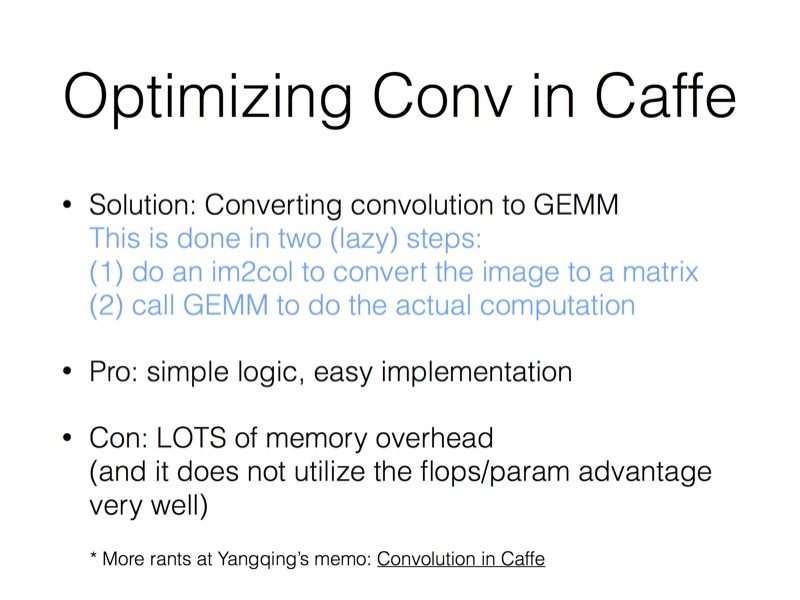
卷积的实现在conv_layer层,conv_layer层继承了base_conv_layer层,base_conv_layer层是卷积操作的基类,包含卷积和反卷积.conv_layer层的前向传播是通过forward_cpu_gemm函数实现,这个函数在vision_layer.hpp里进行了定义,在base_conv_layer.cpp里进行了实现.forward_cpu_gemm函数调用了caffe_cpu_gemm和conv_im2col_cpu,caffe_cpu_gemm的实现在util/math_function.cpp里,conv_im2col_cpu的实现在util/im2col.cpp里
conv_layer层的前向传播代码,先调forward_cpu_gemm函数进行卷积的乘法运算,然后根据是否需要bias项,调用forward_cpu_bias进行加法运算.
template <typename Dtype>

void ConvolutionLayer<Dtype>::Forward_cpu(const vector<Blob<Dtype>*>& bottom,

      const vector<Blob<Dtype>*>& top) {

  const Dtype* weight = this->blobs_[]->cpu_data();

  for (int i = ; i < bottom.size(); ++i) {

    const Dtype* bottom_data = bottom[i]->cpu_data();

    Dtype* top_data = top[i]->mutable_cpu_data();

    for (int n = ; n < this->num_; ++n) {

      this->forward_cpu_gemm(bottom_data + bottom[i]->offset(n), weight,

          top_data + top[i]->offset(n));

      if (this->bias_term_) {

        const Dtype* bias = this->blobs_[]->cpu_data();

        this->forward_cpu_bias(top_data + top[i]->offset(n), bias);

      }

    }

  }

}
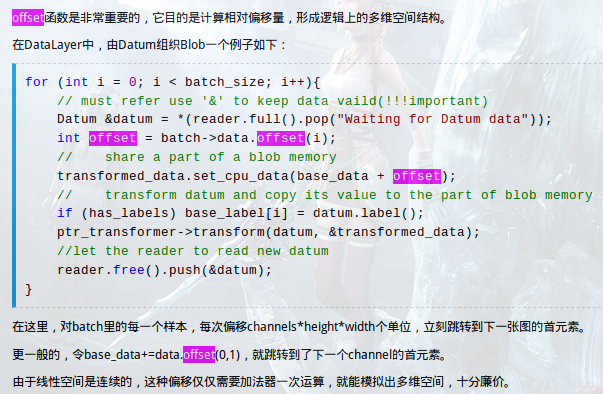
num_在vision_layers.hpp中的BaseConvolutionLayer类中定义,表示batchsize(https://blog.csdn.net/sinat_22336563/article/details/69808612,这个博客给做了说明).也就是说.每一层卷积是先把一个batch所有的数据计算完才传给下一层,不是把batch中的一个在整个网络中计算一次,再把batch中的下一个传进整个网络进行计算.这里的bottom[i]->offset(n),相当于指向一个batch中下一个图片或者feature map的内存地址,即对batch中下一个进行计算
offset在blob.hpp中定义.bottom、top都是blob类,所以可以去调用blob这个类的属性或者方法,看具体实现的时候直接去看这个类怎么实现的就OK.
  inline int offset(const int n, const int c = , const int h = ,

      const int w = ) const {

    CHECK_GE(n, );

    CHECK_LE(n, num());

    CHECK_GE(channels(), );

    CHECK_LE(c, channels());

    CHECK_GE(height(), );

    CHECK_LE(h, height());

    CHECK_GE(width(), );

    CHECK_LE(w, width());

    return ((n * channels() + c) * height() + h) * width() + w;

  }

  inline int offset(const vector<int>& indices) const {

    CHECK_LE(indices.size(), num_axes());

    int offset = ;

    for (int i = ; i < num_axes(); ++i) {

      offset *= shape(i);

      if (indices.size() > i) {

        CHECK_GE(indices[i], );

        CHECK_LT(indices[i], shape(i));

        offset += indices[i];

      }

    }

    return offset;

  }
https://www.cnblogs.com/neopenx/p/5294682.html
forward_cpu_gemm、forward_cpu_bias函数的实现.is_1x1_用来判断是不是1x1的卷积操作,skip_im2col用来判断是不是需要把图片转换成矩阵
template <typename Dtype>

void BaseConvolutionLayer<Dtype>::forward_cpu_gemm(const Dtype* input,

    const Dtype* weights, Dtype* output, bool skip_im2col) {

  const Dtype* col_buff = input;

  if (!is_1x1_) {

    if (!skip_im2col) {

      conv_im2col_cpu(input, col_buffer_.mutable_cpu_data());

    }

    col_buff = col_buffer_.cpu_data();

  }

  for (int g = ; g < group_; ++g) {

    caffe_cpu_gemm<Dtype>(CblasNoTrans, CblasNoTrans, conv_out_channels_ /

        group_, conv_out_spatial_dim_, kernel_dim_ / group_,

        (Dtype)., weights + weight_offset_ * g, col_buff + col_offset_ * g,

        (Dtype)., output + output_offset_ * g);

  }

}

template <typename Dtype>

void BaseConvolutionLayer<Dtype>::forward_cpu_bias(Dtype* output,

    const Dtype* bias) {

  caffe_cpu_gemm<Dtype>(CblasNoTrans, CblasNoTrans, num_output_,

      height_out_ * width_out_, , (Dtype)., bias, bias_multiplier_.cpu_data(),

      (Dtype)., output);

}
conv_im2col_cpu
inline void conv_im2col_cpu(const Dtype* data, Dtype* col_buff) {

    im2col_cpu(data, , conv_in_channels_, conv_in_height_, conv_in_width_,

      kernel_h_, kernel_w_, pad_h_, pad_w_, stride_h_, stride_w_,

      , , col_buff);

  }
template <typename Dtype>

void im2col_cpu(const Dtype* data_im, const int channels,

    const int height, const int width, const int kernel_h, const int kernel_w,

    const int pad_h, const int pad_w,

    const int stride_h, const int stride_w,

    const int dilation_h, const int dilation_w,

    Dtype* data_col) {

  const int output_h = (height +  * pad_h -

    (dilation_h * (kernel_h - ) + )) / stride_h + ;

  const int output_w = (width +  * pad_w -

    (dilation_w * (kernel_w - ) + )) / stride_w + ;

  const int channel_size = height * width;

  for (int channel = channels; channel--; data_im += channel_size) {

    for (int kernel_row = ; kernel_row < kernel_h; kernel_row++) {

      for (int kernel_col = ; kernel_col < kernel_w; kernel_col++) {

        int input_row = -pad_h + kernel_row * dilation_h;

        for (int output_rows = output_h; output_rows; output_rows--) {

          if (!is_a_ge_zero_and_a_lt_b(input_row, height)) {

            for (int output_cols = output_w; output_cols; output_cols--) {

              *(data_col++) = ;

            }

          } else {

            int input_col = -pad_w + kernel_col * dilation_w;

            for (int output_col = output_w; output_col; output_col--) {

              if (is_a_ge_zero_and_a_lt_b(input_col, width)) {

                *(data_col++) = data_im[input_row * width + input_col];

              } else {

                *(data_col++) = ;

              }

              input_col += stride_w;

            }

          }

          input_row += stride_h;

        }

      }

    }

  }

}
caffe_cpu_gemm函数的实现.cblas_sgemm是cblas库的一个函数(# inclue<cblas.h>),
template<>

void caffe_cpu_gemm<float>(const CBLAS_TRANSPOSE TransA,

    const CBLAS_TRANSPOSE TransB, const int M, const int N, const int K,

    const float alpha, const float* A, const float* B, const float beta,

    float* C) {

  int lda = (TransA == CblasNoTrans) ? K : M;

  int ldb = (TransB == CblasNoTrans) ? N : K;

  cblas_sgemm(CblasRowMajor, TransA, TransB, M, N, K, alpha, A, lda, B,

      ldb, beta, C, N);

}

template<>

void caffe_cpu_gemm<double>(const CBLAS_TRANSPOSE TransA,

    const CBLAS_TRANSPOSE TransB, const int M, const int N, const int K,

    const double alpha, const double* A, const double* B, const double beta,

    double* C) {

  int lda = (TransA == CblasNoTrans) ? K : M;

  int ldb = (TransB == CblasNoTrans) ? N : K;

  cblas_dgemm(CblasRowMajor, TransA, TransB, M, N, K, alpha, A, lda, B,

      ldb, beta, C, N);

}

template<>

void caffe_cpu_gemm<Half>(const CBLAS_TRANSPOSE TransA,

    const CBLAS_TRANSPOSE TransB, const int M, const int N, const int K,

    const Half alpha, const Half* A, const Half* B, const Half beta,

    Half* C) {

  DeviceMemPool& pool = Caffe::Get().cpu_mem_pool();

  float* fA = (float*)pool.Allocate(M*K*sizeof(float));

  float* fB = (float*)pool.Allocate(K*N*sizeof(float));

  float* fC = (float*)pool.Allocate(M*N*sizeof(float));

  halves2floats_cpu(A, fA, M*K);

  halves2floats_cpu(B, fB, K*N);

  halves2floats_cpu(C, fC, M*N);

  caffe_cpu_gemm<float>(TransA, TransB, M, N, K, float(alpha), fA, fB, float(beta), fC);

  floats2halves_cpu(fC, C, M*N);

  pool.Free((char*)fA);

  pool.Free((char*)fB);

  pool.Free((char*)fC);

}
caffe卷积层实现的更多相关文章
- caffe 卷积层的运算
贾清扬寻找快速算法之路:https://github.com/Yangqing/caffe/wiki/Convolution-in-Caffe:-a-memo 卷积运算图文并茂:http://www. ...
- caffe卷积层代码阅读笔记
卷积的实现思想: 通过im2col将image转为一个matrix,将卷积操作转为矩阵乘法运算 通过调用GEMM完毕运算操作 以下两个图是我在知乎中发现的,"盗"用一下,确实非常好 ...
- caffe之(一)卷积层
在caffe中,网络的结构由prototxt文件中给出,由一些列的Layer(层)组成,常用的层如:数据加载层.卷积操作层.pooling层.非线性变换层.内积运算层.归一化层.损失计算层等:本篇主要 ...
- caffe源码 卷积层
通俗易懂理解卷积 图示理解神经网络的卷积 input: 3 * 5 * 5 (c * h * w) pading: 1 步长: 2 卷积核: 2 * 3 * 3 * 3 ( n * c * k * k ...
- TensorFlow与caffe中卷积层feature map大小计算
刚刚接触Tensorflow,由于是做图像处理,因此接触比较多的还是卷及神经网络,其中会涉及到在经过卷积层或者pooling层之后,图像Feature map的大小计算,之前一直以为是与caffe相同 ...
- caffe Python API 之卷积层(Convolution)
1.Convolution层: 就是卷积层,是卷积神经网络(CNN)的核心层. 层类型:Convolution lr_mult: 学习率的系数,最终的学习率是这个数乘以solver.prototxt配 ...
- 【caffe】卷积层代码解析
1.Forward_cpu conv_layer.cpp template <typename Dtype> void ConvolutionLayer<Dtype>::For ...
- caffe中卷积层和pooling层计算下一层的特征map的大小
pool层,其中ceil是向上取整函数 卷积层:
- caffe中全卷积层和全连接层训练参数如何确定
今天来仔细讲一下卷基层和全连接层训练参数个数如何确定的问题.我们以Mnist为例,首先贴出网络配置文件: name: "LeNet" layer { name: "mni ...
随机推荐
- opengl键盘回调函数不能获取Ctrl+c的问题
我要令窗口在按下 Ctrl+c 之后关闭. 关键代码如下: /* 这段代码位于键盘回调函数中 */ if ((glutGetModifiers() == GLUT_ACTIVE_CTRL) & ...
- Oracle 数据库实例和数据库
本文参考自oracle数据库实例,数据库的理解,纯属读书笔记,用于加深记忆. 先看Tom关于这二者的解释: 1.数据库 物理操作系统文件或磁盘的集合(我觉得可以理解为数据文件等).使用Oracle 1 ...
- merchantInfo.properties配置文件
p1_MerId=10001126856 keyValue=69cl522AV6q613Ii4W6u8K6XuW8vM1N6bFgyv769220IuYe9u37N4y7rI4Pl callback= ...
- java多线程之join方法使用
看这篇博客:http://www.cnblogs.com/skywang12345/p/3479275.html
- CentOS安装nginx方法命令教程
1.依赖项和必要组件 yum install -y make cmake gcc gcc-c++ yum install -y pcre pcre-devel yum install -y zlib ...
- 调用WCF错误-There was no endpoint listening
问题描述: 今天在调用WCF服务时候出现了下面的错误. 原因: 调用服务的客户端ip设置成了固定ip.(至于固定ip为什么会导致这个错误,没能去研究) 解决方法: 将客户端ip设置成自动获取.
- Docker 创建镜像、修改、上传镜像
Docker 创建镜像.修改.上传镜像 –创建镜像有很多方法,用户可以从 Docker Hub 获取已有镜像并更新,也可以利用本地文件系统创建一个. 一.创建镜像 创建镜像有很多方法,用户可以从 Do ...
- 关于controller和apicontroller的跨域实现过滤器的不同
1.controller的跨域访问 filter的实现请继承System.Web.Mvc.ActionFilterAttribute 2.apicontroller的跨域访问 filter的实现请继承 ...
- php自建静态博客步骤
进入博客目录新建index.php页面 <?php require “XXXX/index.html”;//引入html页面 是否能进入localhost/xxx/index.php 注意,ph ...
- stark——分页、search、actions
一.分页 1.引入自定义分页组件 在/stark目录下创建utils工具包目录,复制page.py到该目录下,文件中有之前自定义的分页组件. class Pagination(object): def ...