
【小家Spring】聊聊Spring中的数据绑定 --- BeanWrapper以及内省Introspector和PropertyDescriptor
#### 每篇一句
> 千古以来要饭的没有要早饭的,知道为什么吗?
#### 相关阅读
[【小家Spring】聊聊Spring中的数据转换:Converter、ConversionService、TypeConverter、PropertyEditor](https://blog.csdn.net/f641385712/article/details/90702928)
[【小家Spring】聊聊Spring中的数据绑定 --- 属性访问器PropertyAccessor和实现类DirectFieldAccessor的使用](https://blog.csdn.net/f641385712/article/details/95481552)
---
对Spring感兴趣可扫码加入wx群:`Java高工、架构师3群`(文末有二维码)
---
#### 前言
这篇文章需要依赖于对属性访问器`PropertyAccessor`的理解,也就是上篇文章的内容:[【小家Spring】聊聊Spring中的数据绑定 --- 属性访问器PropertyAccessor和实现类DirectFieldAccessor的使用](https://blog.csdn.net/f641385712/article/details/95481552)
如果说上篇文章所说的`PropertyAccessor`你没有接触过和听过,那么本文即将要说的重点:`BeanWrapper`你应该多少有所耳闻吧~
`BeanWrapper`可以简单的把它理解为:一个方便开发人员**使用字符串**来对`Java Bean`的属性执行get、set操作的工具。关于它的数据转换使用了如下两种机制:
1. `PropertyEditor`:隶属于**Java Bean规范**。`PropertyEditor`只提供了`String Object`的转换。
2. `ConversionService`:Spring自3.0之后提供的替代PropertyEditor的机制(`BeanWrapper`在Spring的第一个版本就存在了~)
> 按照Spring官方文档的说法,当容器内没有注册`ConversionService`的时候,会退回使用`PropertyEditor`机制。言外之意:首选方案是`ConversionService`
> 其实了解的伙伴应该知道,这不是`BeanWrapper`的内容,而是父接口`PropertyAccessor`的内容~
## BeanWrapper
官方解释:Spring低级JavaBeans基础设施的中央接口。通常来说并不直接使用`BeanWrapper`,而是借助`BeanFactory`或者`DataBinder`来一起使用~
```java
//@since 13 April 2001 很清晰的看到,它也是个`PropertyAccessor`属性访问器
public interface BeanWrapper extends ConfigurablePropertyAccessor {
// @since 4.1
void setAutoGrowCollectionLimit(int autoGrowCollectionLimit);
int getAutoGrowCollectionLimit();
Object getWrappedInstance();
Class getWrappedClass();
// 获取属性们的PropertyDescriptor 获取属性们
PropertyDescriptor[] getPropertyDescriptors();
// 获取具体某一个属性~
PropertyDescriptor getPropertyDescriptor(String propertyName) throws InvalidPropertyException;
}
```
`BeanWrapper`相当于一个代理器,Spring委托`BeanWrapper`完成Bean属性的填充工作。关于此接口的实现类,简单的说它只有唯一实现类:`BeanWrapperImpl`
### BeanWrapperImpl
它作为`BeanWrapper`接口的默认实现,它足以满足所有的典型应用场景,它会缓存Bean的内省结果而提高效率。
> 在Spring2.5之前,此实现类是非public的,但在2.5之后给public了并且还提供了工厂:`PropertyAccessorFactory`帮助第三方框架能快速获取到一个实例~
```java
public class BeanWrapperImpl extends AbstractNestablePropertyAccessor implements BeanWrapper {
// 缓存内省结果~
@Nullable
private CachedIntrospectionResults cachedIntrospectionResults;
// The security context used for invoking the property methods.
@Nullable
private AccessControlContext acc;
// 构造方法都是沿用父类的~
public BeanWrapperImpl() {
this(true);
}
...
private BeanWrapperImpl(Object object, String nestedPath, BeanWrapperImpl parent) {
super(object, nestedPath, parent);
setSecurityContext(parent.acc);
}
// @since 4.3 设置目标对象~~~
public void setBeanInstance(Object object) {
this.wrappedObject = object;
this.rootObject = object;
this.typeConverterDelegate = new TypeConverterDelegate(this, this.wrappedObject);
// 设置内省的clazz
setIntrospectionClass(object.getClass());
}
// 复写父类的方法 增加内省逻辑
@Override
public void setWrappedInstance(Object object, @Nullable String nestedPath, @Nullable Object rootObject) {
super.setWrappedInstance(object, nestedPath, rootObject);
setIntrospectionClass(getWrappedClass());
}
// 如果cachedIntrospectionResults它持有的BeanClass并不是传入的clazz 那就清空缓存 重新来~~~
protected void setIntrospectionClass(Class clazz) {
if (this.cachedIntrospectionResults != null && this.cachedIntrospectionResults.getBeanClass() != clazz) {
this.cachedIntrospectionResults = null;
}
}
private CachedIntrospectionResults getCachedIntrospectionResults() {
if (this.cachedIntrospectionResults == null) {
// forClass此方法:生成此clazz的类型结果,并且缓存了起来~~
this.cachedIntrospectionResults = CachedIntrospectionResults.forClass(getWrappedClass());
}
return this.cachedIntrospectionResults;
}
...
// 获取到此属性的处理器。此处是个BeanPropertyHandler 内部类~
@Override
@Nullable
protected BeanPropertyHandler getLocalPropertyHandler(String propertyName) {
PropertyDescriptor pd = getCachedIntrospectionResults().getPropertyDescriptor(propertyName);
return (pd != null ? new BeanPropertyHandler(pd) : null);
}
@Override
protected BeanWrapperImpl newNestedPropertyAccessor(Object object, String nestedPath) {
return new BeanWrapperImpl(object, nestedPath, this);
}
@Override
public PropertyDescriptor[] getPropertyDescriptors() {
return getCachedIntrospectionResults().getPropertyDescriptors();
}
// 获取具体某一个属性的PropertyDescriptor
@Override
public PropertyDescriptor getPropertyDescriptor(String propertyName) throws InvalidPropertyException {
BeanWrapperImpl nestedBw = (BeanWrapperImpl) getPropertyAccessorForPropertyPath(propertyName);
String finalPath = getFinalPath(nestedBw, propertyName);
PropertyDescriptor pd = nestedBw.getCachedIntrospectionResults().getPropertyDescriptor(finalPath);
if (pd == null) {
throw new InvalidPropertyException(getRootClass(), getNestedPath() + propertyName, "No property '" + propertyName + "' found");
}
return pd;
}
...
// 此处理器处理的是PropertyDescriptor
private class BeanPropertyHandler extends PropertyHandler {
private final PropertyDescriptor pd;
// 是否可读、可写 都是由PropertyDescriptor 去决定了~
// java.beans.PropertyDescriptor~~
public BeanPropertyHandler(PropertyDescriptor pd) {
super(pd.getPropertyType(), pd.getReadMethod() != null, pd.getWriteMethod() != null);
this.pd = pd;
}
...
@Override
@Nullable
public Object getValue() throws Exception {
...
ReflectionUtils.makeAccessible(readMethod);
return readMethod.invoke(getWrappedInstance(), (Object[]) null);
}
...
}
}
```
从继承体系上,首先我们应该能看出来`BeanWrapperImpl`的三重身份:
1. **Bean包裹器**
2. 属性访问器(PropertyAccessor)
3. 属性编辑器注册表(PropertyEditorRegistry)
从源码中继续分析还能再得出如下两个结论:
1. 它给属性赋值调用的是Method方法,如`readMethod.invoke`和`writeMethod.invoke`
2. 它对Bean的操作,大都委托给`CachedIntrospectionResults`去完成~
因此若想了解它,必然主要是要先了解`java.beans.PropertyDescriptor`和`org.springframework.beans.CachedIntrospectionResults`,首当其冲的自然还有`Java内省`。
---
#### Java内省`Introspector`
首先可以先了解下**JavaBean的概念**:一种特殊的类,主要用于传递数据信息。这种类中的方法主要用于访问私有的字段,且方法名**符合某种命名规则**。如果在两个模块之间传递信息,可以将信息封装进JavaBean中,这种对象称为“值对象”(`Value Object`),或“`VO`”。
**因此JavaBean都有如下几个特征:**
1. 属性都是私有的;
2. 有无参的public构造方法;
3. 对私有属性根据需要提供**公有的**getXxx方法以及setXxx方法;
4. getters必须有返回值没有方法参数;setter值没有返回值,有方法参数;
**符合这些特征的类,被称为JavaBean**;JDK中提供了一套API用来访问某个属性的getter/setter方法,这些API存放在`java.beans`中,这就是`内省(Introspector)`。
###### ==内省和反射的区别==
**反射**:Java反射机制是在运行中,对任意一个类,能够获取得到这个类的所有属性和方法;它针对的是**任意类**
**内省(Introspector)**:是Java语言对JavaBean类属性、事件的处理方法
1. 反射可以操作**各种类的属性**,而内省只是通过反射来操作`JavaBean`的属性
2. 内省设置属性值肯定会调用seter方法,反射可以不用(反射可直接操作属性Field)
3. **反射就像照镜子,然后能看到.class的所有,是客观的事实。内省更像主观的判断:比如看到getName()内省就会认为这个类中有name字段,但事实上并不一定会有name;通过内省可以获取bean的getter/setter**
既然反射比内省比内省强大这么多,**那内省用在什么时候场景呢**?下面给出一个示例来说明它的用武之地:
```java
// 就这样简单几步,就完成了表单到User对象的封装~
public void insertUser(HttpServletRequest request) throws Exception {
User user = new User();
// 遍历:根据字段名去拿值即可(此处省略判空、类型转换等细节,不在本文讨论范围)
PropertyDescriptor[] pds = Introspector.getBeanInfo(User.class).getPropertyDescriptors();
for (PropertyDescriptor pd : pds) {
pd.getWriteMethod().invoke(user, request.getParameter(pd.getName()));
}
}
```
通过内省可以很轻松的将form表单的内容填充进对象里面,比反射轻松省力多了。其实像MyBatis这种框架,底层都用到了Java的内省机制。
内省的API主要有Introspector、BeanInfo、PropertyDescriptor等,下面就以他三为例来操作一个JavaBean:
```java
@Getter
@Setter
@ToString
public class Child {
private String name;
private Integer age;
}
```
###### 使用`Introspector` + `BeanInfo`:
```java
public static void main(String[] args) throws IntrospectionException {
BeanInfo beanInfo = Introspector.getBeanInfo(Child.class);
BeanDescriptor beanDescriptor = beanInfo.getBeanDescriptor();
MethodDescriptor[] methodDescriptors = beanInfo.getMethodDescriptors();
PropertyDescriptor[] propertyDescriptors = beanInfo.getPropertyDescriptors();
// 打印
System.out.println(beanDescriptor);
System.out.println("------------------------------");
Arrays.stream(methodDescriptors).forEach(x -> System.out.println(x));
System.out.println("------------------------------");
Arrays.stream(propertyDescriptors).forEach(x -> System.out.println(x));
System.out.println("------------------------------");
}
```
输入内容如下:
```java
java.beans.BeanDescriptor[name=Child; beanClass=class com.fsx.bean.Child]
------------------------------
java.beans.MethodDescriptor[name=getClass; method=public final native java.lang.Class java.lang.Object.getClass()]
java.beans.MethodDescriptor[name=getName; method=public java.lang.String com.fsx.bean.Child.getName()]
java.beans.MethodDescriptor[name=setAge; method=public void com.fsx.bean.Child.setAge(java.lang.Integer)]
java.beans.MethodDescriptor[name=setName; method=public void com.fsx.bean.Child.setName(java.lang.String)]
java.beans.MethodDescriptor[name=getAge; method=public java.lang.Integer com.fsx.bean.Child.getAge()]
java.beans.MethodDescriptor[name=wait; method=public final void java.lang.Object.wait() throws java.lang.InterruptedException]
java.beans.MethodDescriptor[name=notifyAll; method=public final native void java.lang.Object.notifyAll()]
java.beans.MethodDescriptor[name=notify; method=public final native void java.lang.Object.notify()]
java.beans.MethodDescriptor[name=wait; method=public final void java.lang.Object.wait(long,int) throws java.lang.InterruptedException]
java.beans.MethodDescriptor[name=hashCode; method=public native int java.lang.Object.hashCode()]
java.beans.MethodDescriptor[name=wait; method=public final native void java.lang.Object.wait(long) throws java.lang.InterruptedException]
java.beans.MethodDescriptor[name=equals; method=public boolean java.lang.Object.equals(java.lang.Object)]
java.beans.MethodDescriptor[name=toString; method=public java.lang.String com.fsx.bean.Child.toString()]
------------------------------
java.beans.PropertyDescriptor[name=age; propertyType=class java.lang.Integer; readMethod=public java.lang.Integer com.fsx.bean.Child.getAge(); writeMethod=public void com.fsx.bean.Child.setAge(java.lang.Integer)]
java.beans.PropertyDescriptor[name=class; propertyType=class java.lang.Class; readMethod=public final native java.lang.Class java.lang.Object.getClass()]
java.beans.PropertyDescriptor[name=name; propertyType=class java.lang.String; readMethod=public java.lang.String com.fsx.bean.Child.getName(); writeMethod=public void com.fsx.bean.Child.setName(java.lang.String)]
------------------------------
```
可以看到`getMethodDescriptors()`它把父类的`MethodDescriptor`也拿出来了。
而`PropertyDescriptor`中比较特殊的是因为有`getClass()`方法,因此class也算是一个`PropertyDescriptor`,但是它没有`writeMethod`哦~
> 关于`BeanInfo`,Spring在3.1提供了一个类`ExtendedBeanInfo`继承自它实现了功能扩展,并且提供了`BeanInfoFactory`来专门生产它~~~(实现类为:`ExtendedBeanInfoFactory`)
但是如果只想拿某一个属性的话,使用`Introspector`就不是那么方便了,下面介绍更为常用的`PropertyDescriptor`来处理某一个属性~
#### PropertyDescriptor 属性描述器
属性描述符描述了Java bean通过**一对访问器方法导出**的一个属性。上面的示例此处用`PropertyDescriptor`试试:
```java
public static void main(String[] args) throws IntrospectionException {
PropertyDescriptor age = new PropertyDescriptor("age", Child.class);
System.out.println(age.getPropertyType()); //class java.lang.Integer
System.out.println(age.getDisplayName()); //age
// 最重要的两个方法~~~
System.out.println(age.getReadMethod()); //public java.lang.Integer com.fsx.bean.Child.getAge()
System.out.println(age.getWriteMethod()); //public void com.fsx.bean.Child.setAge(java.lang.Integer)
}
```
可以看到它可以实现更加细粒度的控制。将`PropertyDescriptor`类的一些主要方法描述如下:
1. getPropertyType(),获得属性的Class对象;
2. **getReadMethod(),获得用于读取属性值的方法;**
3. **getWriteMethod(),获得用于写入属性值的方法;**
4. setReadMethod(Method readMethod),设置用于读取属性值的方法;
5. setWriteMethod(Method writeMethod),设置用于写入属性值的方法。
---
#### CachedIntrospectionResults
Spring如果需要依赖注入那么就必须依靠Java内省这个特性了,说到**Spring IOC与JDK内省的结合**那么就不得不说一下Spring中的`CachedIntrospectionResults`这个类了。
它是Spring提供的专门用于缓存JavaBean的`PropertyDescriptor`描述信息的类,不能被应用代码直接使用。
它的缓存信息是被静态存储起来的(应用级别),因此对于**同一个类型的**被操作的`JavaBean`并不会都创建一个新的`CachedIntrospectionResults`,因此,这个类使用了工厂模式,使用私有构造器和一个静态的`forClass`工厂方法来获取实例。
```java
public final class CachedIntrospectionResults {
// 它可以通过在spring.properties里设置这个属性,来关闭内省的缓存~~~
public static final String IGNORE_BEANINFO_PROPERTY_NAME = "spring.beaninfo.ignore";
private static final boolean shouldIntrospectorIgnoreBeaninfoClasses = SpringProperties.getFlag(IGNORE_BEANINFO_PROPERTY_NAME);
// 此处使用了SpringFactoriesLoader这个SPI来加载BeanInfoFactory,唯一实现类是ExtendedBeanInfoFactory
/** Stores the BeanInfoFactory instances. */
private static List beanInfoFactories = SpringFactoriesLoader.loadFactories(
BeanInfoFactory.class, CachedIntrospectionResults.class.getClassLoader());
static final Set acceptedClassLoaders = Collections.newSetFromMap(new ConcurrentHashMap(16));
static final ConcurrentMap, CachedIntrospectionResults> strongClassCache = new ConcurrentHashMap(64);
static final ConcurrentMap, CachedIntrospectionResults> softClassCache = new ConcurrentReferenceHashMap(64);
// 被包裹类的BeanInfo~~~也就是目标类
private final BeanInfo beanInfo;
// 它缓存了被包裹类的所有属性的属性描述器PropertyDescriptor。
private final Map propertyDescriptorCache;
... // 其它的都是静态方法
// 只有它会返回一个实例,此类是单例的设计~ 它保证了每个beanClass都有一个CachedIntrospectionResults 对象,然后被缓存起来~
static CachedIntrospectionResults forClass(Class beanClass) throws BeansException { ... }
}
```
本处理类的核心内容是Java内省`getBeanInfo()`以及`PropertyDescriptor`~注意:为了使此内省缓存生效,有个前提条件请保证了:
- 确保将Spring框架的Jar包和你的应用类使用的是同一个`ClassLoader`加载的,这样在**任何情况下**会允许随着应用的生命周期来清楚缓存。
因此对于web应用来说,Spring建议给web容器注册一个`IntrospectorCleanupListener`监听器来防止多`ClassLoader`布局,这样也可以**有效的利用caching**从而提高效率~
---
监听器的配置形如这样(此处以web.xml里配置为例):
```xml
org.springframework.web.util.IntrospectorCleanupListener
```
> 说明:请保证此监听器配置在第一个位置,比`ContextLoaderListener`还靠前~ 此监听器能有效的防止内存泄漏问题~~~(因为内省的缓存是应用级别的全局缓存,很容易造成泄漏的~)
> 其实流行框架比如`struts, Quartz`等在使用JDK的内省时,存在没有释的内存泄漏问题~
---
##### `DirectFieldAccessFallbackBeanWrapper`
说完了`BeanWrapperImpl`,可以看看它的子类`DirectFieldAccessFallbackBeanWrapper`,他就像`BeanWrapperImpl`和`DirectFieldAccessor`的结合体。它先用`BeanWrapperImpl.getPropertyValue()`,若抛出异常了(毕竟内省不是十分靠谱,哈哈)再用`DirectFieldAccessor`~~~此子类在`JedisClusterConnection`有被使用到过,比较简单没啥太多好说的~
#### PropertyAccessorFactory
`Spring2.5`后提供的快速获取`PropertyAccessor`两个重要实现类的工厂。
```java
public final class PropertyAccessorFactory {
private PropertyAccessorFactory() {
}
// 生产一个BeanWrapperImpl(最为常用)
public static BeanWrapper forBeanPropertyAccess(Object target) {
return new BeanWrapperImpl(target);
}
// 生产一个DirectFieldAccessor
public static ConfigurablePropertyAccessor forDirectFieldAccess(Object target) {
return new DirectFieldAccessor(target);
}
}
```
#### BeanWrapper使用Demo
说了这么多,是时候实战一把了~
```java
// 省略Apple类和Size类,有需要的请参照上篇文章(加上@Getter、@Setter即可
public static void main(String[] args) {
Apple apple = new Apple();
BeanWrapper beanWrapper = PropertyAccessorFactory.forBeanPropertyAccess(apple);
// ================当作一个普通的PropertyAccessor来使用 默认情况下字段也都必须有初始值才行~===================
// 设置普通属性
beanWrapper.setPropertyValue("color", "红色"); //请保证对应字段有set方法才行,否则抛错:Does the parameter type of the setter match the return type of the getter?
// 设置嵌套属性(注意:此处能够正常work是因为有= new Size(),
// 否则报错:Value of nested property 'size' is null 下同~)
beanWrapper.setPropertyValue("size.height", 10);
// 设置集合/数组属性
beanWrapper.setPropertyValue("arrStr[0]", "arrStr");
beanWrapper.setPropertyValue("arrStr[1]", "arrStr1"); // 注意:虽然初始化时初始化过数组了,但是仍以此处的为准
// =========打印输出
System.out.println(apple); //Apple(color=红色, size=Size(height=10, width=null), arrStr=[arrStr, arrStr1], listStr=[], map={}, listList=[[]], listMap=[{}])
// 当作BeanWrapper使用
PropertyDescriptor[] propertyDescriptors = beanWrapper.getPropertyDescriptors();
PropertyDescriptor color = beanWrapper.getPropertyDescriptor("color");
System.out.println(propertyDescriptors.length); // 8
System.out.println(color); //org.springframework.beans.GenericTypeAwarePropertyDescriptor[name=color]
System.out.println(beanWrapper.getWrappedClass()); //class com.fsx.bean.Apple
System.out.println(beanWrapper.getWrappedInstance()); //Apple(color=红色, size=Size(height=10...
}
```
上面代码能够清晰的表示了通过`BeanWrapper`来操作JavaBean还是非常之简便的。
---
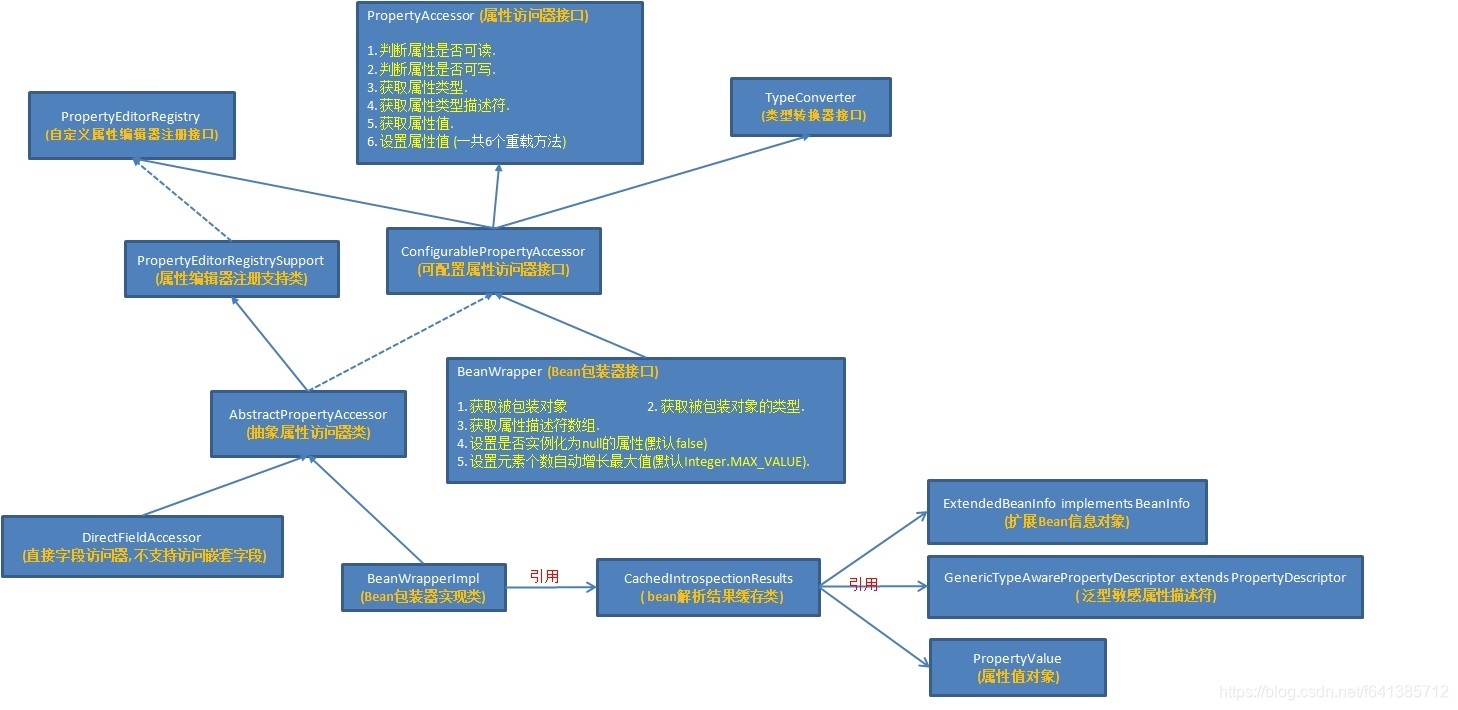
最后,上一张比较丑的结构图,画一画属性编辑器、类型转换器、属性解析器、属性访问器大致的一个关系(此图不喜勿碰):
#### 总结
`BeanWrapper`接口,作为Spring内部的一个**核心接口**,正如其名,它是bean的包裹类,即在内部中将会保存该bean的实例,提供其它一些扩展功能。
Spring对Bean的属性存取都是通过`BeanWrapperImpl`实现的,`BeanWrapperImpl`和`Bean`是一对一的关系,`BeanWrapperImpl`通过属性的**读方法**和**写方法**来存取`Bean`属性的。为了更加深刻的了解`BeanWrapper`,下篇文章会深入分析Spring `BeanFactory`对它的应用~
#### 知识交流
==The last:如果觉得本文对你有帮助,不妨点个赞呗。当然分享到你的朋友圈让更多小伙伴看到也是被`作者本人许可的~`==
**若对技术内容感兴趣可以加入wx群交流:`Java高工、架构师3群`。
若群二维码失效,请加wx号:`fsx641385712`(或者扫描下方wx二维码)。并且备注:`"java入群"` 字样,会手动邀请入群**

【小家Spring】聊聊Spring中的数据绑定 --- BeanWrapper以及内省Introspector和PropertyDescriptor的更多相关文章
- 【小家Spring】聊聊Spring中的数据绑定 --- DataBinder本尊(源码分析)
每篇一句 唯有热爱和坚持,才能让你在程序人生中屹立不倒,切忌跟风什么语言或就学什么去~ 相关阅读 [小家Spring]聊聊Spring中的数据绑定 --- 属性访问器PropertyAccessor和 ...
- 【小家Spring】Spring IoC是如何使用BeanWrapper和Java内省结合起来给Bean属性赋值的
#### 每篇一句 > 具备了技术深度,遇到问题可以快速定位并从根本上解决.有了技术深度之后,学习其它技术可以更快,再深入其它技术也就不会害怕 #### 相关阅读 [[小家Spring]聊聊Sp ...
- 【小家Spring】老项目迁移问题:@ImportResource导入的xml配置里的Bean能够使用@PropertySource导入的属性值吗?
#### 每篇一句 > 大师都是偏执的,偏执才能产生力量,妥协是没有力量的.你对全世界妥协了你就是空气.所以若没有偏见,哪来的大师呢 #### 相关阅读 [[小家Spring]详解Propert ...
- Spring官网阅读(十六)Spring中的数据绑定
文章目录 DataBinder UML类图 使用示例 源码分析 bind方法 doBind方法 applyPropertyValues方法 获取一个属性访问器 通过属性访问器直接set属性值 1.se ...
- 从架构演进的角度聊聊Spring Cloud都做了些什么?
Spring Cloud作为一套微服务治理的框架,几乎考虑到了微服务治理的方方面面,之前也写过一些关于Spring Cloud文章,主要偏重各组件的使用,本次分享主要解答这两个问题:Spring Cl ...
- 聊聊 Spring Boot 2.x 那些事儿
本文目录: 即将的 Spring 2.0 - Spring 2.0 是什么 - 开发环境和 IDE - 使用 Spring Initializr 快速入门 Starter 组件 - Web:REST ...
- 聊聊 Spring Boot 2.0 的 WebFlux
聊聊 Spring Boot 2.0 的 WebFlux## 前言 对照下 Spring Web MVC ,Spring Web MVC 是基于 Servlet API 和 Servlet 容器设计的 ...
- [原创]java WEB学习笔记109:Spring学习---spring对JDBC的支持:使用 JdbcTemplate 查询数据库,简化 JDBC 模板查询,在 JDBC 模板中使用具名参数两种实现
本博客的目的:①总结自己的学习过程,相当于学习笔记 ②将自己的经验分享给大家,相互学习,互相交流,不可商用 内容难免出现问题,欢迎指正,交流,探讨,可以留言,也可以通过以下方式联系. 本人互联网技术爱 ...
- 在Spring tools suite中使用git 共享项目
我们都在eclipse 和 myeclipse中使用过cvs 和 svn 版本控制工具进行团队开发,今天我学习了另外一种版本控制工具git,下面我演示如何在Spring tools suite中使用g ...
随机推荐
- Android Xposed框架出现java.lang.IllegalAccessError: Class ref in pre-verified class resolved to unexpected implementation问题
第一次玩Xposed框架,按照多个demo的格式写了一个demo发现死活不进入 public abstract void handleLoadPackage(LoadPackageParam lppa ...
- OC笔记一:Objective
1.OC简介 全称:Objective-C,是扩充C的面向对象编程语言,主要用于iOS和Mac OS开发. C语言的基础上,增加了一层最小的面向对象语法 完全兼容C语言 可以在OC代码中混入C语言代码 ...
- List遍历删除 或取指定的前N项
class Program { static void Main(string[] args) { /* * List遍历删除 或取指定的前N项 */ List<PerSon> listP ...
- Android零基础入门第14节:使用高速Genymotion,跨入火箭时代
原文:Android零基础入门第14节:使用高速Genymotion,跨入火箭时代 无论是使用Eclipse,还是Android Studio,使用自带的Android模拟器,不仅很费电脑内存,模拟器 ...
- Windows 10 版本信息
原文 https://technet.microsoft.com/zh-cn/windows/release-info Windows 10 版本信息 Microsoft 已更新其服务模型. 半年频道 ...
- 用CDialog实现的消息框MessageBoxST类
http://blog.csdn.net/akof1314/article/details/5078563
- 树莓派 Qt5.7交叉编译
一.准备软件 1.2016-11-25-raspbian-jessie.img(官网下载) 2.cross-compile-tools-master.zip 3.gcc-4.7-li ...
- Tomcat请求过程
Tomcat请求过程 1.用户点击网页内容,请求被发送到本机端口8080,被在那里监听的Coyote HTTP/1.1 Connector获得. 2.Connector把该请求交给它所在的Servic ...
- Ural_1169_Pairs
此题略坑... 思路:把N个点分成m若干个联通子图,然后用m-1个桥把这m个联通子图连接起来即可. 若每个联通子图内部都是完全图也符合题意,但答案却是Wrong Answer,只有把每个联通子图内部当 ...
- java多线程之线程安全
线程安全和非线程安全是多线程的经典问题,非线程安全会在多个线程对同一个对象并发访问时发生. 注意1: 非线程安全的问题存在于实例变量中,如果是方法内部的私有变量,则不存在非线程安全问题. 实例变量是对 ...