
转:解释lsh
Locality sensitive hashing — LSH explained
The problem of finding duplicate documents in a list may look like a simple task — use a hash table, and the job is done quickly and the algorithm is fast. However, if we need to find not only exact duplicates, but also documents with differences such as typos or different words, the problem becomes much more complex. In my case, I’ve had to find duplicates in a very long list of given questions.
Jaccard index
First, we need to define a method of determining whether a question is a duplicate of another. After experimenting with string distance metrics (Levenshtein, Jaro-Winkler, Jaccard index) I’ve come to the conclusion that the Jaccard index performs sufficiently for this use case. The Jaccard index is an intersection over a union. We count the amount of common elements from two sets, and divide by the number of elements that belong to either the first set, the second set, or both. Let’s have a look at the example:
Assuming that we have two following questions:
“Who was the first ruler of Poland”
“Who was the first king of Poland”
We can visualize it in the following sets:
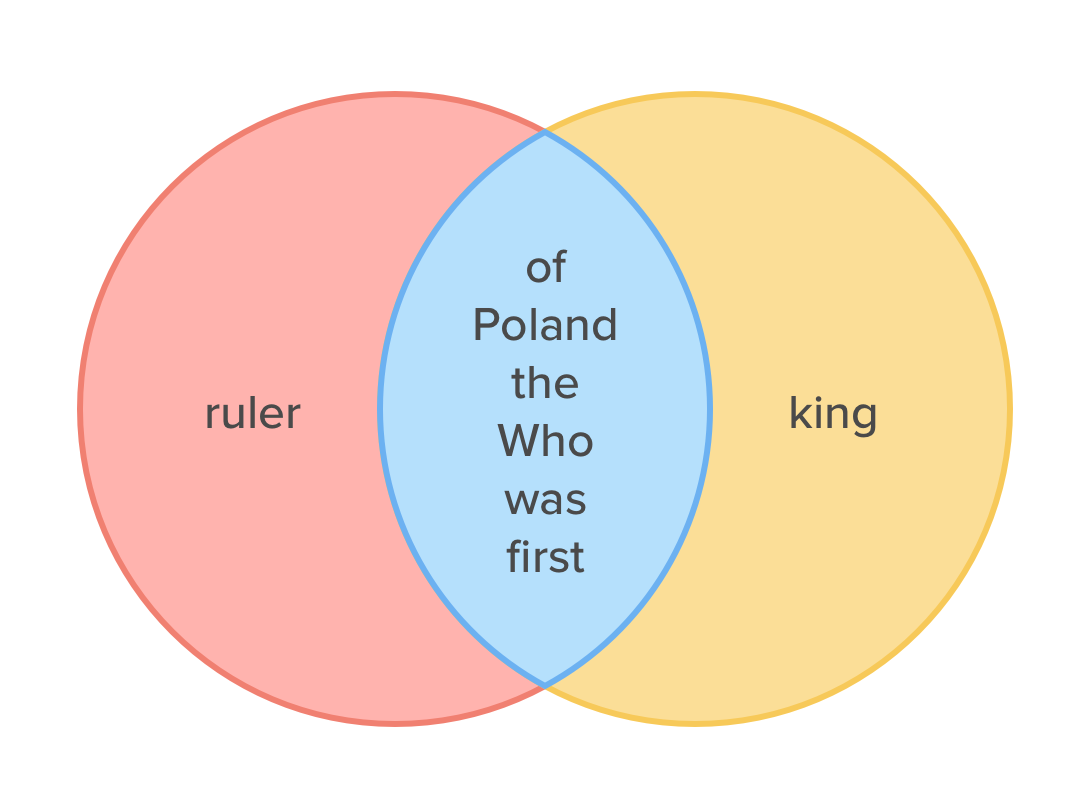
The size of the intersection is 6, while the size of the union is 6 + 1 + 1 = 8, thus the Jaccard index is equal to 6 / 8 = 0.75
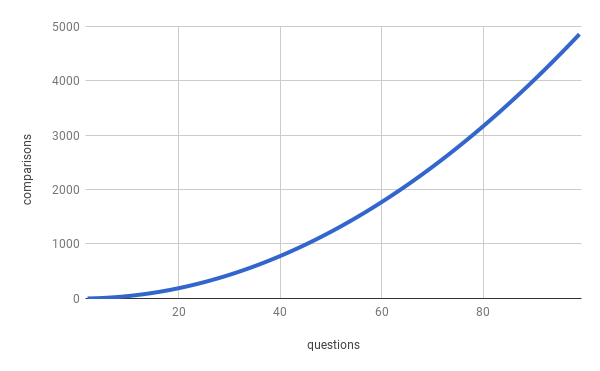
We can conclude — the more common words, the bigger the Jaccard index, the more probable it is that two questions are a duplicate. So where we can set a threshold above which pairs would be marked as a duplicate? For now, let’s assume 0.5 as a threshold, but in a real life, we need to get this value by experiment. We could stop here, but current solution makes a number of comparisons growing quadratically (It’s 0.5*(n²-n) where n is the number of questions).
Min part of MinHash
It’s been shown earlier that the Jaccard can be a good string metric, however, we need to split each question into the words, then, compare the two sets, and repeat for every pair. The amount of pairs will grow rapidly. What if we somehow created a simple fixed-size numeric fingerprint for each sentence and then just compare the fingerprints?
In this section I will use following questions:
“Who was the first king of Poland”
“Who was the first ruler of Poland”
“Who was the last pharaoh of Egypt”
And their Jaccard indexes:
J(“Who was the first king of Poland”, “Who was the first ruler of Poland”) = 0.75
J(“Who was the first king of Poland”,“Who was the last pharaoh of Egypt”) = 0.4
J(“Who was the first ruler of Poland”, “Who was the last pharaoh of Egypt”)=0.4
To calculate MinHash we need to create the dictionary (a set of all words) from all our questions. Then, create a random permutation:
(“last”, “Who”, “Egypt”, “king”, “ruler”, “was”, “of”, “Poland”, “pharaoh”, “the”, “first”)
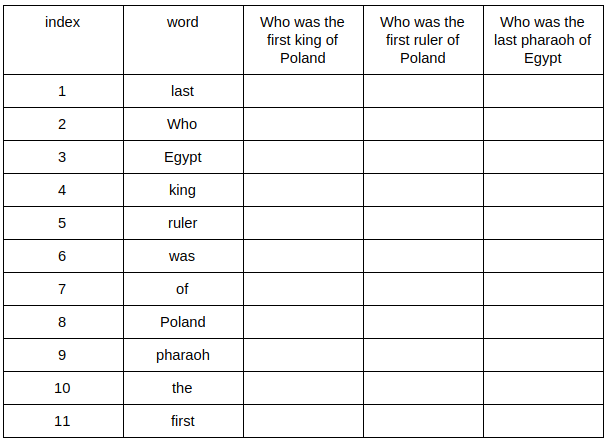
We have to iterate over the rows, writing the index in the respective cell, if the word being checked is present in the sentence.

Now the second row:
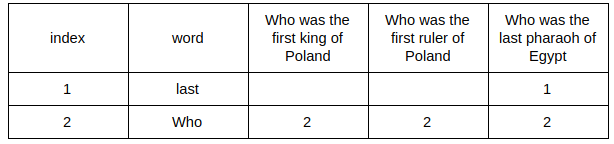
And the rest:
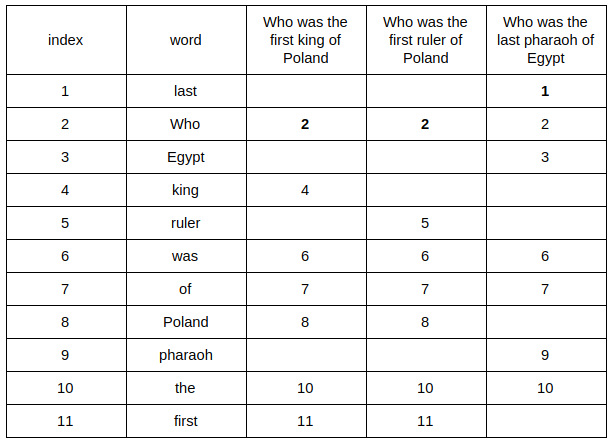
Only the first word occurrence is relevant (giving a minimal index — hence the name MinHash). We have a minimum value for all our questions and the first part of the fingerprint. To get the second one we need to create another random permutation and retrace our steps: /////只有出现的第一个单词是相关的(给出最小索引,因此命名为MinHash)。我们对所有的问题和指纹的第一部分都有一个最小值。为了得到第二个,我们需要创建另一个随机排列,并返回我们的步骤
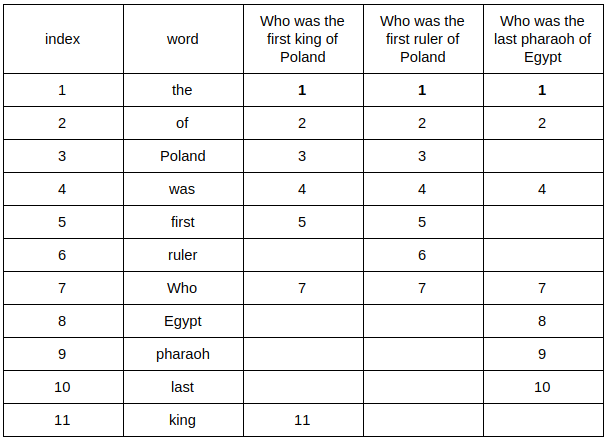
Then, we repeat permuting and searching as many times as big we want our fingerprint. For the purpose of example my consists of 6 items. We’ve already had 2, so let’s create 4 more permutations:
(“first”, “king”, “Egypt”, “was”, “Who”, “of”, “pharaoh”, “last”, “Poland”, “ruler”, “the”)
(“ruler”, “king”, “Poland”, “Who”, “the”, “pharaoh”, “of”, “first”, “Egypt”, “last”, “was”)
(“king”, “Poland”, “ruler”, “last”, “pharaoh”, “the”, “Who”, “Egypt”, “first”, “of”, “was”)
(“the”, “pharaoh”, “Who”, “ruler”, “Poland”, “Egypt”, “king”, “last”, “was”, “first”, “of”)
Our complete MinHashes are:
MinHash(“Who was the first king of Poland”) = [2, 1, 1, 2, 1, 1]
MinHash(“Who was the first ruler of Poland”) = [2, 1, 1, 1, 1, 1]
MinHash(“Who was the last pharaoh of Egypt”) = [1, 1, 3, 4, 4, 1]
Now we can check how similar are two MinHashes by calculating their Jaccard indexes:
MinHashSimilarity(“Who was the first king of Poland”, “Who was the first ruler of Poland”) = 5/6 ≈ 0.83
MinHashSimilarity(“Who was the first king of Poland”, “Who was the last pharaoh of Egypt”) = 2/6 ≈ 0.33
MinHashSimilarity(“Who was the first ruler of Poland”, “Who was the last pharaoh of Egypt”) = 2/6 ≈ 0.33
Well, that’s really close to their Jaccard indexes, and the more permutations we do, the closer the approximations get. How’s that possible?
Let’s analyze how we calculate the Jaccard index. We need to look at our table. Considering only two questions, we can create a table like the following:
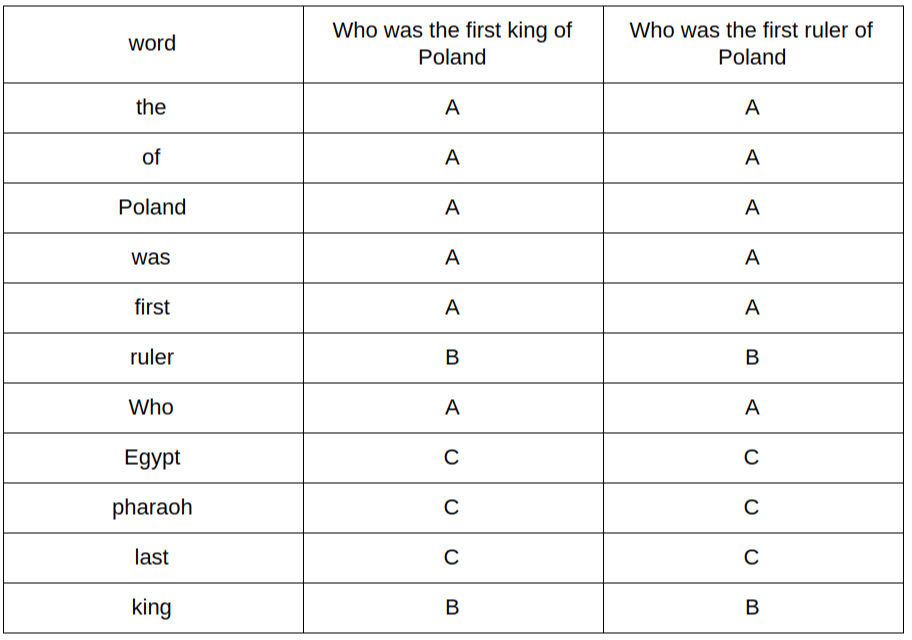
A — where the word is present in both questions
B —it’s present in one of them
C — it’s in the dictionary, but in neither of the questions
We can write the formula for the Jaccard index as a/(a+b) where a is a number of rows of type A and b of type B
Now since we have random permutations, let’s count a probability that two questions will have an equal fingerprint component. We can skip type C rows since they do not interfere in any way with a component value calculation (If we consider only two questions). So what is the probability that we will take type A row, from the set of A and B rows? P = a/(a + b) which is exactly the same as Jaccard index! That explains why our approximations were close and why more permutations mean better approximations.
Hash part of MinHash
We now have an algorithm which could potentially perform better, but the more documents the bigger the dictionary, and thus the higher the cost of creating permutations, both in time and hardware. Instead of creating n permutations we can take a hash function (like md5, sha256 etc.) use it on every word in the question and find a minimal hash value. It will be the first element of the fingerprint, then we will take another hash function, and so on until we have our n elements in the fingerprint. Wait, but why does it work?
Let’s wonder what permutation does — it basically maps each word from dictionary to a different number. The fact that mapped numbers are integers increased by one is not important to us.
What are hash functions doing? Simplifying — they map string to a number, so basically the same as the permutation! How is that better? We don’t need the whole dictionary before — if the new question appears we can easily calculate its MinHash. Also, we don’t need to scan the whole dictionary for each question and create a permutation of the whole dictionary. Both of these operations are pretty costly. We just saved a lot of our and our’s computer time.
So now we can compute a fingerprint and compare it easily, but still we need to compare every fingerprint with all others. This is bad. Exponentially bad.
LSH
Let’s look back at our MinHashes:
MinHash(“Who was the first king of Poland”) = [2, 1, 1, 2, 1, 1]
MinHash(“Who was the first ruler of Poland”) = [2, 1, 1, 1, 1, 1]
MinHash(“Who was the last pharaoh of Egypt”) = [1, 1, 3, 4, 4, 1]
Now group them by three elements:
MinHash(“Who was the first king of Poland”) =[2, 1, 1, 2, 1, 1] => [211, 211]
MinHash(“Who was the first ruler of Poland”) =[2, 1, 1, 1, 1, 1] => [211, 111]
MinHash(“Who was the last pharaoh of Egypt”)=[1, 1, 3, 4, 4, 1]=>[113,441]
What can we see? Our duplicates have one common group (first) where unique has no common groups. Since still, we’re talking about probability influenced issue let’s calculate what is the probability of at least one common group for duplicates:
- Probability of one specific element common in fingerprint = Jaccard index = P1 = 0.75
- Probability that all elements in one group are identical = Jaccard index to number of elements in group power = P2 = 0.75³ = 0.421875
- Probability that group will be different = P3 = 1-P2 = 0.578125
- Probability that all groups will be different = P4 to number of groups power = P3² = 0.334228516
- And finally — Probability that at least one group will be common = P5 = 1 — P4 = 0.665771484
So general equation will look like this: P5 = 1 — (1 — Jn)b
Where:
J — Jaccard index
n — number of elements in group
b — number of groups
And probability for our unique question is 1 — (1–0.4³)² = 0.123904 — much lower. We could also make 3 groups 2 elements each. Here is plot:
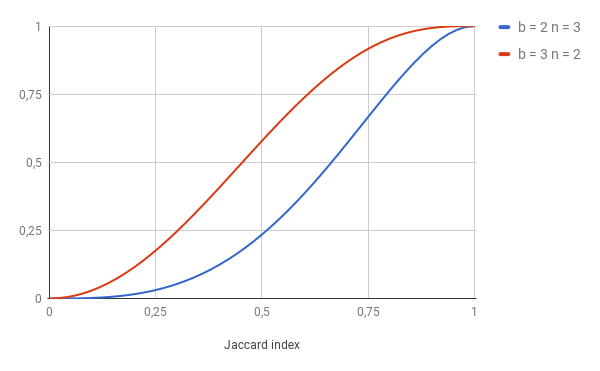
Let’s analyze it: For the pair with J = 0.5 and b = 3, there is only 0.25 probability that we would find it as a duplicate. However, with b = 3 there is about 0.6 probability that we would mark it as a duplicate. What does it mean in practice? — More false positives for b = 3 and more false negatives for b = 2. We need to choose carefully our parameters, but more on that later.
Now we do not need to count anything — if there is a common group we can mark it as duplicates. We can just create lists with single groups:
[211, 211]
[211, 111]
[113, 441]
↓
[
211 => “Who was the first king of Poland”,
211 => “Who was the first ruler of Poland”,
113 => “Who was the last pharaoh of Egypt”
]
And
[
211 => “Who was the first king of Poland”,
111 => “Who was the first ruler of Poland”,
441 => “Who was the last pharaoh of Egypt”
]
It looks familiar to Hashtable! We can put columns of groups in the hash table and check for collision. Collision means that we hit a duplicate. And operations on the hash table have worst case scenario complexity of O(n), so our algorithm (of course depends on implementation) have potential to be also O(n) complex. Way better than O(n²) we had at the beginning.
Tweaking
After what we’ve learned so far we know that LSH takes, 3 arguments:
k — number of elements in MinHash
n — number of elements in groups (or buckets)
b — number of buckets and b*n must equal k
Our goal is to mark as duplicate every pair, or more, that have Jaccard index >= 0.17, so our probability chart should look like this:
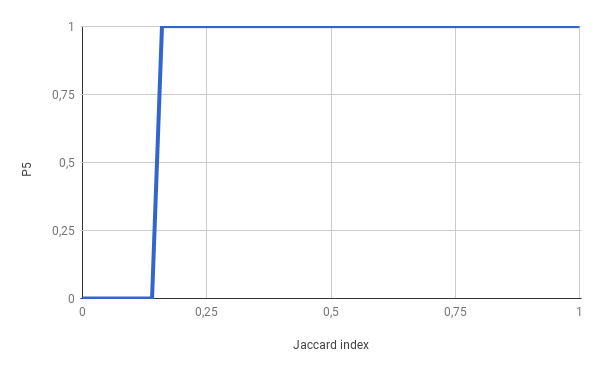
Achieving step function is impossible in our case, so by manipulating our 3 parameters we need to approximate this as close as possible having in mind that bigger the k, more computing power we need (more hashes to calculate). After experiments, I’ve found that 200 for k is good starting value and it also has many divisors. Although 240 has more, so it would be my next shot.
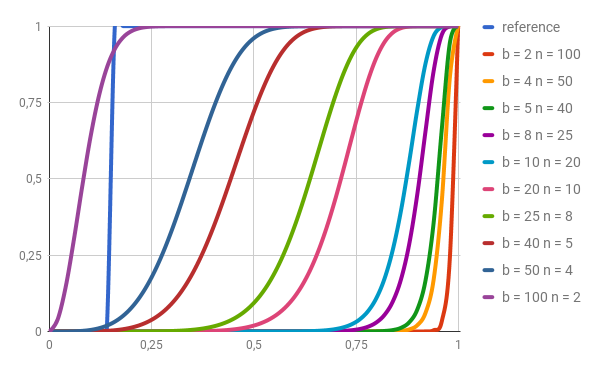
As we can see b = 100 n = 2 or b = 50 n = 4 are the ones closest to reference. We should use both and then compare results.
One thing left — where to get 200 hash functions? Two example solutions:
- use MurmurHash with 200 different seeds
- create our own hash function by taking the output of md5 or another hash function and making XOR with some random number. Example python code:
def myFirstHash(string):
return md5(hash) ^ 636192
def mySecondHash(string):
return md5(hash) ^ 8217622
# And so on.
# But do it in a loop!
Warning — LSH can, and sometimes will produce accidental collisions, so at the end, we still need to compare all questions in given collision but it will be much much fewer operations than comparing all to each other.
And that would be all for now. In next article, I will show example implementation and some benchmarks.
转自:
https://medium.com/engineering-brainly/locality-sensitive-hashing-explained-304eb39291e4
转:解释lsh的更多相关文章
- 实习日记:图像检索算法 LSH 的总结与分析(matlab)
最开始仿真和精度测试,基于 matlab 完成的. Demo_MakeTable.m (生成 Hash 表) %======================================== %** ...
- 海量数据挖掘MMDS week7: 局部敏感哈希LSH(进阶)
http://blog.csdn.net/pipisorry/article/details/49686913 海量数据挖掘Mining Massive Datasets(MMDs) -Jure Le ...
- 海量数据挖掘MMDS week2: 局部敏感哈希Locality-Sensitive Hashing, LSH
http://blog.csdn.net/pipisorry/article/details/48858661 海量数据挖掘Mining Massive Datasets(MMDs) -Jure Le ...
- Locality Sensitive Hashing,LSH
1. 基本思想 局部敏感(Locality Senstitive):即空间中距离较近的点映射后发生冲突的概率高,空间中距离较远的点映射后发生冲突的概率低. 局部敏感哈希的基本思想类似于一种空间域转换思 ...
- Halcon算子解释
Halcon算子解释大全 Halcon/Visionpro视频教程和资料,请访问 重码网,网址: http://www.211code.com Chapter 1 :Classification 1. ...
- BOW模型在ANN框架下的解释
原文链接:http://blog.csdn.net/jwh_bupt/article/details/17540561 作者的视野好,赞一个. 哥德尔第一完备性定理,始终是没有能看完完整的证明,艹!看 ...
- 图像检索中为什么仍用BOW和LSH
原文链接:http://blog.csdn.net/jwh_bupt/article/details/27713453 去年年底的时候在一篇博客中,用ANN的框架解释了BOW模型[1],并与LSH[2 ...
- 位姿检索PoseRecognition:LSH算法.p稳定哈希
位姿检索使用了LSH方法,而不使用PNP方法,是有一定的来由的.主要的工作会转移到特征提取和检索的算法上面来,有得必有失.因此,放弃了解析的方法之后,又放弃了优化的方法,最后陷入了检索的汪洋大海. 0 ...
- 从Go语言编码角度解释实现简易区块链
区块链技术 人们可以用许多不同的方式解释区块链技术,其中通过加密货币来看区块链一直是主流.大多数人接触区块链技术都是从比特币谈起,但比特币仅仅是众多加密货币的一种. 到底什么是区块链技术? 从金融学相 ...
随机推荐
- linux文件的3个时间和7种文件类型
linux文件的三个时间: atime: access time --最近访问时间. ctime: change time --最近改变时间. mtime:modify time --最近修改时间. ...
- 希捷powerchoice磁盘休眠功能配置方法
本篇关于希捷磁盘休眠的配置方法 准备设置的软件 下载地址 https://raw.githubusercontent.com/Seagate/ToolBin/master/SeaChest/Power ...
- Dubbo 服务导出-Version2.7.5
1.源码分析 1.1分析服务导出入口 当容器为spring是dubbo会为容器注册两个监听器:DubboLifecycleComponentApplicationListener和DubboBoots ...
- Weevely使用方法以及通信流量分析
Weevely简介 weevely项目地址:点击查看 weevely是一款针对PHP的webshell的自由软件,可用于模拟一个类似于telnet的连接shell,weevely通常用于web程序的漏 ...
- MySQL第01课- CentOS + 单实例MySql编译安装总结
2016年2月,从oracle转向MySql ,碰上几个坑,特此记录 总结 1.注意环境变量.配置文件,操作过程不能出错 2.相比rpm方式安装,编译安装方式可以指定安装路径,再说安装是简单活,将来安 ...
- ctf-工具-binwalk
binwalk在玩杂项时是个不可缺的工具.1.最简单的,在玩隐写时,首先可以用它来找到其中的字符串例如:在铁人三项,东北赛区个人赛中,有一道题它直接给了一个文件,没有后缀,不知道是什么文件先binwa ...
- mybatis使用细节注意
mybatis细节 增删改查ParameterType都可以不用写 解释这个属性是可选的,因为 MyBatis 可以通过类型处理器(TypeHandler)推断出具体传入语句的参数 mybatis 中 ...
- CorelDRAW“出血线”的精准预设与辅助线便捷操作
CorelDRAW软件是一款常用的制图工具,非常适合用于印刷品输出,各种印刷图文制作都依赖于它.所以,我们设计者每次用CorelDRAW制图的一个关键就是要做好"标尺辅助线"设置, ...
- MySQL给临时表分组后Max函数无效
有道练习题"取得平均薪水最高的部门的部门编号(至少给出两种解决方案)", 为什么我给临时表分组后Max函数就无效了?不分组就可以,但是无法查询到DEPTNO,MySQL版本8.0+ ...
- 【CF600E】Lomsat gelral——树上启发式合并
(题面来自luogu) 题意翻译 一棵树有n个结点,每个结点都是一种颜色,每个颜色有一个编号,求树中每个子树的最多的颜色编号的和. ci <= n <= 1e5 裸题.统计时先扫一遍得到出 ...