
学习java 线程池-1: ThreadPoolExecutor

1. Executor
该接口内只有一个接口方法 ;该方法的目的就是执行指定的 Runnable (但会不会执行,或者会不会立马执行,则不一定。因为要取决于整个线程池的状态)
Executor 中文的翻译就是执行者、执行器的意思
public interface Executor {

    /**

     * Executes the given command at some time in the future.  The command

     * may execute in a new thread, in a pooled thread, or in the calling

     * thread, at the discretion of the {@code Executor} implementation.

     *

     * @param command the runnable task

     * @throws RejectedExecutionException if this task cannot be

     * accepted for execution

     * @throws NullPointerException if command is null

     */

    void execute(Runnable command);

}
2. ExecutorService
执行器的相关服务,这里面提供了较为丰富的接口方法,以方便用户使用线程池的相服务
public interface ExecutorService extends Executor {

    /**

     * Initiates an orderly shutdown in which previously submitted

     * tasks are executed, but no new tasks will be accepted.

     * Invocation has no additional effect if already shut down.

     *

     * <p>This method does not wait for previously submitted tasks to

     * complete execution.  Use {@link #awaitTermination awaitTermination}

     * to do that.

     *

     * @throws SecurityException if a security manager exists and

     *         shutting down this ExecutorService may manipulate

     *         threads that the caller is not permitted to modify

     *         because it does not hold {@link

     *         java.lang.RuntimePermission}{@code ("modifyThread")},

     *         or the security manager's {@code checkAccess} method

     *         denies access.

     */

    void shutdown();

    /**

     * Attempts to stop all actively executing tasks, halts the

     * processing of waiting tasks, and returns a list of the tasks

     * that were awaiting execution.

     *

     * <p>This method does not wait for actively executing tasks to

     * terminate.  Use {@link #awaitTermination awaitTermination} to

     * do that.

     *

     * <p>There are no guarantees beyond best-effort attempts to stop

     * processing actively executing tasks.  For example, typical

     * implementations will cancel via {@link Thread#interrupt}, so any

     * task that fails to respond to interrupts may never terminate.

     *

     * @return list of tasks that never commenced execution

     * @throws SecurityException if a security manager exists and

     *         shutting down this ExecutorService may manipulate

     *         threads that the caller is not permitted to modify

     *         because it does not hold {@link

     *         java.lang.RuntimePermission}{@code ("modifyThread")},

     *         or the security manager's {@code checkAccess} method

     *         denies access.

     */

    List<Runnable> shutdownNow();

    /**

     * Returns {@code true} if this executor has been shut down.

     *

     * @return {@code true} if this executor has been shut down

     */

    boolean isShutdown();

    /**

     * Returns {@code true} if all tasks have completed following shut down.

     * Note that {@code isTerminated} is never {@code true} unless

     * either {@code shutdown} or {@code shutdownNow} was called first.

     *

     * @return {@code true} if all tasks have completed following shut down

     */

    boolean isTerminated();

    /**

     * Blocks until all tasks have completed execution after a shutdown

     * request, or the timeout occurs, or the current thread is

     * interrupted, whichever happens first.

     *

     * @param timeout the maximum time to wait

     * @param unit the time unit of the timeout argument

     * @return {@code true} if this executor terminated and

     *         {@code false} if the timeout elapsed before termination

     * @throws InterruptedException if interrupted while waiting

     */

    boolean awaitTermination(long timeout, TimeUnit unit)

        throws InterruptedException;

    /**

     * Submits a value-returning task for execution and returns a

     * Future representing the pending results of the task. The

     * Future's {@code get} method will return the task's result upon

     * successful completion.

     *

     * <p>

     * If you would like to immediately block waiting

     * for a task, you can use constructions of the form

     * {@code result = exec.submit(aCallable).get();}

     *

     * <p>Note: The {@link Executors} class includes a set of methods

     * that can convert some other common closure-like objects,

     * for example, {@link java.security.PrivilegedAction} to

     * {@link Callable} form so they can be submitted.

     *

     * @param task the task to submit

     * @param <T> the type of the task's result

     * @return a Future representing pending completion of the task

     * @throws RejectedExecutionException if the task cannot be

     *         scheduled for execution

     * @throws NullPointerException if the task is null

     */

    <T> Future<T> submit(Callable<T> task);

    /**

     * Submits a Runnable task for execution and returns a Future

     * representing that task. The Future's {@code get} method will

     * return the given result upon successful completion.

     *

     * @param task the task to submit

     * @param result the result to return

     * @param <T> the type of the result

     * @return a Future representing pending completion of the task

     * @throws RejectedExecutionException if the task cannot be

     *         scheduled for execution

     * @throws NullPointerException if the task is null

     */

    <T> Future<T> submit(Runnable task, T result);

    /**

     * Submits a Runnable task for execution and returns a Future

     * representing that task. The Future's {@code get} method will

     * return {@code null} upon <em>successful</em> completion.

     *

     * @param task the task to submit

     * @return a Future representing pending completion of the task

     * @throws RejectedExecutionException if the task cannot be

     *         scheduled for execution

     * @throws NullPointerException if the task is null

     */

    Future<?> submit(Runnable task);

    /**

     * Executes the given tasks, returning a list of Futures holding

     * their status and results when all complete.

     * {@link Future#isDone} is {@code true} for each

     * element of the returned list.

     * Note that a <em>completed</em> task could have

     * terminated either normally or by throwing an exception.

     * The results of this method are undefined if the given

     * collection is modified while this operation is in progress.

     *

     * @param tasks the collection of tasks

     * @param <T> the type of the values returned from the tasks

     * @return a list of Futures representing the tasks, in the same

     *         sequential order as produced by the iterator for the

     *         given task list, each of which has completed

     * @throws InterruptedException if interrupted while waiting, in

     *         which case unfinished tasks are cancelled

     * @throws NullPointerException if tasks or any of its elements are {@code null}

     * @throws RejectedExecutionException if any task cannot be

     *         scheduled for execution

     */

    <T> List<Future<T>> invokeAll(Collection<? extends Callable<T>> tasks)

        throws InterruptedException;

    /**

     * Executes the given tasks, returning a list of Futures holding

     * their status and results

     * when all complete or the timeout expires, whichever happens first.

     * {@link Future#isDone} is {@code true} for each

     * element of the returned list.

     * Upon return, tasks that have not completed are cancelled.

     * Note that a <em>completed</em> task could have

     * terminated either normally or by throwing an exception.

     * The results of this method are undefined if the given

     * collection is modified while this operation is in progress.

     *

     * @param tasks the collection of tasks

     * @param timeout the maximum time to wait

     * @param unit the time unit of the timeout argument

     * @param <T> the type of the values returned from the tasks

     * @return a list of Futures representing the tasks, in the same

     *         sequential order as produced by the iterator for the

     *         given task list. If the operation did not time out,

     *         each task will have completed. If it did time out, some

     *         of these tasks will not have completed.

     * @throws InterruptedException if interrupted while waiting, in

     *         which case unfinished tasks are cancelled

     * @throws NullPointerException if tasks, any of its elements, or

     *         unit are {@code null}

     * @throws RejectedExecutionException if any task cannot be scheduled

     *         for execution

     */

    <T> List<Future<T>> invokeAll(Collection<? extends Callable<T>> tasks,

                                  long timeout, TimeUnit unit)

        throws InterruptedException;

    /**

     * Executes the given tasks, returning the result

     * of one that has completed successfully (i.e., without throwing

     * an exception), if any do. Upon normal or exceptional return,

     * tasks that have not completed are cancelled.

     * The results of this method are undefined if the given

     * collection is modified while this operation is in progress.

     *

     * @param tasks the collection of tasks

     * @param <T> the type of the values returned from the tasks

     * @return the result returned by one of the tasks

     * @throws InterruptedException if interrupted while waiting

     * @throws NullPointerException if tasks or any element task

     *         subject to execution is {@code null}

     * @throws IllegalArgumentException if tasks is empty

     * @throws ExecutionException if no task successfully completes

     * @throws RejectedExecutionException if tasks cannot be scheduled

     *         for execution

     */

    <T> T invokeAny(Collection<? extends Callable<T>> tasks)

        throws InterruptedException, ExecutionException;

    /**

     * Executes the given tasks, returning the result

     * of one that has completed successfully (i.e., without throwing

     * an exception), if any do before the given timeout elapses.

     * Upon normal or exceptional return, tasks that have not

     * completed are cancelled.

     * The results of this method are undefined if the given

     * collection is modified while this operation is in progress.

     *

     * @param tasks the collection of tasks

     * @param timeout the maximum time to wait

     * @param unit the time unit of the timeout argument

     * @param <T> the type of the values returned from the tasks

     * @return the result returned by one of the tasks

     * @throws InterruptedException if interrupted while waiting

     * @throws NullPointerException if tasks, or unit, or any element

     *         task subject to execution is {@code null}

     * @throws TimeoutException if the given timeout elapses before

     *         any task successfully completes

     * @throws ExecutionException if no task successfully completes

     * @throws RejectedExecutionException if tasks cannot be scheduled

     *         for execution

     */

    <T> T invokeAny(Collection<? extends Callable<T>> tasks,

                    long timeout, TimeUnit unit)

        throws InterruptedException, ExecutionException, TimeoutException;

}
这里面就提供了较为丰富的线程池方法,核心的有 shutDown() shutDownNow() submit() 注意submit 中的参数和返回值,与 execute 进行区分
3. ThreadPoolExecutor
线程池类,创建线程池时要提供一些必要的参数(共7个)
拒绝策略:当工作队列中的任务达到最大值时,该如何处理新的任务。 该类提供了4个内部类

线程工厂:线程工厂就是如何创建线程的类。Executors类内提供了两个
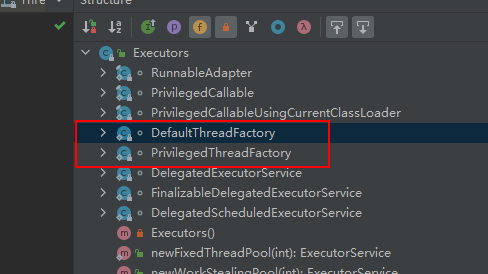
Executors 类是干嘛的呢? 我们应该还节的Collection 接口,有个Collections类; Array有个Arrays类
其实就是提供一些简单易用的操作方法
存活时间:其实就是一个线程不干活,即空闲的时候等待的时间,超过了该时间,空闲的线程就杀死
时间单位:存活时间的单位,是秒,还是分还是小时等
核心线程数:
最大线程数:
工作队列:
学习java 线程池-1: ThreadPoolExecutor的更多相关文章
- Java并发编程:Java线程池核心ThreadPoolExecutor的使用和原理分析
目录 引出线程池 Executor框架 ThreadPoolExecutor详解 构造函数 重要的变量 线程池执行流程 任务队列workQueue 任务拒绝策略 线程池的关闭 ThreadPoolEx ...
- 【Java 多线程】Java线程池类ThreadPoolExecutor、ScheduledThreadPoolExecutor及Executors工厂类
Java中的线程池类有两个,分别是:ThreadPoolExecutor和ScheduledThreadPoolExecutor,这两个类都继承自ExecutorService.利用这两个类,可以创建 ...
- 从使用到原理学习Java线程池
线程池的技术背景 在面向对象编程中,创建和销毁对象是很费时间的,因为创建一个对象要获取内存资源或者其它更多资源.在Java中更是如此,虚拟机将试图跟踪每一个对象,以便能够在对象销毁后进行垃圾回收. 所 ...
- 【转载】从使用到原理学习Java线程池
线程池的技术背景 在面向对象编程中,创建和销毁对象是很费时间的,因为创建一个对象要获取内存资源或者其它更多资源.在Java中更是如此,虚拟机将试图跟踪每一个对象,以便能够在对象销毁后进行垃圾回收. 所 ...
- Java线程池之ThreadPoolExecutor
前言 线程池可以提高程序的并发性能(当然是合适的情况下),因为对于没有线程的情况下,我们每一次提交任务都新建一个线程,这种方法存在不少缺陷: 1. 线程的创建和销毁的开销非常高,线程的创建需要时间, ...
- 深入理解Java线程池:ThreadPoolExecutor
线程池介绍 在web开发中,服务器需要接受并处理请求,所以会为一个请求来分配一个线程来进行处理.如果每次请求都新创建一个线程的话实现起来非常简便,但是存在一个问题: 如果并发的请求数量非常多,但每个线 ...
- Java线程池定制ThreadPoolExecutor官方定制实例
1.仍然先看构造方法:ThreadPoolExecutor构造方法 public ThreadPoolExecutor(int corePoolSize,int maximumPoolSize,lon ...
- java 线程池 ExeutorService
Java线程池 ExecutorService 原文:https://blog.csdn.net/suifeng3051/article/details/49443835/ 本篇主要涉及到的是java ...
- 深入理解Java线程池:ScheduledThreadPoolExecutor
介绍 自JDK1.5开始,JDK提供了ScheduledThreadPoolExecutor类来支持周期性任务的调度.在这之前的实现需要依靠Timer和TimerTask或者其它第三方工具来完成.但T ...
随机推荐
- 记一道CTF隐写题解答过程
0x00 前言 由于我是这几天才开始接触隐写这种东西,所以作为新手我想记录一下刚刚所学.这道CTF所需的知识点包括了图片的内容隐藏,mp3隐写,base64解密,当铺解密,可能用到的工具包括bin ...
- springboot freemark linux 找不到ftl文件
文件路径: 再idea中这样写是可以正常导出文件,但是 打成jar放到linux上就找不到文件了. String templatePath =WordUtils.class.getResource(& ...
- 大型Java进阶专题(七) 设计模式之委派模式与策略模式
前言 今天开始我们专题的第七课了.本章节将介绍:你写的代码中是否觉得很臃肿,程序中有大量的if...else,想优化代码,精简程序逻辑,提升代码的可读性,这章节将介绍如何通过委派模式.策略模式让你 ...
- JVM 专题二十:垃圾回收(四)垃圾回收器 (一)
1. GC分类与性能指标 垃圾收集器没有在规范中进行过多的规定,可以由不同的厂商.不同版本的JVM来实现.由于JDK的版本处于高速迭代过程中,因此Java发展至今已经产生了众多的GC版本.从不同角度分 ...
- 机器学习实战基础(十四):sklearn中的数据预处理和特征工程(七)特征选择 之 Filter过滤法(一) 方差过滤
Filter过滤法 过滤方法通常用作预处理步骤,特征选择完全独立于任何机器学习算法.它是根据各种统计检验中的分数以及相关性的各项指标来选择特征 1 方差过滤 1.1 VarianceThreshold ...
- Python模块04/包/logging日志
Python模块04/包/logging日志 目录 Python模块04/包/logging日志 内容大纲 1.包 2.logging日志 3.今日总结 内容大纲 1.包 2.logging日志 1. ...
- mybatis自动生成代码插件mybatis-generator使用流程(亲测可用)
mybatis-generator是一款在使用mybatis框架时,自动生成model,dao和mapper的工具,很大程度上减少了业务开发人员的手动编码时间 坐着在idea上用maven构建spri ...
- 洛谷P1063.能量项链
题目描述 在Mars星球上,每个Mars人都随身佩带着一串能量项链.在项链上有N颗能量珠.能量珠是一颗有头标记与尾标记的珠子,这些标记对应着某个正整数.并且,对于相邻的两颗珠子,前一颗珠子的尾标记一定 ...
- STL源码剖析:序列式容器
前言 容器,置物之所也.就是存放数据的地方. array(数组).list(串行).tree(树).stack(堆栈).queue(队列).hash table(杂凑表).set(集合).map(映像 ...
- Nginx使用SSL模块配置https
背景 开发微信小程序,需要https域名,因此使用Nginx的SSL模块配置https 步骤 一.去域名管理商(如腾讯云.阿里云等)申请CA证书 二.在Nginx中配置,一般情况下域名管理商会提供配置 ...