
Spring AOP + AspectJ Annotation Example---reference
In this tutorial, we show you how to integrate AspectJ annotation with Spring AOP framework. In simple, Spring AOP + AspectJ allow you to intercept method easily.
Common AspectJ annotations :
- @Before – Run before the method execution
- @After – Run after the method returned a result
- @AfterReturning – Run after the method returned a result, intercept the returned result as well.
- @AfterThrowing – Run after the method throws an exception
- @Around – Run around the method execution, combine all three advices above.
For Spring AOP without AspectJ support, read this build-in Spring AOP examples.
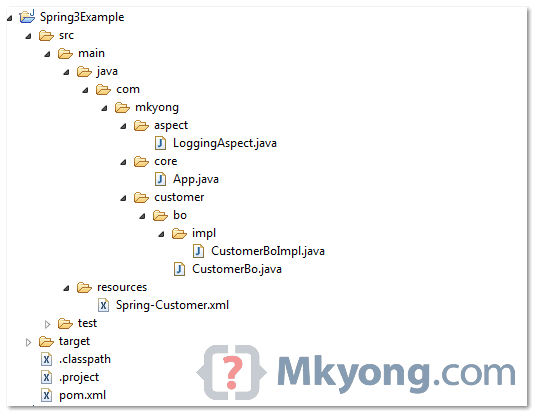
1. Directory Structure
See directory structure of this example.
2. Project Dependencies
To enable AspectJ, you need aspectjrt.jar, aspectjweaver.jar and spring-aop.jar. See following Maven pom.xml file.
This example is using Spring 3, but the AspectJ features are supported since Spring 2.0.
File : pom.xml
<project ...>

    <properties>

        <spring.version>3.0.5.RELEASE</spring.version>

    </properties>

    <dependencies>

        <dependency>

            <groupId>org.springframework</groupId>

            <artifactId>spring-core</artifactId>

            <version>${spring.version}</version>

        </dependency>

        <dependency>

            <groupId>org.springframework</groupId>

            <artifactId>spring-context</artifactId>

            <version>${spring.version}</version>

        </dependency>

        <!-- Spring AOP + AspectJ -->

        <dependency>

            <groupId>org.springframework</groupId>

            <artifactId>spring-aop</artifactId>

            <version>${spring.version}</version>

        </dependency>

        <dependency>

            <groupId>org.aspectj</groupId>

            <artifactId>aspectjrt</artifactId>

            <version>1.6.11</version>

        </dependency>

        <dependency>

            <groupId>org.aspectj</groupId>

            <artifactId>aspectjweaver</artifactId>

            <version>1.6.11</version>

        </dependency>

    </dependencies>

</project>
3. Spring Beans
Normal bean, with few methods, later intercept it via AspectJ annotation.
package com.mkyong.customer.bo;

public interface CustomerBo {

    void addCustomer();

    String addCustomerReturnValue();

    void addCustomerThrowException() throws Exception;

    void addCustomerAround(String name);

}

package com.mkyong.customer.bo.impl;

import com.mkyong.customer.bo.CustomerBo;

public class CustomerBoImpl implements CustomerBo {

    public void addCustomer(){

        System.out.println("addCustomer() is running ");

    }

    public String addCustomerReturnValue(){

        System.out.println("addCustomerReturnValue() is running ");

        return "abc";

    }

    public void addCustomerThrowException() throws Exception {

        System.out.println("addCustomerThrowException() is running ");

        throw new Exception("Generic Error");

    }

    public void addCustomerAround(String name){

        System.out.println("addCustomerAround() is running, args : " + name);

    }

}
4. Enable AspectJ
In Spring configuration file, put “<aop:aspectj-autoproxy />“, and define your Aspect (interceptor) and normal bean.
File : Spring-Customer.xml
<beans xmlns="http://www.springframework.org/schema/beans"

    xmlns:xsi="http://www.w3.org/2001/XMLSchema-instance"

    xmlns:aop="http://www.springframework.org/schema/aop"

    xsi:schemaLocation="http://www.springframework.org/schema/beans

    http://www.springframework.org/schema/beans/spring-beans-3.0.xsd

    http://www.springframework.org/schema/aop

    http://www.springframework.org/schema/aop/spring-aop-3.0.xsd ">

    <aop:aspectj-autoproxy />

    <bean id="customerBo" class="com.mkyong.customer.bo.impl.CustomerBoImpl" />

    <!-- Aspect -->

    <bean id="logAspect" class="com.mkyong.aspect.LoggingAspect" />

</beans>
4. AspectJ @Before
In below example, the logBefore() method will be executed before the execution of customerBo interface, addCustomer()method.
AspectJ “pointcuts” is used to declare which method is going to intercept, and you should refer to this Spring AOP pointcuts guide for full list of supported pointcuts expressions.
File : LoggingAspect.java
package com.mkyong.aspect;

import org.aspectj.lang.JoinPoint;

import org.aspectj.lang.annotation.Aspect;

import org.aspectj.lang.annotation.Before;

@Aspect

public class LoggingAspect {

    @Before("execution(* com.mkyong.customer.bo.CustomerBo.addCustomer(..))")

    public void logBefore(JoinPoint joinPoint) {

        System.out.println("logBefore() is running!");

        System.out.println("hijacked : " + joinPoint.getSignature().getName());

        System.out.println("******");

    }

}
Run it
	CustomerBo customer = (CustomerBo) appContext.getBean("customerBo");

	customer.addCustomer();
Output
logBefore() is running!

hijacked : addCustomer

******

addCustomer() is running
5. AspectJ @After
In below example, the logAfter() method will be executed after the execution of customerBo interface, addCustomer()method.
File : LoggingAspect.java
package com.mkyong.aspect;


import org.aspectj.lang.JoinPoint;

import org.aspectj.lang.annotation.Aspect;

import org.aspectj.lang.annotation.After;


@Aspect

public class LoggingAspect {


	@After("execution(* com.mkyong.customer.bo.CustomerBo.addCustomer(..))")

	public void logAfter(JoinPoint joinPoint) {


		System.out.println("logAfter() is running!");

		System.out.println("hijacked : " + joinPoint.getSignature().getName());

		System.out.println("******");


	}


}
Run it
	CustomerBo customer = (CustomerBo) appContext.getBean("customerBo");

	customer.addCustomer();
Output
addCustomer() is running

logAfter() is running!

hijacked : addCustomer

******
6. AspectJ @AfterReturning
In below example, the logAfterReturning() method will be executed after the execution of customerBo interface,addCustomerReturnValue() method. In addition, you can intercept the returned value with the “returning” attribute.
To intercept returned value, the value of the “returning” attribute (result) need to be same with the method parameter (result).
File : LoggingAspect.java
package com.mkyong.aspect;


import org.aspectj.lang.JoinPoint;

import org.aspectj.lang.annotation.Aspect;

import org.aspectj.lang.annotation.AfterReturning;


@Aspect

public class LoggingAspect {


   @AfterReturning(

      pointcut = "execution(* com.mkyong.customer.bo.CustomerBo.addCustomerReturnValue(..))",

      returning= "result")

   public void logAfterReturning(JoinPoint joinPoint, Object result) {


	System.out.println("logAfterReturning() is running!");

	System.out.println("hijacked : " + joinPoint.getSignature().getName());

	System.out.println("Method returned value is : " + result);

	System.out.println("******");


   }


}
Run it
	CustomerBo customer = (CustomerBo) appContext.getBean("customerBo");

	customer.addCustomerReturnValue();
Output
addCustomerReturnValue() is running

logAfterReturning() is running!

hijacked : addCustomerReturnValue

Method returned value is : abc

******
7. AspectJ @AfterReturning
In below example, the logAfterThrowing() method will be executed if the customerBo interface,addCustomerThrowException() method is throwing an exception.
File : LoggingAspect.java
package com.mkyong.aspect;


import org.aspectj.lang.JoinPoint;

import org.aspectj.lang.annotation.Aspect;

import org.aspectj.lang.annotation.AfterThrowing;


@Aspect

public class LoggingAspect {


   @AfterThrowing(

      pointcut = "execution(* com.mkyong.customer.bo.CustomerBo.addCustomerThrowException(..))",

      throwing= "error")

    public void logAfterThrowing(JoinPoint joinPoint, Throwable error) {


	System.out.println("logAfterThrowing() is running!");

	System.out.println("hijacked : " + joinPoint.getSignature().getName());

	System.out.println("Exception : " + error);

	System.out.println("******");


    }

}
Run it
	CustomerBo customer = (CustomerBo) appContext.getBean("customerBo");

	customer.addCustomerThrowException();
Output
addCustomerThrowException() is running

logAfterThrowing() is running!

hijacked : addCustomerThrowException

Exception : java.lang.Exception: Generic Error

******

Exception in thread "main" java.lang.Exception: Generic Error

	//...
8. AspectJ @Around
In below example, the logAround() method will be executed before the customerBo interface, addCustomerAround()method, and you have to define the “joinPoint.proceed();” to control when should the interceptor return the control to the original addCustomerAround() method.
File : LoggingAspect.java
package com.mkyong.aspect;


import org.aspectj.lang.ProceedingJoinPoint;

import org.aspectj.lang.annotation.Aspect;

import org.aspectj.lang.annotation.Around;


@Aspect

public class LoggingAspect {


   @Around("execution(* com.mkyong.customer.bo.CustomerBo.addCustomerAround(..))")

   public void logAround(ProceedingJoinPoint joinPoint) throws Throwable {


	System.out.println("logAround() is running!");

	System.out.println("hijacked method : " + joinPoint.getSignature().getName());

	System.out.println("hijacked arguments : " + Arrays.toString(joinPoint.getArgs()));


	System.out.println("Around before is running!");

	joinPoint.proceed(); //continue on the intercepted method

	System.out.println("Around after is running!");


	System.out.println("******");


   }


}
Run it
	CustomerBo customer = (CustomerBo) appContext.getBean("customerBo");

	customer.addCustomerAround("mkyong");
Output
logAround() is running!

hijacked method : addCustomerAround

hijacked arguments : [mkyong]

Around before is running!

addCustomerAround() is running, args : mkyong

Around after is running!

******
Conclusion
It’s always recommended to apply the least power AsjectJ annotation. It’s rather long article about AspectJ in Spring. for further explanations and examples, please visit the reference links below.
No worry, AspectJ supported XML configuration also, read this Spring AOP + AspectJ XML example.
Download Source Code
原文地址:http://www.mkyong.com/spring3/spring-aop-aspectj-annotation-example/
Spring AOP + AspectJ Annotation Example---reference的更多相关文章
- Spring AOP + AspectJ annotation example
In this tutorial, we show you how to integrate AspectJ annotation with Spring AOP framework. In simp ...
- Spring AOP @AspectJ 入门基础
需要的类包: 1.一个简单的例子 Waiter接口: package com.yyq.annotation; public interface Waiter { void greetTo(String ...
- 关于 Spring AOP (AspectJ) 该知晓的一切
关联文章: 关于Spring IOC (DI-依赖注入)你需要知道的一切 关于 Spring AOP (AspectJ) 你该知晓的一切 本篇是年后第一篇博文,由于博主用了不少时间在构思这篇博文,加上 ...
- Spring学习(十八)----- Spring AOP+AspectJ注解实例
我们将向你展示如何将AspectJ注解集成到Spring AOP框架.在这个Spring AOP+ AspectJ 示例中,让您轻松实现拦截方法. 常见AspectJ的注解: @Before – 方法 ...
- 关于 Spring AOP (AspectJ) 你该知晓的一切
版权声明:本文为CSDN博主「zejian_」的原创文章,遵循 CC 4.0 BY-SA 版权协议,转载请附上原文出处链接及本声明.原文链接:https://blog.csdn.net/javazej ...
- 关于 Spring AOP (AspectJ) 你该知晓的一切 (转)
出处:关于 Spring AOP (AspectJ) 你该知晓的一切
- Spring AOP AspectJ
本文讲述使用AspectJ框架实现Spring AOP. 再重复一下Spring AOP中的三个概念, Advice:向程序内部注入的代码. Pointcut:注入Advice的位置,切入点,一般为某 ...
- spring AOP AspectJ 定义切面实现拦截
总结记录一下AOP常用的应用场景及使用方式,如有错误,请留言. 1. 讲AOP之前,先来总结web项目的几种拦截方式 A: 过滤器 使用过滤器可以过滤URL请求,以及请求和响应的信息,但是过 ...
- Spring AOP AspectJ Pointcut Expressions With Examples--转
原文地址:http://howtodoinjava.com/spring/spring-aop/writing-spring-aop-aspectj-pointcut-expressions-with ...
随机推荐
- Windows命令行下pip安装python whl包
因为做网页爬虫,需要用到一个爬新闻的BeautifulSoup 的包,然后再关网上下的是whl包,第一次装,虽然花了点时间,最后还是装上去了,记录一下,方便下次. 先发一下官方文档地址.http:// ...
- Java实现http服务器(一)
基于Java实现Http服务器有多种多样的方法 一种轻量级的方式是使用JDK内置的com.sun.net.httpserver包下和sun.net.httpserver包下类提供的方法构建,该方法轻便 ...
- JSON和XML的比较
整理日: 2015/4/5 ◆可读性 JSON和XML的可读性可谓不相上下,一边是简易的语法,一边是规范的标签形式,很难分出胜负. ◆可扩展性 XML天生有很好的扩展性,JSON当然也有,没有什么是X ...
- Data Guard配置后续检查
Data Guard配置后续检查 1.打开生产端节点192.166.1.190上的数据库实例: SQL>startup; 2.打开容灾端节点192.166.1.60上的数据库实例: SQL> ...
- [BZOJ 1047] [HAOI2007] 理想的正方形 【单调队列】
题目链接:BZOJ - 1047 题目分析 使用单调队列在 O(n^2) 的时间内求出每个 n * n 正方形的最大值,最小值.然后就可以直接统计答案了. 横向有 a 个单调队列(代码中是 Q[1] ...
- matlab提速技巧(自matlab帮助文件)
matlab提速技巧(自matlab帮助文件) 1.首先要学会用profiler.1.1. 打开profiler.To open the Profiler, select View -> Pro ...
- importExcel运用注解实现EXCEL导入poi类
JAVA报表 package com.app.common.excel; import java.io.File; import java.io.FileInputStream; import jav ...
- 调优UWSGI,后台启动,热更改PY,杜绝502
记得加启动参数: --daemonize /var/log/uwsgi.log --post-buffering 32768 --buffer-size 32768 reload.set #!/bin ...
- 在线浏览pdf文件,pdfobject的简单使用
该js插件,官网有详细的使用教程(网址:http://www.pdfobject.com/examples/).打开里面的例子后,查看新打开页面,打开并查看该页面的源代码. 需要的材料: 1.PDFo ...
- Android WebView JavaScript交互
今天介绍一下,Android中Webview与JavaScript的交互,首先是在布局文件里添加webview控件: <WebView android:id="@+id/webview ...