
Python GIL 多线程机制 (C source code)
最近阅读《Python源码剖析》对进程线程的封装解释:
GIL,Global Interpreter Lock,对于python的多线程机制非常重要,其如何实现的?代码中实现如下:

指向一个void*,C语言中的空指针类型可以指向任意类型。Python建立多线程环境的动作只会执行一次。
PyEval_InitThreads--》PyThread_allocate_lock创建GIL之后,当前线程开始遵守python的多线程机制,即任何调用Python C API之前需要先获得GIL.
也就是代码中PyThread_acquire_lock尝试获取GIL。

static PyMethodDef thread_methods[] = {

    {"start_new_thread",        (PyCFunction)thread_PyThread_start_new_thread,

                            METH_VARARGS,

                            start_new_doc},

    {"start_new",               (PyCFunction)thread_PyThread_start_new_thread,

                            METH_VARARGS,

                            start_new_doc},

    {"allocate_lock",           (PyCFunction)thread_PyThread_allocate_lock,

     METH_NOARGS, allocate_doc},

    {"allocate",                (PyCFunction)thread_PyThread_allocate_lock,

     METH_NOARGS, allocate_doc},

    {"exit_thread",             (PyCFunction)thread_PyThread_exit_thread,

     METH_NOARGS, exit_doc},

    {"exit",                    (PyCFunction)thread_PyThread_exit_thread,

     METH_NOARGS, exit_doc},

    {"interrupt_main",          (PyCFunction)thread_PyThread_interrupt_main,

     METH_NOARGS, interrupt_doc},

    {"get_ident",               (PyCFunction)thread_get_ident,

     METH_NOARGS, get_ident_doc},

    {"_count",                  (PyCFunction)thread__count,

     METH_NOARGS, _count_doc},

    {"stack_size",              (PyCFunction)thread_stack_size,

                            METH_VARARGS,

                            stack_size_doc},

    {NULL,                      NULL}           /* sentinel */

};

/*创建bootstate,并初始化,其保存关于线程的一切信息,如线程过程,和参数等,*/

static PyObject *

thread_PyThread_start_new_thread(PyObject *self, PyObject *fargs)

{

    PyObject *func, *args, *keyw = NULL;

    struct bootstate *boot;

    long ident;

    if (!PyArg_UnpackTuple(fargs, "start_new_thread", , ,

                           &func, &args, &keyw))

        return NULL;

    if (!PyCallable_Check(func)) {

        PyErr_SetString(PyExc_TypeError,

                        "first arg must be callable");

        return NULL;

    }

    if (!PyTuple_Check(args)) {

        PyErr_SetString(PyExc_TypeError,

                        "2nd arg must be a tuple");

        return NULL;

    }

    if (keyw != NULL && !PyDict_Check(keyw)) {

        PyErr_SetString(PyExc_TypeError,

                        "optional 3rd arg must be a dictionary");

        return NULL;

    }

    boot = PyMem_NEW(struct bootstate, );

    if (boot == NULL)

        return PyErr_NoMemory();

    boot->interp = PyThreadState_GET()->interp;

    boot->func = func;

    boot->args = args;

    boot->keyw = keyw;

    boot->tstate = _PyThreadState_Prealloc(boot->interp);

    if (boot->tstate == NULL) {

        PyMem_DEL(boot);

        return PyErr_NoMemory();

    }

    Py_INCREF(func);

    Py_INCREF(args);

    Py_XINCREF(keyw);

    PyEval_InitThreads(); /* Start the interpreter's thread-awareness */

    ident = PyThread_start_new_thread(t_bootstrap, (void*) boot);

    if (ident == -) {

        PyErr_SetString(ThreadError, "can't start new thread");

        Py_DECREF(func);

        Py_DECREF(args);

        Py_XDECREF(keyw);

        PyThreadState_Clear(boot->tstate);

        PyMem_DEL(boot);

        return NULL;

    }

    return PyInt_FromLong(ident);

}

/*以boot为参数,创建一个原生线程*/

PyThreadState *

_PyThreadState_Prealloc(PyInterpreterState *interp)

{

    return new_threadstate(interp, );

}

static PyThreadState *

new_threadstate(PyInterpreterState *interp, int init)

{

    PyThreadState *tstate = (PyThreadState *)malloc(sizeof(PyThreadState));

    if (_PyThreadState_GetFrame == NULL)

        _PyThreadState_GetFrame = threadstate_getframe;

    if (tstate != NULL) {

        tstate->interp = interp;

        tstate->frame = NULL;

        tstate->recursion_depth = ;

        tstate->tracing = ;

        tstate->use_tracing = ;

        tstate->tick_counter = ;

        tstate->gilstate_counter = ;

        tstate->async_exc = NULL;

#ifdef WITH_THREAD

        tstate->thread_id = PyThread_get_thread_ident();

#else

        tstate->thread_id = ;

#endif

        tstate->dict = NULL;

        tstate->curexc_type = NULL;

        tstate->curexc_value = NULL;

        tstate->curexc_traceback = NULL;

        tstate->exc_type = NULL;

        tstate->exc_value = NULL;

        tstate->exc_traceback = NULL;

        tstate->c_profilefunc = NULL;

        tstate->c_tracefunc = NULL;

        tstate->c_profileobj = NULL;

        tstate->c_traceobj = NULL;

        tstate->trash_delete_nesting = ;

        tstate->trash_delete_later = NULL;

        if (init)

            _PyThreadState_Init(tstate);

        HEAD_LOCK();

        tstate->next = interp->tstate_head;

        interp->tstate_head = tstate;

        HEAD_UNLOCK();

    }

    return tstate;

}
GIL(NRMUTEX)对象,结构中有4个成员,其中hevent就是Win32平台下的Event内核对象,而thread_id则记录任意时刻获取的GIL的线程ID。
 /*

  * Lock support. It has too be implemented as semaphores.

  * I [Dag] tried to implement it with mutex but I could find a way to

  * tell whether a thread already own the lock or not.

  */

 PyThread_type_lock

 PyThread_allocate_lock(void)

 {

     PNRMUTEX aLock;

     dprintf(("PyThread_allocate_lock called\n"));

     if (!initialized)

         PyThread_init_thread();

     aLock = AllocNonRecursiveMutex() ;

     dprintf(("%ld: PyThread_allocate_lock() -> %p\n", PyThread_get_thread_ident(), aLock));

     return (PyThread_type_lock) aLock;

 }

 typedef struct NRMUTEX {

     LONG   owned ;

     DWORD  thread_id ;

     HANDLE hevent ;

 } NRMUTEX, *PNRMUTEX ;

 PNRMUTEX

 AllocNonRecursiveMutex(void)

 {

     PNRMUTEX mutex = (PNRMUTEX)malloc(sizeof(NRMUTEX)) ;

     if (mutex && !InitializeNonRecursiveMutex(mutex))

     {

         free(mutex) ;

         mutex = NULL ;

     }

     return mutex ;

 }

 BOOL

 InitializeNonRecursiveMutex(PNRMUTEX mutex)

 {

     mutex->owned = - ;  /* No threads have entered NonRecursiveMutex */

     mutex->thread_id =  ;

     mutex->hevent = CreateEvent(NULL, FALSE, FALSE, NULL) ;

     return mutex->hevent != NULL ;      /* TRUE if the mutex is created */

 }
PyThread_acquire_lock尝试获取GIL代码如下:
void

PyEval_InitThreads(void)

{

    if (interpreter_lock)

        return;

    interpreter_lock = PyThread_allocate_lock();

    PyThread_acquire_lock(interpreter_lock, );

    main_thread = PyThread_get_thread_ident();

}
/*

 * Return 1 on success if the lock was acquired

 *

 * and 0 if the lock was not acquired. This means a 0 is returned

 * if the lock has already been acquired by this thread!

 */

int

PyThread_acquire_lock(PyThread_type_lock aLock, int waitflag)

{

    int success ;

    dprintf(("%ld: PyThread_acquire_lock(%p, %d) called\n", PyThread_get_thread_ident(),aLock, waitflag));

    success = aLock && EnterNonRecursiveMutex((PNRMUTEX) aLock, (waitflag ? INFINITE : )) == WAIT_OBJECT_0 ;

    dprintf(("%ld: PyThread_acquire_lock(%p, %d) -> %d\n", PyThread_get_thread_ident(),aLock, waitflag, success));

    return success;

}
Windown下调用系统的WaitForSingleObject
DWORD

EnterNonRecursiveMutex(PNRMUTEX mutex, BOOL wait)

{

    /* Assume that the thread waits successfully */

    DWORD ret ;

    /* InterlockedIncrement(&mutex->owned) == 0 means that no thread currently owns the mutex */

    if (!wait)

    {

        if (InterlockedCompareExchange(&mutex->owned, , -) != -)

            return WAIT_TIMEOUT ;

        ret = WAIT_OBJECT_0 ;

    }

    else

        ret = InterlockedIncrement(&mutex->owned) ?

            /* Some thread owns the mutex, let's wait... */

            WaitForSingleObject(mutex->hevent, INFINITE) : WAIT_OBJECT_0 ;

    mutex->thread_id = GetCurrentThreadId() ; /* We own it */

    return ret ;

}
Linux下则使用互斥锁metux和lock机制,条件等待机制一起使用。
先由本线程调用status = pthread_mutex_lock( &thelock->mut )锁住,mutex保持锁定状态,并在线程挂起进入等待前解锁。
然后status = pthread_cond_wait(&thelock->lock_released,&thelock->mut);
之后status = pthread_mutex_unlock( &thelock->mut );
int

PyThread_acquire_lock(PyThread_type_lock lock, int waitflag)

{

    int success;

    pthread_lock *thelock = (pthread_lock *)lock;

    int status, error = ;

    dprintf(("PyThread_acquire_lock(%p, %d) called\n", lock, waitflag));

    status = pthread_mutex_lock( &thelock->mut );

    CHECK_STATUS("pthread_mutex_lock[1]");

    success = thelock->locked == ;

    if ( !success && waitflag ) {

        /* continue trying until we get the lock */

        /* mut must be locked by me -- part of the condition

         * protocol */

        while ( thelock->locked ) {

            status = pthread_cond_wait(&thelock->lock_released,

                                       &thelock->mut);

            CHECK_STATUS("pthread_cond_wait");

        }

        success = ;

    }

    if (success) thelock->locked = ;

    status = pthread_mutex_unlock( &thelock->mut );

    CHECK_STATUS("pthread_mutex_unlock[1]");

    if (error) success = ;

    dprintf(("PyThread_acquire_lock(%p, %d) -> %d\n", lock, waitflag, success));

    return success;

}

python创建子线程过程:
多线程环境初始化之后,python开始创建底层平台的原生线程。主线程通过调用 thread_PyThread_start_new_thread-》PyThread_start_new_thread完成子线程的工作,返回子线程的ID。子线程的ID只有被激活才能从子线程中获取,因此主线程等待这个子线程的ID,一旦子线程设置好ID,就会设法唤醒主线程。至此,主线程和子线程开始分道扬镳。主线程在返回子线程ID之后,继续执行后续的字节码。
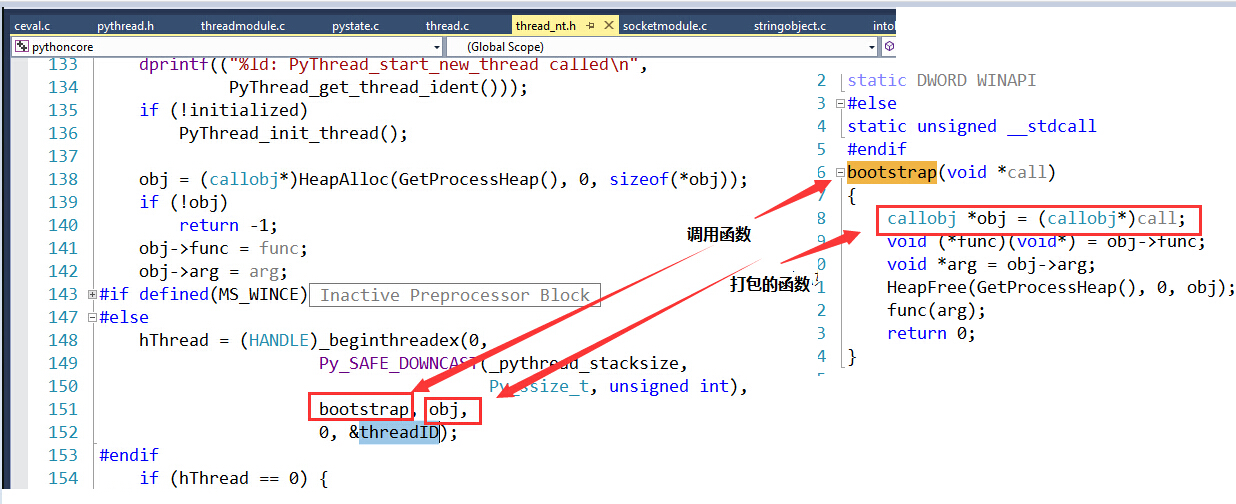
PyThread_start_new_thread传入的func是函数t_bootstrap,而arg则是bootstate结构体boot。而boot中保存着程序中所定义的线程信息。PyThread_start_new_thread首先将func和arg都打包到一个类型为callobj结构体中。
创建好子线程之后,其开始与主线程对GIL竞争。在t_bootstrap中调用PyEval_AcquireThread申请GIL,成功之后就申请到GIL,接下来子线程调用PyEval_CallObjectWithKeywords并最终调用我们熟悉的函数PyEval_EvalFrameEx,也就是python的字节码执行引擎。之后执行完毕,进行清理扫尾工作PyThreadState_DeleteCurrent释放GIL。
t_bootstrap 看上去似乎子线程一直执行到释放GIL,他们是如何激活多线程机制的呢?答案在于函数PyEval_EvalFrameEx中,python内部维护的模拟中断时钟不断激活线程的调度机制,从而实现子线程和主线程的切换。
执行秩序: thread_PyThread_start_new_thread-》PyThread_start_new_thread-》bootstrap--》t_bootstrap
t_bootstrap 代码:
static void

t_bootstrap(void *boot_raw)

{

    struct bootstate *boot = (struct bootstate *) boot_raw;

    PyThreadState *tstate;

    PyObject *res;

    tstate = boot->tstate;

    tstate->thread_id = PyThread_get_thread_ident();

    _PyThreadState_Init(tstate);

    PyEval_AcquireThread(tstate);

    nb_threads++;

    res = PyEval_CallObjectWithKeywords(

        boot->func, boot->args, boot->keyw);

    if (res == NULL) {

        if (PyErr_ExceptionMatches(PyExc_SystemExit))

            PyErr_Clear();

        else {

            PyObject *file;

            PyObject *exc, *value, *tb;

            PyErr_Fetch(&exc, &value, &tb);

            PySys_WriteStderr(

                "Unhandled exception in thread started by ");

            file = PySys_GetObject("stderr");

            if (file)

                PyFile_WriteObject(boot->func, file, 0);

            else

                PyObject_Print(boot->func, stderr, 0);

            PySys_WriteStderr("\n");

            PyErr_Restore(exc, value, tb);

            PyErr_PrintEx(0);

        }

    }

    else

        Py_DECREF(res);

    Py_DECREF(boot->func);

    Py_DECREF(boot->args);

    Py_XDECREF(boot->keyw);

    PyMem_DEL(boot_raw);

    nb_threads--;

    PyThreadState_Clear(tstate);

    PyThreadState_DeleteCurrent();

    PyThread_exit_thread();

}
完成打包之后,调用Win32下的创建thread API 函数CreateThread或者_beginthreadex ,然后通过bootstrap调用我们定义的函数(例如自己的test.py中的def testThread 函数)
函数打包,调用代码:
Python GIL 多线程机制 (C source code)的更多相关文章
- python多线程机制
Python中的线程从一开始就是操作系统的原生线程.而Python虚拟机也同样使用一个全局解释器锁(Global Interpreter Lock,GIL)来互斥线程多Python虚拟机的使用. GI ...
- convert source code files to pdf format in python
import os import sys def find_file(root_dir, type): dirs_pool = [root_dir] dest_pool = [] def scan_d ...
- python GIL 全局锁,多核cpu下的多线程性能究竟如何?
python GIL 全局锁,多核cpu下的多线程性能究竟如何?GIL全称Global Interpreter Lock GIL是什么? 首先需要明确的一点是GIL并不是Python的特性,它是在实现 ...
- Defining Python Source Code Encodings
Defining the Encoding Python will default to ASCII as standard encoding if no other encoding hints a ...
- [ Python - 11 ] 多线程及GIL全局锁
1. GIL是什么? 首先需要明确的一点是GIL并不是python的特性, 它是在实现python解析器(Cpython)时所引入的一个概念. 而Cpython是大部分环境下默认的python执行环境 ...
- UI5 Source code map机制的细节介绍
在我的博客A debugging issue caused by source code mapping里我介绍了在我做SAP C4C开发时遇到的一个曾经困扰我很久的问题,最后结论是这个问题由于Jav ...
- Source Code Structure - Python 源码目录结构
Source Code Structure - Python 源码目录结构 Include 目录包含了 Python 提供的所有头文件, 如果用户需要用 C 或 C++ 编写自定义模块扩展 Pytho ...
- Python使用import导入模块时报ValueError: source code string cannot contain null bytes的解决方案
老猿在导入一个Python模块时报错: >>> import restartnet.py Traceback (most recent call last): File " ...
- Python GIL(Global Interpreter Lock)
一,介绍 定义: In CPython, the global interpreter lock, or GIL, is a mutex that prevents multiple native t ...
随机推荐
- ACM: NBUT 1107 盒子游戏 - 简单博弈
NBUT 1107 盒子游戏 Time Limit:1000MS Memory Limit:65535KB 64bit IO Format: Practice Appoint ...
- sql ce4 的问题
前面用sql ce4来做数据库,发现一个问题.在localhos:xxx下面速度很快,但是一放到iis上面,速度变慢了.每个查询要13秒.分析了好久,最后,查找了半天的资料,去掉了数据库的密码.速度快 ...
- crawler4j 学习
crawler4j 学习(一) crawler4j是一个轻量级多线程网络爬虫,开发者可以调用相应的接口在短时间内创建一个多线程网络爬虫. 前期准备 使用maven 为了使用最近版本的crawler4j ...
- c#内部类的使用
using System;using System.Collections.Generic;using System.Linq;using System.Text;using System.Threa ...
- *HDU2510 DFS
符号三角形 Time Limit: 2000/1000 MS (Java/Others) Memory Limit: 32768/32768 K (Java/Others)Total Submi ...
- *HDU1598 并查集
find the most comfortable road Time Limit: 1000/1000 MS (Java/Others) Memory Limit: 32768/32768 K ...
- 如何使用sysdba身份通过jdbc连接oracle?
Class.forName("oracle.jdbc.driver.OracleDriver").newInstance(); Properties conProps = new ...
- WPF整理-XAML构建后台类对象
1.XAML 接触WPF的第一眼就是XAML---XAML是用来描绘界面的.其实不然! "Actually, XAML has nothing to do with UI. It's mer ...
- 使用mutt+msmtp在Linux命令行界面下发邮件(续)
一年前写过一篇<使用mutt+msmtp在Linux命令行界面下发邮件>,但是最近想照着文中的办法解决新的问题时发现又有新的疑惑了,所以就有了今天这篇“续集”. 首先说说msmtp.如果你 ...
- AD Local Domain groups, Global groups and Universal groups
http://ss64.com/nt/syntax-groups.html Rules that govern when a group can be added to another group ( ...