
lucene源码分析(5)lucence-group
1. 普通查询的用法
org.apache.lucene.search.IndexSearcher
public void search(Query query, Collector results)
其中
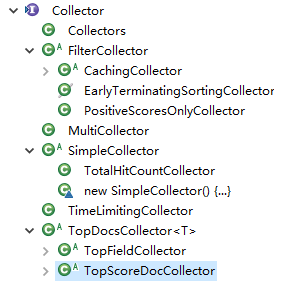
Collector定义
/**
* <p>Expert: Collectors are primarily meant to be used to
* gather raw results from a search, and implement sorting
* or custom result filtering, collation, etc. </p>
*
* <p>Lucene's core collectors are derived from {@link Collector}
* and {@link SimpleCollector}. Likely your application can
* use one of these classes, or subclass {@link TopDocsCollector},
* instead of implementing Collector directly:
*
* <ul>
*
* <li>{@link TopDocsCollector} is an abstract base class
* that assumes you will retrieve the top N docs,
* according to some criteria, after collection is
* done. </li>
*
* <li>{@link TopScoreDocCollector} is a concrete subclass
* {@link TopDocsCollector} and sorts according to score +
* docID. This is used internally by the {@link
* IndexSearcher} search methods that do not take an
* explicit {@link Sort}. It is likely the most frequently
* used collector.</li>
*
* <li>{@link TopFieldCollector} subclasses {@link
* TopDocsCollector} and sorts according to a specified
* {@link Sort} object (sort by field). This is used
* internally by the {@link IndexSearcher} search methods
* that take an explicit {@link Sort}.
*
* <li>{@link TimeLimitingCollector}, which wraps any other
* Collector and aborts the search if it's taken too much
* time.</li>
*
* <li>{@link PositiveScoresOnlyCollector} wraps any other
* Collector and prevents collection of hits whose score
* is <= 0.0</li>
*
* </ul>
*
* @lucene.experimental
*/
Collector的层次结构
2 lucene-group
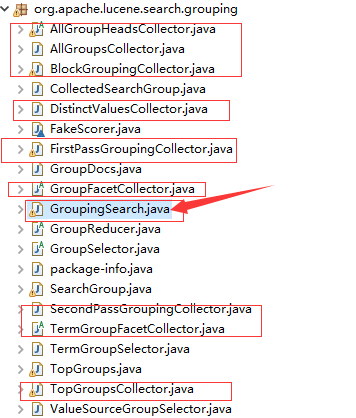
提供了分组查询GroupingSearch,对应相应的collector
3.实例:
public Map<String, Integer> groupBy(Query query, String field, int topCount) {

          Map<String, Integer> map = new HashMap<String, Integer>();

          long begin = System.currentTimeMillis();

          int topNGroups = topCount;

          int groupOffset = 0;

          int maxDocsPerGroup = 100;

          int withinGroupOffset = 0;

          try {

           FirstPassGroupingCollector c1 = new FirstPassGroupingCollector(field, Sort.RELEVANCE, topNGroups);

           boolean cacheScores = true;

           double maxCacheRAMMB = 4.0;

           CachingCollector cachedCollector = CachingCollector.create(c1, cacheScores, maxCacheRAMMB);

           indexSearcher.search(query, cachedCollector);

           Collection<SearchGroup<String>> topGroups = c1.getTopGroups(groupOffset, true);

           if (topGroups == null) {

            return null;

           }

           SecondPassGroupingCollector c2 = new SecondPassGroupingCollector(field, topGroups, Sort.RELEVANCE, Sort.RELEVANCE, maxDocsPerGroup, true, true, true);

           if (cachedCollector.isCached()) {

            // Cache fit within maxCacheRAMMB, so we can replay it:

            cachedCollector.replay(c2);

           } else {

               // Cache was too large; must re-execute query:

            indexSearcher.search(query, c2);

           }

           TopGroups<String> tg = c2.getTopGroups(withinGroupOffset);

           GroupDocs<String>[] gds = tg.groups;

           for(GroupDocs<String> gd : gds) {

            map.put(gd.groupValue, gd.totalHits);

           }

          } catch (IOException e) {

           e.printStackTrace();

          }

          long end = System.currentTimeMillis();

          System.out.println("group by time :" + (end - begin) + "ms");

          return map;

        }
几个参数说明:
groupField: 分组域groupSort: 分组排序topNGroups: 最大分组数groupOffset: 分组分页用withinGroupSort: 组内结果排序maxDocsPerGroup: 每个分组的最多结果数withinGroupOffset: 组内分页用
参考资料
https://blog.csdn.net/wyyl1/article/details/7388241
lucene源码分析(5)lucence-group的更多相关文章
- Lucene 源码分析之倒排索引(三)
上文找到了 collect(-) 方法,其形参就是匹配的文档 Id,根据代码上下文,其中 doc 是由 iterator.nextDoc() 获得的,那 DefaultBulkScorer.itera ...
- 一个lucene源码分析的博客
ITpub上的一个lucene源码分析的博客,写的比较全面:http://blog.itpub.net/28624388/cid-93356-list-1/
- lucene源码分析的一些资料
针对lucene6.1较新的分析:http://46aae4d1e2371e4aa769798941cef698.devproxy.yunshipei.com/conansonic/article/d ...
- Lucene 源码分析之倒排索引(一)
倒排索引是 Lucene 的核心数据结构,该系列文章将从源码层面(源码版本:Lucene-7.3.0)分析.该系列文章将以如下的思路展开. 什么是倒排索引? 如何定位 Lucene 中的倒排索引? 倒 ...
- lucene源码分析(1)基本要素
1.源码包 core: Lucene core library analyzers-common: Analyzers for indexing content in different langua ...
- Lucene 源码分析之倒排索引(二)
本文以及后面几篇文章将讲解如何定位 Lucene 中的倒排索引.内容很多,唯有静下心才能跟着思路遨游. 我们可以思考一下,哪个步骤与倒排索引有关,很容易想到检索文档一定是要查询倒排列表的,那么就从此处 ...
- lucene源码分析(8)MergeScheduler
1.使用IndexWriter.java mergeScheduler.merge(this, MergeTrigger.EXPLICIT, newMergesFound); 2.定义MergeSch ...
- lucene源码分析(7)Analyzer分析
1.Analyzer的使用 Analyzer使用在IndexWriter的构造方法 /** * Constructs a new IndexWriter per the settings given ...
- lucene源码分析(6)Query分析
查询的入口 /** Lower-level search API. * * <p>{@link LeafCollector#collect(int)} is called for ever ...
随机推荐
- Elasticsearch、Kibana Windows下环境搭建
Elasticsearch 簡介 ElasticSearch是一个基于Lucene的搜索服务器.它提供了一个分布式多用户能力的全文搜索引擎,基于RESTful web接口.Elasticsearch是 ...
- lnmp下thinkphp 500错误指南
先在php.ini打开报错,display_errors: on: 如果是open_basedir的问题,修改nginx的配置文件fastcgi.conf 将fastcgi_param PHP_ADM ...
- c# 将一个长耗时任务改成task
public Task<ObservableCollection<WaterFallDataSource2>> InitalrenderSourceandBrush2(int ...
- 异常测试之Socket网络异常
本文由作者张雨授权网易云社区发布. 前言 不知道大家在测试的过程中有没有发现关于异常测试这样一个特点: 无论是分散在功能测试中的异常用例还是规模相对较大的专项异常测试中,异常测试的用例占比虽然不大但是 ...
- JQuery Mobile - 为什么绑定事件后会被多次执行?
JQuery Mobile 在绑定事件时候,发现会被多次执行,为什么啊? 原来,jquery click 不是替换原有的function ,而是接着添加,所以才会执行次数越来越多,怎么办才能按需实现 ...
- LiLicense server OR Activation code
JET BRAINS系列工具下载地址: https://www.jetbrains.com/products.html?fromMenu License server 输入下列两个任何一个点击 Act ...
- BZOJ 4517--[Sdoi2016]排列计数(乘法逆元)
4517: [Sdoi2016]排列计数 Time Limit: 60 Sec Memory Limit: 128 MBSubmit: 1727 Solved: 1067 Description ...
- StormUI详解
StormUI由Cluster Summary,topology summary,supervisor summary,Nimbus Configuration四部分组成,如下图所示: Cluster ...
- C#里面const和readonly
一.const关键字限定一个变量不允许被改变. 使用const在一定程度上可以提高程序的安全性和可靠性. 1.用于修改字段或局部变量的声明,表示指定的字段或局部变量的值是常数,不能被修改. 2.常数声 ...
- 解决chrome无法启用印象笔记-剪藏功能
新版Chrome浏览器安全的问题,导致从印象笔记官网下载的rxs(crx)文件无法直接通过drap&drop功能添加功能块.可以将rxs(crx)文件后缀名改成rar格式,然后解压,通 ...