
USB Mass Storage Class – Bulk Only Transport - Error Handling
6.4 Device Error Handling
The device may not be able to fully satisfy the host's request.
At the point when the device discovers that it cannot
fully satisfy the request, there may be a Data-In or Data-Out transfer
in progress on the bus, and the host may have other pending requests.
The device may cause the host to terminate such transfers by STALLing
the appropriate pipe.The response of a device to a CBW that
is not meaningful is not specified.
Please note that whether or not a STALL handshake actually
appears on the bus depends on whether or not there is a transfer
in progress at the point in time when the device is ready to STALL the pipe.
6.5 Host Error Handling
If the host receives a CSW which is not valid,
then the host shall perform a Reset Recovery.
If the host receives a CSW which is not meaningful,
then the host may perform a Reset Recovery.
6.6 Error Classes
In every transaction between the host and the device,
there are four possible classes of errors.
These classes are not always independent of each other
and may occur at any time during the transaction.
6.6.1 CBW Not Valid
If the CBW is not valid, the device shall STALL the Bulk-In pipe.
Also, the device shall either STALL the Bulk-Out pipe,
or the device shall accept and discard any Bulk-Out data.
The device shall maintain this state until a Reset Recovery.
6.6.2 Internal Device Error
The device may detect an internal error for
which it has no reliable means of recovery other than a reset.
The device shall respond to such conditions by:
either STALLing any data transfer in progress and returning a Phase Error status (bCSWStatus = 02h).
or STALLing all further requests on the Bulk-In and the Bulk-Out pipes until a Reset Recovery.
6.6.3 Host/Device Disagreements
After recognizing that a CBW is valid and meaningful, ( != 6.6.1 CBW Not Valid )
and in the absence of internal errors, ( != 6.6.2 Internal Device Error )
the device may detect a condition where it cannot meet
the host’s expectation for data transfer,
as indicated by the Direction bit of the bmCBWFlags field
and the dCBWDataTransferLength field of the CBW.
In some of these cases, the device may require a reset to recover.
In these cases, the device shall return Phase Error status (bCSWStatus = 02h).
Details on which cases result in Phase Error vs. non-Phase Error status
are given in 6.7 The Thirteen Cases.
6.6.4 Command Failure
After recognizing that a CBW is valid and meaningful,
the device may still fail in its attempt to satisfy the command.
The device shall report this condition by
returning a Command Failed status (bCSWStatus = 01h).
6.7 The Thirteen Cases
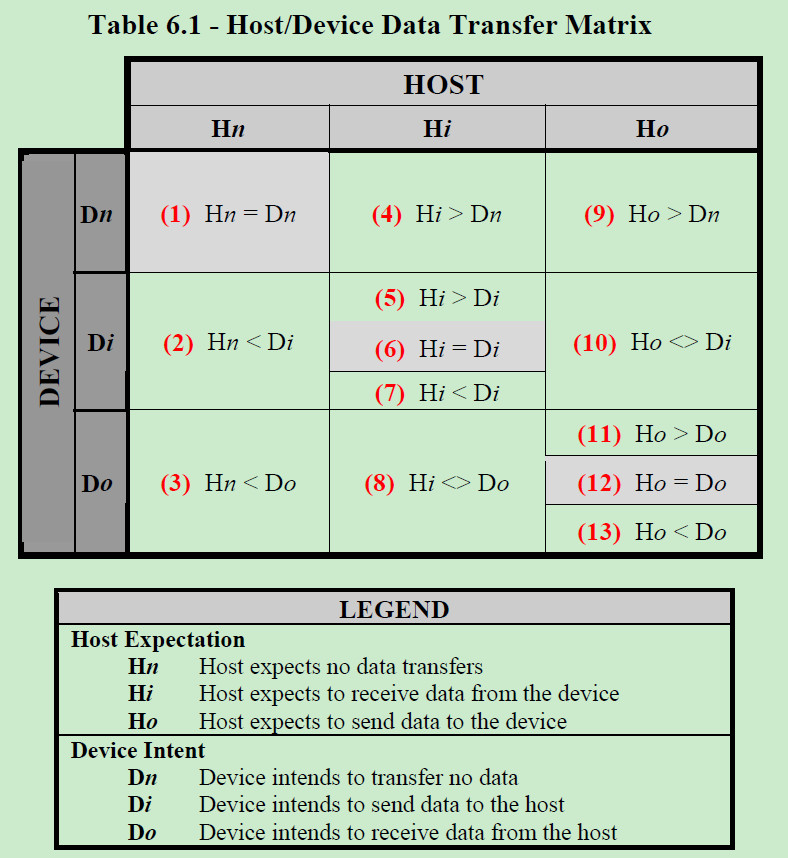
This section describes the thirteen possible cases of host expectations
and device intent in the absence of overriding error conditions.
Table 6.1 – Host/Device Data Transfer Matrix graphically displays these thirteen cases.
Important notes about the thirteen cases.
· Cases (1), (6) and (12) represent the majority of host and device transactions.
They indicate those conditions where the host and device agree as to the direction
and amount of data to be transferred. These cases are also referred to as “the thin diagonal.”
· Any host or device behavior not specifically outlined in the following sections
shall be considered outside this specification and the results are indeterminate.
6.7.1 Hn - Host expects no data transfers : Case (1), (2), (3)
These cases occur when dCBWDataTransferLength is zero. This indicates that
the host is not expecting to send or receive any data to or from the device.
The specific host requirements are:
1. The host shall send a valid and meaningful CBW.
2. The host shall attempt to receive a CSW.
3. On a STALL condition receiving the CSW, then:
( 6.6.1 CBW Not Valid ) or ( 6.6.2 Internal Device Error )
· The host shall clear the Bulk-In pipe.
· The host shall attempt to receive the CSW again.
4. When the CSW is valid and meaningful, then:
· [Case (1)] The bCSWStatus = 00h or 01h, and the dCSWDataResidue is 0.
( 6.6.4 Command Failure )
send next a valid and meaningful CBW.
· [Case (2) or (3)] If bCSWStatus = 02h, then:
( 6.6.3 Host/Device Disagreements )
The host shall Ignore the value of the dCSWDataResidue.
The host shall Perform a Reset Recovery.
The specific device requirements are:
1. The device shall receive a CBW.
2. When the CBW is not valid and meaningful ( 6.6.1 CBW Not Valid )
· else The device shall attempt the command.
[Case (1)]
If the device had no data to send or receive, then:
The device shall set bCSWStatus to 00h or 01h.
The device shall set the dCSWDataResidue to 0.
· [Case (2) or (3)] ( 6.6.3 Host/Device Disagreements )
If the device did have data to send or receive, then:
The device shall set bCSWStatus to 02h. ( may STALL the Bulk-In pipe )
3. The device shall return a valid and meaningful CSW.
· The device may STALL the Bulk-In pipe if bCSWStatus is not 00h or 01h.
6.7.2 Hi - Host expects to receive data from the device : Case 4, 5, ,6, 7, 8
These cases occur when dCBWDataTransferLength is non zero
and the Direction bit is 1 (Data-In). This indicates that
the host is expecting to receive data from the device.
The specific host requirements are:
1. The host shall send a valid and meaningful CBW.
2. The host shall attempt to receive data from the device.
3. On a STALL condition receiving data, then: ( data xfer end, Hi != Di )
The host shall accept the data received.
The host shall clear the Bulk-In pipe. ( to receive a CSW )
4. The host shall attempt to receive a CSW.
5. On a STALL condition receiving the CSW, then:
The host shall clear the Bulk-In pipe.
The host shall again attempt to receive the CSW.
6. When the CSW is valid and meaningful, then:
· [Case (4), (5), or (6)]
If bCSWStatus = 00h or 01h, then:
The host shall determine the amount of relevant data received
from the difference between dCBWDataTransferLength
and the value of dCSWDataResidue.
· [Case (7) or (8)]
If bCSWStatus = 02h, then:
The host shall ignore the value of the dCSWDataResidue.
The host shall perform a Reset Recovery.
The specific device requirements are:
1. The device shall receive a CBW.
2. When the CBW is valid and meaningful, then:
· The device shall attempt the command.
· [Case (6)]
If the device intends to send dCBWDataTransferLength, then:
The device shall send dCBWDataTransferLength bytes of data.
The device shall set bCSWStatus to 00h or 01h.
The device shall set dCSWDataResidue to zero.
· [Case (4) or (5) ] Hi > Dn, Hi > Di
If the device intends to send less data than the host indicated, then:
The device shall send the intended data.
The device may send fill data to pad up to a total of dCBWDataTransferLength.
If the device actually transfers less data than the host indicated, then:
The device may end the transfer with a short packet.
The device shall STALL the Bulk-In pipe.
The device shall set bCSWStatus to 00h or 01h.
The device shall set dCSWDataResidue to the difference
between dCBWDataTransferLength and the actual amount of relevant data sent.
· [Case (7) or (8)]
If the device either intends to send more data than the host indicated
or intends to receive data from the host, then:
The device may send data up to a total of dCBWDataTransferLength.
If the device actually transfers less data than the host indicated, then:
The device may end the transfer with a short packet.
The device shall STALL the Bulk-In pipe.
If the device actually transfers dCBWDataTransferLength then:
The device may STALL the Bulk-In pipe.
The device shall set bCSWStatus to 02h.
3. The device shall return a valid and meaningful CSW.
6.7.3 Ho - Host expects to send data to the device, Case 9, 10, 11, 12, 13
These cases occur when dCBWDataTransferLength is non zero
and the Direction bit is 0 (Data-Out).
This indicates that the host is expecting to send data to the device.
The general requirement of these cases is:
· The host shall not send zero length packets.
The specific host requirements are:
1. The host shall send a valid and meaningful CBW.
2. The host shall send data to the device.
· The host shall send a short packet only at the end of the data transfer.
3. On a STALL condition sending data, then: ( Ho > Do ), ( Ho > Dn )
· The host shall clear the Bulk-Out pipe.
4. The host shall attempt to receive a CSW.
5. On a STALL condition receiving the CSW, then:
· The host shall clear the Bulk-In pipe.
· The host shall again attempt to receive the CSW.
6. When the CSW is valid and meaningful, then:
· [Case (9), (11), or (12)]
If bCSWStatus = 00h or 01h, then:
The host shall determine the amount of data
that was processed from the difference of
dCBWDataTransferLength and the value of dCSWDataResidue.
· [Case (10) or (13)]
If bCSWStatus = 02h, then:
The host shall ignore the value of the dCSWDataResidue.
The host shall perform a Reset Recovery.
The specific device requirements are:
1. The device shall receive a CBW.
2. When the CBW is valid and meaningful, then:
· The device shall attempt the command.
· [Case (9), (11), or (12)]
If the device intends to process less than or
equal to the amount of data that the host indicated, then:
The device shall receive the intended data.
The device shall either accept a total of dCBWDataTransferLength, (Ho = Do)
or end the transfer prematurely by STALLing the Bulk-Out pipe. (Ho > Do), (Ho > Dn)
The device shall set bCSWStatus to 00h or 01h.
The device shall set dCSWDataResidue to the difference
between dCBWDataTransferLength and the actual amount of data
that was processed by the device.
· [Case (10) or (13)] (Ho <> Di), (Ho < Do)
If the device either intends to process more data than the host indicated
or intends to send data, then:
The device may receive data up to a total of dCBWDataTransferLength.
The device shall either accept a total of dCBWDataTransferLength,
or end the transfer prematurely by STALLing the Bulk-Out pipe.
The device shall set bCSWStatus to 02h.
3. The device shall return a valid and meaningful CSW.
· The device may STALL the Bulk-In pipe if bCSWStatus is not 00h or 01h.
USB Mass Storage Class – Bulk Only Transport - Error Handling的更多相关文章
- USB Mass Storage大容量存储的基本知识
http://www.crifan.com/files/doc/docbook/usb_disk_driver/release/htmls/ch02_msc_basic.html 目录 2.1. US ...
- USB Mass Storage学习笔记-STM32+FLASH实现U盘
一.内容概述 采用STM32内部自带USB控制器外加大页NAND FLASH K9F1G08U0A实现一个128M的U盘. 1.STM32的USB控制器 STM32F103的MCU自带USB从控制器 ...
- USB Mass Storage协议分析
目录 简介 指令数据和状态协议 CBW指令格式 CSWCommand Status Wrapper状态格式 SCSI命令集 Format Unit Inquiry MODE SELECT 简介 USB ...
- USB mass storage协议
这一节主要把在实现“linux模拟U盘功能”过程中的一些调试过程记录下来,并加以解析. 一.背景知识 1.USB Mass Storage类规范概述 USB 组织在univers ...
- 实现Linux下的U盘(USB Mass Storage)驱动
如何实现Linux下的U盘(USB Mass Storage)驱动 版本:v0.7 How to Write Linux USB MSC (Mass Storage Class) Driver Cri ...
- 如何实现Linux下的U盘(USB Mass Storage)驱动
如何实现Linux下的U盘(USB Mass Storage)驱动 版本:v0.7 How to Write Linux USB MSC (Mass Storage Class) Driver Cri ...
- USB Mass Storage大容量存储 The Thirteen Class章节的理解
http://blog.csdn.net/xgbing/article/details/7002558 USB Mass Storage 6.7 The Thirteen Class章节的理解 Cas ...
- Android USB Connections Explained: MTP, PTP, and USB Mass Storage
Android USB Connections Explained: MTP, PTP, and USB Mass Storage Older Android devices support USB ...
- usb mass storage device
Problem adding USB host device to KVM Windows guest machine. Status: CLOSED CURRENTRELEASE Aliases ...
随机推荐
- nio复习总结
观察者: 多个对象依赖一个对象的状态, 当这个对象状态发生改变时,依次通知多个对象. 消息的分发和处理 事件驱动 / IO多路复用 借助select epoll等 reactor: io事件触发时, ...
- centos7.2安装mysql5.7
1.安装前工作 在安装前需要确定现在这个系统有没有 mysql,如果有那么必须卸载(在 centos7 自带的是 mariaDb 数据库,所以第一步是卸载数据库). 卸载系统自带的Mariadb: 查 ...
- php和mysql两种不同方式的分割字符串和类型转换
一.sql语句1.分割字符串方法:substring_index(字符串,'分隔符',正数从左数起几位/负数从右数起几位); 例如:subtring_index('aa_bb_cc_dd','_',1 ...
- MySQL学习笔记:生成时间维度表
# ---- 对应时间戳怎么生成的? ---- /*TIME_CD TIME_CD1000000 000005000001 000005000002 000005000003 000005000004 ...
- C# 图片和二进制之间的转换
1> 图片转二进制 public byte[] GetPictureData(string imagepath){/**/////根据图片文件的路径使用文件流打开,并保存为byte[] Fil ...
- LoadRunner测试ajax框架,回放后系统中没有产生数据解决方法
1.QTP11 下载地址:http://www.genilogix.com/downloads/unified-functional-testing/quicktest-professional-11 ...
- 2015 icpc北京赛区 D 最小割
题目大意:给你一棵技能树,如果要学习一个技能,那么它之前的技能要全部学完,第 i 个点需要ai 能学习 每条边有一个消耗c 如果支付c那么就能去掉这条边, 你还可以kejin 花费di 就能直接学习 ...
- 实现Ecshop注册页面手机号唯一的验证
如果Ecshop实现了用手机号码来登陆,那么就需要在注册时保证会员所填写的手机号是唯一的,也就是说手机号还未被注册,那么该怎么来检测填写的手机号是否注册过了呢? 一.参考ecshop检测邮箱 因为注册 ...
- 【知了堂学习笔记】java web 简单的登录
最近皮皮潇在学习java web,刚接触了简单的东西,所以今天给大家带来一个简单的登录实现. 页面: 页面代码: <%@ page language="java" conte ...
- 在centOS使用systemctl配置启动多个tomcat
公司服务器使用的是阿里云CentOS7,CentOS7和CentOS6目前最大区别就是service变成了现在的systemctl,简单的查了一下并结合使用,发现systemctl功能上等同于6上面的 ...