
ContextLoaderListener vs DispatcherServlet
In XML based Spring MVC configuration, you must have seen two declarations in web.xml file i.e. ContextLoaderListener and DispatcherServlet. Let’s try to understand their purpose in framework and their differences.
Root and child contexts
Before reading further, please understand that –
- Spring can have multiple contexts at a time. One of them will be root context, and all other contexts will be child contexts.
- All child contexts can access the beans defined in root context; but opposite is not true. Root context cannot access child contexts beans.
DispatcherServlet – Child application contexts
DispatcherServlet is essentially a Servlet (it extends HttpServlet) whose primary purpose is to handle incoming web requests matching the configured URL pattern. It take an incoming URI and find the right combination of controller and view. So it is the front controller.
When you define a DispatcherServlet in spring configuration, you provide an XML file with entries of controller classes, views mappings etc. using contextConfigLocationattribute.
<servlet> <servlet-name>employee-services</servlet-name> <servlet-class>org.springframework.web.servlet.DispatcherServlet</servlet-class> <init-param> <param-name>contextConfigLocation</param-name> <param-value>classpath:employee-services-servlet.xml</param-value> </init-param> <load-on-startup>1</load-on-startup></servlet> |
If you do not provide configuration file then it will load its own configuration file using [servlet_name]-servlet.xml. Web applications can define any number of DispatcherServlet entries. Each servlet will operate in its own namespace, loading its own application context with mappings, handlers, etc.
It means that each DispatcherServlet has access to web application context. Until specified, each DispatcherServlet creates own internal web application context.
DispatcherServlet(WebApplicationContext webApplicationContext) create a new DispatcherServlet with the given web application context. It is possible only in Servlet 3.x environment through the ServletContext.addServlet(java.lang.String, java.lang.String) API support.ContextLoaderListener – Root application context
ContextLoaderListener creates the root application context and will be shared with child contexts created by all DispatcherServlet contexts. You can have only one entry of this in web.xml.
<listener> <listener-class> org.springframework.web.context.ContextLoaderListener </listener-class></listener> <context-param> <param-name>contextConfigLocation</param-name> <param-value>/WEB-INF/spring/applicationContext.xml</param-value></context-param> |
The context of ContextLoaderListener contains beans that globally visible, like services, repositories, infrastructure beans, etc. After the root application context is created, it’s stored in ServletContext as an attribute, the name is:
servletContext.setAttribute(WebApplicationContext.ROOT_WEB_APPLICATION_CONTEXT_ATTRIBUTE, this.context);//Where attibute is defined in /org/springframework/web/context/WebApplicationContext.java asWebApplicationContext.ROOT_WEB_APPLICATION_CONTEXT_ATTRIBUTE = WebApplicationContext.class.getName() + ".ROOT"; |
To get root application context in Spring controller, you can use WebApplicationContextUtils class.
@AutowiredServletContext context; ApplicationContext ac = WebApplicationContextUtils.getWebApplicationContext(context);if(ac == null){ return "root application context is null";} |
ContextLoaderListener vs DispatcherServlet
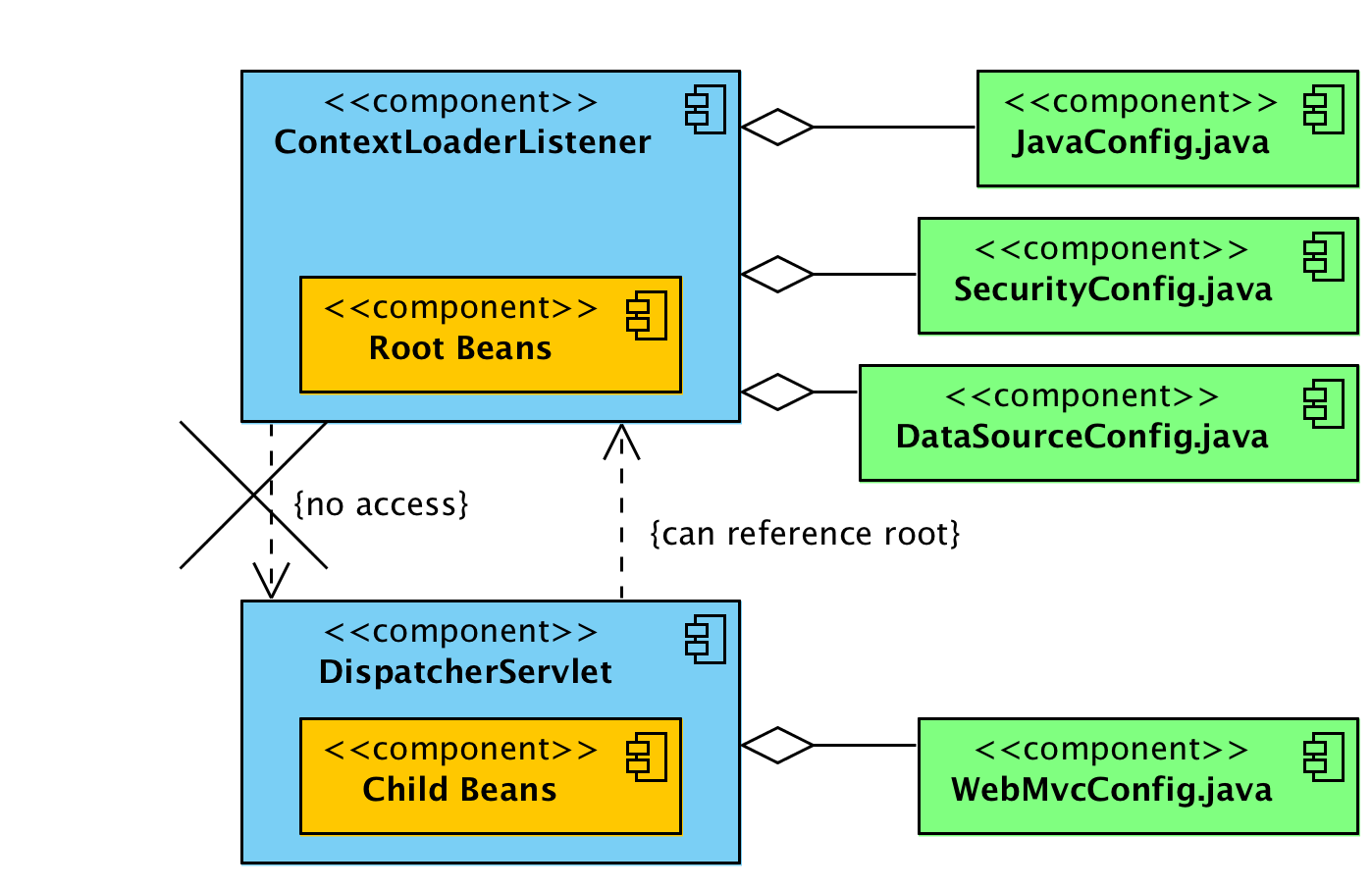
Below image describe the whole relation in single view.
 ContextLoaderListener vs DispatcherServlet
ContextLoaderListenercreates root application context.DispatcherServletentries create one child application context per servlet entry.- Child contexts can access beans defined in root context.
- Beans in root context cannot access beans in child contexts (directly).
- All contexts are added to
ServletContext. - You can access root context using
WebApplicationContextUtilsclass.
Summary
Generally, you will define all MVC related beans (controller and views etc) in DispatcherServlet context, and all cross-cutting beans such as security, transaction, services etc. at root context by ContextLoaderListener.
Generally, this setup works fine because rarely you will need to access any MVC bean (from child context) into security related class (from root context). Mostly we use security beans on MVC classes, and they can access it with above setup.
Happy Learning !!
https://howtodoinjava.com/spring-mvc/contextloaderlistener-vs-dispatcherservlet/
ContextLoaderListener vs DispatcherServlet的更多相关文章
- 【转】ContextLoaderListener和DispatcherServlet加载内容的区别
一.ContextLoaderListener加载内容 二.DispatcherServlet加载内容 ContextLoaderListener和DispatcherServlet都会在Web容器启 ...
- web.xml中的ContextLoaderListener和DispatcherServlet区别
ContextLoaderListener和DispatcherServlet都会在Web容器启动的时候加载一下bean配置. 区别在于: DispatcherServlet一般会加载MVC相关的be ...
- 使用shiro 框架 报错No WebApplicationContext found: no ContextLoaderListener or DispatcherServlet registered?
1.问题描述:ssm 框架中使用shiro 中出现问题 原来web.xml 文件如下: <!DOCTYPE web-app PUBLIC "-//Sun Microsystems, ...
- 【转】ContextLoaderListener 和 DispatcherServlet
转载地址: http://www.guoweiwei.com/archives/797 DispatcherServlet介绍 DispatcherServlet是Spring前端控制器的实现,提供S ...
- ContextLoaderListener与DispatcherServlet所加载的applicationContext的区别
spring通过在web.xml 中配置ContextLoaderListener 来加载context配置文件,在DispatcherServlet中也可以来加载spring context配置文件 ...
- Spring ContextLoaderListener与DispatcherServlet所加载的applicationContext的区别
http://www.lai18.com/content/9755931.html Spring 容器(Spring 的上下文) https://my.oschina.net/jast90/blog/ ...
- ContextLoaderListener和Spring MVC中的DispatcherServlet加载内容的区别
一:ContextLoaderListener加载内容 二:DispatcherServlt加载内容 ContextLoaderListener和DispatcherServlet都会在Web容器启动 ...
- 【Spring】浅谈ContextLoaderListener及其上下文与DispatcherServlet的区别
一般在使用SpingMVC开发的项目中,一般都会在web.xml文件中配置ContextLoaderListener监听器,如下: <listener> <listener-clas ...
- ContextLoaderListener和Spring MVC中的DispatcherServlet加载内容的区别【转】
原文地址:https://blog.csdn.net/py_xin/article/details/52052627 ContextLoaderListener和DispatcherServlet都会 ...
随机推荐
- vue中路由传参的方式
一.params的类型: 配置路由格式: /router/:id 传递的方式: 在path后面跟上对应的值 传递后形成的路径: /router/123, /router/abc 通过:to字符串拼接的 ...
- 如何通过Dataphin构建数据中台新增100万用户?
欢迎来到数据中台小讲堂!这一期我们来看看,作为阿里巴巴数据中台(OneData - OneModel.OneID.OneService)方法论的产品载体,Dataphin如何帮助传统零售企业实现数字化 ...
- 使用Docker搭建Cloudera Hadoop 环境搭建
单节点 单节点:https://hub.docker.com/r/cloudera/quickstart/ 相关命令 docker pull cloudera/quickstart:latest do ...
- sql2008质疑处理方法
日常对Sql Server 2005关系数据库进行操作时,有时对数据库(如:Sharepoint网站配置数据库名Sharepoint_Config)进行些不正常操作如数据库在读写时而无故停止数据库,从 ...
- mysql 8.0版本下载安装以及默认密码修改
1. 下载 去mysql官网下载地址进行下载,选择需要的安装包 可以直接跳过登录进行下载 ps:我是先注册账号下载的,注册时遇到一个坑,就是在chrome75版本无法选择省市,不选择又不让注册. 可以 ...
- loadrunner(预测系统行为和性能的负载测试工具)
LoadRunner,是一种预测系统行为和性能的负载测试工具.通过以模拟上千万用户实施并发负载及实时性能监测的方式来确认和查找问题,LoadRunner能够对整个企业架构进行测试.企业使用LoadRu ...
- BUUCTF | [HCTF 2018]admin
首先爬一遍整个网站,发现有没注册的时候有“login”,"register",这两个页面,注册一个123用户登录后发现有 "index“,”post“,”logout“, ...
- 【计算机网络】两个网络模型——OSI参考模型和TCP/IP模型
计算机网络 两个网络模型 计算机网络模型 分层机制----规划通讯细节 层与层之间之间是独立的.屏蔽的,下层为上层提供服务. 一些概念 实体: 任何发送/接收信息的软件/硬件进程. 对等层: 两个不同 ...
- Cocos2d Box2D之碰撞检测
| 版权声明:本文为博主原创文章,未经博主允许不得转载. 在Box2D中碰撞事件由b2ContactListener类函数实现,b2ContactListener是Box2D提供的抽象类,它的抽象 ...
- lvm 磁盘扩容
LVM磁盘管理 一.LVM简介 LVM是 Logical Volume Manager(逻辑卷管理)的简写,它由Heinz Mauelshagen在Linux 2.4内核上实现.LVM将一个或多个硬盘 ...