
Redis网络库源码分析(3)之ae.c
一、aeCreateEventLoop & aeCreateFileEvent
上一篇文章中,我们已经将服务器启动,只是其中有些细节我们跳过了,比如aeCreateEventLoop函数到底做了什么? 接下来我们要分析ae.c文件,它是整个Redis网络事件框架,其中定义了各个管理事件的函数,比如aeCreateFileEvent,aeDeleteFileEvent分别是注册新的事件和删除事件。
其实aeCreateEventLoop的作用主要是给server->loop申请空间。
//ae.c

aeEventLoop *aeCreateEventLoop(int setsize) {

    aeEventLoop *eventLoop;

    if ((eventLoop = zmalloc(sizeof(*eventLoop))) == NULL) {    //给eventLoop申请空间

        goto err;

    }

    eventLoop->events = zmalloc(sizeof(aeFileEvent) * setsize); //给events链表申请空间

    eventLoop->fired = zmalloc(sizeof(aeFiredEvent) * setsize); //给fired链表申请空间

    if (eventLoop->events == NULL || eventLoop->fired == NULL) {

        goto err;

    }

    eventLoop->setsize = setsize;           //设置大小

    eventLoop->lastTime = time(NULL);       //设置lastTime=now

    eventLoop->timeEventHead = NULL;        //定时事件链表置空

    eventLoop->timeEventNextId = 0;         //定时事件的id为0

    eventLoop->stop = 0;                    //stop为0

    eventLoop->maxfd = -1;                  //最大文件描述符为0

    eventLoop->beforesleep = NULL;          //beforesleep设置为NULL

    if (aeApiCreate(eventLoop) == -1) {     //给EPOLL申请空间

        goto err;

    }

    /* Events with mask == AE_NONE are not set. So let's initialize the vector with it. */

    for (int i = 0; i < setsize; i++) {

        eventLoop->events[i].mask = AE_NONE; //将每一个fd的事件初始化为0

    }

    return eventLoop;

err:

    if (eventLoop) {

        zfree(eventLoop->events);

        zfree(eventLoop->fired);

        zfree(eventLoop);

    }

    return NULL;

}
至此申请空间完成,我们整个EventLoop结构如下图所示:
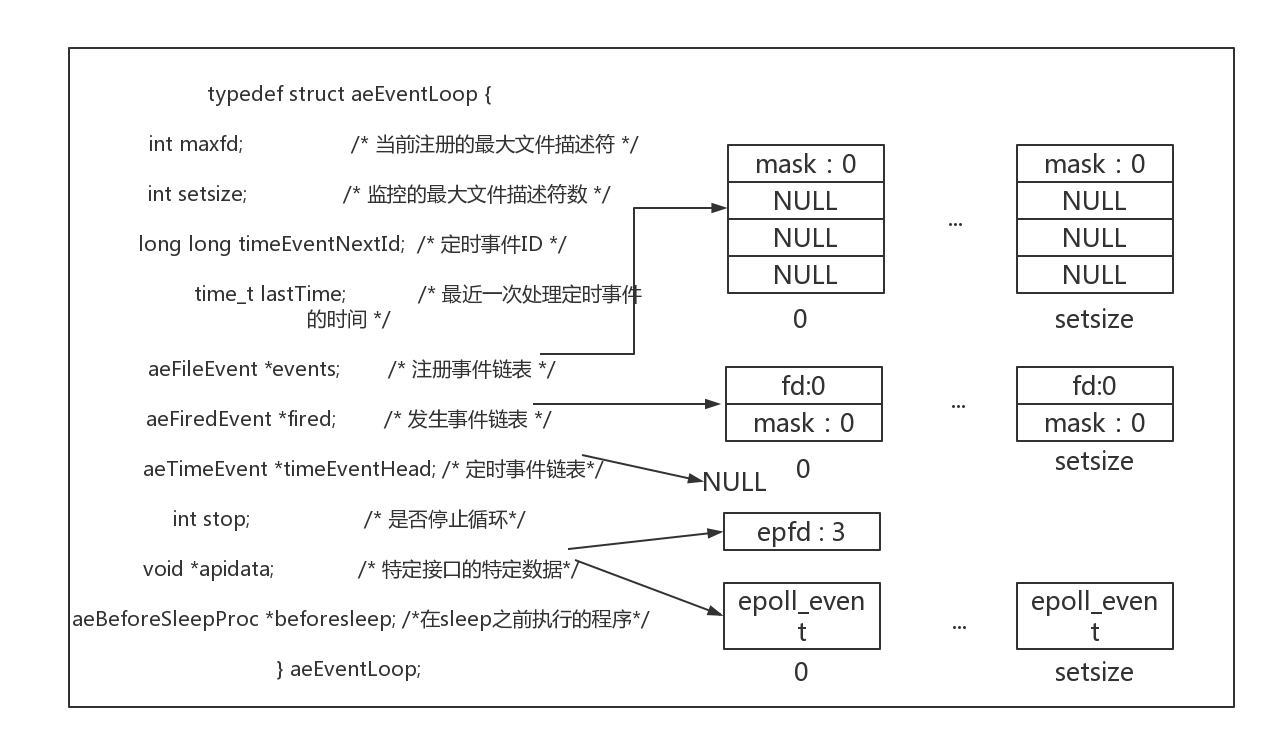
我们完成了所有空间的申请和初始化工作:
loop->events : 是一个aeFileEvent 数组,大小为 setsize 。

loop->fired :  是一个aeFiredEvent 数组,大小也为 setsize 。

loop->timeEventHead :目前为NULL

loop->apidata:指向aeApiState,包含epfd和epoll_event数组。接着我们调用anetTcpServer返回了listen_fd,anetTcpServer我们在anet.c分析的时候再说,接下来重点是我们调用aeCreateFileEvent将listen_fd注册到epfd上的过程。
//ae.c

int aeCreateFileEvent(aeEventLoop *eventLoop, int fd, int mask, aeFileProc *proc, void *clientData) {

    if (fd >= eventLoop->setsize) {

        errno = ERANGE;

        return AE_ERR;

    }

    aeFileEvent *fe = &eventLoop->events[fd];  //利用fe指向eventLoop->events[listen_fd]

    if (aeApiAddEvent(eventLoop, fd, mask) == -1) { //本质是调用epoll_ctl(epfd,EPOLL_CTL_ADD,fd,...);

        return AE_ERR;

    }

    fe->mask |= mask;                          //如果fe->mask之前不是空,现在就相当于同时监控两个事件

    if (mask & AE_READABLE) {

        fe->rfileProc = proc;                  //说明proc是读操作的处理函数

    }

    if (mask & AE_WRITABLE) {

        fe->wfileProc = proc;                  //说明proc是写操作的处理函数

    }

    fe->clientData = clientData;               //让它们指向同一个client或者server实例

    if (fd > eventLoop->maxfd) {

        eventLoop->maxfd = fd;                 //如果新的fd大于maxfd,则更新maxfd

    }

    return AE_OK;

}
此时我们的整个EventLoop变成了下面这个样子:
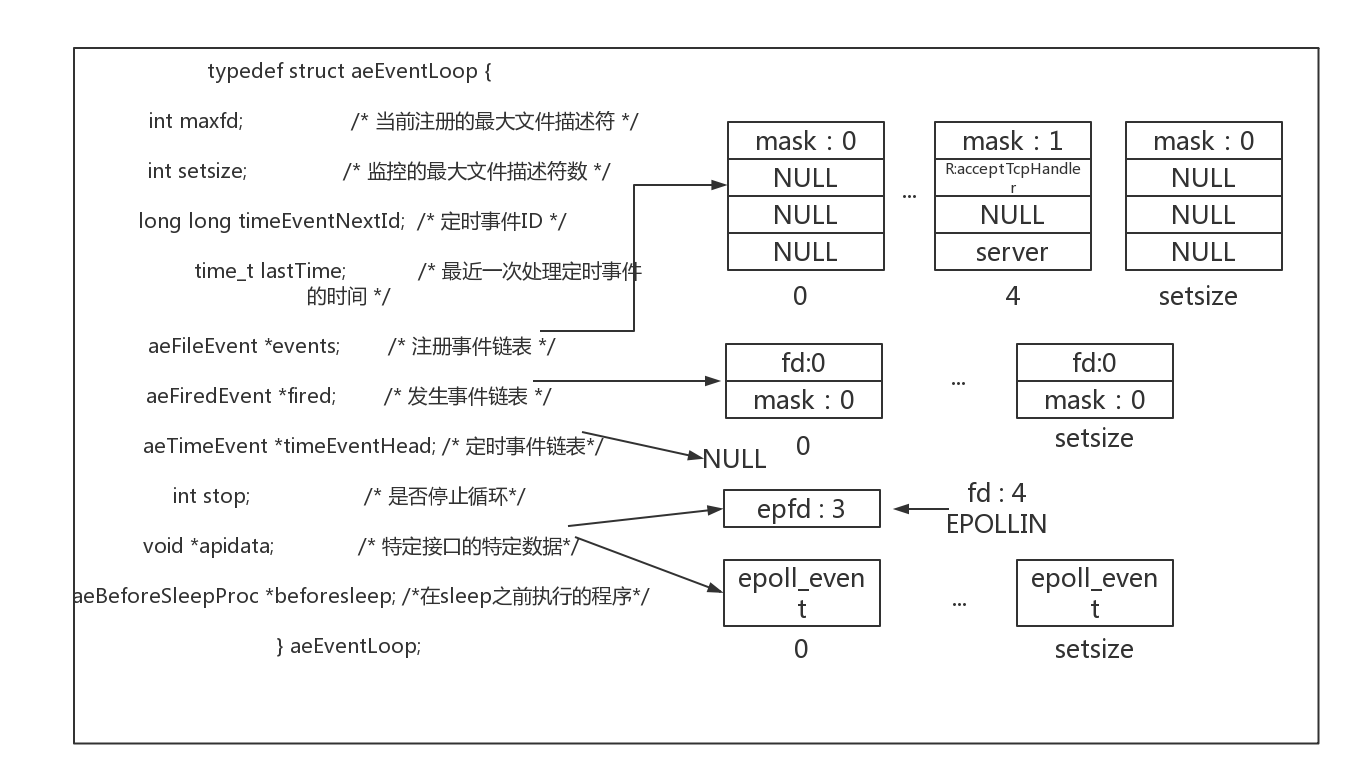
可以看到:
1 : loop->events[4].mask  = 1 , 表示读,rfileProc 为 acceptTcpHandler。 因为它是listen_fd,负责接受连接。为什么是 4 呢?因为 3 已经作为 epfd 的文件描述符了。

2 : 我们将 fd = 4 & EPOLLIN事件注册给了epfd。现在就等着来新的连接了,因为这样的话一旦检测到listen_fd上有数据可读,那就会调用acceptTcpHandler接受连接,这也是回掉机制的一种体现:我们现在已经给listen_fd注册了相应的回掉函数了,等着事件发生,然后去调用注册好的函数。我们继续往下走继续看这个过程:
二、aeProcessEvents & acceptTcpHandler
继续向下会进入aeMain,之后一直轮询调用aeProcessEvents,接下来我们分析下aeProcessEvents到底是怎么处理各类事件的:
//ae.c

int aeProcessEvents(aeEventLoop *eventLoop, int flags) {

    int processed = 0, numevents;

    /* Nothing to do? return ASAP */

    if (!(flags & AE_TIME_EVENTS) && !(flags & AE_FILE_EVENTS)) {

        //如果flags什么事件都没有监听,return 0

        return 0;

    }

    /* Note that we want call select() even if there are no

     * file events to process as long as we want to process time

     * events, in order to sleep until the next time event is ready

     * to fire. */

    /* 注意,我们即使没有文件事件,但是仍然想调用select/epoll,让其阻塞直到我们想处理的

     * 定时事件发生为止*/

    if (eventLoop->maxfd != -1 || ((flags & AE_TIME_EVENTS) && !(flags & AE_DONT_WAIT))) {

        //如果有定时事件处理

        aeTimeEvent *shortest = NULL;

        struct timeval tv, *tvp;

        if (flags & AE_TIME_EVENTS && !(flags & AE_DONT_WAIT)) {

            // for 循环查找到最近需要发生的定时事件

            shortest = aeSearchNearestTimer(eventLoop);

        }

        if (shortest) {

            long now_sec, now_ms;

            aeGetTime(&now_sec, &now_ms);

            tvp = &tv;

            /* How many milliseconds we need to wait for the next time event to fire? */

            /* 计算我们需要等待的ms数,直到最近的定时事件发生*/

            long long ms = (shortest->when_sec - now_sec) * 1000 + shortest->when_ms - now_ms;

            if (ms > 0) {

                //如果定时事件没有过期,计算出需要等待的时间,作为epoll_wait的第四个参数

                tvp->tv_sec = ms / 1000;

                tvp->tv_usec = (ms % 1000) * 1000;

            } else {

                //否则置为0,epoll_wait就不会阻塞

                tvp->tv_sec = 0;

                tvp->tv_usec = 0;

            }

        } else {

            /* If we have to check for events but need to return

             * ASAP because of AE_DONT_WAIT we need to set the timeout to zero */

            /*如果没有找到定时事件 */

            if (flags & AE_DONT_WAIT) {  //设置了AE_DONT_WAIT操作,就不等

                tv.tv_sec = tv.tv_usec = 0;

                tvp = &tv;

            } else {                     //否则就阻塞等待直到事件发生

                /* Otherwise we can block */

                tvp = NULL; /* wait forever */

            }

        }

        numevents = aeApiPoll(eventLoop, tvp);  //调用epoll_wait函数,返回需要处理的事件列表

        for (int i = 0; i < numevents; i++) {   //遍历依次处理loop->fired

            aeFileEvent *fe = &eventLoop->events[eventLoop->fired[i].fd];

            int mask = eventLoop->fired[i].mask;

            int fd = eventLoop->fired[i].fd;

            int rfired = 0;

            /* note the fe->mask & mask & ... code: maybe an already processed

             * event removed an element that fired and we still didn't

             * processed, so we check if the event is still valid. */

            if (fe->mask & mask & AE_READABLE) {

                rfired = 1;     //确保读或者写只执行一个

                fe->rfileProc(eventLoop, fd, fe->clientData, mask); //执行读处理

            }

            if (fe->mask & mask & AE_WRITABLE) {

                if (!rfired || fe->wfileProc != fe->rfileProc) {

                    fe->wfileProc(eventLoop, fd, fe->clientData, mask);

                }

            }

            processed++;

        }

    }

    /* Check time events */

    /* 处理所有的时间事件 */

    if (flags & AE_TIME_EVENTS) {

        processed += processTimeEvents(eventLoop);

    }

    return processed; /* return the number of processed file/time events */

}
假设 listen_fd此时发生了事件,那一定是有新的连接过来,fe->rfileProc(eventLoop, fd, fe->clientData, mask) 就会使用 acceptTcpHandler接受连接:
static void acceptTcpHandler(aeEventLoop *loop, int fd, void *data, int mask)

{

    char cip[64];

    int cport;

    server_t *server = (server_t *)data;

    int cfd = anetTcpAccept(NULL, fd, cip, sizeof(cip), &cport); //调用accept接受连接

    if (cfd != -1) {

        printf("accepted ip %s:%d\n", cip, cport);

        anetNonBlock(NULL, cfd);                                 //设置socket非阻塞

        anetEnableTcpNoDelay(NULL, cfd);                         //开启TcpNoDelay选项

        client_t *client = alloc_client();                       //申请一个新的客户端

        if (!client) {

            printf("alloc client error...close socket\n");

            close(fd);

            return;

        }

        client->loop = loop;

        client->fd = cfd;

        if (aeCreateFileEvent(loop, cfd, AE_READABLE, readEventHandler, client) == AE_ERR) {

            //继续调用aeCreateFileEvent给新连接的fd注册可读事件,并且注册读函数readEventHandler

            if (errno == ERANGE) {

                // or use aeResizeSetSize(server->loop, cfd) modify this limit

                printf("so many client, close new.");

            } else {

                printf("create socket readable event error, close it.");

            }

            free_client(client);

        }

    }

}
处理到这里,算是接受了一个连接,至于以后的读写操作,等到下次再分析~
Redis网络库源码分析(3)之ae.c的更多相关文章
- Redis网络库源码分析(1)之介绍篇
一.前言 Redis网络库是一个单线程EPOLL模型的网络库,和Memcached使用的libevent相比,它没有那么庞大,代码一共2000多行,因此比较容易分析.其实网上已经有非常多有关这个网络库 ...
- Redis网络库源码分析(2)之启动服务器
一.从main开始 main函数定义在server.c中,它的内容如下: //server.c int main() { signal(SIGPIPE, SIG_IGN); //忽略SIGPIPE信号 ...
- 第08课:【实战】Redis网络通信模块源码分析(1)
我们这里先研究redis-server端的网络通信模块.除去Redis本身的业务功能以外,Redis的网络通信模块实现思路和细节非常有代表性.由于网络通信模块的设计也是Linux C++后台开发一个很 ...
- 第10课:[实战] Redis 网络通信模块源码分析(3)
redis-server 接收到客户端的第一条命令 redis-cli 给 redis-server 发送的第一条数据是 *1\r\n\$7\r\nCOMMAND\r\n .我们来看下对于这条数据如何 ...
- Redis事件库源码分析
由于老大在新项目中使用redis的事件库代替了libevent,我也趁着机会读了一遍redis的事件库代码,第一次读到“优美,让人愉快”的代码,加之用xmind制作的类图非常帅,所以留文纪念. Red ...
- 第09课:【实战】Redis网络通信模块源码分析(2)
侦听 fd 与客户端 fd 是如何挂载到 EPFD 上去的 同样的方式,要把一个 fd 挂载到 EPFD 上去,需要调用系统 API epoll_ctl ,搜索一下这个函数名.在文件 ae_epoll ...
- # Volley源码解析(二) 没有缓存的情况下直接走网络请求源码分析#
Volley源码解析(二) 没有缓存的情况下直接走网络请求源码分析 Volley源码一共40多个类和接口.除去一些工具类的实现,核心代码只有20多个类.所以相对来说分析起来没有那么吃力.但是要想分析透 ...
- Redis网络模型的源码分析
Redis的网络模型是基于I/O多路复用程序来实现的.源码中包含四种多路复用函数库epoll.select.evport.kqueue.在程序编译时会根据系统自动选择这四种库其中之一.下面以epoll ...
- Android网络框架源码分析一---Volley
转载自 http://www.jianshu.com/p/9e17727f31a1?utm_campaign=maleskine&utm_content=note&utm_medium ...
随机推荐
- Jmeter扩展组件开发(6) - 将响应结果数据显示到查看结果树中
CODE //用来存储响应数据,目的是将响应结果放到查看结果树当中private String resultData;/** 这个方法就是实现你具体功能逻辑的方法* @param javaSample ...
- 修改CentOS ll命令显示时间格式
临时更改显示样式,当会话结束后恢复原来的样式: export TIME_STYLE='+%Y-%m-%d %H:%M:%S' 永久改变显示样式,更改后的效果会保存下来 修改/etc/profile文件 ...
- 修改为阿里的yum源
如果没有wget,先安装一个.(如果有请蹦过) yum install wget -y 备份本地yum源 mv /etc/yum.repos.d/CentOS-Base.repo /etc/yum.r ...
- 【大咖直播】Elastic 企业搜索实战工作坊(第一期)
借助 App Search 提供的内置功能,您可轻松打造卓越的搜索体验.直观的相关度调整以及开箱即用的搜索分析,不仅可以优化所提供的内容,其提供的 API 还可帮助您将位于各处的所有内容源关联在一起. ...
- 宝塔配置vnc+wine实现Q群机器人
图形界面必备X Window System yum -y groupinstall "X Window System" 安装epel源 yum -y install epel-re ...
- Bootstrap的模态框无法弹出的问题
今天在使用Bootstrap官网所提供的模态框插件时候发现其中的 可选尺寸模态框 无法弹出 在模态框前使用过其他 Bootstrap的js插件,可以正常使用,说明所需依赖js文件已经正常引用 注意:j ...
- firewalld dbus接口使用指南
firewalld,一个基于动态区的iptables/nftables守护程序,自2009年左右开始开发,最新版本 - 防火墙0.6.3 - 发布于2018年10月11日.主要的开发人员是托马斯·沃纳 ...
- 10.3 Nginx
Nginx介绍 engine X,2002年开发,分为社区版和商业版(nginx plus) 2019年 f5 Networks 6.7亿美元收购nginx Nginx 免费 开源 高性能 http ...
- uoj279题目交流通道(dp)
题目大意: 神犇星球有 \(n\) 座小城.对于任意两座小城 \(v,u\)\((v≠u)\),吉米多出题斯基想在 \(v,u\) 之间建立一个传送时间为 \(w(v,u)\)的无向传送通道,其中 \ ...
- 从0到1使用Kubernetes系列(三):使用Ansible安装Kubernetes集群
前两期的文章介绍了Kubernetes基本概念和架构,用Kubeadm+Ansible搭建Kubernetes集群所需要的工具及其作用.本篇介绍怎么使用Ansible安装Kubernetes集群. 启 ...