
HDU 2490 Parade(DPの单调队列)(2008 Asia Regional Beijing)
Description
When seeing his Citizens, Panagola always waves his hands. He may get tired and need a break. So please never make Panagola travel in a same west-east road for more than k minutes. If it takes p minutes to pass a love-hate zone, we say the length of that love-hate zone is p. Of course you know every love-hate zone’s length.
The figure below illustrates the case in sample input. In this figure, a best route is marked by thicker lines. 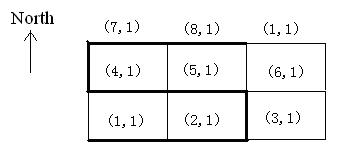
Input
The first line contains three integers: n, m and k.(0<n<=100,0<m<=10000, 0<=k<=3000000)
The next n+1 lines stands for n + 1 west-east roads in north to south order. Each line contains m integers showing the welcome values of the road’s m love-hate zones, in west to east order.
The last n+1 lines also stands for n + 1 west-east roads in north to south order. Each line contains m integers showing the lengths (in minutes) of the road's m love-hate zones, in west to east order.
Output
题目大意:有一个n*m的矩阵,只能沿着边走,只能往左、往右或往上走,在同一行只能沿一个方向走(走了左边就不能返回走右边了)。打横的边都有一个权值(可能为负数)和一个长度,每行走过的长度不能超过k,打竖的边没有权值和长度。先要从最下面的任意一个点开始,走到最上面的任意一个点,问最大权值和为多少(答案不超过$2^{31}-1$,虽然题目不是这么说的)。
思路:一看就是动态规划,每一行只和上一行的状态有关。因为习惯从小到大循环我们从上往下走,反正都一样。设dp[i][j]为走到第 i 行第 j 个点的最大权值(已往左往右走完),那么dp[i][j] = max(dp[i-1][x] + sum(welcome[i][y])),distance(x, y) ≤ k,y in [x, i]。其中distance和sum(welcome[i][y])可以预处理出来(如sum[i]代表1~i的和,distance(i, j) = sum[j] - sum[i],i ≤ j),平均到处理每个dp[i][j]身上时间复杂度为O(1)。但是这样计算dp数组,时间复杂度高达$O(nm^2)$。
现假设我们从左到右走,那么dp[i][j] = max(dp[i - 1][x] - sum_welcome[x] + sum_welcome[y]) = dp[i][j] = max(dp[i - 1][x] - sum_welcome[x]) + sum_welcome[y],那么对每一个j,所用的dp[i - 1][x] - sum_welcome[x]都是一样的,这里很容易能想到单调队列优化(如果你知道单调队列的话)。每次把队列末尾小于dp[i - 1][j] - sum_welcome[j]弹出,把队头distance(i, x) > k的弹出,队头就是最佳的dp[i - 1][x] - sum_welcome[x]。优化完时间复杂度为$O(nm)$,已经是读入数据的复杂度了。(这里不介绍单调队列)
PS:可恶这题居然不让人在线非要我把整个矩阵一起读进来……
代码(1078MS,可恶啊C++又比G++快一倍):
 #include <cstdio>

 #include <cstring>

 #include <iostream>

 #include <algorithm>

 using namespace std;

 const int MAXN = ;

 const int MAXM = ;

 int wel[MAXN][MAXM], len[MAXN][MAXM];

 int sum_w[MAXM], sum_l[MAXM];

 int a[MAXM], b[MAXM], head, tail;

 int dp[][MAXM];

 int n, m, k, cur;

 inline void insert(int x, int y) {

     while(head != tail && a[tail - ] < x) --tail;

     a[tail] = x; b[tail] = y; ++tail;

 }

 void solve() {

     memset(dp, , sizeof(dp));

     cur = ;

     for(int i = ; i < n; ++i) {

         cur ^= ;

         memset(dp[cur], , sizeof(dp[cur]));

         sum_w[] = sum_l[] = ;

         for(int j = ; j <= m; ++j) sum_w[j] = sum_w[j - ] + wel[i][j];

         for(int j = ; j <= m; ++j) sum_l[j] = sum_l[j - ] + len[i][j];

         head = tail = ;

         for(int j = ; j <= m; ++j) {

             insert(dp[cur ^ ][j] - sum_w[j], sum_l[j]);

             while(k < sum_l[j] - b[head]) ++head;

             dp[cur][j] = max(dp[cur][j], a[head] + sum_w[j]);

         }

         sum_w[m] = sum_l[m] = ;

         for(int j = m; j > ; --j) sum_w[j - ] = sum_w[j] + wel[i][j];

         for(int j = m; j > ; --j) sum_l[j - ] = sum_l[j] + len[i][j];

         head = tail = ;

         for(int j = m; j >= ; --j) {

             insert(dp[cur ^ ][j] - sum_w[j], sum_l[j]);

             while(k < sum_l[j] - b[head]) ++head;

             dp[cur][j] = max(dp[cur][j], a[head] + sum_w[j]);

         }

     }

 }

 int main() {

     while(scanf("%d%d%d", &n, &m, &k) != EOF) {

         if(n ==  && m ==  && k == ) break;

         ++n;

         for(int i = ; i < n; ++i)

             for(int j = ; j <= m; ++j) scanf("%d", &wel[i][j]);

         for(int i = ; i < n; ++i)

             for(int j = ; j <= m; ++j) scanf("%d", &len[i][j]);

         solve();

         int ans = ;

         for(int i = ; i <= m; ++i) ans = max(ans, dp[cur][i]);

         printf("%d\n", ans);

     }

 }
HDU 2490 Parade(DPの单调队列)(2008 Asia Regional Beijing)的更多相关文章
- HDU 3401 Trade dp+单调队列优化
题目链接: http://acm.hdu.edu.cn/showproblem.php?pid=3401 Trade Time Limit: 2000/1000 MS (Java/Others)Mem ...
- HDU - 3415(DP + 单调队列)
链接:HDU - 3415 题意:给出一个包含 n 个数的环,求满足长度大于 0 小于等于 k 的最大区间和. 题解:将数组加倍,形成环.求一个前缀和sum.枚举每一个sum[i],以 i 结尾的最大 ...
- HDU 5945 题解(DP)(单调队列)
题面: Fxx and game Time Limit: 3000/1500 MS (Java/Others) Memory Limit: 131072/65536 K (Java/Others) T ...
- hdu 4123 树形DP+单调队列
http://acm.hust.edu.cn/vjudge/problem/25790 这题基本同poj 3162 要注意mx,mx2,vx,vx2每次都要初始化 #include <iostr ...
- HDU 4749 Parade Show 2013 ACM/ICPC Asia Regional Nanjing Online
题目链接:http://acm.hdu.edu.cn/showproblem.php?pid=4749 题目大意:给一个原序列N,再给出一个序列M,问从N中一共可以找出多少个长度为m的序列,序列中的数 ...
- HDU 2494/POJ 3930 Elevator(模拟)(2008 Asia Regional Beijing)
Description Too worrying about the house price bubble, poor Mike sold his house and rent an apartmen ...
- HDU 2492 Ping pong(数学+树状数组)(2008 Asia Regional Beijing)
Description N(3<=N<=20000) ping pong players live along a west-east street(consider the street ...
- HDU 2491 Priest John's Busiest Day(贪心)(2008 Asia Regional Beijing)
Description John is the only priest in his town. October 26th is the John's busiest day in a year be ...
- HDU 2489 Minimal Ratio Tree(暴力+最小生成树)(2008 Asia Regional Beijing)
Description For a tree, which nodes and edges are all weighted, the ratio of it is calculated accord ...
随机推荐
- React通过dva-model-extend实现 dva 动态生成 model
前言 实现通过单个component 单个router通过相应的标识对应产生不同model实现数据包分离,model namespce将会覆盖基础的Model,其中的model[state|subsc ...
- numpy如何使用
numpy介绍 创建numpy的数组 一维数组是什么样子 可以理解为格子纸的一行就是一个一维数据 two_arr = np.array([1, 2, 3]) 二维数组什么样子 理解为一张格子纸, 多个 ...
- PHP 使用GD库合成带二维码的海报步骤以及源码实现
PHP 使用GD库合成带二维码的海报步骤以及源码实现 在做微信项目开发过程中,经常会遇到图片合成的问题,比如将用户的二维码合成到宣传海报中,那么,遇到这种情况,利用PHP的GD库也是很容易实现的,实现 ...
- yii学习笔记(1),目录结构和请求过程
最近找找工作面试,发现很多要求会yii.于是准备学习一个新的框架 先在腾讯课堂找了个视频看了一下,然后去网上现在了“归档文件”(还有一种方式是通过php的包管理工具“composer”安装) 归档文件 ...
- hadoop生态搭建(3节点)-13.mongodb配置
# 13.mongodb配置_副本集_认证授权# ==================================================================安装 mongod ...
- openwrt利用openvpn两网互通
目录 创建证书文件服务器端配置防火墙配置客户端配置uvs-001(远端PC)uvs-002(网关下属设备)测试连接 创建证书文件 安装证书工具 opkg openvpn-easy-rsa 创建证书 b ...
- 部署zabbix,自动发现lnmp环境,监控主机状态,实现 邮件及微信报警(配置server端)
二.配置server端监控 1.监控apache 首先在本机下载模板:https://github.com/rdvn/zabbix-templates/archive/master.zip 该 zi ...
- mySql——case when else ....demo
DROP PROCEDURE IF EXISTS Pro_query_change_charge_by_layer_report; CREATE PROCEDURE Pro_query_change_ ...
- dubbo之main启动
一.dubbo的main启动在使用上面会简单的多,但是需要做一些简单的配置. dubbo.spring.config=classpath*:META-INF/spring/*.xml 备注:这个是默认 ...
- springBoot cache操作2
版权声明:本文为博主原创文章,未经博主允许不得转载. https://blog.csdn.net/zxd1435513775/article/details/85091793一.基本项目搭建测试项目是 ...