
Java ZIP File Example---refernce
In this tutorial we are going to see how to ZIP a file in Java. ZIP is an archive file format that enables data compression and it is mostly used on files and folders. A ZIP file may contain one or more compressed files or folders. Many compression algorithms have been used by several ZIP implementations, which are ubiquitous in many platforms. It is also possible to store a file in a ZIP archive file without compressing it.
Let’s start with a simple example of adding a single file to a ZIP archive.
1. Add a single file to a ZIP archive
In this example we are adding a regular file to a ZIP archive using java.util.zip utility classes.
ZipFileExample.java:
package com.javacodegeeks.core.zip;

import java.io.*;

import java.util.zip.ZipEntry;

import java.util.zip.ZipOutputStream;

public class ZipFileExample {

    private static final String INPUT_FILE = "C:\\Users\\nikos\\Desktop\\TestFiles\\testFile.txt";

    private static final String OUTPUT_FILE = "C:\\Users\\nikos\\Desktop\\TestFiles\\testFile.zip";

    public static void main(String[] args) {

        zipFile(new File(INPUT_FILE), OUTPUT_FILE);

    }

    public static void zipFile(File inputFile, String zipFilePath) {

        try {

            // Wrap a FileOutputStream around a ZipOutputStream

            // to store the zip stream to a file. Note that this is

            // not absolutely necessary

            FileOutputStream fileOutputStream = new FileOutputStream(zipFilePath);

            ZipOutputStream zipOutputStream = new ZipOutputStream(fileOutputStream);

            // a ZipEntry represents a file entry in the zip archive

            // We name the ZipEntry after the original file's name

            ZipEntry zipEntry = new ZipEntry(inputFile.getName());

            zipOutputStream.putNextEntry(zipEntry);

            FileInputStream fileInputStream = new FileInputStream(inputFile);

            byte[] buf = new byte[1024];

            int bytesRead;

            // Read the input file by chucks of 1024 bytes

            // and write the read bytes to the zip stream

            while ((bytesRead = fileInputStream.read(buf)) > 0) {

                zipOutputStream.write(buf, 0, bytesRead);

            }

            // close ZipEntry to store the stream to the file

            zipOutputStream.closeEntry();

            zipOutputStream.close();

            fileOutputStream.close();

            System.out.println("Regular file :" + inputFile.getCanonicalPath()+" is zipped to archive :"+zipFilePath);

        } catch (IOException e) {

            e.printStackTrace();

        }

    }

}
The code is pretty self explanatory,but let’s go through each step:
- First we wrap a
FileOutputStreamaround aZipOutputStreamto store the zip stream to a file. Note that this is not absolutely necessary, as you can redirect theZipOutputStreamto any other stream destination you like, e.g a socket. - Then we create a new
ZipEntrythat represents a file entry in the zip archive. We append this entry to the zip output stream. This is necessary as a zip entry marks the begging and ending of each file or folder that is archived in the zip file. It is also important to name that entry, so that you know how to later unzip it. - We create a
FileInputStreamto read the input file in chucks f 1024 bytes. - We then append those bytes to to zip output stream.
- We close the
ZipEntry. This positions the stream’s “cursor” at the end of this entry, preparing it to receive a new zip entry.
Now if we run the above code this is the output:
Regular file :C:\Users\nikos\Desktop\TestFiles\testFile.txt is zipped to archive :C:\Users\nikos\Desktop\TestFiles\testFile.zipHere is the folder before zipping this single file:
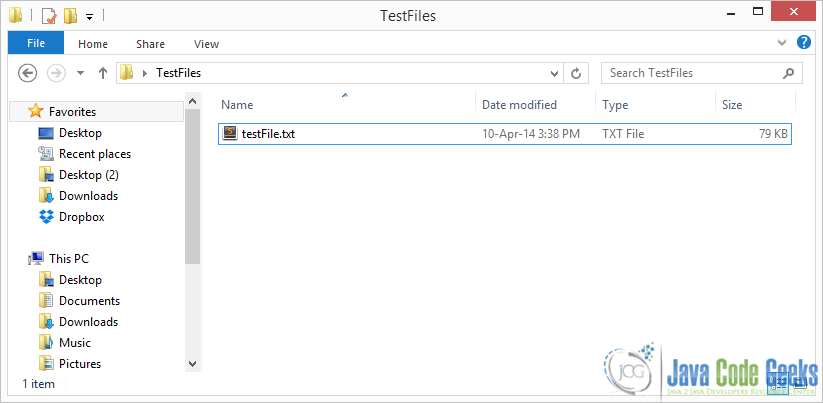
And this is after zipping “testFile.txt” :
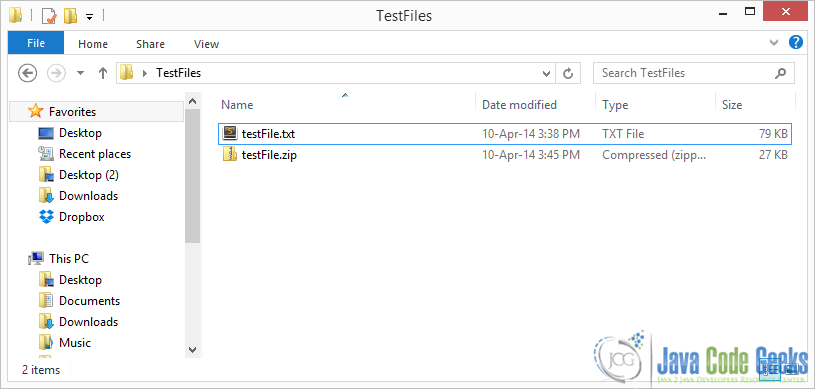
2. Add a single folder to a ZIP archive
Now let’s see how you can add a simple folder, that contains only files to a zip archive.
ZipFileExample.java:
package com.javacodegeeks.core.zip;

import org.omg.CosNaming.NamingContextExtPackage.StringNameHelper;

import java.io.*;

import java.net.URI;

import java.util.zip.ZipEntry;

import java.util.zip.ZipOutputStream;

public class ZipFileExample {

    private static final String INPUT_FOLDER = "C:\\Users\\nikos\\Desktop\\TestFiles";

    private static final String ZIPPED_FOLDER = "C:\\Users\\nikos\\Desktop\\TestFiles.zip";

    public static void main(String[] args) {

        zipSimpleFolder(new File(INPUT_FOLDER),"", ZIPPED_FOLDER);

    }

    public static void zipSimpleFolder(File inputFolder, String parentName ,String zipFilePath ){

        try {

            FileOutputStream fileOutputStream = new FileOutputStream(zipFilePath);

            ZipOutputStream zipOutputStream = new ZipOutputStream(fileOutputStream);

            String myname = parentName +inputFolder.getName()+"\\";

            ZipEntry folderZipEntry = new ZipEntry(myname);

            zipOutputStream.putNextEntry(folderZipEntry);

            File[] contents = inputFolder.listFiles();

            for (File f : contents){

                if (f.isFile())

                    zipFile(f,myname,zipOutputStream);

            }

            zipOutputStream.closeEntry();

            zipOutputStream.close();

        } catch (FileNotFoundException e) {

            e.printStackTrace();

        } catch (IOException e) {

            e.printStackTrace();

        }

    }

    public static void zipFile(File inputFile,String parentName,ZipOutputStream zipOutputStream) {

        try {

            // A ZipEntry represents a file entry in the zip archive

            // We name the ZipEntry after the original file's name

            ZipEntry zipEntry = new ZipEntry(parentName+inputFile.getName());

            zipOutputStream.putNextEntry(zipEntry);

            FileInputStream fileInputStream = new FileInputStream(inputFile);

            byte[] buf = new byte[1024];

            int bytesRead;

            // Read the input file by chucks of 1024 bytes

            // and write the read bytes to the zip stream

            while ((bytesRead = fileInputStream.read(buf)) > 0) {

                zipOutputStream.write(buf, 0, bytesRead);

            }

            // close ZipEntry to store the stream to the file

            zipOutputStream.closeEntry();

            System.out.println("Regular file :" + inputFile.getCanonicalPath()+" is zipped to archive :"+ZIPPED_FOLDER);

        } catch (IOException e) {

            e.printStackTrace();

        }

    }

}
The basic goal here is to zip a folder that contains only flat files. An important thing to notice here is that we create ZipEntry for the folder and add it to the archive. Then we create a Zip entry for each file in the folder. After zipping all the files in the folder and having created and closed all file zip entries we finally close the zip entry of the folder. Another important thing to notice is that we’ve added aparentName argument in the methods. That is basically to easily calculate the absolute path of each file in order to place it in the correct folder in the archive. Our situation here is very simple as we have only one parent folder in the archive.
Now if we run the above code this is the output:
Regular file :TestFiles\testFile.txt is zipped to archive :C:\Users\nikos\Desktop\TestFiles.zipHere is the zipped folder :
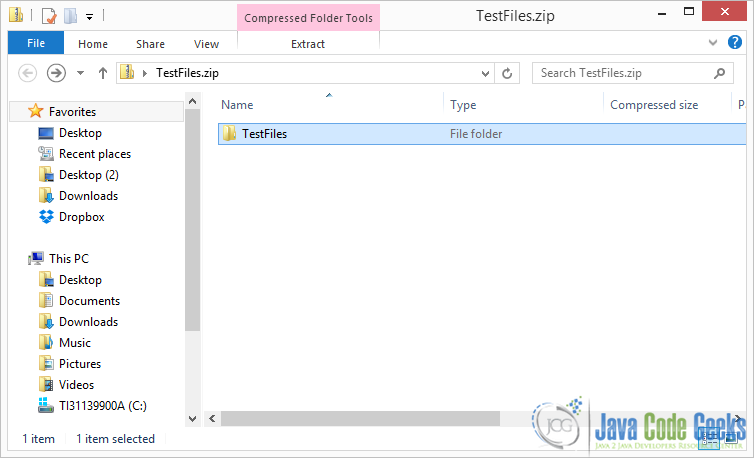
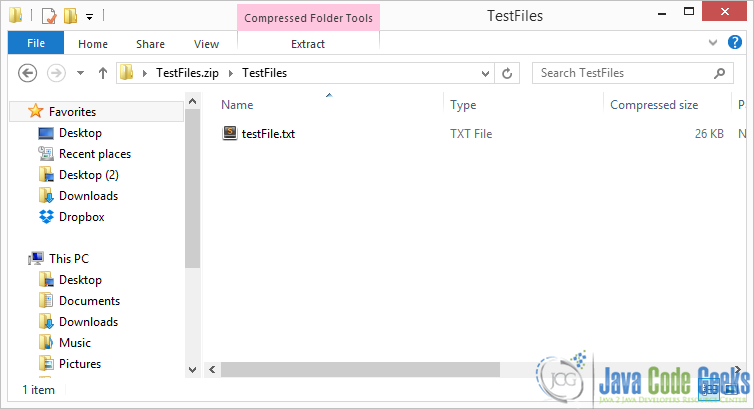
And you can see that it contains a singe file:
3. Add a complete directory tree to a ZIP archive
In this section we are going to add a complete directory tree in the archive. This means that our parent directory might not only contain flat files, but a folder as well, which in turn might contain other files and folders etc.
Let’s see a recursive solution:
ZipFileExample.java:
package com.javacodegeeks.core.zip;

import java.io.File;

import java.io.FileNotFoundException;

import java.io.FileOutputStream;

import java.io.FileInputStream;

import java.io.IOException;

import java.util.zip.ZipEntry;

import java.util.zip.ZipOutputStream;

public class ZipFileExample {

    private static final String INPUT_FOLDER = "C:\\Users\\nikos\\Desktop\\TestFiles";

    private static final String ZIPPED_FOLDER = "C:\\Users\\nikos\\Desktop\\TestFiles.zip";

    public static void main(String[] args) {

        try {

            zip( INPUT_FOLDER, ZIPPED_FOLDER);

        } catch (IOException e) {

            e.printStackTrace();

        }

    }

    public static void zip(String inputFolder,String targetZippedFolder)  throws IOException {

        FileOutputStream fileOutputStream = null;

        fileOutputStream = new FileOutputStream(targetZippedFolder);

        ZipOutputStream zipOutputStream = new ZipOutputStream(fileOutputStream);

        File inputFile = new File(inputFolder);

        if (inputFile.isFile())

            zipFile(inputFile,"",zipOutputStream);

        else if (inputFile.isDirectory())

            zipFolder(zipOutputStream,inputFile,"");

        zipOutputStream.close();

    }

    public static void zipFolder(ZipOutputStream zipOutputStream,File inputFolder, String parentName)  throws IOException {

        String myname = parentName +inputFolder.getName()+"\\";

        ZipEntry folderZipEntry = new ZipEntry(myname);

        zipOutputStream.putNextEntry(folderZipEntry);

        File[] contents = inputFolder.listFiles();

        for (File f : contents){

            if (f.isFile())

                zipFile(f,myname,zipOutputStream);

            else if(f.isDirectory())

                zipFolder(zipOutputStream,f, myname);

        }

        zipOutputStream.closeEntry();

    }

    public static void zipFile(File inputFile,String parentName,ZipOutputStream zipOutputStream) throws IOException{

        // A ZipEntry represents a file entry in the zip archive

        // We name the ZipEntry after the original file's name

        ZipEntry zipEntry = new ZipEntry(parentName+inputFile.getName());

        zipOutputStream.putNextEntry(zipEntry);

        FileInputStream fileInputStream = new FileInputStream(inputFile);

        byte[] buf = new byte[1024];

        int bytesRead;

        // Read the input file by chucks of 1024 bytes

        // and write the read bytes to the zip stream

        while ((bytesRead = fileInputStream.read(buf)) > 0) {

            zipOutputStream.write(buf, 0, bytesRead);

        }

        // close ZipEntry to store the stream to the file

        zipOutputStream.closeEntry();

        System.out.println("Regular file :" + parentName+inputFile.getName() +" is zipped to archive :"+ZIPPED_FOLDER);

    }

}
As you can see inside zipFolder method we simply add a recursive call if the file we are trying to zip is a directory. That’s it. Notice that we create our ZipOutputStream to the top level zip method, so that all methods calls from then on can use the same instance of that stream. If we left the code as before, every time zipFolder was called, a new ZipOutputStream would be created, something that we definitely don’t want.
To test this, I’ve copied an Eclipse Project folder in my TestFiles folder.
Now if we run the above code this is the output:
Regular file :TestFiles\EJBInterceptor\EJBInterceptorEAR\.project is zipped to archive :C:\Users\nikos\Desktop\TestFiles.zip

Regular file :TestFiles\EJBInterceptor\EJBInterceptorEAR\.settings\org.eclipse.wst.common.component is zipped to archive :C:\Users\nikos\Desktop\TestFiles.zip

Regular file :TestFiles\EJBInterceptor\EJBInterceptorEAR\.settings\org.eclipse.wst.common.project.facet.core.xml is zipped to archive :C:\Users\nikos\Desktop\TestFiles.zip

Regular file :TestFiles\EJBInterceptor\EJBInterceptorEAR\EarContent\META-INF\application.xml is zipped to archive :C:\Users\nikos\Desktop\TestFiles.zip

Regular file :TestFiles\EJBInterceptor\InterceptorsEJB\.classpath is zipped to archive :C:\Users\nikos\Desktop\TestFiles.zip

Regular file :TestFiles\EJBInterceptor\InterceptorsEJB\.project is zipped to archive :C:\Users\nikos\Desktop\TestFiles.zip

Regular file :TestFiles\EJBInterceptor\InterceptorsEJB\.settings\org.eclipse.jdt.core.prefs is zipped to archive :C:\Users\nikos\Desktop\TestFiles.zip

Regular file :TestFiles\EJBInterceptor\InterceptorsEJB\.settings\org.eclipse.wst.common.component is zipped to archive :C:\Users\nikos\Desktop\TestFiles.zip

Regular file :TestFiles\EJBInterceptor\InterceptorsEJB\.settings\org.eclipse.wst.common.project.facet.core.xml is zipped to archive :C:\Users\nikos\Desktop\TestFiles.zip

Regular file :TestFiles\EJBInterceptor\InterceptorsEJB\build\classes\com\javacodegeeks\enterprise\ejb\interceptor\SecondInterceptor.class is zipped to archive :C:\Users\nikos\Desktop\TestFiles.zip

Regular file :TestFiles\EJBInterceptor\InterceptorsEJB\build\classes\com\javacodegeeks\enterprise\ejb\interceptor\SimpleInterceptor.class is zipped to archive :C:\Users\nikos\Desktop\TestFiles.zip

Regular file :TestFiles\EJBInterceptor\InterceptorsEJB\build\classes\com\javacodegeeks\enterprise\ejb\SimpleEJB.class is zipped to archive :C:\Users\nikos\Desktop\TestFiles.zip

Regular file :TestFiles\EJBInterceptor\InterceptorsEJB\build\classes\META-INF\ejb-jar.xml is zipped to archive :C:\Users\nikos\Desktop\TestFiles.zip

...
Now you can use this simple zip method as a utility to zip a normal file or a complete file path.
Here you can see the zipped folder:
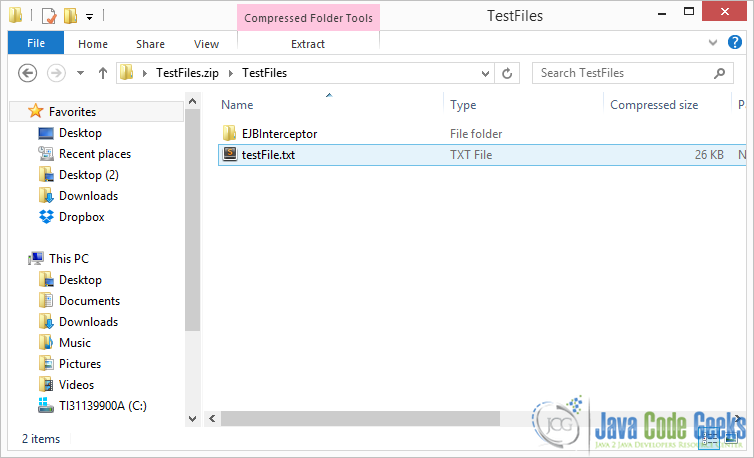
And from there you can navigate the file path. For example :
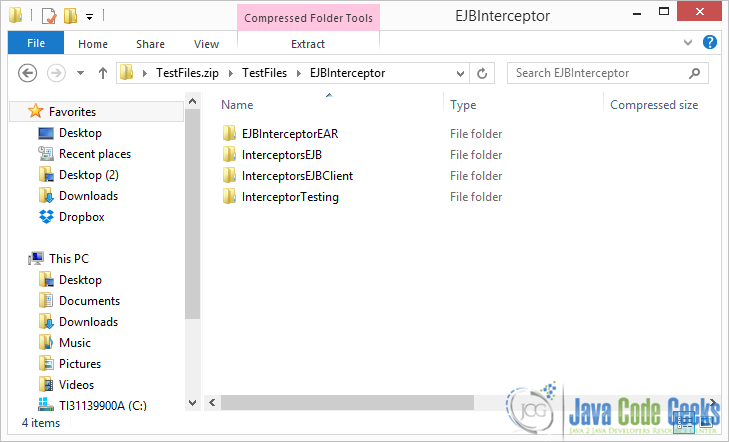
4. Compressing files
java.util.zip basically offers two methods to compressed the files that you add in the archive: STORED and DEFLATED. In STORED method, you basically store the files uncompressed, it just stores the raw bytes. DEFLATED on the other hand uses the LZ77 alogrithm and Huffman code to perform compression on the files. You can specify which compression algorithm you want to use at each individualZipEntry using setMethod(ZipEntry.STORED) or setMethod(ZipEntry.DEFLATED) ZipEntry API methods.
Additionally you can specify other characteristics of the compressed components, to increase security and consistency of the contents of the archive. These include the size of the file and the check sum of the file. For the check sum java.util.zip offers a utility to calculate CRC32 checksum of the file. You can then add it to the ZipEntry using its setCrc API method. It is not always advisable to compress all the files in DEFLATED mode, because it simply takes more time.
Download Source Code
This was a Java ZIP File Example. You can download the source code of this example here : ZIPFileExample.zip
Java ZIP File Example---refernce的更多相关文章
- 07-09 07:28:38.350: E/AndroidRuntime(1437): Caused by: java.lang.ClassNotFoundException: Didn't find class "com.example.googleplay.ui.activity.MainActivity" on path: DexPathList[[zip file "/data/app/c
一运行,加载mainActivity就报错 布局文件乱写一通,然后急着运行,报莫名其妙的错误: 07-09 07:28:38.350: E/AndroidRuntime(1437): Caused b ...
- java.util.zip.ZipException:ZIP file must have at least one entry
1.错误描述 java.util.zip.ZipException:ZIP file must have at least one entry 2.错误原因 由于在导出文件时,要将导出的文件压缩到压缩 ...
- 解决使用maven的java web项目导入后出现的有关问题 -cannot be read or is not a valid ZIP file
解决使用maven的java web项目导入后出现的有关问题 -cannot be read or is not a valid ZIP file 错误问题:虽然查找repository目录下是有 ...
- Tomcat启动报错:org.apache.catalina.LifecycleException: Failed to start component...java.util.zip.ZipException: error in opening zip file
1.项目环境 IntelliJ IDEA2018.1.6 apache-tomcat-8.0.53 基于springboot开发的项目 maven3.5.3 2.出现问题 从svn同步下项目 启动to ...
- java.lang.IllegalStateException: Zip File is closed
最近在研究利用sax读取excel大文件时,出现了以下的错误: java.lang.IllegalStateException: Zip File is closed at org.apache.po ...
- [java ] java.util.zip.ZipException: error in opening zip file
严重: Failed to processes JAR found at URL [jar:file:/D:/tools/apache-tomcat-7.0.64_2/webapps/bbs/WEB- ...
- 【POI】解析xls报错:java.util.zip.ZipException: error in opening zip file
今天使用POI解析XLS,报错如下: Servlet.service() for servlet [rest] in context with path [/cetBrand] threw excep ...
- Caused by: java.lang.ClassNotFoundException: Didn't find class "** *** ** **" on path: DexPathList[[zip file "/data/app/*** *** ***-2/base.apk"],nativeLibraryDirectories
Caused by: java.lang.ClassNotFoundException: Didn't find class "** *** ** **" on path: Dex ...
- Caused by: java.util.zip.ZipException: zip file is empty
1.问题描述:mybranch分支代码和master分支的代码一模一样,mybranch代码部署到服务器上没有任何问题,而master代码部署到服务器上运行不起来. 2.解决办法: (1)登陆服务器启 ...
随机推荐
- TortoiseGit日常使用指南
本文在介绍了软件安装和设置后, 写了TortoiseGit 常用的一些功能, 包括:创建新库添加文件及文件夹创建分支看分支情况及修改log比较版本差异合并分支其他操作: Stash; 忽略文件本文不包 ...
- 扩展类加载器-------改变JAVA的父优先类加载顺序
java的类加载机制默认情况下是采用委托模型:当加载某个类时JVM会首先尝试用当前类加载器的父类加载器加载该类,若父类加载器加载不到再由当前类加载器来加载,因此这种模型又叫做“父优先”模型. 但是在实 ...
- 【原创】Linux下使用SecureCRT的方法:破解&编码
1.下载SecureCRT软件 ubuntu64位:http://download.csdn.net/detail/cobps/7941145 ubuntu32位:http://download.cs ...
- RequestHander类介绍
RequestHander是一个抽象类,是一个线程.它封装了一个Socket.代码不难: package org.simpleHTTPServer; import java.io.IOExceptio ...
- SRM 599 DIV 2
rating又掉了...变灰色了%>_<%.250pt很简单,一眼看上去是个背包,没有多想立马写了个01背包,后面发现其实就是个简单的排序...因为只是需要求数量而已.500pt被我写残了 ...
- SGU131 - Hardwood floor(状态压缩DP)
题目大意 给定一个N*M大小的矩形,要求你用1*2和2*2(缺个角)的砖块把矩形铺满(不能重叠),问总共有多少种铺法? 题解 受POJ2411的影响,怎么都没想到3,4,5,6这几种情况该怎么放置,看 ...
- 获取最外层View
获取最外层View activity.getWindow().getDecorView()
- nyoj 60 谁获得了最高奖学金
谁获得了最高奖学金 时间限制:1000 ms | 内存限制:65535 KB 难度:2 描述 某校的惯例是在每学期的期末考试之后发放奖学金.发放的奖学金共有五种,获取的条件各自不同: ...
- java入门学习(十一)逻辑运算符和位运算符
请关注我的博客:www.taomaipin.com 家里有急事 暂停了几天,抱歉,现在呢开始说说java的运算语句和运算符 如果想利用java的运算语句 那么就离不开java的运算符,前面第九章讲了j ...
- 【转载】Restful 简介
转自阮一峰的网络日志 http://www.ruanyifeng.com/blog/2011/09/restful.html 越来越多的人开始意识到,网站即软件,而且是一种新型的软件. 这种&quo ...