
k8s client-go源码分析 informer源码分析(5)-Controller&Processor源码分析
client-go之Controller&Processor源码分析
1.controller与Processor概述
Controller
Controller从DeltaFIFO中pop Deltas出来处理,根据对象的变化更新Indexer本地缓存,并通知Processor相关对象有变化事件发生。
Processor
Processor根据Controller的通知,即根据对象的变化事件类型,调用相应的ResourceEventHandler来处理对象的变化。
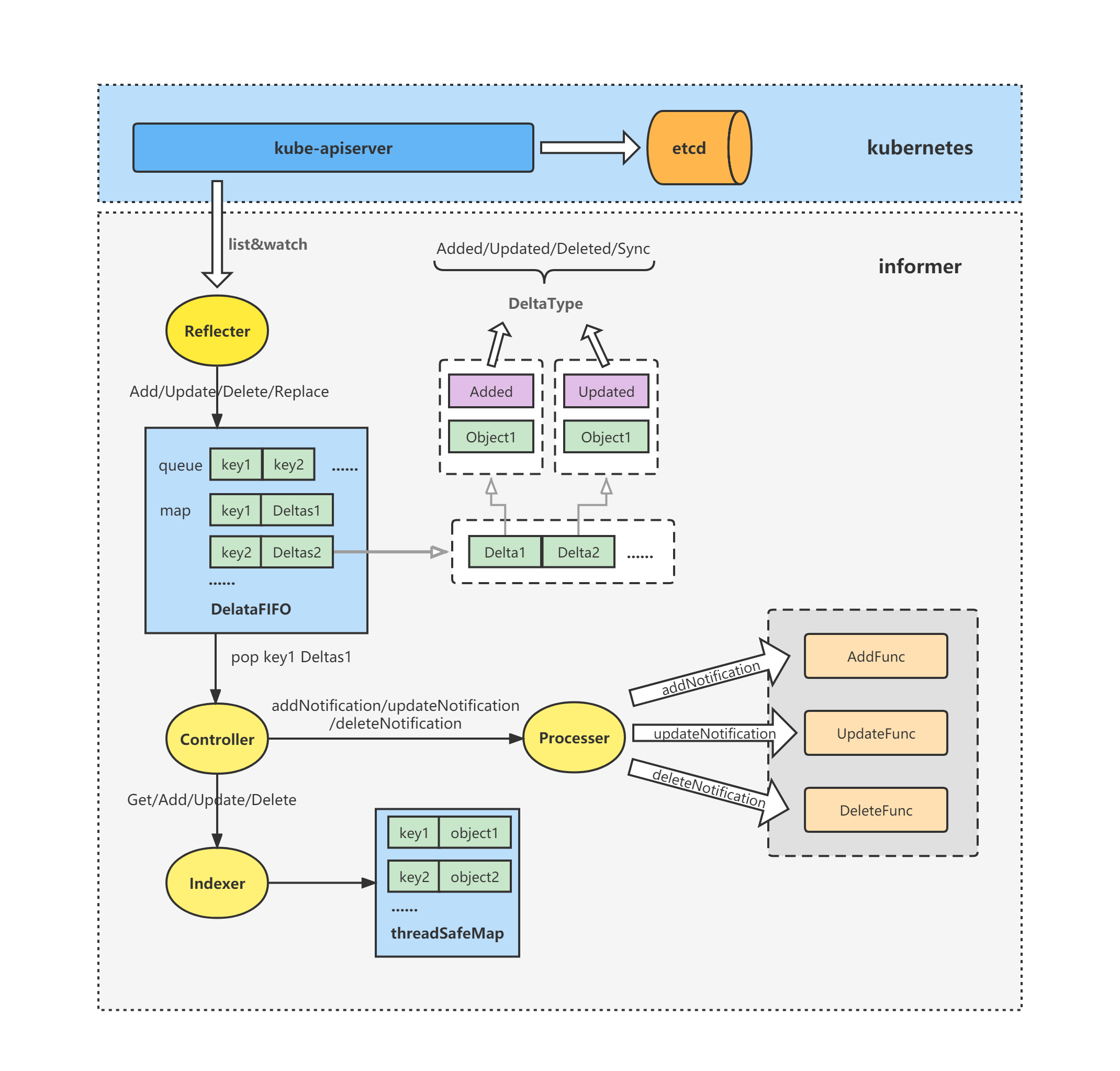
先通过一张informer概要架构图看一下Controller&Processor所处位置与概要功能。
2.Controller初始化与启动分析
2.1 Cotroller初始化-New
New用于初始化Controller,方法比较简单。
// staging/src/k8s.io/client-go/tools/cache/controller.go

func New(c *Config) Controller {

	ctlr := &controller{

		config: *c,

		clock:  &clock.RealClock{},

	}

	return ctlr

}
2.2 Controller启动-controller.Run
controller.Run为controller的启动方法,这里主要看到几个点:
(1)调用NewReflector,初始化Reflector;
(2)调用r.Run,实际上是调用了Reflector的启动方法来启动Reflector(Reflector相关的分析前面的博客已经分析过了,这里不再重复);
(3)调用c.processLoop,开始controller的核心处理;
// staging/src/k8s.io/client-go/tools/cache/controller.go

func (c *controller) Run(stopCh <-chan struct{}) {

	defer utilruntime.HandleCrash()

	go func() {

		<-stopCh

		c.config.Queue.Close()

	}()

	r := NewReflector(

		c.config.ListerWatcher,

		c.config.ObjectType,

		c.config.Queue,

		c.config.FullResyncPeriod,

	)

	r.ShouldResync = c.config.ShouldResync

	r.clock = c.clock

	c.reflectorMutex.Lock()

	c.reflector = r

	c.reflectorMutex.Unlock()

	var wg wait.Group

	defer wg.Wait()

	wg.StartWithChannel(stopCh, r.Run)

	wait.Until(c.processLoop, time.Second, stopCh)

}
3.controller核心处理方法分析
controller.processLoop即为controller的核心处理方法。
controller.processLoop
controller的核心处理方法processLoop中,最重要的逻辑是循环调用c.config.Queue.Pop将DeltaFIFO中的队头元素给pop出来(实际上pop出来的是Deltas,是Delta的切片类型),然后调用c.config.Process方法来做处理,当处理出错时,再调用c.config.Queue.AddIfNotPresent将对象重新加入到DeltaFIFO中去。
func (c *controller) processLoop() {

	for {

		obj, err := c.config.Queue.Pop(PopProcessFunc(c.config.Process))

		if err != nil {

			if err == ErrFIFOClosed {

				return

			}

			if c.config.RetryOnError {

				// This is the safe way to re-enqueue.

				c.config.Queue.AddIfNotPresent(obj)

			}

		}

	}

}
根据前面sharedIndexInformer的初始化与启动分析(sharedIndexInformer.Run)可以得知,c.config.Process即为s.HandleDeltas方法,所以接下来看到s.HandleDeltas方法的分析。
c.config.Process/s.HandleDeltas
根据前面分析知道HandleDeltas要处理的是Deltas,是Delta的切片类型。
再来看到HandleDeltas方法的主要逻辑:
(1)循环遍历Deltas,拿到单个Delta;
(2)判断Delta的类型;
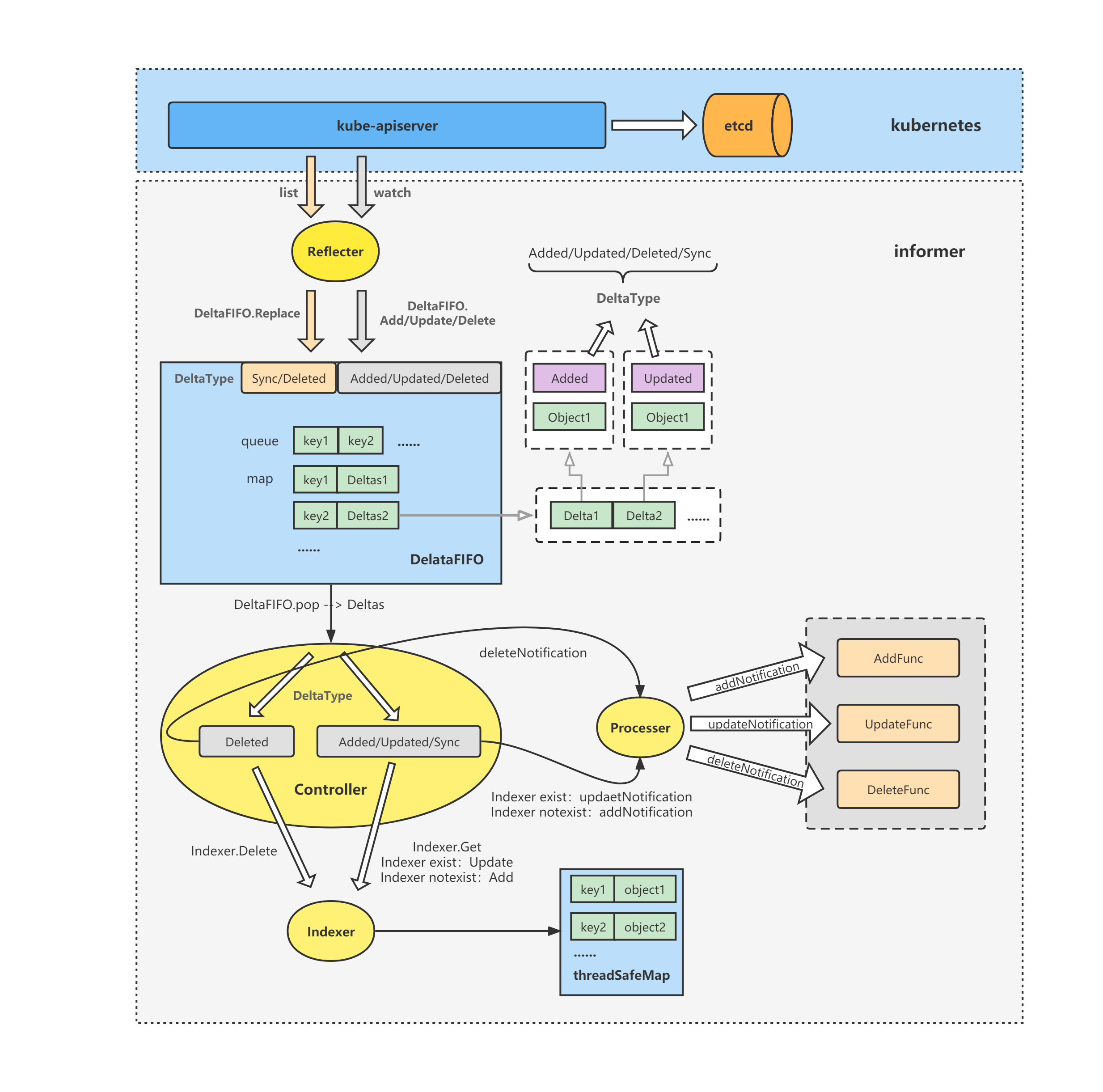
(3)如果是Added、Updated、Sync类型,则从indexer中获取该对象,存在则调用s.indexer.Update来更新indexer中的该对象,随后构造updateNotification struct,并调用s.processor.distribute方法;如果indexer中不存在该对象,则调用s.indexer.Add来往indexer中添加该对象,随后构造addNotification struct,并调用s.processor.distribute方法;
(4)如果是Deleted类型,则调用s.indexer.Delete来将indexer中的该对象删除,随后构造deleteNotification struct,并调用s.processor.distribute方法;
// staging/src/k8s.io/client-go/tools/cache/shared_informer.go

func (s *sharedIndexInformer) HandleDeltas(obj interface{}) error {

	s.blockDeltas.Lock()

	defer s.blockDeltas.Unlock()

	// from oldest to newest

	for _, d := range obj.(Deltas) {

		switch d.Type {

		case Sync, Added, Updated:

			isSync := d.Type == Sync

			s.cacheMutationDetector.AddObject(d.Object)

			if old, exists, err := s.indexer.Get(d.Object); err == nil && exists {

				if err := s.indexer.Update(d.Object); err != nil {

					return err

				}

				s.processor.distribute(updateNotification{oldObj: old, newObj: d.Object}, isSync)

			} else {

				if err := s.indexer.Add(d.Object); err != nil {

					return err

				}

				s.processor.distribute(addNotification{newObj: d.Object}, isSync)

			}

		case Deleted:

			if err := s.indexer.Delete(d.Object); err != nil {

				return err

			}

			s.processor.distribute(deleteNotification{oldObj: d.Object}, false)

		}

	}

	return nil

}

type updateNotification struct {

	oldObj interface{}

	newObj interface{}

}

type addNotification struct {

	newObj interface{}

}

type deleteNotification struct {

	oldObj interface{}

}
至此,Controller的分析就结束了,用一张图来回忆一下Controller的功能与架构。
4.processor核心处理方法分析
sharedIndexInformer.processor.distribute
接下来分析一下前面提到的s.processor.distribute方法。
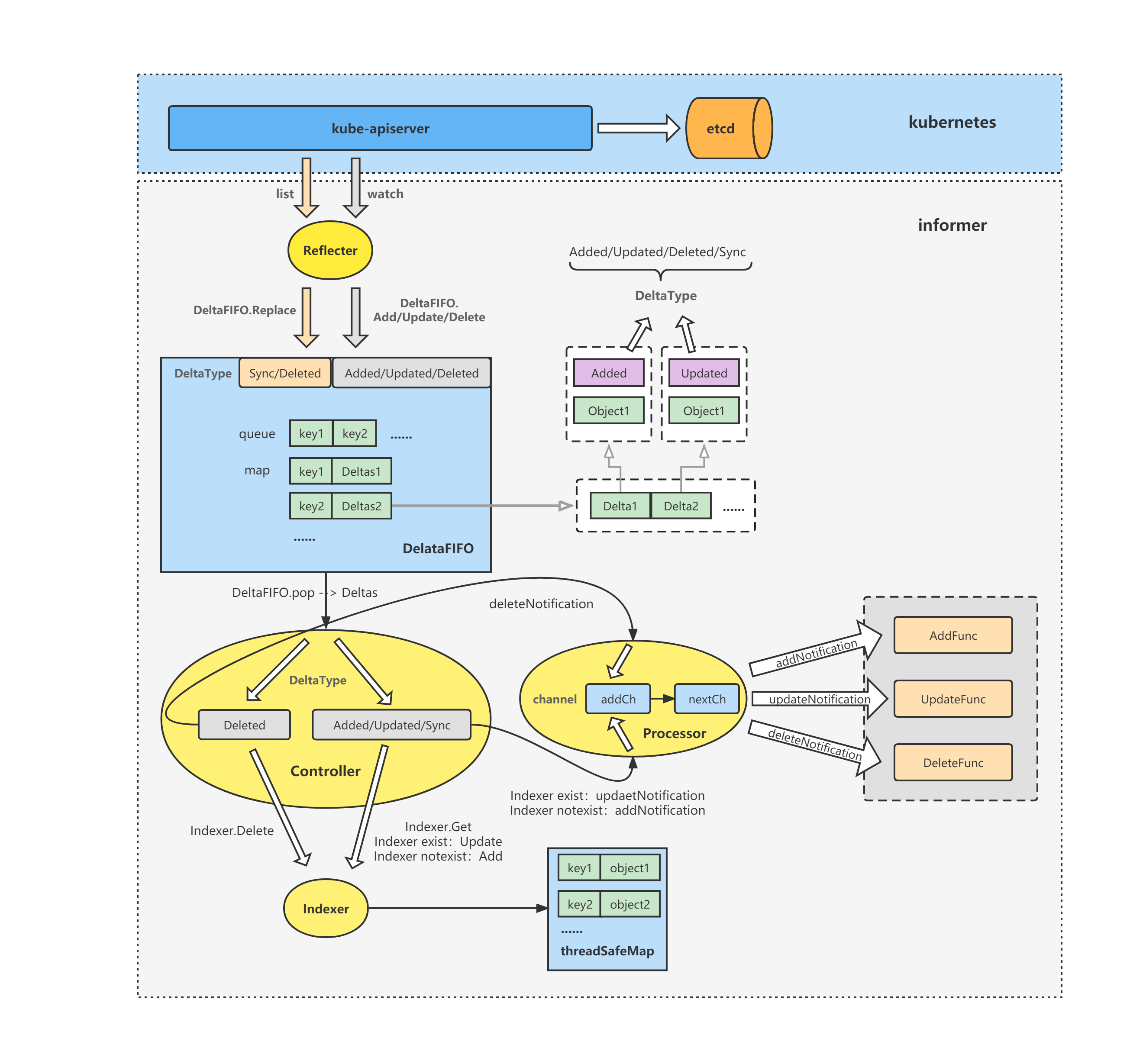
可以看到distribute方法最终是将构造好的addNotification、updateNotification、deleteNotification对象写入到p.addCh中。
sync类型的对象写入到p.syncingListeners中,但informer中貌似没有启动p.syncingListeners或对p.syncingListeners做处理,所以sync类型的对象变化(也即list操作得到的对象所生成的对象变化)会被忽略?有待验证。
// staging/src/k8s.io/client-go/tools/cache/shared_informer.go

func (p *sharedProcessor) distribute(obj interface{}, sync bool) {

	p.listenersLock.RLock()

	defer p.listenersLock.RUnlock()

	if sync {

		for _, listener := range p.syncingListeners {

			listener.add(obj)

		}

	} else {

		for _, listener := range p.listeners {

			listener.add(obj)

		}

	}

}

func (p *processorListener) add(notification interface{}) {

	p.addCh <- notification

}
sharedIndexInformer.processor.run
s.processor.run启动了processor,其中注意到listener.run与listener.pop两个核心方法。
这里可以看到processor的run方法中只启动了p.listeners,没有启动p.syncingListeners。
// staging/src/k8s.io/client-go/tools/cache/shared_informer.go

func (p *sharedProcessor) run(stopCh <-chan struct{}) {

	func() {

		p.listenersLock.RLock()

		defer p.listenersLock.RUnlock()

		for _, listener := range p.listeners {

			p.wg.Start(listener.run)

			p.wg.Start(listener.pop)

		}

		p.listenersStarted = true

	}()

	<-stopCh

	p.listenersLock.RLock()

	defer p.listenersLock.RUnlock()

	for _, listener := range p.listeners {

		close(listener.addCh) // Tell .pop() to stop. .pop() will tell .run() to stop

	}

	p.wg.Wait() // Wait for all .pop() and .run() to stop

}
processorListener.pop
分析processorListener的pop方法可以得知,其逻辑实际上就是将p.addCh中的对象给拿出来,然后丢进了p.nextCh中。那么谁来处理p.nextCh呢?继续往下看。
// staging/src/k8s.io/client-go/tools/cache/shared_informer.go

func (p *processorListener) pop() {

	defer utilruntime.HandleCrash()

	defer close(p.nextCh) // Tell .run() to stop

	var nextCh chan<- interface{}

	var notification interface{}

	for {

		select {

		case nextCh <- notification:

			// Notification dispatched

			var ok bool

			notification, ok = p.pendingNotifications.ReadOne()

			if !ok { // Nothing to pop

				nextCh = nil // Disable this select case

			}

		case notificationToAdd, ok := <-p.addCh:

			if !ok {

				return

			}

			if notification == nil { // No notification to pop (and pendingNotifications is empty)

				// Optimize the case - skip adding to pendingNotifications

				notification = notificationToAdd

				nextCh = p.nextCh

			} else { // There is already a notification waiting to be dispatched

				p.pendingNotifications.WriteOne(notificationToAdd)

			}

		}

	}

}
processorListener.run
在processorListener的run方法中,将循环读取p.nextCh,判断对象类型,是updateNotification则调用p.handler.OnUpdate方法,是addNotification则调用p.handler.OnAdd方法,是deleteNotification则调用p.handler.OnDelete方法做处理。
// staging/src/k8s.io/client-go/tools/cache/shared_informer.go

func (p *processorListener) run() {

	// this call blocks until the channel is closed.  When a panic happens during the notification

	// we will catch it, **the offending item will be skipped!**, and after a short delay (one second)

	// the next notification will be attempted.  This is usually better than the alternative of never

	// delivering again.

	stopCh := make(chan struct{})

	wait.Until(func() {

		// this gives us a few quick retries before a long pause and then a few more quick retries

		err := wait.ExponentialBackoff(retry.DefaultRetry, func() (bool, error) {

			for next := range p.nextCh {

				switch notification := next.(type) {

				case updateNotification:

					p.handler.OnUpdate(notification.oldObj, notification.newObj)

				case addNotification:

					p.handler.OnAdd(notification.newObj)

				case deleteNotification:

					p.handler.OnDelete(notification.oldObj)

				default:

					utilruntime.HandleError(fmt.Errorf("unrecognized notification: %T", next))

				}

			}

			// the only way to get here is if the p.nextCh is empty and closed

			return true, nil

		})

		// the only way to get here is if the p.nextCh is empty and closed

		if err == nil {

			close(stopCh)

		}

	}, 1*time.Minute, stopCh)

}
而p.handler.OnUpdate、p.handler.OnAdd、p.handler.OnDelete方法实际上就是自定义的的ResourceEventHandlerFuncs了。
informer.AddEventHandler(cache.ResourceEventHandlerFuncs{

    AddFunc:    onAdd,

    UpdateFunc: onUpdate,

    DeleteFunc: onDelete,

  })
// staging/src/k8s.io/client-go/tools/cache/controller.go

type ResourceEventHandlerFuncs struct {

	AddFunc    func(obj interface{})

	UpdateFunc func(oldObj, newObj interface{})

	DeleteFunc func(obj interface{})

}

func (r ResourceEventHandlerFuncs) OnAdd(obj interface{}) {

	if r.AddFunc != nil {

		r.AddFunc(obj)

	}

}

func (r ResourceEventHandlerFuncs) OnUpdate(oldObj, newObj interface{}) {

	if r.UpdateFunc != nil {

		r.UpdateFunc(oldObj, newObj)

	}

}

func (r ResourceEventHandlerFuncs) OnDelete(obj interface{}) {

	if r.DeleteFunc != nil {

		r.DeleteFunc(obj)

	}

}
至此,Processor的分析也结束了,用一张图来回忆一下Processor的功能与架构。
总结
Controller
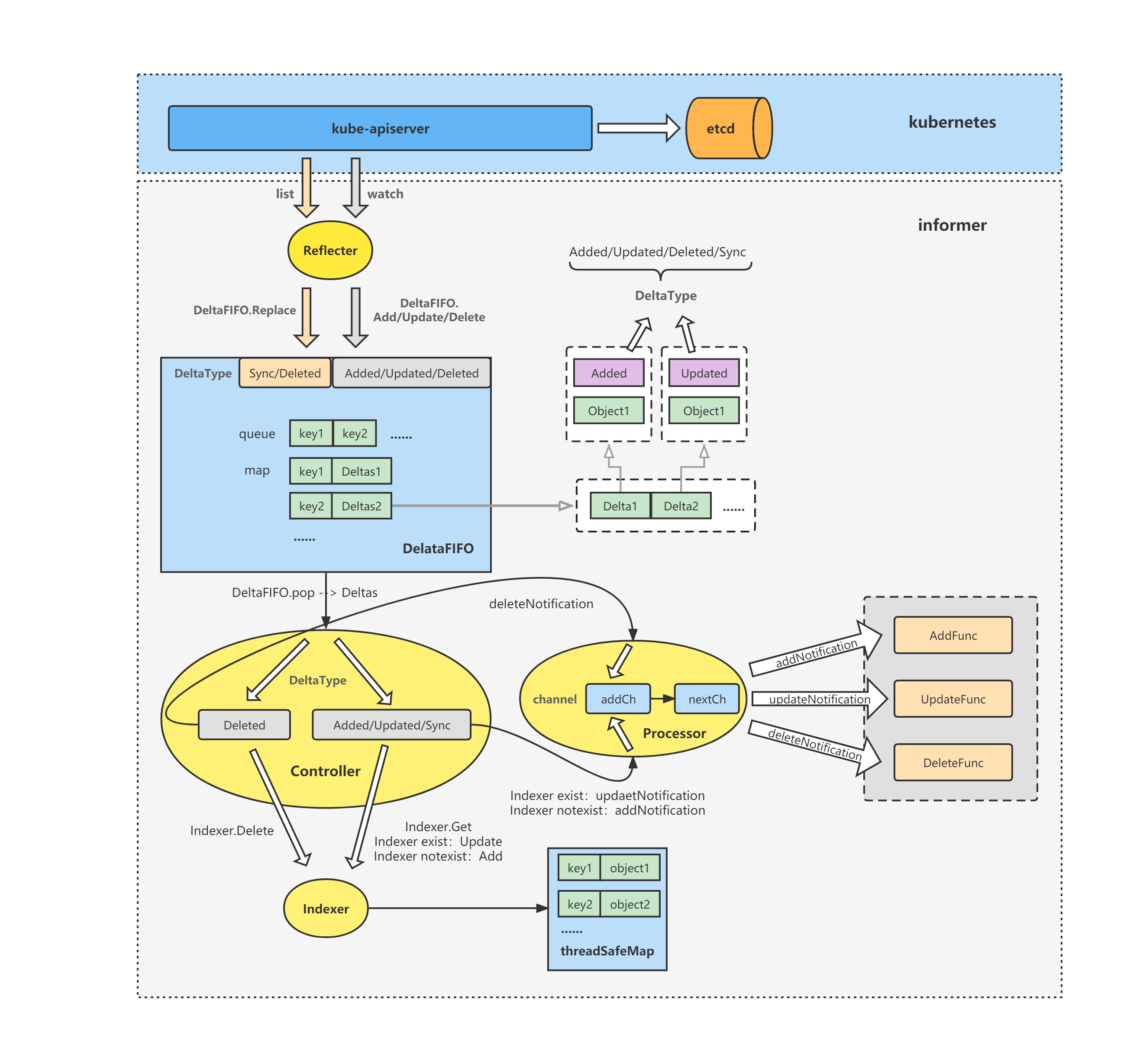
Controller从DeltaFIFO中pop Deltas出来处理,根据对象的变化更新Indexer本地缓存,并通知Processor相关对象有变化事件发生:
(1)如果是Added、Updated、Sync类型,则从indexer中获取该对象,存在则调用s.indexer.Update来更新indexer中的该对象,随后构造updateNotification struct,并通知Processor;如果indexer中不存在该对象,则调用s.indexer.Add来往indexer中添加该对象,随后构造addNotification struct,并通知Processor;
(2)如果是Deleted类型,则调用s.indexer.Delete来将indexer中的该对象删除,随后构造deleteNotification struct,并通知Processor;
Processor
Processor根据Controller的通知,即根据对象的变化事件类型(addNotification、updateNotification、deleteNotification),调用相应的ResourceEventHandler(addFunc、updateFunc、deleteFunc)来处理对象的变化。
informer架构中的Controller&Processor
在对informer中的Controller与Processor分析完之后,接下来将分析informer中的Indexer。
k8s client-go源码分析 informer源码分析(5)-Controller&Processor源码分析的更多相关文章
- k8s client-go源码分析 informer源码分析(1)-概要分析
k8s informer概述 我们都知道可以使用k8s的Clientset来获取所有的原生资源对象,那么怎么能持续的获取集群的所有资源对象,或监听集群的资源对象数据的变化呢?这里不需要轮询去不断执行L ...
- k8s client-go源码分析 informer源码分析(2)-初始化与启动分析
k8s client-go源码分析 informer源码分析(2)-初始化与启动分析 前面一篇文章对k8s informer做了概要分析,本篇文章将对informer的初始化与启动进行分析. info ...
- k8s client-go源码分析 informer源码分析(3)-Reflector源码分析
k8s client-go源码分析 informer源码分析(3)-Reflector源码分析 1.Reflector概述 Reflector从kube-apiserver中list&watc ...
- k8s client-go源码分析 informer源码分析(4)-DeltaFIFO源码分析
client-go之DeltaFIFO源码分析 1.DeltaFIFO概述 先从名字上来看,DeltaFIFO,首先它是一个FIFO,也就是一个先进先出的队列,而Delta代表变化的资源对象,其包含资 ...
- Java并发包源码学习之AQS框架(四)AbstractQueuedSynchronizer源码分析
经过前面几篇文章的铺垫,今天我们终于要看看AQS的庐山真面目了,建议第一次看AbstractQueuedSynchronizer 类源码的朋友可以先看下我前面几篇文章: <Java并发包源码学习 ...
- 详解SpringMVC请求的时候是如何找到正确的Controller[附带源码分析]
目录 前言 源码分析 重要接口介绍 SpringMVC初始化的时候做了什么 HandlerExecutionChain的获取 实例 资源文件映射 总结 参考资料 前言 SpringMVC是目前主流的W ...
- Linux内核分析(一)---linux体系简介|内核源码简介|内核配置编译安装
原文:Linux内核分析(一)---linux体系简介|内核源码简介|内核配置编译安装 Linux内核分析(一) 从本篇博文开始我将对linux内核进行学习和分析,整个过程必将十分艰辛,但我会坚持到底 ...
- Spring源码分析之IOC的三种常见用法及源码实现(二)
Spring源码分析之IOC的三种常见用法及源码实现(二) 回顾上文 我们研究的是 AnnotationConfigApplicationContext annotationConfigApplica ...
- 鸿蒙内核源码分析(源码结构篇) | 内核每个文件的含义 | 百篇博客分析OpenHarmony源码 | v18.04
百篇博客系列篇.本篇为: v18.xx 鸿蒙内核源码分析(源码结构篇) | 内核每个文件的含义 | 51.c.h .o 前因后果相关篇为: v08.xx 鸿蒙内核源码分析(总目录) | 百万汉字注解 ...
随机推荐
- PAT 1048数字加密
本题要求实现一种数字加密方法.首先固定一个加密用正整数 A,对任一正整数 B,将其每 1 位数字与 A 的对应位置上的数字进行以下运算:对奇数位,对应位的数字相加后对 13 取余--这里用 J 代表 ...
- oracle数据库存储过程中的select语句的位置
导读:在oracle数据库存储过程中如果用了select语句,要么使用"select into 变量"语句要么使用游标,oracle不支持单独的select语句. 先看下这个存储过 ...
- 爬虫---scrapy分布式和增量式
分布式 概念: 需要搭建一个分布式的机群, 然后在每一台电脑中执行同一组程序, 让其对某一网站的数据进行联合分布爬取. 原生的scrapy框架不能实现分布式的原因 调度器不能被共享, 管道也不能被共享 ...
- MySQL---什么是事务
什么是事务 一个数据库事务通常包含对数据库进行读或写的一个操作序列.它的存在包含有以下两个目的: 为数据库操作提供了一个从失败中恢复到正常状态的方法,同时提供了数据库即使在异常状态下仍能保持一致性的方 ...
- Java数组的常见算法2
1. 求数值型数组中元素的最大值.最小值.平均值.总值等 2. 数组的复制.反转.查找(线性查找.二分法查找)
- 从实例学习 Go 语言、"基础与进阶" 学习笔记及心得体会、Go指南
第一轮学习 golang "基础与进阶"学习笔记,Go指南练习题目解析.使用学习资料 <Go-zh/tour tour>.记录我认为会比较容易忘记的知识点,进行补充,整 ...
- Java学习day9
抽象类的关键字:abstract 类中有抽象方法时,需要在类名前也加上abstract关键字,即 public abstract class 类名{ } 同时,抽象类不能直接实例化,需要通过子类继承, ...
- Java语言学习day26--7月01日
###14内部类 * A: 内部类的概述 将类写在其他类的内部,可以写在其他类的成员位置和局部位置,这时写在其他类内部的类就称为内部类. 其他类也称为外部类. * B: 什么时候使用内部类 在描述事物 ...
- Go通过cobra快速构建命令行应用
来自jetbrains Go 语言现状调查报告 显示:在go开发者中使用go开发实用小程序的比例为31%仅次于web,go得益于跨平台.无依赖的特性,用来编写命令行或系统管理这类小程序非常不错. 本文 ...
- Python学习笔记: 通过type annotation来伪指定变量类型
简介 通过annotation像强类型language那样指定变量类型,包括参数和返回值的类型 因为Python是弱类型语言,这种指定实际上无效的.所以这种写法叫annotation,就是个注释参考的 ...