
Elman network with additional notes
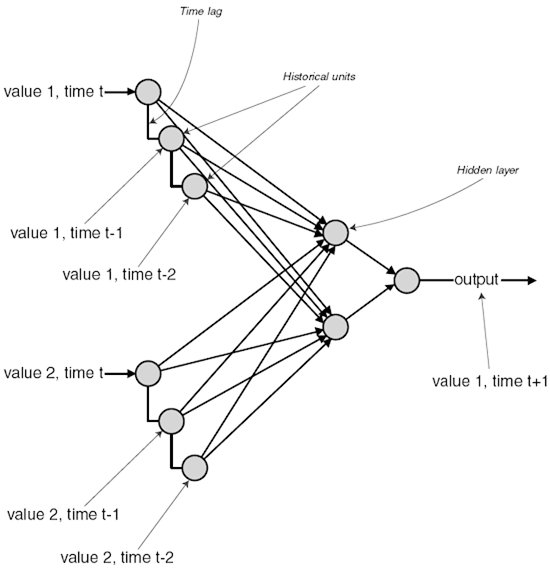
// Author:        John McCullock

// Date:        10-15-05

// Description:    Elman Network Example 1.

//http://www.mnemstudio.org/neural-networks-elman.htm

#include <iostream>

#include <iomanip>

#include <cmath>

#include <string>

#include <ctime>

#include <cstdlib>

using namespace std;

const int maxTests = 10000;

const int maxSamples = 4;

const int inputNeurons = 6;

const int hiddenNeurons = 3;

const int outputNeurons = 6;

const int contextNeurons = 3;

const double learnRate = 0.2;    //Rho.

const int trainingReps = 2000;

//beVector is the symbol used to start or end a sequence.

double beVector[inputNeurons] = {1.0, 0.0, 0.0, 0.0, 0.0, 0.0};

                                     //  0    1    2    3    4    5

double sampleInput[3][inputNeurons] = {{0.0, 0.0, 0.0, 1.0, 0.0, 0.0},

                                       {0.0, 0.0, 0.0, 0.0, 0.0, 1.0},

                                       {0.0, 0.0, 1.0, 0.0, 0.0, 0.0}};

//Input to Hidden weights (with biases).

double wih[inputNeurons + 1][hiddenNeurons];

//Context to Hidden weights (with biases).

double wch[contextNeurons + 1][hiddenNeurons];

//Hidden to Output weights (with biases).

double who[hiddenNeurons + 1][outputNeurons];

//Hidden to Context weights (no biases).

double whc[outputNeurons + 1][contextNeurons];

//Activations.

double inputs[inputNeurons];

double hidden[hiddenNeurons];

double target[outputNeurons];

double actual[outputNeurons];

double context[contextNeurons];

//Unit errors.

double erro[outputNeurons];

double errh[hiddenNeurons];

void ElmanNetwork();

void testNetwork();

void feedForward();

void backPropagate();

void assignRandomWeights();

int getRandomNumber();

double sigmoid(double val);

double sigmoidDerivative(double val);

int main(){

    cout << fixed << setprecision(3) << endl;           //Format all the output.

    srand((unsigned)time(0));   //Seed random number generator with system time.

    ElmanNetwork();

    testNetwork();

    return 0;

}

void ElmanNetwork(){

    double err;

    int sample = 0;

    int iterations = 0;

    bool stopLoop = false;

    assignRandomWeights();

    //Train the network.

    do {

        if(sample == 0){

            for(int i = 0; i <= (inputNeurons - 1); i++){

                inputs[i] = beVector[i];

            } // i

        } else {

            for(int i = 0; i <= (inputNeurons - 1); i++){

                inputs[i] = sampleInput[sample - 1][i];

            } // i

        }

        //After the samples are entered into the input units, the sample are

        //then offset by one and entered into target-output units for

        //later comparison.

        if(sample == maxSamples - 1){

            for(int i = 0; i <= (inputNeurons - 1); i++){

                target[i] = beVector[i];

            } // i

        } else {

            for(int i = 0; i <= (inputNeurons - 1); i++){

                target[i] = sampleInput[sample][i];

            } // i

        }

        feedForward();

        err = 0.0;

        for(int i = 0; i <= (outputNeurons - 1); i++){

            err += sqrt(target[i] - actual[i]);

        } // i

        err = 0.5 * err;

        if(iterations > trainingReps){

            stopLoop = true;

        }

        iterations += 1;

        backPropagate();

        sample += 1;

        if(sample == maxSamples){

            sample = 0;

        }

    } while(stopLoop == false);

    cout << "Iterations = " << iterations << endl;

}

void testNetwork(){

    int index;

    int randomNumber, predicted;

    bool stopTest, stopSample, successful;

    //Test the network with random input patterns.

    stopTest = false;

    for(int test = 0; test <= maxTests; test++){

        //Enter Beginning string.

        inputs[0] = 1.0;

        inputs[1] = 0.0;

        inputs[2] = 0.0;

        inputs[3] = 0.0;

        inputs[4] = 0.0;

        inputs[5] = 0.0;

        cout << "(0) ";

        feedForward();

        stopSample = false;

        successful = false;

        index = 0;                 //note:If failed then index start from 0 again
     /*However, the nature of this kind of recurrent network is easier to understand (at least to me),
imply by referring to the unit's position in serial order (i.e.; Y0, Y1, Y2, Y3, ...).
So for the purpose of this illustration, I'll just use strings of numbers like: 0, 3, 5, 2, 0,
where 0 refers to Y0, 3 refers to Y3, 5 refers to Y5, etc.  Each string begins and ends with a terminal symbol; I'll use 0 for this example.*/


        randomNumber = 0;

        predicted = 0;

        do {

            for(int i = 0; i <= 5; i++){

                cout << actual[i] << " ";

                if(actual[i] >= 0.3){

                    //The output unit with the highest value (usually over 3.0)

                    //is the network's predicted unit that it expects to appear

                    //in the next input vector.

                    //For example, if the 3rd output unit has the highest value,

                    //the network expects the 3rd unit in the next input to

                    //be 1.0

                    //If the actual value isn't what it expected, the random

                    //sequence has failed, and a new test sequence begins.

                    predicted = i;

                }

            } // i

            cout << "\n";

            randomNumber = getRandomNumber(); //Enter a random letter.

            index += 1;              //Increment to the next position.

            if(index == 5){

                stopSample = true;

            } else {

                cout << "(" << randomNumber << ") ";

            }

            for( i = 0; i <= 5; i++){

                if(i == randomNumber){//note:i==randomNumber&&i == predicted then succeed

                    inputs[i] = 1.0;

                    if(i == predicted){

                        successful = true;

                        //for(int k=0;k<5;k++)//have a look;

                        //    cout<<"\nTang :the sequence is:"<<inputs[k]<<'\t';

                        //cout<<endl;

                    } else {

                        //Failure. Stop this sample and try a new sample.

                        stopSample = true;

                    }

                } else {

                    inputs[i] = 0.0;

                }

            } // i

            feedForward();

        } while(stopSample == false); //Enter another letter into this sample sequence.

        if((index > 4) && (successful == true)){      //note: stop the iteration until success a sequence matching success at least 5 times.

            //If the random sequence happens to be in the correct order,

            //the network reports success.

            cout << "Success." << endl;

            cout << "Completed " << test << " tests." << endl;

            stopTest = true;

            break;

        } else {

            cout << "Failed." << endl;

            if(test > maxTests){

                stopTest = true;

                cout << "Completed " << test << " tests with no success." << endl;

                break;

            }

        }

    } // Test

}

void feedForward(){

    double sum;

    //Calculate input and context connections to hidden layer.

    for(int hid = 0; hid <= (hiddenNeurons - 1); hid++){

        sum = 0.0;

        //from input to hidden...

        for(int inp = 0; inp <= (inputNeurons - 1); inp++){

            sum += inputs[inp] * wih[inp][hid];

        } // inp

        //from context to hidden...

        for(int con = 0; con <= (contextNeurons - 1); con++){

            sum += context[con] * wch[con][hid];

        } // con

        //Add in bias.

        sum += wih[inputNeurons][hid];

        sum += wch[contextNeurons][hid];

        hidden[hid] = sigmoid(sum);

    } // hid

    //Calculate the hidden to output layer.

    for(int out = 0; out <= (outputNeurons - 1); out++){

        sum = 0.0;

        for(int hid = 0; hid <= (hiddenNeurons - 1); hid++){

            sum += hidden[hid] * who[hid][out];

        } // hid

        //Add in bias.

        sum += who[hiddenNeurons][out];

        actual[out] = sigmoid(sum);

    } // out

    //Copy outputs of the hidden to context layer.

    for(int con = 0; con <= (contextNeurons - 1); con++){

        context[con] = hidden[con];

    } // con

}

void backPropagate(){

    //Calculate the output layer error (step 3 for output cell).

    for(int out = 0; out <= (outputNeurons - 1); out++){

        erro[out] = (target[out] - actual[out]) * sigmoidDerivative(actual[out]);

    } // out

    //Calculate the hidden layer error (step 3 for hidden cell).

    for(int hid = 0; hid <= (hiddenNeurons - 1); hid++){

        errh[hid] = 0.0;

        for(int out = 0; out <= (outputNeurons - 1); out++){

            errh[hid] += erro[out] * who[hid][out];

        } // out

        errh[hid] *= sigmoidDerivative(hidden[hid]);

    } // hid

    //Update the weights for the output layer (step 4).

    for( out = 0; out <= (outputNeurons - 1); out++){

        for(int hid = 0; hid <= (hiddenNeurons - 1); hid++){

            who[hid][out] += (learnRate * erro[out] * hidden[hid]);

        } // hid

        //Update the bias.

        who[hiddenNeurons][out] += (learnRate * erro[out]);

    } // out

    //Update the weights for the hidden layer (step 4).

    for( hid = 0; hid <= (hiddenNeurons - 1); hid++){

        for(int inp = 0; inp <= (inputNeurons - 1); inp++){

            wih[inp][hid] += (learnRate * errh[hid] * inputs[inp]);

        } // inp

        //Update the bias.

        wih[inputNeurons][hid] += (learnRate * errh[hid]);

    } // hid

}

void assignRandomWeights(){

    for(int inp = 0; inp <= inputNeurons; inp++){

        for(int hid = 0; hid <= (hiddenNeurons - 1); hid++){

            //Assign a random weight value between -0.5 and 0.5

            wih[inp][hid] = -0.5 + double(rand()/(RAND_MAX + 1.0));

        } // hid

    } // inp

    for(int con = 0; con <= contextNeurons; con++){

        for(int hid = 0; hid <= (hiddenNeurons - 1); hid++){

            //Assign a random weight value between -0.5 and 0.5

            wch[con][hid] = -0.5 + double(rand()/(RAND_MAX + 1.0));

        } // hid

    } // con

    for(int hid = 0; hid <= hiddenNeurons; hid++){

        for(int out = 0; out <= (outputNeurons - 1); out++){

            //Assign a random weight value between -0.5 and 0.5

            who[hid][out] = -0.5 + double(rand()/(RAND_MAX + 1.0));

        } // out

    } // hid

    for(int out = 0; out <= outputNeurons; out++){

        for(int con = 0; con <= (contextNeurons - 1); con++){

            //These are all fixed weights set to 0.5

            whc[out][con] = 0.5;

        } // con

    } // out

}

int getRandomNumber(){

    //Generate random value between 0 and 6.

    return int(6*rand()/(RAND_MAX + 1.0));

}

double sigmoid(double val){

    return (1.0 / (1.0 + exp(-val)));

}

double sigmoidDerivative(double val){

    return (val * (1.0 - val));

}
Elman network with additional notes的更多相关文章
- 论文笔记之:Progressive Neural Network Google DeepMind
Progressive Neural Network Google DeepMind 摘要:学习去解决任务的复杂序列 --- 结合 transfer (迁移),并且避免 catastrophic f ...
- 详解循环神经网络(Recurrent Neural Network)
本文结构: 模型 训练算法 基于 RNN 的语言模型例子 代码实现 1. 模型 和全连接网络的区别 更细致到向量级的连接图 为什么循环神经网络可以往前看任意多个输入值 循环神经网络种类繁多,今天只看最 ...
- Heterogeneous Self-Organizing Network for Access and Backhaul
This application discloses methods for creating self-organizing networks implemented on heterogeneou ...
- Real-time storage area network
A cluster of computing systems is provided with guaranteed real-time access to data storage in a sto ...
- Gitlab的搭建
从网上看了一大堆的资料,最终选定按照github上的文档来搭建,虽然本人英文不好,就这样看着 这个博客弯曲完全是拷贝过来的,只为了做个笔记 原文地址:https://github.com/gitlab ...
- CentOS6.5Minimal安装Gitlab7.5
文章出处:http://www.restran.net/2015/04/09/gilab-centos-installation-note/ 在 CentOS 6.5 Minimal 系统环境下,用源 ...
- Windows Server 2008 HPC 版本介绍以及的Pack
最近接触了下 这个比较少见的 Windows Server版本 Windows Server 2008 HPC 微软官方的介绍 http://www.microsoft.com/china/hpc/ ...
- 【Caffe 测试】Training LeNet on MNIST with Caffe
Training LeNet on MNIST with Caffe We will assume that you have Caffe successfully compiled. If not, ...
- rsync Backups for Windows
Transfer your Windows Backups to an rsync server over SSH rsync.net provides cloud storage for offsi ...
随机推荐
- 图解python | 基础数据类型
作者:韩信子@ShowMeAI 教程地址:http://www.showmeai.tech/tutorials/56 本文地址:http://www.showmeai.tech/article-det ...
- splunk设置索引周期和索引大小
步骤一: 编辑/opt/splunk/etc/apps/search/local/indexs.conf ,在每个索引下面 加入最后两行内容 [messages] coldPath = $SPLUNK ...
- JDK动态代理为什么必须要基于接口?
原创:微信公众号 码农参上,欢迎分享,转载请保留出处. 前几天的时候,交流群里的小伙伴抛出了一个问题,为什么JDK的动态代理一定要基于接口实现呢? 好的安排,其实要想弄懂这个问题还是需要一些关于代理和 ...
- Wireshark教程之过滤器设置
实验目的 1.工具介绍 2.主要应用 实验原理 1.网络管理员用来解决网络问题 2.网络安全工程师用来检测安全隐患 3.开发人员用来测试执行情况 4.学习网络协议 实验内容 1.抓取特定数据流 2.显 ...
- Python 中的闭包和自由变量
1.定义 在函数内部再定义一个函数,并且这个函数用到了外部函数的变量(LEGB),最后返回新建函数的函数名索引,那么将这样的能够访问其定义时所在的作用域的函数以及用到的一些变量称之为闭包.被引用的非全 ...
- 洛谷 简单字符串 'P1055ISBN号码' 问题
题目描述如下: 知识点①:char数组与int型数字进行运算时,需要将 char[i]-'0' .比如 char c[5]; int i; for(i=0;i<5;i++) scanf(&quo ...
- 02_opencv_python_图像处理进阶
1 灰度图 import cv2 # opencv读取的格式是BGR import numpy as np import matplotlib.pyplot as plt # Matplotlib是 ...
- Python中的dotenv的详细用法
最简单和最常见的用法是在应用程序启动时调用load_dotenv,从当前目录或其父目录中的.env文件或指定的路径加载环境变量,然后你可以调用os.getenv提供的与环境相关的方法. .env 文件 ...
- 微信小程序知识点汇总
微信小程序常用标签与HTML的对应关系 <div></div> <view></view> <h1></h1>...<h6 ...
- phpStudy 升级 MySQL5.7
最新在开发项目中需要使用到mysql5.7以上版本,但是phpStudy的版本是5.5,所以需要针对MySQL升级一下 步骤 1.备份原本MySQL 备份:原本phpStudy中的MySQL文件夹改 ...