
Canbus ID filter and mask
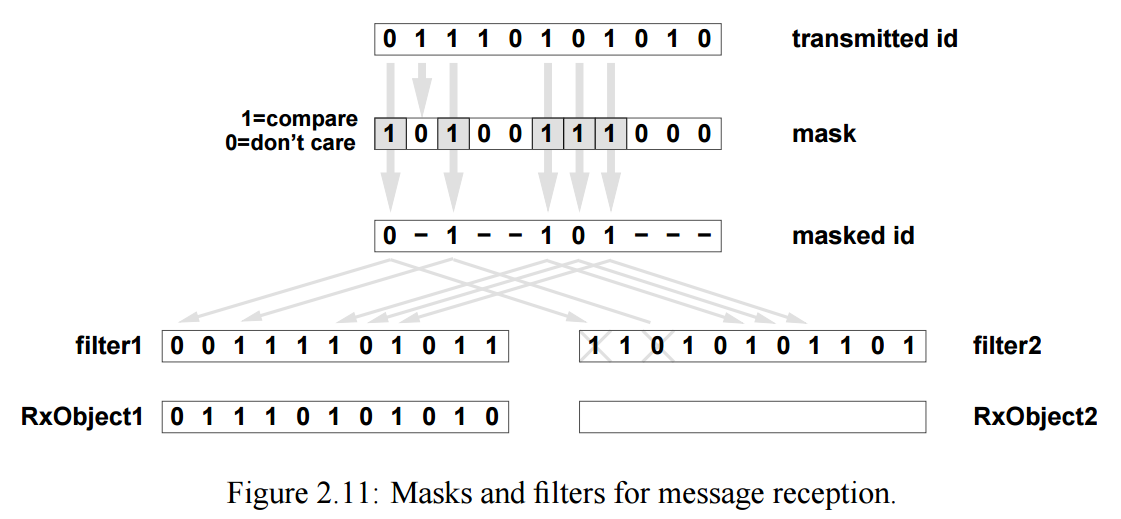
CANBUS is a two-wire, half-duplex, bus based LAN system that is ‘collision free’.
Data is BROADCAST onto the bus -THERE IS NO SUCH THNG AS A POINT TO POINT CONNECTION as with data LANs.
All nodes receive all broadcast data and decide whether or not that data is relevant.
A CANBUS B frame consists of a four byte header (containing a 29-bit identifier), followed by up to 8 data bytes.
A receiving node would examine the identifier to decide if it was relevant (e.g. waiting for a frame with ID 00001567 which contains data to switch on or off a motor).
It could do this via software (using a C if or case statement); in practice the Canbus interface contains firmware to carry out this task
using the acceptance filter and mask value to filter out unwanted messages.
The filter mask is used to determine which bits in the identifier of the received frame are compared with the filter
If a mask bit is set to a zero, the corresponding ID bit will automatically be accepted, regardless of the value of the filter bit.
If a mask bit is set to a one, the corresponding ID bit will be compare with the value of the filter bit;
if they match it is accepted otherwise the frame is rejected.
A filter matches, when received_can_id & mask == can_id & mask -- Mask=1 : Do Care Bits
Example 1. we wish to accept only frames with ID of 00001567 (hexadecimal values)
set filter to 00001567
set mask to 1FFFFFFF --- Every Bit must match filter
when a frame arrives its ID is compared with the filter and all bits must match; any frame that does not match ID 00001567 is rejected
Example 2. we wish to accept only frames with IDs of 00001560 thru to 0000156F
set filter to 00001560
set mask to 1FFFFFF Low 4 Bits dont care
when a frame arrives its ID is compared with the filter and all bits except bits 0 to 3 must match; any frame other frame is rejected
Example 3. we wish to accept only frames with IDs of 00001560 thru to 00001567
set filter to 00001560
set mask to 1FFFFFF8 Low 3 Bits dont care
when a frame arrives its ID is compared with the filter and all bits except bits 0 to 2 must match; any frame other frame is rejected
Example 4. we wish to accept any frame
set filter to 0
set mask to 0 --- Every Bits dont care
all frames are accepted
In practice Canbus interfaces tends to have a number of filters and masks so combinations of IDs can be accepted,
e.g. a module that carries out a number of different tasks.// mask bit n | filter bit n | message ID bit n | result
   //     Mask       Filter         ID

   //     0             x               x             accept

   //     1             0               0             accept

   //     1             0               1             reject

   //     1             1               0             reject

   //     1             1               1             accept
Since this filtering is done in hardware it is fairly primitive. Usually the calculation involves two registers a mask and a filter. The equivalent logic in C would be:
/* dsPIC style; mask specifies "do care" bits */

if ((arbitrationId & mask) == filter) {

    /* Message accepted; rx interrupt triggered */

}

/* Accept all */

mask = ;

filter = ;

/* Accept CANopen default connection set (excluding SYNC and NMT) */

mask = 0x7F;

filter = node_id;
/* SJA 1000 style; mask specifies "do not care" bits */

if ((arbitrationId & ~mask) == filter) {

    /* Message accepted; rx interrupt triggered */

}

/* Accept all */

mask = ~;

filter = ;

/* Accept CANopen default connection set (excluding SYNC and NMT) */

mask = ~0x7F;

filter = node_id;
4.1 RAW protocol sockets with can_filters (SOCK_RAW)

  Using CAN_RAW sockets is extensively comparable to the commonly

  known access to CAN character devices. To meet the new possibilities

  provided by the multi user SocketCAN approach, some reasonable

  defaults are set at RAW socket binding time:

  - The filters are set to exactly one filter receiving everything

  - The socket only receives valid data frames (=> no error message frames)

  - The loopback of sent CAN frames is enabled (see chapter 3.2)

  - The socket does not receive its own sent frames (in loopback mode)

  These default settings may be changed before or after binding the socket.

  To use the referenced definitions of the socket options for CAN_RAW

  sockets, include <linux/can/raw.h>.

  4.1.1 RAW socket option CAN_RAW_FILTER

  The reception of CAN frames using CAN_RAW sockets can be controlled

  by defining 0 .. n filters with the CAN_RAW_FILTER socket option.

  The CAN filter structure is defined in include/linux/can.h:

    struct can_filter {

            canid_t can_id;

            canid_t can_mask;

    };

  A filter matches, when

    <received_can_id> & mask == can_id & mask


  which is analogous to known CAN controllers hardware filter semantics.

  The filter can be inverted in this semantic, when the CAN_INV_FILTER

  bit is set in can_id element of the can_filter structure. In

  contrast to CAN controller hardware filters the user may set 0 .. n

  receive filters for each open socket separately:

    struct can_filter rfilter[2];

    rfilter[0].can_id   = 0x123;

    rfilter[0].can_mask = CAN_SFF_MASK;

    rfilter[1].can_id   = 0x200;

    rfilter[1].can_mask = 0x700;

    setsockopt(s, SOL_CAN_RAW, CAN_RAW_FILTER, &rfilter, sizeof(rfilter));

  To disable the reception of CAN frames on the selected CAN_RAW socket:

    setsockopt(s, SOL_CAN_RAW, CAN_RAW_FILTER, NULL, 0);

  To set the filters to zero filters is quite obsolete as to not read

  data causes the raw socket to discard the received CAN frames. But

  having this 'send only' use-case we may remove the receive list in the

  Kernel to save a little (really a very little!) CPU usage.

  4.1.1.1 CAN filter usage optimisation

  The CAN filters are processed in per-device filter lists at CAN frame

  reception time. To reduce the number of checks that need to be performed

  while walking through the filter lists the CAN core provides an optimized

  filter handling when the filter subscription focusses on a single CAN ID.

  For the possible 2048 SFF CAN identifiers the identifier is used as an index

  to access the corresponding subscription list without any further checks.

  For the 2^29 possible EFF CAN identifiers a 10 bit XOR folding is used as

  hash function to retrieve the EFF table index.

  To benefit from the optimized filters for single CAN identifiers the

  CAN_SFF_MASK or CAN_EFF_MASK have to be set into can_filter.mask together

  with set CAN_EFF_FLAG and CAN_RTR_FLAG bits. A set CAN_EFF_FLAG bit in the

  can_filter.mask makes clear that it matters whether a SFF or EFF CAN ID is

  subscribed. E.g. in the example from above

    rfilter[0].can_id   = 0x123;

    rfilter[0].can_mask = CAN_SFF_MASK;

  both SFF frames with CAN ID 0x123 and EFF frames with 0xXXXXX123 can pass.

  To filter for only 0x123 (SFF) and 0x12345678 (EFF) CAN identifiers the

  filter has to be defined in this way to benefit from the optimized filters:

    struct can_filter rfilter[2];

    rfilter[0].can_id   = 0x123;

    rfilter[0].can_mask = (CAN_EFF_FLAG | CAN_RTR_FLAG | CAN_SFF_MASK);

    rfilter[1].can_id   = 0x12345678 | CAN_EFF_FLAG;

    rfilter[1].can_mask = (CAN_EFF_FLAG | CAN_RTR_FLAG | CAN_EFF_MASK);

    setsockopt(s, SOL_CAN_RAW, CAN_RAW_FILTER, &rfilter, sizeof(rfilter));

  4.1.2 RAW socket option CAN_RAW_ERR_FILTER

  As described in chapter 3.4 the CAN interface driver can generate so

  called Error Message Frames that can optionally be passed to the user

  application in the same way as other CAN frames. The possible

  errors are divided into different error classes that may be filtered

  using the appropriate error mask. To register for every possible

  error condition CAN_ERR_MASK can be used as value for the error mask.

  The values for the error mask are defined in linux/can/error.h .

    can_err_mask_t err_mask = ( CAN_ERR_TX_TIMEOUT | CAN_ERR_BUSOFF );

    setsockopt(s, SOL_CAN_RAW, CAN_RAW_ERR_FILTER,

               &err_mask, sizeof(err_mask));
Canbus ID filter and mask的更多相关文章
- 【转】汽车CAN总线
概述 CAN(Controller Area Network)总线协议是由 BOSCH 发明的一种基于消息广播模式的串行通信总线,它起初用于实现汽车内ECU之间可靠的通信,后因其简单实用可靠等特点,而 ...
- [CAN].CAN总线详解
转自:https://blog.csdn.net/cheatscat/article/details/82886889 CAN(Controller Area Network)总线协议是由 BOSCH ...
- PHP Filter
PHP filters are used to validate and sanitize external input. Validating data is determine if the da ...
- 用php自带的filter函数验证、过滤数据 -转载
PHP过滤器包含两种类型 Validation:用来验证验证项是否合法 Sanitization:用来格式化被验证的项目,因此它可能会修改验证项的值,将不合法的字符删除等. input_filters ...
- filter滤镜的使用
刚开始学css,开始遇到filter不懂什么意思后来到网上查了,觉得解释的很全面,就把它抠下来,以便自己经常来看看. CSS滤镜的使用方法:filter:filtername(parameters) ...
- 了不起的 “filter(NULL IS NOT NULL)”
经常会在执行计划中看到很奇怪的"FILTER"操作,然后看对应的执行信息是"filter(NULL IS NOT NULL)". 其实这是优化器非常聪明的“短 ...
- [代码解析]Mask R-CNN介绍与实现(转)
文章来源 DFann 版权声明:如果你觉得写的还可以,可以考虑打赏一下.转载请联系. https://blog.csdn.net/u011974639/article/details/78483779 ...
- csc_滤镜filter和实现透明的两种方式
有这样一个需求,给一个地图实现半透明效果. 使用css滤镜属性可以实现:filter. 下面是属性的所以值 filter: none | blur() | brightness() | contras ...
- vue循环遍历给div添加id
html部分 <div class="img-preview" v-for="(img,i) of list" :key="img.imageK ...
随机推荐
- 关于caffe的安装问题
在caffe的安装过程中,出现 /usr/bin/ld: cannot find -lcblas /usr/bin/ld: cannot find -latlas的问题 这时解决方案为http://s ...
- CSS font系列
font-family font-family: Verdana,Helvetica,Arial,"Microsoft YaHei",sans-serif; font-family ...
- KNN实现手写数字识别
KNN实现手写数字识别 博客上显示这个没有Jupyter的好看,想看Jupyter Notebook的请戳KNN实现手写数字识别.ipynb 1 - 导入模块 import numpy as np i ...
- Bug Bounty Reference
https://github.com/ngalongc/bug-bounty-reference/blob/master/README.md#remote-code-execution Bug Bou ...
- 【网络编程】使用getnameinfo()/getaddrinfo()/InetPton()
1.简要 从前用的网络编程函数现在又做了一定的改动,报了这么3个错误. error C4996: 'inet_ntoa': Use inet_ntop() or InetNtop() instead ...
- 发布构件到Maven中央仓库
一.注册jira账号 访问如下网址: https://issues.sonatype.org/secure/Signup.jspa 记住邮箱,用户名,密码以备以后使用,一定牢记. 二.创建一个issu ...
- SQLServer 的case when语句使用实现统计
已知有表game_info 如下 date_info result_info 2018-2-4 win 2018-2-4 lose 2018-2-4 win 2018-2-4 lose 2018-2- ...
- P1203 [USACO1.1]坏掉的项链Broken Necklace
P1203 [USACO1.1]坏掉的项链Broken Necklace不错的断环为链的模拟题,开成三倍,有很多细节要考虑,比如总长度要<=n,开头第一个是w等等. #include<bi ...
- 006.FTP用户访问控制配置
一 FTP控制文件 1.1 文件说明 /etc/vsftpd/ftpusers:黑名单,优先级高 #通常不修改此文件 /etc/vsftpd/user_list:黑名单,优先级相对低 注意:Linux ...
- Java对epub电子书类型切割
Epub电子书切割 引言:由于公司存储电子书的格式是.epub.一本电子书加载的时候,如果电子书大的话,全部加载该电子书会非常的消耗时间和资源.非常的不合理.那么现在,将所有电子书按章切分.将拆分的电 ...