
Python之路,Day2 - Python基础2
运算符
1、算数运算:
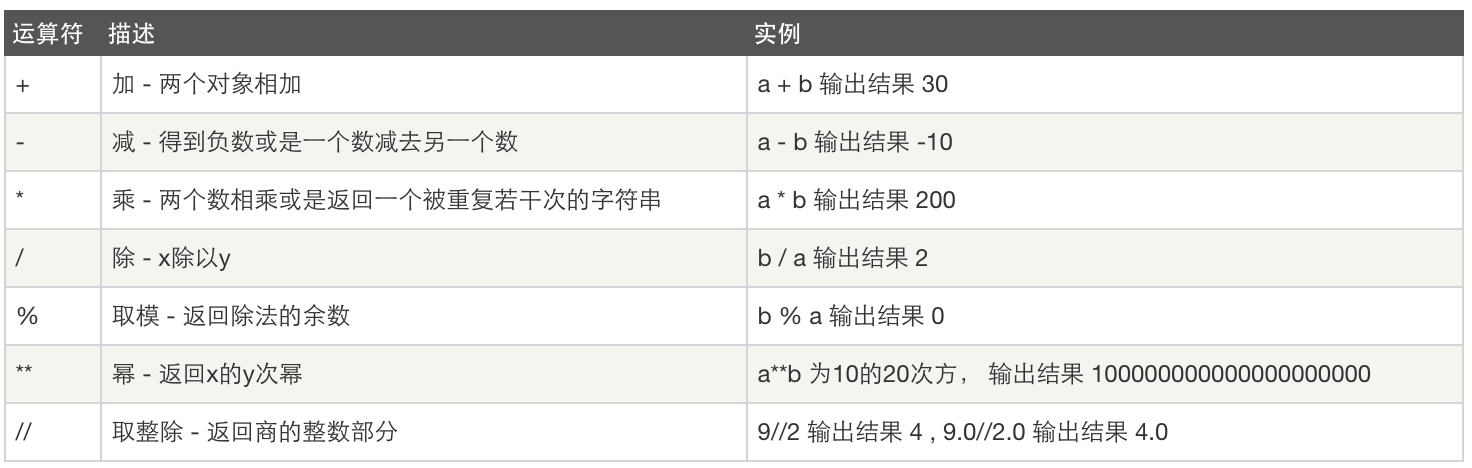
2、比较运算:
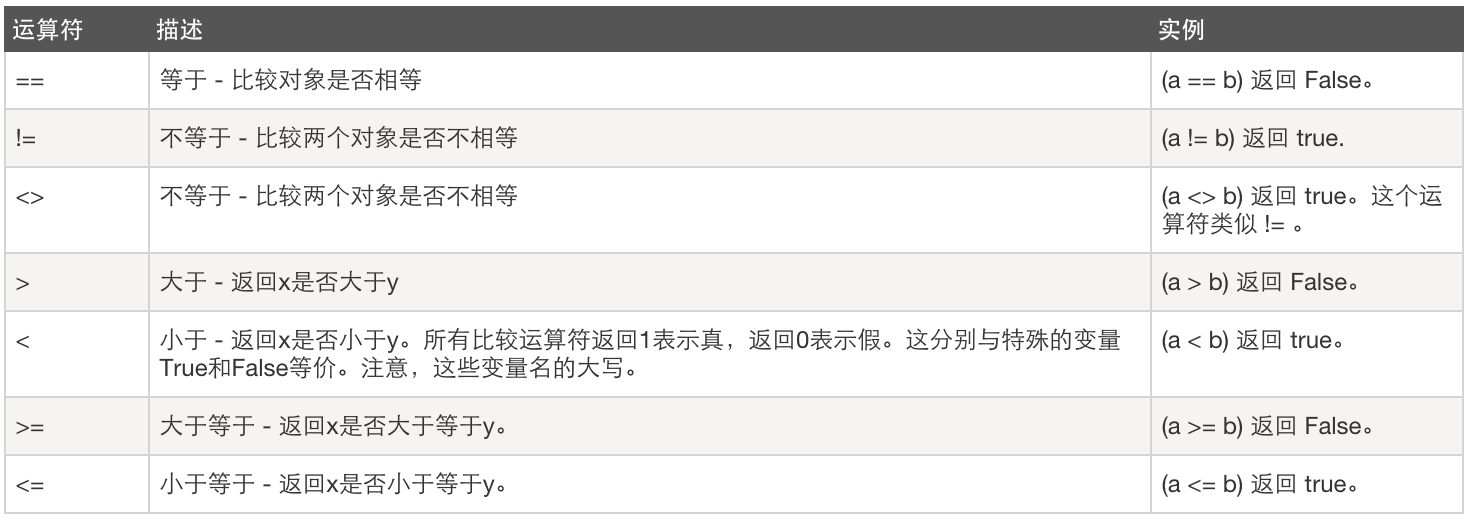
3、赋值运算:
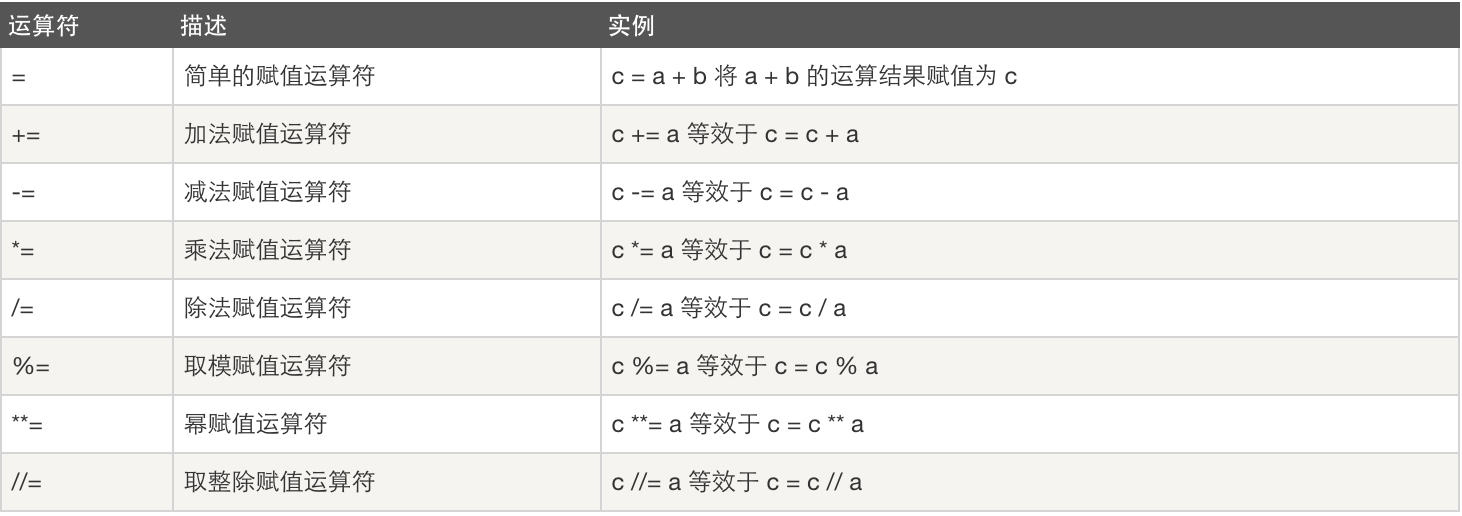
4、逻辑运算:

5、成员运算:

基本数据类型
1、数字
int(整型)
在32位机器上,整数的位数为32位,取值范围为-2**31~2**31-1,即-2147483648~2147483647
在64位系统上,整数的位数为64位,取值范围为-2**63~2**63-1,即-9223372036854775808~9223372036854775807
2、布尔值
真或假
1 或 0
3、字符串
"hello world"
字符串常用功能:
- 移除空白
- 分割
- 长度
- 索引
- 切片
class str(basestring): """ str(object='') -> string Return a nice string representation of the object. If the argument is a string, the return value is the same object. """ def capitalize(self): """ 首字母变大写 """ """ S.capitalize() -> string Return a copy of the string S with only its first character capitalized. """ return "" def center(self, width, fillchar=None): """ 内容居中,width:总长度;fillchar:空白处填充内容,默认无 """ """ S.center(width[, fillchar]) -> string Return S centered in a string of length width. Padding is done using the specified fill character (default is a space) """ return "" def count(self, sub, start=None, end=None): """ 子序列个数 """ """ S.count(sub[, start[, end]]) -> int Return the number of non-overlapping occurrences of substring sub in string S[start:end]. Optional arguments start and end are interpreted as in slice notation. """ return 0 def decode(self, encoding=None, errors=None): """ 解码 """ """ S.decode([encoding[,errors]]) -> object Decodes S using the codec registered for encoding. encoding defaults to the default encoding. errors may be given to set a different error handling scheme. Default is 'strict' meaning that encoding errors raise a UnicodeDecodeError. Other possible values are 'ignore' and 'replace' as well as any other name registered with codecs.register_error that is able to handle UnicodeDecodeErrors. """ return object() def encode(self, encoding=None, errors=None): """ 编码,针对unicode """ """ S.encode([encoding[,errors]]) -> object Encodes S using the codec registered for encoding. encoding defaults to the default encoding. errors may be given to set a different error handling scheme. Default is 'strict' meaning that encoding errors raise a UnicodeEncodeError. Other possible values are 'ignore', 'replace' and 'xmlcharrefreplace' as well as any other name registered with codecs.register_error that is able to handle UnicodeEncodeErrors. """ return object() def endswith(self, suffix, start=None, end=None): """ 是否以 xxx 结束 """ """ S.endswith(suffix[, start[, end]]) -> bool Return True if S ends with the specified suffix, False otherwise. With optional start, test S beginning at that position. With optional end, stop comparing S at that position. suffix can also be a tuple of strings to try. """ return False def expandtabs(self, tabsize=None): """ 将tab转换成空格,默认一个tab转换成8个空格 """ """ S.expandtabs([tabsize]) -> string Return a copy of S where all tab characters are expanded using spaces. If tabsize is not given, a tab size of 8 characters is assumed. """ return "" def find(self, sub, start=None, end=None): """ 寻找子序列位置,如果没找到,返回 -1 """ """ S.find(sub [,start [,end]]) -> int Return the lowest index in S where substring sub is found, such that sub is contained within S[start:end]. Optional arguments start and end are interpreted as in slice notation. Return -1 on failure. """ return 0 def format(*args, **kwargs): # known special case of str.format """ 字符串格式化,动态参数,将函数式编程时细说 """ """ S.format(*args, **kwargs) -> string Return a formatted version of S, using substitutions from args and kwargs. The substitutions are identified by braces ('{' and '}'). """ pass def index(self, sub, start=None, end=None): """ 子序列位置,如果没找到,报错 """ S.index(sub [,start [,end]]) -> int Like S.find() but raise ValueError when the substring is not found. """ return 0 def isalnum(self): """ 是否是字母和数字 """ """ S.isalnum() -> bool Return True if all characters in S are alphanumeric and there is at least one character in S, False otherwise. """ return False def isalpha(self): """ 是否是字母 """ """ S.isalpha() -> bool Return True if all characters in S are alphabetic and there is at least one character in S, False otherwise. """ return False def isdigit(self): """ 是否是数字 """ """ S.isdigit() -> bool Return True if all characters in S are digits and there is at least one character in S, False otherwise. """ return False def islower(self): """ 是否小写 """ """ S.islower() -> bool Return True if all cased characters in S are lowercase and there is at least one cased character in S, False otherwise. """ return False def isspace(self): """ S.isspace() -> bool Return True if all characters in S are whitespace and there is at least one character in S, False otherwise. """ return False def istitle(self): """ S.istitle() -> bool Return True if S is a titlecased string and there is at least one character in S, i.e. uppercase characters may only follow uncased characters and lowercase characters only cased ones. Return False otherwise. """ return False def isupper(self): """ S.isupper() -> bool Return True if all cased characters in S are uppercase and there is at least one cased character in S, False otherwise. """ return False def join(self, iterable): """ 连接 """ """ S.join(iterable) -> string Return a string which is the concatenation of the strings in the iterable. The separator between elements is S. """ return "" def ljust(self, width, fillchar=None): """ 内容左对齐,右侧填充 """ """ S.ljust(width[, fillchar]) -> string Return S left-justified in a string of length width. Padding is done using the specified fill character (default is a space). """ return "" def lower(self): """ 变小写 """ """ S.lower() -> string Return a copy of the string S converted to lowercase. """ return "" def lstrip(self, chars=None): """ 移除左侧空白 """ """ S.lstrip([chars]) -> string or unicode Return a copy of the string S with leading whitespace removed. If chars is given and not None, remove characters in chars instead. If chars is unicode, S will be converted to unicode before stripping """ return "" def partition(self, sep): """ 分割,前,中,后三部分 """ """ S.partition(sep) -> (head, sep, tail) Search for the separator sep in S, and return the part before it, the separator itself, and the part after it. If the separator is not found, return S and two empty strings. """ pass def replace(self, old, new, count=None): """ 替换 """ """ S.replace(old, new[, count]) -> string Return a copy of string S with all occurrences of substring old replaced by new. If the optional argument count is given, only the first count occurrences are replaced. """ return "" def rfind(self, sub, start=None, end=None): """ S.rfind(sub [,start [,end]]) -> int Return the highest index in S where substring sub is found, such that sub is contained within S[start:end]. Optional arguments start and end are interpreted as in slice notation. Return -1 on failure. """ return 0 def rindex(self, sub, start=None, end=None): """ S.rindex(sub [,start [,end]]) -> int Like S.rfind() but raise ValueError when the substring is not found. """ return 0 def rjust(self, width, fillchar=None): """ S.rjust(width[, fillchar]) -> string Return S right-justified in a string of length width. Padding is done using the specified fill character (default is a space) """ return "" def rpartition(self, sep): """ S.rpartition(sep) -> (head, sep, tail) Search for the separator sep in S, starting at the end of S, and return the part before it, the separator itself, and the part after it. If the separator is not found, return two empty strings and S. """ pass def rsplit(self, sep=None, maxsplit=None): """ S.rsplit([sep [,maxsplit]]) -> list of strings Return a list of the words in the string S, using sep as the delimiter string, starting at the end of the string and working to the front. If maxsplit is given, at most maxsplit splits are done. If sep is not specified or is None, any whitespace string is a separator. """ return [] def rstrip(self, chars=None): """ S.rstrip([chars]) -> string or unicode Return a copy of the string S with trailing whitespace removed. If chars is given and not None, remove characters in chars instead. If chars is unicode, S will be converted to unicode before stripping """ return "" def split(self, sep=None, maxsplit=None): """ 分割, maxsplit最多分割几次 """ """ S.split([sep [,maxsplit]]) -> list of strings Return a list of the words in the string S, using sep as the delimiter string. If maxsplit is given, at most maxsplit splits are done. If sep is not specified or is None, any whitespace string is a separator and empty strings are removed from the result. """ return [] def splitlines(self, keepends=False): """ 根据换行分割 """ """ S.splitlines(keepends=False) -> list of strings Return a list of the lines in S, breaking at line boundaries. Line breaks are not included in the resulting list unless keepends is given and true. """ return [] def startswith(self, prefix, start=None, end=None): """ 是否起始 """ """ S.startswith(prefix[, start[, end]]) -> bool Return True if S starts with the specified prefix, False otherwise. With optional start, test S beginning at that position. With optional end, stop comparing S at that position. prefix can also be a tuple of strings to try. """ return False def strip(self, chars=None): """ 移除两段空白 """ """ S.strip([chars]) -> string or unicode Return a copy of the string S with leading and trailing whitespace removed. If chars is given and not None, remove characters in chars instead. If chars is unicode, S will be converted to unicode before stripping """ return "" def swapcase(self): """ 大写变小写,小写变大写 """ """ S.swapcase() -> string Return a copy of the string S with uppercase characters converted to lowercase and vice versa. """ return "" def title(self): """ S.title() -> string Return a titlecased version of S, i.e. words start with uppercase characters, all remaining cased characters have lowercase. """ return "" def translate(self, table, deletechars=None): """ 转换,需要先做一个对应表,最后一个表示删除字符集合 intab = "aeiou" outtab = "12345" trantab = maketrans(intab, outtab) str = "this is string example....wow!!!" print str.translate(trantab, 'xm') """ """ S.translate(table [,deletechars]) -> string Return a copy of the string S, where all characters occurring in the optional argument deletechars are removed, and the remaining characters have been mapped through the given translation table, which must be a string of length 256 or None. If the table argument is None, no translation is applied and the operation simply removes the characters in deletechars. """ return "" def upper(self): """ S.upper() -> string Return a copy of the string S converted to uppercase. """ return "" def zfill(self, width): """方法返回指定长度的字符串,原字符串右对齐,前面填充0。""" """ S.zfill(width) -> string Pad a numeric string S with zeros on the left, to fill a field of the specified width. The string S is never truncated. """ return "" def _formatter_field_name_split(self, *args, **kwargs): # real signature unknown pass def _formatter_parser(self, *args, **kwargs): # real signature unknown pass def __add__(self, y): """ x.__add__(y) <==> x+y """ pass def __contains__(self, y): """ x.__contains__(y) <==> y in x """ pass def __eq__(self, y): """ x.__eq__(y) <==> x==y """ pass def __format__(self, format_spec): """ S.__format__(format_spec) -> string Return a formatted version of S as described by format_spec. """ return "" def __getattribute__(self, name): """ x.__getattribute__('name') <==> x.name """ pass def __getitem__(self, y): """ x.__getitem__(y) <==> x[y] """ pass def __getnewargs__(self, *args, **kwargs): # real signature unknown pass def __getslice__(self, i, j): """ x.__getslice__(i, j) <==> x[i:j] Use of negative indices is not supported. """ pass def __ge__(self, y): """ x.__ge__(y) <==> x>=y """ pass def __gt__(self, y): """ x.__gt__(y) <==> x>y """ pass def __hash__(self): """ x.__hash__() <==> hash(x) """ pass def __init__(self, string=''): # known special case of str.__init__ """ str(object='') -> string Return a nice string representation of the object. If the argument is a string, the return value is the same object. # (copied from class doc) """ pass def __len__(self): """ x.__len__() <==> len(x) """ pass def __le__(self, y): """ x.__le__(y) <==> x<=y """ pass def __lt__(self, y): """ x.__lt__(y) <==> x<y """ pass def __mod__(self, y): """ x.__mod__(y) <==> x%y """ pass def __mul__(self, n): """ x.__mul__(n) <==> x*n """ pass @staticmethod # known case of __new__ def __new__(S, *more): """ T.__new__(S, ...) -> a new object with type S, a subtype of T """ pass def __ne__(self, y): """ x.__ne__(y) <==> x!=y """ pass def __repr__(self): """ x.__repr__() <==> repr(x) """ pass def __rmod__(self, y): """ x.__rmod__(y) <==> y%x """ pass def __rmul__(self, n): """ x.__rmul__(n) <==> n*x """ pass def __sizeof__(self): """ S.__sizeof__() -> size of S in memory, in bytes """ pass def __str__(self): """ x.__str__() <==> str(x) """ passstr
4、列表
创建列表:
1
2
3
name_list = ['alex', 'seven', 'eric']
或
name_list = list(['alex', 'seven', 'eric'])
基本操作:
- 索引
- 切片
- 追加
- 删除
- 长度
- 切片
- 循环
- 包含
class list(object): """ list() -> new empty list list(iterable) -> new list initialized from iterable's items """ def append(self, p_object): # real signature unknown; restored from __doc__ """ L.append(object) -- append object to end """ pass def count(self, value): # real signature unknown; restored from __doc__ """ L.count(value) -> integer -- return number of occurrences of value """ return 0 def extend(self, iterable): # real signature unknown; restored from __doc__ """ L.extend(iterable) -- extend list by appending elements from the iterable """ pass def index(self, value, start=None, stop=None): # real signature unknown; restored from __doc__ """ L.index(value, [start, [stop]]) -> integer -- return first index of value. Raises ValueError if the value is not present. """ return 0 def insert(self, index, p_object): # real signature unknown; restored from __doc__ """ L.insert(index, object) -- insert object before index """ pass def pop(self, index=None): # real signature unknown; restored from __doc__ """ L.pop([index]) -> item -- remove and return item at index (default last). Raises IndexError if list is empty or index is out of range. """ pass def remove(self, value): # real signature unknown; restored from __doc__ """ L.remove(value) -- remove first occurrence of value. Raises ValueError if the value is not present. """ pass def reverse(self): # real signature unknown; restored from __doc__ """ L.reverse() -- reverse *IN PLACE* """ pass def sort(self, cmp=None, key=None, reverse=False): # real signature unknown; restored from __doc__ """ L.sort(cmp=None, key=None, reverse=False) -- stable sort *IN PLACE*; cmp(x, y) -> -1, 0, 1 """ pass def __add__(self, y): # real signature unknown; restored from __doc__ """ x.__add__(y) <==> x+y """ pass def __contains__(self, y): # real signature unknown; restored from __doc__ """ x.__contains__(y) <==> y in x """ pass def __delitem__(self, y): # real signature unknown; restored from __doc__ """ x.__delitem__(y) <==> del x[y] """ pass def __delslice__(self, i, j): # real signature unknown; restored from __doc__ """ x.__delslice__(i, j) <==> del x[i:j] Use of negative indices is not supported. """ pass def __eq__(self, y): # real signature unknown; restored from __doc__ """ x.__eq__(y) <==> x==y """ pass def __getattribute__(self, name): # real signature unknown; restored from __doc__ """ x.__getattribute__('name') <==> x.name """ pass def __getitem__(self, y): # real signature unknown; restored from __doc__ """ x.__getitem__(y) <==> x[y] """ pass def __getslice__(self, i, j): # real signature unknown; restored from __doc__ """ x.__getslice__(i, j) <==> x[i:j] Use of negative indices is not supported. """ pass def __ge__(self, y): # real signature unknown; restored from __doc__ """ x.__ge__(y) <==> x>=y """ pass def __gt__(self, y): # real signature unknown; restored from __doc__ """ x.__gt__(y) <==> x>y """ pass def __iadd__(self, y): # real signature unknown; restored from __doc__ """ x.__iadd__(y) <==> x+=y """ pass def __imul__(self, y): # real signature unknown; restored from __doc__ """ x.__imul__(y) <==> x*=y """ pass def __init__(self, seq=()): # known special case of list.__init__ """ list() -> new empty list list(iterable) -> new list initialized from iterable's items # (copied from class doc) """ pass def __iter__(self): # real signature unknown; restored from __doc__ """ x.__iter__() <==> iter(x) """ pass def __len__(self): # real signature unknown; restored from __doc__ """ x.__len__() <==> len(x) """ pass def __le__(self, y): # real signature unknown; restored from __doc__ """ x.__le__(y) <==> x<=y """ pass def __lt__(self, y): # real signature unknown; restored from __doc__ """ x.__lt__(y) <==> x<y """ pass def __mul__(self, n): # real signature unknown; restored from __doc__ """ x.__mul__(n) <==> x*n """ pass @staticmethod # known case of __new__ def __new__(S, *more): # real signature unknown; restored from __doc__ """ T.__new__(S, ...) -> a new object with type S, a subtype of T """ pass def __ne__(self, y): # real signature unknown; restored from __doc__ """ x.__ne__(y) <==> x!=y """ pass def __repr__(self): # real signature unknown; restored from __doc__ """ x.__repr__() <==> repr(x) """ pass def __reversed__(self): # real signature unknown; restored from __doc__ """ L.__reversed__() -- return a reverse iterator over the list """ pass def __rmul__(self, n): # real signature unknown; restored from __doc__ """ x.__rmul__(n) <==> n*x """ pass def __setitem__(self, i, y): # real signature unknown; restored from __doc__ """ x.__setitem__(i, y) <==> x[i]=y """ pass def __setslice__(self, i, j, y): # real signature unknown; restored from __doc__ """ x.__setslice__(i, j, y) <==> x[i:j]=y Use of negative indices is not supported. """ pass def __sizeof__(self): # real signature unknown; restored from __doc__ """ L.__sizeof__() -- size of L in memory, in bytes """ pass __hash__ = Nonelist
5、元祖
创建元祖:
1
2
3
ages = (11, 22, 33, 44, 55)
或
ages = tuple((11, 22, 33, 44, 55))
基本操作:
- 索引
- 切片
- 循环
- 长度
- 包含
lass tuple(object): """ tuple() -> empty tuple tuple(iterable) -> tuple initialized from iterable's items If the argument is a tuple, the return value is the same object. """ def count(self, value): # real signature unknown; restored from __doc__ """ T.count(value) -> integer -- return number of occurrences of value """ return 0 def index(self, value, start=None, stop=None): # real signature unknown; restored from __doc__ """ T.index(value, [start, [stop]]) -> integer -- return first index of value. Raises ValueError if the value is not present. """ return 0 def __add__(self, y): # real signature unknown; restored from __doc__ """ x.__add__(y) <==> x+y """ pass def __contains__(self, y): # real signature unknown; restored from __doc__ """ x.__contains__(y) <==> y in x """ pass def __eq__(self, y): # real signature unknown; restored from __doc__ """ x.__eq__(y) <==> x==y """ pass def __getattribute__(self, name): # real signature unknown; restored from __doc__ """ x.__getattribute__('name') <==> x.name """ pass def __getitem__(self, y): # real signature unknown; restored from __doc__ """ x.__getitem__(y) <==> x[y] """ pass def __getnewargs__(self, *args, **kwargs): # real signature unknown pass def __getslice__(self, i, j): # real signature unknown; restored from __doc__ """ x.__getslice__(i, j) <==> x[i:j] Use of negative indices is not supported. """ pass def __ge__(self, y): # real signature unknown; restored from __doc__ """ x.__ge__(y) <==> x>=y """ pass def __gt__(self, y): # real signature unknown; restored from __doc__ """ x.__gt__(y) <==> x>y """ pass def __hash__(self): # real signature unknown; restored from __doc__ """ x.__hash__() <==> hash(x) """ pass def __init__(self, seq=()): # known special case of tuple.__init__ """ tuple() -> empty tuple tuple(iterable) -> tuple initialized from iterable's items If the argument is a tuple, the return value is the same object. # (copied from class doc) """ pass def __iter__(self): # real signature unknown; restored from __doc__ """ x.__iter__() <==> iter(x) """ pass def __len__(self): # real signature unknown; restored from __doc__ """ x.__len__() <==> len(x) """ pass def __le__(self, y): # real signature unknown; restored from __doc__ """ x.__le__(y) <==> x<=y """ pass def __lt__(self, y): # real signature unknown; restored from __doc__ """ x.__lt__(y) <==> x<y """ pass def __mul__(self, n): # real signature unknown; restored from __doc__ """ x.__mul__(n) <==> x*n """ pass @staticmethod # known case of __new__ def __new__(S, *more): # real signature unknown; restored from __doc__ """ T.__new__(S, ...) -> a new object with type S, a subtype of T """ pass def __ne__(self, y): # real signature unknown; restored from __doc__ """ x.__ne__(y) <==> x!=y """ pass def __repr__(self): # real signature unknown; restored from __doc__ """ x.__repr__() <==> repr(x) """ pass def __rmul__(self, n): # real signature unknown; restored from __doc__ """ x.__rmul__(n) <==> n*x """ pass def __sizeof__(self): # real signature unknown; restored from __doc__ """ T.__sizeof__() -- size of T in memory, in bytes """ passtuple
6、字典(无序)
创建字典:
1
2
3
person = {"name": "mr.wu", 'age': 18}
或
person = dict({"name": "mr.wu", 'age': 18})
常用操作:
- 索引
- 新增
- 删除
- 键、值、键值对
- 循环
- 长度
class dict(object): """ dict() -> new empty dictionary dict(mapping) -> new dictionary initialized from a mapping object's (key, value) pairs dict(iterable) -> new dictionary initialized as if via: d = {} for k, v in iterable: d[k] = v dict(**kwargs) -> new dictionary initialized with the name=value pairs in the keyword argument list. For example: dict(one=1, two=2) """ def clear(self): # real signature unknown; restored from __doc__ """ 清除内容 """ """ D.clear() -> None. Remove all items from D. """ pass def copy(self): # real signature unknown; restored from __doc__ """ 浅拷贝 """ """ D.copy() -> a shallow copy of D """ pass @staticmethod # known case def fromkeys(S, v=None): # real signature unknown; restored from __doc__ """ dict.fromkeys(S[,v]) -> New dict with keys from S and values equal to v. v defaults to None. """ pass def get(self, k, d=None): # real signature unknown; restored from __doc__ """ 根据key获取值,d是默认值 """ """ D.get(k[,d]) -> D[k] if k in D, else d. d defaults to None. """ pass def has_key(self, k): # real signature unknown; restored from __doc__ """ 是否有key """ """ D.has_key(k) -> True if D has a key k, else False """ return False def items(self): # real signature unknown; restored from __doc__ """ 所有项的列表形式 """ """ D.items() -> list of D's (key, value) pairs, as 2-tuples """ return [] def iteritems(self): # real signature unknown; restored from __doc__ """ 项可迭代 """ """ D.iteritems() -> an iterator over the (key, value) items of D """ pass def iterkeys(self): # real signature unknown; restored from __doc__ """ key可迭代 """ """ D.iterkeys() -> an iterator over the keys of D """ pass def itervalues(self): # real signature unknown; restored from __doc__ """ value可迭代 """ """ D.itervalues() -> an iterator over the values of D """ pass def keys(self): # real signature unknown; restored from __doc__ """ 所有的key列表 """ """ D.keys() -> list of D's keys """ return [] def pop(self, k, d=None): # real signature unknown; restored from __doc__ """ 获取并在字典中移除 """ """ D.pop(k[,d]) -> v, remove specified key and return the corresponding value. If key is not found, d is returned if given, otherwise KeyError is raised """ pass def popitem(self): # real signature unknown; restored from __doc__ """ 获取并在字典中移除 """ """ D.popitem() -> (k, v), remove and return some (key, value) pair as a 2-tuple; but raise KeyError if D is empty. """ pass def setdefault(self, k, d=None): # real signature unknown; restored from __doc__ """ 如果key不存在,则创建,如果存在,则返回已存在的值且不修改 """ """ D.setdefault(k[,d]) -> D.get(k,d), also set D[k]=d if k not in D """ pass def update(self, E=None, **F): # known special case of dict.update """ 更新 {'name':'alex', 'age': 18000} [('name','sbsbsb'),] """ """ D.update([E, ]**F) -> None. Update D from dict/iterable E and F. If E present and has a .keys() method, does: for k in E: D[k] = E[k] If E present and lacks .keys() method, does: for (k, v) in E: D[k] = v In either case, this is followed by: for k in F: D[k] = F[k] """ pass def values(self): # real signature unknown; restored from __doc__ """ 所有的值 """ """ D.values() -> list of D's values """ return [] def viewitems(self): # real signature unknown; restored from __doc__ """ 所有项,只是将内容保存至view对象中 """ """ D.viewitems() -> a set-like object providing a view on D's items """ pass def viewkeys(self): # real signature unknown; restored from __doc__ """ D.viewkeys() -> a set-like object providing a view on D's keys """ pass def viewvalues(self): # real signature unknown; restored from __doc__ """ D.viewvalues() -> an object providing a view on D's values """ pass def __cmp__(self, y): # real signature unknown; restored from __doc__ """ x.__cmp__(y) <==> cmp(x,y) """ pass def __contains__(self, k): # real signature unknown; restored from __doc__ """ D.__contains__(k) -> True if D has a key k, else False """ return False def __delitem__(self, y): # real signature unknown; restored from __doc__ """ x.__delitem__(y) <==> del x[y] """ pass def __eq__(self, y): # real signature unknown; restored from __doc__ """ x.__eq__(y) <==> x==y """ pass def __getattribute__(self, name): # real signature unknown; restored from __doc__ """ x.__getattribute__('name') <==> x.name """ pass def __getitem__(self, y): # real signature unknown; restored from __doc__ """ x.__getitem__(y) <==> x[y] """ pass def __ge__(self, y): # real signature unknown; restored from __doc__ """ x.__ge__(y) <==> x>=y """ pass def __gt__(self, y): # real signature unknown; restored from __doc__ """ x.__gt__(y) <==> x>y """ pass def __init__(self, seq=None, **kwargs): # known special case of dict.__init__ """ dict() -> new empty dictionary dict(mapping) -> new dictionary initialized from a mapping object's (key, value) pairs dict(iterable) -> new dictionary initialized as if via: d = {} for k, v in iterable: d[k] = v dict(**kwargs) -> new dictionary initialized with the name=value pairs in the keyword argument list. For example: dict(one=1, two=2) # (copied from class doc) """ pass def __iter__(self): # real signature unknown; restored from __doc__ """ x.__iter__() <==> iter(x) """ pass def __len__(self): # real signature unknown; restored from __doc__ """ x.__len__() <==> len(x) """ pass def __le__(self, y): # real signature unknown; restored from __doc__ """ x.__le__(y) <==> x<=y """ pass def __lt__(self, y): # real signature unknown; restored from __doc__ """ x.__lt__(y) <==> x<y """ pass @staticmethod # known case of __new__ def __new__(S, *more): # real signature unknown; restored from __doc__ """ T.__new__(S, ...) -> a new object with type S, a subtype of T """ pass def __ne__(self, y): # real signature unknown; restored from __doc__ """ x.__ne__(y) <==> x!=y """ pass def __repr__(self): # real signature unknown; restored from __doc__ """ x.__repr__() <==> repr(x) """ pass def __setitem__(self, i, y): # real signature unknown; restored from __doc__ """ x.__setitem__(i, y) <==> x[i]=y """ pass def __sizeof__(self): # real signature unknown; restored from __doc__ """ D.__sizeof__() -> size of D in memory, in bytes """ pass __hash__ = Nonedict
PS:循环,range,continue 和 break
1、for循环
用户按照顺序循环可迭代对象中的内容,
PS:break、continue
li = [11,22,33,44]for item in li: print item
2、enumrate
li = [11,22,33]for k,v in enumerate(li, 1): print(k,v)
3、range和xrange
指定范围,生成指定的数字
print range(1, 10)# 结果:[1, 2, 3, 4, 5, 6, 7, 8, 9] print range(1, 10, 2)# 结果:[1, 3, 5, 7, 9] print range(30, 0, -2)# 结果:[30, 28, 26, 24, 22, 20, 18, 16, 14, 12, 10, 8, 6, 4, 2]
PS:字符串的处理
str='python String function'生成字符串变量str='python String function'字符串长度获取:len(str)例:print '%s length=%d' % (str,len(str))字母处理全部大写:str.upper()全部小写:str.lower()大小写互换:str.swapcase()首字母大写,其余小写:str.capitalize()首字母大写:str.title()print '%s lower=%s' % (str,str.lower())print '%s upper=%s' % (str,str.upper())print '%s swapcase=%s' % (str,str.swapcase())print '%s capitalize=%s' % (str,str.capitalize())print '%s title=%s' % (str,str.title()) 格式化相关获取固定长度,右对齐,左边不够用空格补齐:str.ljust(width)获取固定长度,左对齐,右边不够用空格补齐:str.ljust(width)获取固定长度,中间对齐,两边不够用空格补齐:str.ljust(width)获取固定长度,右对齐,左边不足用0补齐print '%s ljust=%s' % (str,str.ljust(20))print '%s rjust=%s' % (str,str.rjust(20))print '%s center=%s' % (str,str.center(20))print '%s zfill=%s' % (str,str.zfill(20))字符串搜索相关搜索指定字符串,没有返回-1:str.find('t')指定起始位置搜索:str.find('t',start)指定起始及结束位置搜索:str.find('t',start,end)从右边开始查找:str.rfind('t')搜索到多少个指定字符串:str.count('t')上面所有方法都可用index代替,不同的是使用index查找不到会抛异常,而find返回-1print '%s find nono=%d' % (str,str.find('nono'))print '%s find t=%d' % (str,str.find('t'))print '%s find t from %d=%d' % (str,1,str.find('t',1))print '%s find t from %d to %d=%d' % (str,1,2,str.find('t',1,2))#print '%s index nono ' % (str,str.index('nono',1,2))print '%s rfind t=%d' % (str,str.rfind('t'))print '%s count t=%d' % (str,str.count('t'))字符串替换相关替换old为new:str.replace('old','new')替换指定次数的old为new:str.replace('old','new',maxReplaceTimes)print '%s replace t to *=%s' % (str,str.replace('t', '*'))print '%s replace t to *=%s' % (str,str.replace('t', '*',1))字符串去空格及去指定字符去两边空格:str.strip()去左空格:str.lstrip()去右空格:str.rstrip()去两边字符串:str.strip('d'),相应的也有lstrip,rstripstr=' python String function 'print '%s strip=%s' % (str,str.strip())str='python String function'print '%s strip=%s' % (str,str.strip('d'))按指定字符分割字符串为数组:str.split(' ')默认按空格分隔str='a b c de'print '%s strip=%s' % (str,str.split())str='a-b-c-de'print '%s strip=%s' % (str,str.split('-'))字符串判断相关是否以start开头:str.startswith('start')是否以end结尾:str.endswith('end')是否全为字母或数字:str.isalnum()是否全字母:str.isalpha()是否全数字:str.isdigit()是否全小写:str.islower()是否全大写:str.isupper()str='python String function'print '%s startwith t=%s' % (str,str.startswith('t'))print '%s endwith d=%s' % (str,str.endswith('d'))print '%s isalnum=%s' % (str,str.isalnum())str='pythonStringfunction'print '%s isalnum=%s' % (str,str.isalnum())print '%s isalpha=%s' % (str,str.isalpha())print '%s isupper=%s' % (str,str.isupper())print '%s islower=%s' % (str,str.islower())print '%s isdigit=%s' % (str,str.isdigit())str='3423'print '%s isdigit=%s' % (str,str.isdigit())
作业:
附件列表
Python之路,Day2 - Python基础2的更多相关文章
- Python之路,Day2 - Python基础(转载Alex)
Day2-转自金角大王 本节内容 列表.元组操作 字符串操作 字典操作 集合操作 文件操作 字符编码与转码 1. 列表.元组操作 列表是我们最以后最常用的数据类型之一,通过列表可以对数据实现最方便的存 ...
- Python之路 day2 文件基础操作
#!/usr/bin/env python # -*- coding:utf-8 -*- #Author:ersa ''' #f,文件句柄;模式 a : append 追加文件内容 f = open( ...
- Python之路,Day2 - Python基础,列表,循环
1.列表练习name0 = 'wuchao'name1 = 'jinxin'name2 = 'xiaohu'name3 = 'sanpang'name4 = 'ligang' names = &quo ...
- Python之路,Day4 - Python基础4 (new版)
Python之路,Day4 - Python基础4 (new版) 本节内容 迭代器&生成器 装饰器 Json & pickle 数据序列化 软件目录结构规范 作业:ATM项目开发 ...
- Python之路,Day1 - Python基础1
本节内容 Python介绍 发展史 Python 2 or 3? 安装 Hello World程序 变量 用户输入 模块初识 .pyc是个什么鬼? 数据类型初识 数据运算 表达式if ...else语 ...
- Python之路,Day1 - Python基础1(转载Alex)
本节内容 Python介绍 发展史 Python 2 or 3? 安装 Hello World程序 变量 用户输入 模块初识 .pyc是个什么鬼? 数据类型初识 数据运算 表达式if ...else语 ...
- Python之路,Day1 - Python基础1 --转自金角大王
本节内容 Python介绍 发展史 Python 2 or 3? 安装 Hello World程序 变量 用户输入 模块初识 .pyc是个什么鬼? 数据类型初识 数据运算 表达式if ...else语 ...
- Python之路,Day1 - Python基础1 介绍、基本语法、流程控制
本节内容 1.python介绍 2.发展史 3.python 2.x or python 3.x ? 4.python 安装 5.第一个程序 Hello World 程序 6.变量 7.用户输入 8. ...
- Python之路:Python操作 RabbitMQ、Redis、Memcache、SQLAlchemy
Memcached Memcached 是一个高性能的分布式内存对象缓存系统,用于动态Web应用以减轻数据库负载.它通过在内存中缓存数据和对象来减少读取数据库的次数,从而提高动态.数据库驱动网站的速度 ...
随机推荐
- Servlet容器Tomcat中web.xml中url-pattern的配置详解[附带源码分析]
目录 前言 现象 源码分析 实战例子 总结 参考资料 前言 今天研究了一下tomcat上web.xml配置文件中url-pattern的问题. 这个问题其实毕业前就困扰着我,当时忙于找工作. 找到工作 ...
- knockoutJS学习笔记08:表单域绑定
前面的绑定都是用在基本标签上,这章主要讲表单域标签的绑定. 一.value 绑定 绑定标签:input text.textarea. <p>用户名:<input type=" ...
- 1128ORDER BY的原理
工作过程中,各种业务需求在访问数据库的时候要求有order by排序.有时候不必要的或者不合理的排序操作很可能导致数据库系统崩溃.如何处理好order by排序呢?本文从原理以及优化层面介绍 ord ...
- python使用uuid库生成唯一id
概述: UUID是128位的全局唯一标识符,通常由32字节的字符串表示. 它可以保证时间和空间的唯一性,也称为GUID,全称为: UUID -- Universally Unique IDentifi ...
- Android中Shape的使用
先看一下文档对Shape Drawable的描述: Shape Drawable An XML file that defines a geometric shape, including color ...
- Apache 80无法启动
netstat -abno后查看,经过查找为pid=4的system进程,因为是系统进程,也无法结束它,经查SQL Server ReportingServices (SQLEXPRESS) 服务占用 ...
- Alpha阶段第三次Scrum Meeting
情况简述 Alpha阶段第三次Scrum Meeting 敏捷开发起始时间 2016/10/24 00:00 敏捷开发终止时间 2016/10/25 00:00 会议基本内容摘要 总结了之前学习的内容 ...
- top命令
TOP是一个动态显示过程,即可以通过用户按键来不断刷新当前状态.如果在前台执行该命令,它将独占前台,直到用户终止该程序为止.比较准确的说,top命令提供了实时的对系统处理器的状态监视.它将显示系统中C ...
- Web jquery表格组件 JQGrid 的使用 - 6.准备工作 & Hello JQGrid
系列索引 Web jquery表格组件 JQGrid 的使用 - 从入门到精通 开篇及索引 Web jquery表格组件 JQGrid 的使用 - 4.JQGrid参数.ColModel API.事件 ...
- yii2 codeception程序功能测试
原文地址: http://www.360us.net/article/35.html http://blog.csdn.net/enoch612/article/details/48679069 ht ...
2、比较运算:
3、赋值运算:
4、逻辑运算:
5、成员运算:
基本数据类型
1、数字
int(整型)
在32位机器上,整数的位数为32位,取值范围为-2**31~2**31-1,即-2147483648~2147483647
在64位系统上,整数的位数为64位,取值范围为-2**63~2**63-1,即-9223372036854775808~9223372036854775807
2、布尔值
真或假
1 或 0
3、字符串
"hello world"
字符串常用功能:
- 移除空白
- 分割
- 长度
- 索引
- 切片
class str(basestring): """ str(object='') -> string Return a nice string representation of the object. If the argument is a string, the return value is the same object. """ def capitalize(self): """ 首字母变大写 """ """ S.capitalize() -> string Return a copy of the string S with only its first character capitalized. """ return "" def center(self, width, fillchar=None): """ 内容居中,width:总长度;fillchar:空白处填充内容,默认无 """ """ S.center(width[, fillchar]) -> string Return S centered in a string of length width. Padding is done using the specified fill character (default is a space) """ return "" def count(self, sub, start=None, end=None): """ 子序列个数 """ """ S.count(sub[, start[, end]]) -> int Return the number of non-overlapping occurrences of substring sub in string S[start:end]. Optional arguments start and end are interpreted as in slice notation. """ return 0 def decode(self, encoding=None, errors=None): """ 解码 """ """ S.decode([encoding[,errors]]) -> object Decodes S using the codec registered for encoding. encoding defaults to the default encoding. errors may be given to set a different error handling scheme. Default is 'strict' meaning that encoding errors raise a UnicodeDecodeError. Other possible values are 'ignore' and 'replace' as well as any other name registered with codecs.register_error that is able to handle UnicodeDecodeErrors. """ return object() def encode(self, encoding=None, errors=None): """ 编码,针对unicode """ """ S.encode([encoding[,errors]]) -> object Encodes S using the codec registered for encoding. encoding defaults to the default encoding. errors may be given to set a different error handling scheme. Default is 'strict' meaning that encoding errors raise a UnicodeEncodeError. Other possible values are 'ignore', 'replace' and 'xmlcharrefreplace' as well as any other name registered with codecs.register_error that is able to handle UnicodeEncodeErrors. """ return object() def endswith(self, suffix, start=None, end=None): """ 是否以 xxx 结束 """ """ S.endswith(suffix[, start[, end]]) -> bool Return True if S ends with the specified suffix, False otherwise. With optional start, test S beginning at that position. With optional end, stop comparing S at that position. suffix can also be a tuple of strings to try. """ return False def expandtabs(self, tabsize=None): """ 将tab转换成空格,默认一个tab转换成8个空格 """ """ S.expandtabs([tabsize]) -> string Return a copy of S where all tab characters are expanded using spaces. If tabsize is not given, a tab size of 8 characters is assumed. """ return "" def find(self, sub, start=None, end=None): """ 寻找子序列位置,如果没找到,返回 -1 """ """ S.find(sub [,start [,end]]) -> int Return the lowest index in S where substring sub is found, such that sub is contained within S[start:end]. Optional arguments start and end are interpreted as in slice notation. Return -1 on failure. """ return 0 def format(*args, **kwargs): # known special case of str.format """ 字符串格式化,动态参数,将函数式编程时细说 """ """ S.format(*args, **kwargs) -> string Return a formatted version of S, using substitutions from args and kwargs. The substitutions are identified by braces ('{' and '}'). """ pass def index(self, sub, start=None, end=None): """ 子序列位置,如果没找到,报错 """ S.index(sub [,start [,end]]) -> int Like S.find() but raise ValueError when the substring is not found. """ return 0 def isalnum(self): """ 是否是字母和数字 """ """ S.isalnum() -> bool Return True if all characters in S are alphanumeric and there is at least one character in S, False otherwise. """ return False def isalpha(self): """ 是否是字母 """ """ S.isalpha() -> bool Return True if all characters in S are alphabetic and there is at least one character in S, False otherwise. """ return False def isdigit(self): """ 是否是数字 """ """ S.isdigit() -> bool Return True if all characters in S are digits and there is at least one character in S, False otherwise. """ return False def islower(self): """ 是否小写 """ """ S.islower() -> bool Return True if all cased characters in S are lowercase and there is at least one cased character in S, False otherwise. """ return False def isspace(self): """ S.isspace() -> bool Return True if all characters in S are whitespace and there is at least one character in S, False otherwise. """ return False def istitle(self): """ S.istitle() -> bool Return True if S is a titlecased string and there is at least one character in S, i.e. uppercase characters may only follow uncased characters and lowercase characters only cased ones. Return False otherwise. """ return False def isupper(self): """ S.isupper() -> bool Return True if all cased characters in S are uppercase and there is at least one cased character in S, False otherwise. """ return False def join(self, iterable): """ 连接 """ """ S.join(iterable) -> string Return a string which is the concatenation of the strings in the iterable. The separator between elements is S. """ return "" def ljust(self, width, fillchar=None): """ 内容左对齐,右侧填充 """ """ S.ljust(width[, fillchar]) -> string Return S left-justified in a string of length width. Padding is done using the specified fill character (default is a space). """ return "" def lower(self): """ 变小写 """ """ S.lower() -> string Return a copy of the string S converted to lowercase. """ return "" def lstrip(self, chars=None): """ 移除左侧空白 """ """ S.lstrip([chars]) -> string or unicode Return a copy of the string S with leading whitespace removed. If chars is given and not None, remove characters in chars instead. If chars is unicode, S will be converted to unicode before stripping """ return "" def partition(self, sep): """ 分割,前,中,后三部分 """ """ S.partition(sep) -> (head, sep, tail) Search for the separator sep in S, and return the part before it, the separator itself, and the part after it. If the separator is not found, return S and two empty strings. """ pass def replace(self, old, new, count=None): """ 替换 """ """ S.replace(old, new[, count]) -> string Return a copy of string S with all occurrences of substring old replaced by new. If the optional argument count is given, only the first count occurrences are replaced. """ return "" def rfind(self, sub, start=None, end=None): """ S.rfind(sub [,start [,end]]) -> int Return the highest index in S where substring sub is found, such that sub is contained within S[start:end]. Optional arguments start and end are interpreted as in slice notation. Return -1 on failure. """ return 0 def rindex(self, sub, start=None, end=None): """ S.rindex(sub [,start [,end]]) -> int Like S.rfind() but raise ValueError when the substring is not found. """ return 0 def rjust(self, width, fillchar=None): """ S.rjust(width[, fillchar]) -> string Return S right-justified in a string of length width. Padding is done using the specified fill character (default is a space) """ return "" def rpartition(self, sep): """ S.rpartition(sep) -> (head, sep, tail) Search for the separator sep in S, starting at the end of S, and return the part before it, the separator itself, and the part after it. If the separator is not found, return two empty strings and S. """ pass def rsplit(self, sep=None, maxsplit=None): """ S.rsplit([sep [,maxsplit]]) -> list of strings Return a list of the words in the string S, using sep as the delimiter string, starting at the end of the string and working to the front. If maxsplit is given, at most maxsplit splits are done. If sep is not specified or is None, any whitespace string is a separator. """ return [] def rstrip(self, chars=None): """ S.rstrip([chars]) -> string or unicode Return a copy of the string S with trailing whitespace removed. If chars is given and not None, remove characters in chars instead. If chars is unicode, S will be converted to unicode before stripping """ return "" def split(self, sep=None, maxsplit=None): """ 分割, maxsplit最多分割几次 """ """ S.split([sep [,maxsplit]]) -> list of strings Return a list of the words in the string S, using sep as the delimiter string. If maxsplit is given, at most maxsplit splits are done. If sep is not specified or is None, any whitespace string is a separator and empty strings are removed from the result. """ return [] def splitlines(self, keepends=False): """ 根据换行分割 """ """ S.splitlines(keepends=False) -> list of strings Return a list of the lines in S, breaking at line boundaries. Line breaks are not included in the resulting list unless keepends is given and true. """ return [] def startswith(self, prefix, start=None, end=None): """ 是否起始 """ """ S.startswith(prefix[, start[, end]]) -> bool Return True if S starts with the specified prefix, False otherwise. With optional start, test S beginning at that position. With optional end, stop comparing S at that position. prefix can also be a tuple of strings to try. """ return False def strip(self, chars=None): """ 移除两段空白 """ """ S.strip([chars]) -> string or unicode Return a copy of the string S with leading and trailing whitespace removed. If chars is given and not None, remove characters in chars instead. If chars is unicode, S will be converted to unicode before stripping """ return "" def swapcase(self): """ 大写变小写,小写变大写 """ """ S.swapcase() -> string Return a copy of the string S with uppercase characters converted to lowercase and vice versa. """ return "" def title(self): """ S.title() -> string Return a titlecased version of S, i.e. words start with uppercase characters, all remaining cased characters have lowercase. """ return "" def translate(self, table, deletechars=None): """ 转换,需要先做一个对应表,最后一个表示删除字符集合 intab = "aeiou" outtab = "12345" trantab = maketrans(intab, outtab) str = "this is string example....wow!!!" print str.translate(trantab, 'xm') """ """ S.translate(table [,deletechars]) -> string Return a copy of the string S, where all characters occurring in the optional argument deletechars are removed, and the remaining characters have been mapped through the given translation table, which must be a string of length 256 or None. If the table argument is None, no translation is applied and the operation simply removes the characters in deletechars. """ return "" def upper(self): """ S.upper() -> string Return a copy of the string S converted to uppercase. """ return "" def zfill(self, width): """方法返回指定长度的字符串,原字符串右对齐,前面填充0。""" """ S.zfill(width) -> string Pad a numeric string S with zeros on the left, to fill a field of the specified width. The string S is never truncated. """ return "" def _formatter_field_name_split(self, *args, **kwargs): # real signature unknown pass def _formatter_parser(self, *args, **kwargs): # real signature unknown pass def __add__(self, y): """ x.__add__(y) <==> x+y """ pass def __contains__(self, y): """ x.__contains__(y) <==> y in x """ pass def __eq__(self, y): """ x.__eq__(y) <==> x==y """ pass def __format__(self, format_spec): """ S.__format__(format_spec) -> string Return a formatted version of S as described by format_spec. """ return "" def __getattribute__(self, name): """ x.__getattribute__('name') <==> x.name """ pass def __getitem__(self, y): """ x.__getitem__(y) <==> x[y] """ pass def __getnewargs__(self, *args, **kwargs): # real signature unknown pass def __getslice__(self, i, j): """ x.__getslice__(i, j) <==> x[i:j] Use of negative indices is not supported. """ pass def __ge__(self, y): """ x.__ge__(y) <==> x>=y """ pass def __gt__(self, y): """ x.__gt__(y) <==> x>y """ pass def __hash__(self): """ x.__hash__() <==> hash(x) """ pass def __init__(self, string=''): # known special case of str.__init__ """ str(object='') -> string Return a nice string representation of the object. If the argument is a string, the return value is the same object. # (copied from class doc) """ pass def __len__(self): """ x.__len__() <==> len(x) """ pass def __le__(self, y): """ x.__le__(y) <==> x<=y """ pass def __lt__(self, y): """ x.__lt__(y) <==> x<y """ pass def __mod__(self, y): """ x.__mod__(y) <==> x%y """ pass def __mul__(self, n): """ x.__mul__(n) <==> x*n """ pass @staticmethod # known case of __new__ def __new__(S, *more): """ T.__new__(S, ...) -> a new object with type S, a subtype of T """ pass def __ne__(self, y): """ x.__ne__(y) <==> x!=y """ pass def __repr__(self): """ x.__repr__() <==> repr(x) """ pass def __rmod__(self, y): """ x.__rmod__(y) <==> y%x """ pass def __rmul__(self, n): """ x.__rmul__(n) <==> n*x """ pass def __sizeof__(self): """ S.__sizeof__() -> size of S in memory, in bytes """ pass def __str__(self): """ x.__str__() <==> str(x) """ passstr
4、列表
创建列表:
1
2
3
name_list = ['alex', 'seven', 'eric']
或
name_list = list(['alex', 'seven', 'eric'])
基本操作:
- 索引
- 切片
- 追加
- 删除
- 长度
- 切片
- 循环
- 包含
class list(object): """ list() -> new empty list list(iterable) -> new list initialized from iterable's items """ def append(self, p_object): # real signature unknown; restored from __doc__ """ L.append(object) -- append object to end """ pass def count(self, value): # real signature unknown; restored from __doc__ """ L.count(value) -> integer -- return number of occurrences of value """ return 0 def extend(self, iterable): # real signature unknown; restored from __doc__ """ L.extend(iterable) -- extend list by appending elements from the iterable """ pass def index(self, value, start=None, stop=None): # real signature unknown; restored from __doc__ """ L.index(value, [start, [stop]]) -> integer -- return first index of value. Raises ValueError if the value is not present. """ return 0 def insert(self, index, p_object): # real signature unknown; restored from __doc__ """ L.insert(index, object) -- insert object before index """ pass def pop(self, index=None): # real signature unknown; restored from __doc__ """ L.pop([index]) -> item -- remove and return item at index (default last). Raises IndexError if list is empty or index is out of range. """ pass def remove(self, value): # real signature unknown; restored from __doc__ """ L.remove(value) -- remove first occurrence of value. Raises ValueError if the value is not present. """ pass def reverse(self): # real signature unknown; restored from __doc__ """ L.reverse() -- reverse *IN PLACE* """ pass def sort(self, cmp=None, key=None, reverse=False): # real signature unknown; restored from __doc__ """ L.sort(cmp=None, key=None, reverse=False) -- stable sort *IN PLACE*; cmp(x, y) -> -1, 0, 1 """ pass def __add__(self, y): # real signature unknown; restored from __doc__ """ x.__add__(y) <==> x+y """ pass def __contains__(self, y): # real signature unknown; restored from __doc__ """ x.__contains__(y) <==> y in x """ pass def __delitem__(self, y): # real signature unknown; restored from __doc__ """ x.__delitem__(y) <==> del x[y] """ pass def __delslice__(self, i, j): # real signature unknown; restored from __doc__ """ x.__delslice__(i, j) <==> del x[i:j] Use of negative indices is not supported. """ pass def __eq__(self, y): # real signature unknown; restored from __doc__ """ x.__eq__(y) <==> x==y """ pass def __getattribute__(self, name): # real signature unknown; restored from __doc__ """ x.__getattribute__('name') <==> x.name """ pass def __getitem__(self, y): # real signature unknown; restored from __doc__ """ x.__getitem__(y) <==> x[y] """ pass def __getslice__(self, i, j): # real signature unknown; restored from __doc__ """ x.__getslice__(i, j) <==> x[i:j] Use of negative indices is not supported. """ pass def __ge__(self, y): # real signature unknown; restored from __doc__ """ x.__ge__(y) <==> x>=y """ pass def __gt__(self, y): # real signature unknown; restored from __doc__ """ x.__gt__(y) <==> x>y """ pass def __iadd__(self, y): # real signature unknown; restored from __doc__ """ x.__iadd__(y) <==> x+=y """ pass def __imul__(self, y): # real signature unknown; restored from __doc__ """ x.__imul__(y) <==> x*=y """ pass def __init__(self, seq=()): # known special case of list.__init__ """ list() -> new empty list list(iterable) -> new list initialized from iterable's items # (copied from class doc) """ pass def __iter__(self): # real signature unknown; restored from __doc__ """ x.__iter__() <==> iter(x) """ pass def __len__(self): # real signature unknown; restored from __doc__ """ x.__len__() <==> len(x) """ pass def __le__(self, y): # real signature unknown; restored from __doc__ """ x.__le__(y) <==> x<=y """ pass def __lt__(self, y): # real signature unknown; restored from __doc__ """ x.__lt__(y) <==> x<y """ pass def __mul__(self, n): # real signature unknown; restored from __doc__ """ x.__mul__(n) <==> x*n """ pass @staticmethod # known case of __new__ def __new__(S, *more): # real signature unknown; restored from __doc__ """ T.__new__(S, ...) -> a new object with type S, a subtype of T """ pass def __ne__(self, y): # real signature unknown; restored from __doc__ """ x.__ne__(y) <==> x!=y """ pass def __repr__(self): # real signature unknown; restored from __doc__ """ x.__repr__() <==> repr(x) """ pass def __reversed__(self): # real signature unknown; restored from __doc__ """ L.__reversed__() -- return a reverse iterator over the list """ pass def __rmul__(self, n): # real signature unknown; restored from __doc__ """ x.__rmul__(n) <==> n*x """ pass def __setitem__(self, i, y): # real signature unknown; restored from __doc__ """ x.__setitem__(i, y) <==> x[i]=y """ pass def __setslice__(self, i, j, y): # real signature unknown; restored from __doc__ """ x.__setslice__(i, j, y) <==> x[i:j]=y Use of negative indices is not supported. """ pass def __sizeof__(self): # real signature unknown; restored from __doc__ """ L.__sizeof__() -- size of L in memory, in bytes """ pass __hash__ = Nonelist
5、元祖
创建元祖:
1
2
3
ages = (11, 22, 33, 44, 55)
或
ages = tuple((11, 22, 33, 44, 55))
基本操作:
- 索引
- 切片
- 循环
- 长度
- 包含
lass tuple(object): """ tuple() -> empty tuple tuple(iterable) -> tuple initialized from iterable's items If the argument is a tuple, the return value is the same object. """ def count(self, value): # real signature unknown; restored from __doc__ """ T.count(value) -> integer -- return number of occurrences of value """ return 0 def index(self, value, start=None, stop=None): # real signature unknown; restored from __doc__ """ T.index(value, [start, [stop]]) -> integer -- return first index of value. Raises ValueError if the value is not present. """ return 0 def __add__(self, y): # real signature unknown; restored from __doc__ """ x.__add__(y) <==> x+y """ pass def __contains__(self, y): # real signature unknown; restored from __doc__ """ x.__contains__(y) <==> y in x """ pass def __eq__(self, y): # real signature unknown; restored from __doc__ """ x.__eq__(y) <==> x==y """ pass def __getattribute__(self, name): # real signature unknown; restored from __doc__ """ x.__getattribute__('name') <==> x.name """ pass def __getitem__(self, y): # real signature unknown; restored from __doc__ """ x.__getitem__(y) <==> x[y] """ pass def __getnewargs__(self, *args, **kwargs): # real signature unknown pass def __getslice__(self, i, j): # real signature unknown; restored from __doc__ """ x.__getslice__(i, j) <==> x[i:j] Use of negative indices is not supported. """ pass def __ge__(self, y): # real signature unknown; restored from __doc__ """ x.__ge__(y) <==> x>=y """ pass def __gt__(self, y): # real signature unknown; restored from __doc__ """ x.__gt__(y) <==> x>y """ pass def __hash__(self): # real signature unknown; restored from __doc__ """ x.__hash__() <==> hash(x) """ pass def __init__(self, seq=()): # known special case of tuple.__init__ """ tuple() -> empty tuple tuple(iterable) -> tuple initialized from iterable's items If the argument is a tuple, the return value is the same object. # (copied from class doc) """ pass def __iter__(self): # real signature unknown; restored from __doc__ """ x.__iter__() <==> iter(x) """ pass def __len__(self): # real signature unknown; restored from __doc__ """ x.__len__() <==> len(x) """ pass def __le__(self, y): # real signature unknown; restored from __doc__ """ x.__le__(y) <==> x<=y """ pass def __lt__(self, y): # real signature unknown; restored from __doc__ """ x.__lt__(y) <==> x<y """ pass def __mul__(self, n): # real signature unknown; restored from __doc__ """ x.__mul__(n) <==> x*n """ pass @staticmethod # known case of __new__ def __new__(S, *more): # real signature unknown; restored from __doc__ """ T.__new__(S, ...) -> a new object with type S, a subtype of T """ pass def __ne__(self, y): # real signature unknown; restored from __doc__ """ x.__ne__(y) <==> x!=y """ pass def __repr__(self): # real signature unknown; restored from __doc__ """ x.__repr__() <==> repr(x) """ pass def __rmul__(self, n): # real signature unknown; restored from __doc__ """ x.__rmul__(n) <==> n*x """ pass def __sizeof__(self): # real signature unknown; restored from __doc__ """ T.__sizeof__() -- size of T in memory, in bytes """ passtuple
6、字典(无序)
创建字典:
1
2
3
person = {"name": "mr.wu", 'age': 18}
或
person = dict({"name": "mr.wu", 'age': 18})
常用操作:
- 索引
- 新增
- 删除
- 键、值、键值对
- 循环
- 长度
class dict(object): """ dict() -> new empty dictionary dict(mapping) -> new dictionary initialized from a mapping object's (key, value) pairs dict(iterable) -> new dictionary initialized as if via: d = {} for k, v in iterable: d[k] = v dict(**kwargs) -> new dictionary initialized with the name=value pairs in the keyword argument list. For example: dict(one=1, two=2) """ def clear(self): # real signature unknown; restored from __doc__ """ 清除内容 """ """ D.clear() -> None. Remove all items from D. """ pass def copy(self): # real signature unknown; restored from __doc__ """ 浅拷贝 """ """ D.copy() -> a shallow copy of D """ pass @staticmethod # known case def fromkeys(S, v=None): # real signature unknown; restored from __doc__ """ dict.fromkeys(S[,v]) -> New dict with keys from S and values equal to v. v defaults to None. """ pass def get(self, k, d=None): # real signature unknown; restored from __doc__ """ 根据key获取值,d是默认值 """ """ D.get(k[,d]) -> D[k] if k in D, else d. d defaults to None. """ pass def has_key(self, k): # real signature unknown; restored from __doc__ """ 是否有key """ """ D.has_key(k) -> True if D has a key k, else False """ return False def items(self): # real signature unknown; restored from __doc__ """ 所有项的列表形式 """ """ D.items() -> list of D's (key, value) pairs, as 2-tuples """ return [] def iteritems(self): # real signature unknown; restored from __doc__ """ 项可迭代 """ """ D.iteritems() -> an iterator over the (key, value) items of D """ pass def iterkeys(self): # real signature unknown; restored from __doc__ """ key可迭代 """ """ D.iterkeys() -> an iterator over the keys of D """ pass def itervalues(self): # real signature unknown; restored from __doc__ """ value可迭代 """ """ D.itervalues() -> an iterator over the values of D """ pass def keys(self): # real signature unknown; restored from __doc__ """ 所有的key列表 """ """ D.keys() -> list of D's keys """ return [] def pop(self, k, d=None): # real signature unknown; restored from __doc__ """ 获取并在字典中移除 """ """ D.pop(k[,d]) -> v, remove specified key and return the corresponding value. If key is not found, d is returned if given, otherwise KeyError is raised """ pass def popitem(self): # real signature unknown; restored from __doc__ """ 获取并在字典中移除 """ """ D.popitem() -> (k, v), remove and return some (key, value) pair as a 2-tuple; but raise KeyError if D is empty. """ pass def setdefault(self, k, d=None): # real signature unknown; restored from __doc__ """ 如果key不存在,则创建,如果存在,则返回已存在的值且不修改 """ """ D.setdefault(k[,d]) -> D.get(k,d), also set D[k]=d if k not in D """ pass def update(self, E=None, **F): # known special case of dict.update """ 更新 {'name':'alex', 'age': 18000} [('name','sbsbsb'),] """ """ D.update([E, ]**F) -> None. Update D from dict/iterable E and F. If E present and has a .keys() method, does: for k in E: D[k] = E[k] If E present and lacks .keys() method, does: for (k, v) in E: D[k] = v In either case, this is followed by: for k in F: D[k] = F[k] """ pass def values(self): # real signature unknown; restored from __doc__ """ 所有的值 """ """ D.values() -> list of D's values """ return [] def viewitems(self): # real signature unknown; restored from __doc__ """ 所有项,只是将内容保存至view对象中 """ """ D.viewitems() -> a set-like object providing a view on D's items """ pass def viewkeys(self): # real signature unknown; restored from __doc__ """ D.viewkeys() -> a set-like object providing a view on D's keys """ pass def viewvalues(self): # real signature unknown; restored from __doc__ """ D.viewvalues() -> an object providing a view on D's values """ pass def __cmp__(self, y): # real signature unknown; restored from __doc__ """ x.__cmp__(y) <==> cmp(x,y) """ pass def __contains__(self, k): # real signature unknown; restored from __doc__ """ D.__contains__(k) -> True if D has a key k, else False """ return False def __delitem__(self, y): # real signature unknown; restored from __doc__ """ x.__delitem__(y) <==> del x[y] """ pass def __eq__(self, y): # real signature unknown; restored from __doc__ """ x.__eq__(y) <==> x==y """ pass def __getattribute__(self, name): # real signature unknown; restored from __doc__ """ x.__getattribute__('name') <==> x.name """ pass def __getitem__(self, y): # real signature unknown; restored from __doc__ """ x.__getitem__(y) <==> x[y] """ pass def __ge__(self, y): # real signature unknown; restored from __doc__ """ x.__ge__(y) <==> x>=y """ pass def __gt__(self, y): # real signature unknown; restored from __doc__ """ x.__gt__(y) <==> x>y """ pass def __init__(self, seq=None, **kwargs): # known special case of dict.__init__ """ dict() -> new empty dictionary dict(mapping) -> new dictionary initialized from a mapping object's (key, value) pairs dict(iterable) -> new dictionary initialized as if via: d = {} for k, v in iterable: d[k] = v dict(**kwargs) -> new dictionary initialized with the name=value pairs in the keyword argument list. For example: dict(one=1, two=2) # (copied from class doc) """ pass def __iter__(self): # real signature unknown; restored from __doc__ """ x.__iter__() <==> iter(x) """ pass def __len__(self): # real signature unknown; restored from __doc__ """ x.__len__() <==> len(x) """ pass def __le__(self, y): # real signature unknown; restored from __doc__ """ x.__le__(y) <==> x<=y """ pass def __lt__(self, y): # real signature unknown; restored from __doc__ """ x.__lt__(y) <==> x<y """ pass @staticmethod # known case of __new__ def __new__(S, *more): # real signature unknown; restored from __doc__ """ T.__new__(S, ...) -> a new object with type S, a subtype of T """ pass def __ne__(self, y): # real signature unknown; restored from __doc__ """ x.__ne__(y) <==> x!=y """ pass def __repr__(self): # real signature unknown; restored from __doc__ """ x.__repr__() <==> repr(x) """ pass def __setitem__(self, i, y): # real signature unknown; restored from __doc__ """ x.__setitem__(i, y) <==> x[i]=y """ pass def __sizeof__(self): # real signature unknown; restored from __doc__ """ D.__sizeof__() -> size of D in memory, in bytes """ pass __hash__ = Nonedict
PS:循环,range,continue 和 break
1、for循环
用户按照顺序循环可迭代对象中的内容,
PS:break、continue
li = [11,22,33,44]for item in li: print item
2、enumrate
li = [11,22,33]for k,v in enumerate(li, 1): print(k,v)
3、range和xrange
指定范围,生成指定的数字
print range(1, 10)# 结果:[1, 2, 3, 4, 5, 6, 7, 8, 9] print range(1, 10, 2)# 结果:[1, 3, 5, 7, 9] print range(30, 0, -2)# 结果:[30, 28, 26, 24, 22, 20, 18, 16, 14, 12, 10, 8, 6, 4, 2]
PS:字符串的处理
str='python String function'生成字符串变量str='python String function'字符串长度获取:len(str)例:print '%s length=%d' % (str,len(str))字母处理全部大写:str.upper()全部小写:str.lower()大小写互换:str.swapcase()首字母大写,其余小写:str.capitalize()首字母大写:str.title()print '%s lower=%s' % (str,str.lower())print '%s upper=%s' % (str,str.upper())print '%s swapcase=%s' % (str,str.swapcase())print '%s capitalize=%s' % (str,str.capitalize())print '%s title=%s' % (str,str.title()) 格式化相关获取固定长度,右对齐,左边不够用空格补齐:str.ljust(width)获取固定长度,左对齐,右边不够用空格补齐:str.ljust(width)获取固定长度,中间对齐,两边不够用空格补齐:str.ljust(width)获取固定长度,右对齐,左边不足用0补齐print '%s ljust=%s' % (str,str.ljust(20))print '%s rjust=%s' % (str,str.rjust(20))print '%s center=%s' % (str,str.center(20))print '%s zfill=%s' % (str,str.zfill(20))字符串搜索相关搜索指定字符串,没有返回-1:str.find('t')指定起始位置搜索:str.find('t',start)指定起始及结束位置搜索:str.find('t',start,end)从右边开始查找:str.rfind('t')搜索到多少个指定字符串:str.count('t')上面所有方法都可用index代替,不同的是使用index查找不到会抛异常,而find返回-1print '%s find nono=%d' % (str,str.find('nono'))print '%s find t=%d' % (str,str.find('t'))print '%s find t from %d=%d' % (str,1,str.find('t',1))print '%s find t from %d to %d=%d' % (str,1,2,str.find('t',1,2))#print '%s index nono ' % (str,str.index('nono',1,2))print '%s rfind t=%d' % (str,str.rfind('t'))print '%s count t=%d' % (str,str.count('t'))字符串替换相关替换old为new:str.replace('old','new')替换指定次数的old为new:str.replace('old','new',maxReplaceTimes)print '%s replace t to *=%s' % (str,str.replace('t', '*'))print '%s replace t to *=%s' % (str,str.replace('t', '*',1))字符串去空格及去指定字符去两边空格:str.strip()去左空格:str.lstrip()去右空格:str.rstrip()去两边字符串:str.strip('d'),相应的也有lstrip,rstripstr=' python String function 'print '%s strip=%s' % (str,str.strip())str='python String function'print '%s strip=%s' % (str,str.strip('d'))按指定字符分割字符串为数组:str.split(' ')默认按空格分隔str='a b c de'print '%s strip=%s' % (str,str.split())str='a-b-c-de'print '%s strip=%s' % (str,str.split('-'))字符串判断相关是否以start开头:str.startswith('start')是否以end结尾:str.endswith('end')是否全为字母或数字:str.isalnum()是否全字母:str.isalpha()是否全数字:str.isdigit()是否全小写:str.islower()是否全大写:str.isupper()str='python String function'print '%s startwith t=%s' % (str,str.startswith('t'))print '%s endwith d=%s' % (str,str.endswith('d'))print '%s isalnum=%s' % (str,str.isalnum())str='pythonStringfunction'print '%s isalnum=%s' % (str,str.isalnum())print '%s isalpha=%s' % (str,str.isalpha())print '%s isupper=%s' % (str,str.isupper())print '%s islower=%s' % (str,str.islower())print '%s isdigit=%s' % (str,str.isdigit())str='3423'print '%s isdigit=%s' % (str,str.isdigit())
作业:
int(整型)
在64位系统上,整数的位数为64位,取值范围为-2**63~2**63-1,即-9223372036854775808~9223372036854775807
"hello world"
- 移除空白
- 分割
- 长度
- 索引
- 切片
class str(basestring):"""str(object='') -> stringReturn a nice string representation of the object.If the argument is a string, the return value is the same object."""def capitalize(self):""" 首字母变大写 """"""S.capitalize() -> stringReturn a copy of the string S with only its first charactercapitalized."""return ""def center(self, width, fillchar=None):""" 内容居中,width:总长度;fillchar:空白处填充内容,默认无 """"""S.center(width[, fillchar]) -> stringReturn S centered in a string of length width. Padding isdone using the specified fill character (default is a space)"""return ""def count(self, sub, start=None, end=None):""" 子序列个数 """"""S.count(sub[, start[, end]]) -> intReturn the number of non-overlapping occurrences of substring sub instring S[start:end]. Optional arguments start and end are interpretedas in slice notation."""return 0def decode(self, encoding=None, errors=None):""" 解码 """"""S.decode([encoding[,errors]]) -> objectDecodes S using the codec registered for encoding. encoding defaultsto the default encoding. errors may be given to set a different errorhandling scheme. Default is 'strict' meaning that encoding errors raisea UnicodeDecodeError. Other possible values are 'ignore' and 'replace'as well as any other name registered with codecs.register_error that isable to handle UnicodeDecodeErrors."""return object()def encode(self, encoding=None, errors=None):""" 编码,针对unicode """"""S.encode([encoding[,errors]]) -> objectEncodes S using the codec registered for encoding. encoding defaultsto the default encoding. errors may be given to set a different errorhandling scheme. Default is 'strict' meaning that encoding errors raisea UnicodeEncodeError. Other possible values are 'ignore', 'replace' and'xmlcharrefreplace' as well as any other name registered withcodecs.register_error that is able to handle UnicodeEncodeErrors."""return object()def endswith(self, suffix, start=None, end=None):""" 是否以 xxx 结束 """"""S.endswith(suffix[, start[, end]]) -> boolReturn True if S ends with the specified suffix, False otherwise.With optional start, test S beginning at that position.With optional end, stop comparing S at that position.suffix can also be a tuple of strings to try."""return Falsedef expandtabs(self, tabsize=None):""" 将tab转换成空格,默认一个tab转换成8个空格 """"""S.expandtabs([tabsize]) -> stringReturn a copy of S where all tab characters are expanded using spaces.If tabsize is not given, a tab size of 8 characters is assumed."""return ""def find(self, sub, start=None, end=None):""" 寻找子序列位置,如果没找到,返回 -1 """"""S.find(sub [,start [,end]]) -> intReturn the lowest index in S where substring sub is found,such that sub is contained within S[start:end]. Optionalarguments start and end are interpreted as in slice notation.Return -1 on failure."""return 0def format(*args, **kwargs): # known special case of str.format""" 字符串格式化,动态参数,将函数式编程时细说 """"""S.format(*args, **kwargs) -> stringReturn a formatted version of S, using substitutions from args and kwargs.The substitutions are identified by braces ('{' and '}')."""passdef index(self, sub, start=None, end=None):""" 子序列位置,如果没找到,报错 """S.index(sub [,start [,end]]) -> intLike S.find() but raise ValueError when the substring is not found."""return 0def isalnum(self):""" 是否是字母和数字 """"""S.isalnum() -> boolReturn True if all characters in S are alphanumericand there is at least one character in S, False otherwise."""return Falsedef isalpha(self):""" 是否是字母 """"""S.isalpha() -> boolReturn True if all characters in S are alphabeticand there is at least one character in S, False otherwise."""return Falsedef isdigit(self):""" 是否是数字 """"""S.isdigit() -> boolReturn True if all characters in S are digitsand there is at least one character in S, False otherwise."""return Falsedef islower(self):""" 是否小写 """"""S.islower() -> boolReturn True if all cased characters in S are lowercase and there isat least one cased character in S, False otherwise."""return Falsedef isspace(self):"""S.isspace() -> boolReturn True if all characters in S are whitespaceand there is at least one character in S, False otherwise."""return Falsedef istitle(self):"""S.istitle() -> boolReturn True if S is a titlecased string and there is at least onecharacter in S, i.e. uppercase characters may only follow uncasedcharacters and lowercase characters only cased ones. Return Falseotherwise."""return Falsedef isupper(self):"""S.isupper() -> boolReturn True if all cased characters in S are uppercase and there isat least one cased character in S, False otherwise."""return Falsedef join(self, iterable):""" 连接 """"""S.join(iterable) -> stringReturn a string which is the concatenation of the strings in theiterable. The separator between elements is S."""return ""def ljust(self, width, fillchar=None):""" 内容左对齐,右侧填充 """"""S.ljust(width[, fillchar]) -> stringReturn S left-justified in a string of length width. Padding isdone using the specified fill character (default is a space)."""return ""def lower(self):""" 变小写 """"""S.lower() -> stringReturn a copy of the string S converted to lowercase."""return ""def lstrip(self, chars=None):""" 移除左侧空白 """"""S.lstrip([chars]) -> string or unicodeReturn a copy of the string S with leading whitespace removed.If chars is given and not None, remove characters in chars instead.If chars is unicode, S will be converted to unicode before stripping"""return ""def partition(self, sep):""" 分割,前,中,后三部分 """"""S.partition(sep) -> (head, sep, tail)Search for the separator sep in S, and return the part before it,the separator itself, and the part after it. If the separator is notfound, return S and two empty strings."""passdef replace(self, old, new, count=None):""" 替换 """"""S.replace(old, new[, count]) -> stringReturn a copy of string S with all occurrences of substringold replaced by new. If the optional argument count isgiven, only the first count occurrences are replaced."""return ""def rfind(self, sub, start=None, end=None):"""S.rfind(sub [,start [,end]]) -> intReturn the highest index in S where substring sub is found,such that sub is contained within S[start:end]. Optionalarguments start and end are interpreted as in slice notation.Return -1 on failure."""return 0def rindex(self, sub, start=None, end=None):"""S.rindex(sub [,start [,end]]) -> intLike S.rfind() but raise ValueError when the substring is not found."""return 0def rjust(self, width, fillchar=None):"""S.rjust(width[, fillchar]) -> stringReturn S right-justified in a string of length width. Padding isdone using the specified fill character (default is a space)"""return ""def rpartition(self, sep):"""S.rpartition(sep) -> (head, sep, tail)Search for the separator sep in S, starting at the end of S, and returnthe part before it, the separator itself, and the part after it. If theseparator is not found, return two empty strings and S."""passdef rsplit(self, sep=None, maxsplit=None):"""S.rsplit([sep [,maxsplit]]) -> list of stringsReturn a list of the words in the string S, using sep as thedelimiter string, starting at the end of the string and workingto the front. If maxsplit is given, at most maxsplit splits aredone. If sep is not specified or is None, any whitespace stringis a separator."""return []def rstrip(self, chars=None):"""S.rstrip([chars]) -> string or unicodeReturn a copy of the string S with trailing whitespace removed.If chars is given and not None, remove characters in chars instead.If chars is unicode, S will be converted to unicode before stripping"""return ""def split(self, sep=None, maxsplit=None):""" 分割, maxsplit最多分割几次 """"""S.split([sep [,maxsplit]]) -> list of stringsReturn a list of the words in the string S, using sep as thedelimiter string. If maxsplit is given, at most maxsplitsplits are done. If sep is not specified or is None, anywhitespace string is a separator and empty strings are removedfrom the result."""return []def splitlines(self, keepends=False):""" 根据换行分割 """"""S.splitlines(keepends=False) -> list of stringsReturn a list of the lines in S, breaking at line boundaries.Line breaks are not included in the resulting list unless keependsis given and true."""return []def startswith(self, prefix, start=None, end=None):""" 是否起始 """"""S.startswith(prefix[, start[, end]]) -> boolReturn True if S starts with the specified prefix, False otherwise.With optional start, test S beginning at that position.With optional end, stop comparing S at that position.prefix can also be a tuple of strings to try."""return Falsedef strip(self, chars=None):""" 移除两段空白 """"""S.strip([chars]) -> string or unicodeReturn a copy of the string S with leading and trailingwhitespace removed.If chars is given and not None, remove characters in chars instead.If chars is unicode, S will be converted to unicode before stripping"""return ""def swapcase(self):""" 大写变小写,小写变大写 """"""S.swapcase() -> stringReturn a copy of the string S with uppercase charactersconverted to lowercase and vice versa."""return ""def title(self):"""S.title() -> stringReturn a titlecased version of S, i.e. words start with uppercasecharacters, all remaining cased characters have lowercase."""return ""def translate(self, table, deletechars=None):"""转换,需要先做一个对应表,最后一个表示删除字符集合intab = "aeiou"outtab = "12345"trantab = maketrans(intab, outtab)str = "this is string example....wow!!!"print str.translate(trantab, 'xm')""""""S.translate(table [,deletechars]) -> stringReturn a copy of the string S, where all characters occurringin the optional argument deletechars are removed, and theremaining characters have been mapped through the giventranslation table, which must be a string of length 256 or None.If the table argument is None, no translation is applied andthe operation simply removes the characters in deletechars."""return ""def upper(self):"""S.upper() -> stringReturn a copy of the string S converted to uppercase."""return ""def zfill(self, width):"""方法返回指定长度的字符串,原字符串右对齐,前面填充0。""""""S.zfill(width) -> stringPad a numeric string S with zeros on the left, to fill a fieldof the specified width. The string S is never truncated."""return ""def _formatter_field_name_split(self, *args, **kwargs): # real signature unknownpassdef _formatter_parser(self, *args, **kwargs): # real signature unknownpassdef __add__(self, y):""" x.__add__(y) <==> x+y """passdef __contains__(self, y):""" x.__contains__(y) <==> y in x """passdef __eq__(self, y):""" x.__eq__(y) <==> x==y """passdef __format__(self, format_spec):"""S.__format__(format_spec) -> stringReturn a formatted version of S as described by format_spec."""return ""def __getattribute__(self, name):""" x.__getattribute__('name') <==> x.name """passdef __getitem__(self, y):""" x.__getitem__(y) <==> x[y] """passdef __getnewargs__(self, *args, **kwargs): # real signature unknownpassdef __getslice__(self, i, j):"""x.__getslice__(i, j) <==> x[i:j]Use of negative indices is not supported."""passdef __ge__(self, y):""" x.__ge__(y) <==> x>=y """passdef __gt__(self, y):""" x.__gt__(y) <==> x>y """passdef __hash__(self):""" x.__hash__() <==> hash(x) """passdef __init__(self, string=''): # known special case of str.__init__"""str(object='') -> stringReturn a nice string representation of the object.If the argument is a string, the return value is the same object.# (copied from class doc)"""passdef __len__(self):""" x.__len__() <==> len(x) """passdef __le__(self, y):""" x.__le__(y) <==> x<=y """passdef __lt__(self, y):""" x.__lt__(y) <==> x<y """passdef __mod__(self, y):""" x.__mod__(y) <==> x%y """passdef __mul__(self, n):""" x.__mul__(n) <==> x*n """pass@staticmethod # known case of __new__def __new__(S, *more):""" T.__new__(S, ...) -> a new object with type S, a subtype of T """passdef __ne__(self, y):""" x.__ne__(y) <==> x!=y """passdef __repr__(self):""" x.__repr__() <==> repr(x) """passdef __rmod__(self, y):""" x.__rmod__(y) <==> y%x """passdef __rmul__(self, n):""" x.__rmul__(n) <==> n*x """passdef __sizeof__(self):""" S.__sizeof__() -> size of S in memory, in bytes """passdef __str__(self):""" x.__str__() <==> str(x) """passstr
|
1
2
3
|
name_list = ['alex', 'seven', 'eric']或name_list = list(['alex', 'seven', 'eric']) |
基本操作:
- 索引
- 切片
- 追加
- 删除
- 长度
- 切片
- 循环
- 包含
class list(object):"""list() -> new empty listlist(iterable) -> new list initialized from iterable's items"""def append(self, p_object): # real signature unknown; restored from __doc__""" L.append(object) -- append object to end """passdef count(self, value): # real signature unknown; restored from __doc__""" L.count(value) -> integer -- return number of occurrences of value """return 0def extend(self, iterable): # real signature unknown; restored from __doc__""" L.extend(iterable) -- extend list by appending elements from the iterable """passdef index(self, value, start=None, stop=None): # real signature unknown; restored from __doc__"""L.index(value, [start, [stop]]) -> integer -- return first index of value.Raises ValueError if the value is not present."""return 0def insert(self, index, p_object): # real signature unknown; restored from __doc__""" L.insert(index, object) -- insert object before index """passdef pop(self, index=None): # real signature unknown; restored from __doc__"""L.pop([index]) -> item -- remove and return item at index (default last).Raises IndexError if list is empty or index is out of range."""passdef remove(self, value): # real signature unknown; restored from __doc__"""L.remove(value) -- remove first occurrence of value.Raises ValueError if the value is not present."""passdef reverse(self): # real signature unknown; restored from __doc__""" L.reverse() -- reverse *IN PLACE* """passdef sort(self, cmp=None, key=None, reverse=False): # real signature unknown; restored from __doc__"""L.sort(cmp=None, key=None, reverse=False) -- stable sort *IN PLACE*;cmp(x, y) -> -1, 0, 1"""passdef __add__(self, y): # real signature unknown; restored from __doc__""" x.__add__(y) <==> x+y """passdef __contains__(self, y): # real signature unknown; restored from __doc__""" x.__contains__(y) <==> y in x """passdef __delitem__(self, y): # real signature unknown; restored from __doc__""" x.__delitem__(y) <==> del x[y] """passdef __delslice__(self, i, j): # real signature unknown; restored from __doc__"""x.__delslice__(i, j) <==> del x[i:j]Use of negative indices is not supported."""passdef __eq__(self, y): # real signature unknown; restored from __doc__""" x.__eq__(y) <==> x==y """passdef __getattribute__(self, name): # real signature unknown; restored from __doc__""" x.__getattribute__('name') <==> x.name """passdef __getitem__(self, y): # real signature unknown; restored from __doc__""" x.__getitem__(y) <==> x[y] """passdef __getslice__(self, i, j): # real signature unknown; restored from __doc__"""x.__getslice__(i, j) <==> x[i:j]Use of negative indices is not supported."""passdef __ge__(self, y): # real signature unknown; restored from __doc__""" x.__ge__(y) <==> x>=y """passdef __gt__(self, y): # real signature unknown; restored from __doc__""" x.__gt__(y) <==> x>y """passdef __iadd__(self, y): # real signature unknown; restored from __doc__""" x.__iadd__(y) <==> x+=y """passdef __imul__(self, y): # real signature unknown; restored from __doc__""" x.__imul__(y) <==> x*=y """passdef __init__(self, seq=()): # known special case of list.__init__"""list() -> new empty listlist(iterable) -> new list initialized from iterable's items# (copied from class doc)"""passdef __iter__(self): # real signature unknown; restored from __doc__""" x.__iter__() <==> iter(x) """passdef __len__(self): # real signature unknown; restored from __doc__""" x.__len__() <==> len(x) """passdef __le__(self, y): # real signature unknown; restored from __doc__""" x.__le__(y) <==> x<=y """passdef __lt__(self, y): # real signature unknown; restored from __doc__""" x.__lt__(y) <==> x<y """passdef __mul__(self, n): # real signature unknown; restored from __doc__""" x.__mul__(n) <==> x*n """pass@staticmethod # known case of __new__def __new__(S, *more): # real signature unknown; restored from __doc__""" T.__new__(S, ...) -> a new object with type S, a subtype of T """passdef __ne__(self, y): # real signature unknown; restored from __doc__""" x.__ne__(y) <==> x!=y """passdef __repr__(self): # real signature unknown; restored from __doc__""" x.__repr__() <==> repr(x) """passdef __reversed__(self): # real signature unknown; restored from __doc__""" L.__reversed__() -- return a reverse iterator over the list """passdef __rmul__(self, n): # real signature unknown; restored from __doc__""" x.__rmul__(n) <==> n*x """passdef __setitem__(self, i, y): # real signature unknown; restored from __doc__""" x.__setitem__(i, y) <==> x[i]=y """passdef __setslice__(self, i, j, y): # real signature unknown; restored from __doc__"""x.__setslice__(i, j, y) <==> x[i:j]=yUse of negative indices is not supported."""passdef __sizeof__(self): # real signature unknown; restored from __doc__""" L.__sizeof__() -- size of L in memory, in bytes """pass__hash__ = Nonelist
|
1
2
3
|
ages = (11, 22, 33, 44, 55)或ages = tuple((11, 22, 33, 44, 55)) |
- 索引
- 切片
- 循环
- 长度
- 包含
lass tuple(object):"""tuple() -> empty tupletuple(iterable) -> tuple initialized from iterable's itemsIf the argument is a tuple, the return value is the same object."""def count(self, value): # real signature unknown; restored from __doc__""" T.count(value) -> integer -- return number of occurrences of value """return 0def index(self, value, start=None, stop=None): # real signature unknown; restored from __doc__"""T.index(value, [start, [stop]]) -> integer -- return first index of value.Raises ValueError if the value is not present."""return 0def __add__(self, y): # real signature unknown; restored from __doc__""" x.__add__(y) <==> x+y """passdef __contains__(self, y): # real signature unknown; restored from __doc__""" x.__contains__(y) <==> y in x """passdef __eq__(self, y): # real signature unknown; restored from __doc__""" x.__eq__(y) <==> x==y """passdef __getattribute__(self, name): # real signature unknown; restored from __doc__""" x.__getattribute__('name') <==> x.name """passdef __getitem__(self, y): # real signature unknown; restored from __doc__""" x.__getitem__(y) <==> x[y] """passdef __getnewargs__(self, *args, **kwargs): # real signature unknownpassdef __getslice__(self, i, j): # real signature unknown; restored from __doc__"""x.__getslice__(i, j) <==> x[i:j]Use of negative indices is not supported."""passdef __ge__(self, y): # real signature unknown; restored from __doc__""" x.__ge__(y) <==> x>=y """passdef __gt__(self, y): # real signature unknown; restored from __doc__""" x.__gt__(y) <==> x>y """passdef __hash__(self): # real signature unknown; restored from __doc__""" x.__hash__() <==> hash(x) """passdef __init__(self, seq=()): # known special case of tuple.__init__"""tuple() -> empty tupletuple(iterable) -> tuple initialized from iterable's itemsIf the argument is a tuple, the return value is the same object.# (copied from class doc)"""passdef __iter__(self): # real signature unknown; restored from __doc__""" x.__iter__() <==> iter(x) """passdef __len__(self): # real signature unknown; restored from __doc__""" x.__len__() <==> len(x) """passdef __le__(self, y): # real signature unknown; restored from __doc__""" x.__le__(y) <==> x<=y """passdef __lt__(self, y): # real signature unknown; restored from __doc__""" x.__lt__(y) <==> x<y """passdef __mul__(self, n): # real signature unknown; restored from __doc__""" x.__mul__(n) <==> x*n """pass@staticmethod # known case of __new__def __new__(S, *more): # real signature unknown; restored from __doc__""" T.__new__(S, ...) -> a new object with type S, a subtype of T """passdef __ne__(self, y): # real signature unknown; restored from __doc__""" x.__ne__(y) <==> x!=y """passdef __repr__(self): # real signature unknown; restored from __doc__""" x.__repr__() <==> repr(x) """passdef __rmul__(self, n): # real signature unknown; restored from __doc__""" x.__rmul__(n) <==> n*x """passdef __sizeof__(self): # real signature unknown; restored from __doc__""" T.__sizeof__() -- size of T in memory, in bytes """passtuple
|
1
2
3
|
person = {"name": "mr.wu", 'age': 18}或person = dict({"name": "mr.wu", 'age': 18}) |
常用操作:
- 索引
- 新增
- 删除
- 键、值、键值对
- 循环
- 长度
class dict(object):"""dict() -> new empty dictionarydict(mapping) -> new dictionary initialized from a mapping object's(key, value) pairsdict(iterable) -> new dictionary initialized as if via:d = {}for k, v in iterable:d[k] = vdict(**kwargs) -> new dictionary initialized with the name=value pairsin the keyword argument list. For example: dict(one=1, two=2)"""def clear(self): # real signature unknown; restored from __doc__""" 清除内容 """""" D.clear() -> None. Remove all items from D. """passdef copy(self): # real signature unknown; restored from __doc__""" 浅拷贝 """""" D.copy() -> a shallow copy of D """pass@staticmethod # known casedef fromkeys(S, v=None): # real signature unknown; restored from __doc__"""dict.fromkeys(S[,v]) -> New dict with keys from S and values equal to v.v defaults to None."""passdef get(self, k, d=None): # real signature unknown; restored from __doc__""" 根据key获取值,d是默认值 """""" D.get(k[,d]) -> D[k] if k in D, else d. d defaults to None. """passdef has_key(self, k): # real signature unknown; restored from __doc__""" 是否有key """""" D.has_key(k) -> True if D has a key k, else False """return Falsedef items(self): # real signature unknown; restored from __doc__""" 所有项的列表形式 """""" D.items() -> list of D's (key, value) pairs, as 2-tuples """return []def iteritems(self): # real signature unknown; restored from __doc__""" 项可迭代 """""" D.iteritems() -> an iterator over the (key, value) items of D """passdef iterkeys(self): # real signature unknown; restored from __doc__""" key可迭代 """""" D.iterkeys() -> an iterator over the keys of D """passdef itervalues(self): # real signature unknown; restored from __doc__""" value可迭代 """""" D.itervalues() -> an iterator over the values of D """passdef keys(self): # real signature unknown; restored from __doc__""" 所有的key列表 """""" D.keys() -> list of D's keys """return []def pop(self, k, d=None): # real signature unknown; restored from __doc__""" 获取并在字典中移除 """"""D.pop(k[,d]) -> v, remove specified key and return the corresponding value.If key is not found, d is returned if given, otherwise KeyError is raised"""passdef popitem(self): # real signature unknown; restored from __doc__""" 获取并在字典中移除 """"""D.popitem() -> (k, v), remove and return some (key, value) pair as a2-tuple; but raise KeyError if D is empty."""passdef setdefault(self, k, d=None): # real signature unknown; restored from __doc__""" 如果key不存在,则创建,如果存在,则返回已存在的值且不修改 """""" D.setdefault(k[,d]) -> D.get(k,d), also set D[k]=d if k not in D """passdef update(self, E=None, **F): # known special case of dict.update""" 更新{'name':'alex', 'age': 18000}[('name','sbsbsb'),]""""""D.update([E, ]**F) -> None. Update D from dict/iterable E and F.If E present and has a .keys() method, does: for k in E: D[k] = E[k]If E present and lacks .keys() method, does: for (k, v) in E: D[k] = vIn either case, this is followed by: for k in F: D[k] = F[k]"""passdef values(self): # real signature unknown; restored from __doc__""" 所有的值 """""" D.values() -> list of D's values """return []def viewitems(self): # real signature unknown; restored from __doc__""" 所有项,只是将内容保存至view对象中 """""" D.viewitems() -> a set-like object providing a view on D's items """passdef viewkeys(self): # real signature unknown; restored from __doc__""" D.viewkeys() -> a set-like object providing a view on D's keys """passdef viewvalues(self): # real signature unknown; restored from __doc__""" D.viewvalues() -> an object providing a view on D's values """passdef __cmp__(self, y): # real signature unknown; restored from __doc__""" x.__cmp__(y) <==> cmp(x,y) """passdef __contains__(self, k): # real signature unknown; restored from __doc__""" D.__contains__(k) -> True if D has a key k, else False """return Falsedef __delitem__(self, y): # real signature unknown; restored from __doc__""" x.__delitem__(y) <==> del x[y] """passdef __eq__(self, y): # real signature unknown; restored from __doc__""" x.__eq__(y) <==> x==y """passdef __getattribute__(self, name): # real signature unknown; restored from __doc__""" x.__getattribute__('name') <==> x.name """passdef __getitem__(self, y): # real signature unknown; restored from __doc__""" x.__getitem__(y) <==> x[y] """passdef __ge__(self, y): # real signature unknown; restored from __doc__""" x.__ge__(y) <==> x>=y """passdef __gt__(self, y): # real signature unknown; restored from __doc__""" x.__gt__(y) <==> x>y """passdef __init__(self, seq=None, **kwargs): # known special case of dict.__init__"""dict() -> new empty dictionarydict(mapping) -> new dictionary initialized from a mapping object's(key, value) pairsdict(iterable) -> new dictionary initialized as if via:d = {}for k, v in iterable:d[k] = vdict(**kwargs) -> new dictionary initialized with the name=value pairsin the keyword argument list. For example: dict(one=1, two=2)# (copied from class doc)"""passdef __iter__(self): # real signature unknown; restored from __doc__""" x.__iter__() <==> iter(x) """passdef __len__(self): # real signature unknown; restored from __doc__""" x.__len__() <==> len(x) """passdef __le__(self, y): # real signature unknown; restored from __doc__""" x.__le__(y) <==> x<=y """passdef __lt__(self, y): # real signature unknown; restored from __doc__""" x.__lt__(y) <==> x<y """pass@staticmethod # known case of __new__def __new__(S, *more): # real signature unknown; restored from __doc__""" T.__new__(S, ...) -> a new object with type S, a subtype of T """passdef __ne__(self, y): # real signature unknown; restored from __doc__""" x.__ne__(y) <==> x!=y """passdef __repr__(self): # real signature unknown; restored from __doc__""" x.__repr__() <==> repr(x) """passdef __setitem__(self, i, y): # real signature unknown; restored from __doc__""" x.__setitem__(i, y) <==> x[i]=y """passdef __sizeof__(self): # real signature unknown; restored from __doc__""" D.__sizeof__() -> size of D in memory, in bytes """pass__hash__ = Nonedict
li = [11,22,33,44]for item in li:print item
li = [11,22,33]for k,v in enumerate(li, 1):print(k,v)
print range(1, 10)# 结果:[1, 2, 3, 4, 5, 6, 7, 8, 9]print range(1, 10, 2)# 结果:[1, 3, 5, 7, 9]print range(30, 0, -2)# 结果:[30, 28, 26, 24, 22, 20, 18, 16, 14, 12, 10, 8, 6, 4, 2]
str='python String function'生成字符串变量str='python String function'字符串长度获取:len(str)例:print '%s length=%d' % (str,len(str))字母处理全部大写:str.upper()全部小写:str.lower()大小写互换:str.swapcase()首字母大写,其余小写:str.capitalize()首字母大写:str.title()print '%s lower=%s' % (str,str.lower())print '%s upper=%s' % (str,str.upper())print '%s swapcase=%s' % (str,str.swapcase())print '%s capitalize=%s' % (str,str.capitalize())print '%s title=%s' % (str,str.title())格式化相关获取固定长度,右对齐,左边不够用空格补齐:str.ljust(width)获取固定长度,左对齐,右边不够用空格补齐:str.ljust(width)获取固定长度,中间对齐,两边不够用空格补齐:str.ljust(width)获取固定长度,右对齐,左边不足用0补齐print '%s ljust=%s' % (str,str.ljust(20))print '%s rjust=%s' % (str,str.rjust(20))print '%s center=%s' % (str,str.center(20))print '%s zfill=%s' % (str,str.zfill(20))字符串搜索相关搜索指定字符串,没有返回-1:str.find('t')指定起始位置搜索:str.find('t',start)指定起始及结束位置搜索:str.find('t',start,end)从右边开始查找:str.rfind('t')搜索到多少个指定字符串:str.count('t')上面所有方法都可用index代替,不同的是使用index查找不到会抛异常,而find返回-1print '%s find nono=%d' % (str,str.find('nono'))print '%s find t=%d' % (str,str.find('t'))print '%s find t from %d=%d' % (str,1,str.find('t',1))print '%s find t from %d to %d=%d' % (str,1,2,str.find('t',1,2))#print '%s index nono ' % (str,str.index('nono',1,2))print '%s rfind t=%d' % (str,str.rfind('t'))print '%s count t=%d' % (str,str.count('t'))字符串替换相关替换old为new:str.replace('old','new')替换指定次数的old为new:str.replace('old','new',maxReplaceTimes)print '%s replace t to *=%s' % (str,str.replace('t', '*'))print '%s replace t to *=%s' % (str,str.replace('t', '*',1))字符串去空格及去指定字符去两边空格:str.strip()去左空格:str.lstrip()去右空格:str.rstrip()去两边字符串:str.strip('d'),相应的也有lstrip,rstripstr=' python String function 'print '%s strip=%s' % (str,str.strip())str='python String function'print '%s strip=%s' % (str,str.strip('d'))按指定字符分割字符串为数组:str.split(' ')默认按空格分隔str='a b c de'print '%s strip=%s' % (str,str.split())str='a-b-c-de'print '%s strip=%s' % (str,str.split('-'))字符串判断相关是否以start开头:str.startswith('start')是否以end结尾:str.endswith('end')是否全为字母或数字:str.isalnum()是否全字母:str.isalpha()是否全数字:str.isdigit()是否全小写:str.islower()是否全大写:str.isupper()str='python String function'print '%s startwith t=%s' % (str,str.startswith('t'))print '%s endwith d=%s' % (str,str.endswith('d'))print '%s isalnum=%s' % (str,str.isalnum())str='pythonStringfunction'print '%s isalnum=%s' % (str,str.isalnum())print '%s isalpha=%s' % (str,str.isalpha())print '%s isupper=%s' % (str,str.isupper())print '%s islower=%s' % (str,str.islower())print '%s isdigit=%s' % (str,str.isdigit())str='3423'print '%s isdigit=%s' % (str,str.isdigit())
附件列表
Day2-转自金角大王 本节内容 列表.元组操作 字符串操作 字典操作 集合操作 文件操作 字符编码与转码 1. 列表.元组操作 列表是我们最以后最常用的数据类型之一,通过列表可以对数据实现最方便的存 ...
#!/usr/bin/env python # -*- coding:utf-8 -*- #Author:ersa ''' #f,文件句柄;模式 a : append 追加文件内容 f = open( ...
1.列表练习name0 = 'wuchao'name1 = 'jinxin'name2 = 'xiaohu'name3 = 'sanpang'name4 = 'ligang' names = &quo ...
Python之路,Day4 - Python基础4 (new版) 本节内容 迭代器&生成器 装饰器 Json & pickle 数据序列化 软件目录结构规范 作业:ATM项目开发 ...
本节内容 Python介绍 发展史 Python 2 or 3? 安装 Hello World程序 变量 用户输入 模块初识 .pyc是个什么鬼? 数据类型初识 数据运算 表达式if ...else语 ...
本节内容 Python介绍 发展史 Python 2 or 3? 安装 Hello World程序 变量 用户输入 模块初识 .pyc是个什么鬼? 数据类型初识 数据运算 表达式if ...else语 ...
本节内容 Python介绍 发展史 Python 2 or 3? 安装 Hello World程序 变量 用户输入 模块初识 .pyc是个什么鬼? 数据类型初识 数据运算 表达式if ...else语 ...
本节内容 1.python介绍 2.发展史 3.python 2.x or python 3.x ? 4.python 安装 5.第一个程序 Hello World 程序 6.变量 7.用户输入 8. ...
Memcached Memcached 是一个高性能的分布式内存对象缓存系统,用于动态Web应用以减轻数据库负载.它通过在内存中缓存数据和对象来减少读取数据库的次数,从而提高动态.数据库驱动网站的速度 ...
目录 前言 现象 源码分析 实战例子 总结 参考资料 前言 今天研究了一下tomcat上web.xml配置文件中url-pattern的问题. 这个问题其实毕业前就困扰着我,当时忙于找工作. 找到工作 ...
前面的绑定都是用在基本标签上,这章主要讲表单域标签的绑定. 一.value 绑定 绑定标签:input text.textarea. <p>用户名:<input type=" ...
工作过程中,各种业务需求在访问数据库的时候要求有order by排序.有时候不必要的或者不合理的排序操作很可能导致数据库系统崩溃.如何处理好order by排序呢?本文从原理以及优化层面介绍 ord ...
概述: UUID是128位的全局唯一标识符,通常由32字节的字符串表示. 它可以保证时间和空间的唯一性,也称为GUID,全称为: UUID -- Universally Unique IDentifi ...
先看一下文档对Shape Drawable的描述: Shape Drawable An XML file that defines a geometric shape, including color ...
netstat -abno后查看,经过查找为pid=4的system进程,因为是系统进程,也无法结束它,经查SQL Server ReportingServices (SQLEXPRESS) 服务占用 ...
情况简述 Alpha阶段第三次Scrum Meeting 敏捷开发起始时间 2016/10/24 00:00 敏捷开发终止时间 2016/10/25 00:00 会议基本内容摘要 总结了之前学习的内容 ...
TOP是一个动态显示过程,即可以通过用户按键来不断刷新当前状态.如果在前台执行该命令,它将独占前台,直到用户终止该程序为止.比较准确的说,top命令提供了实时的对系统处理器的状态监视.它将显示系统中C ...
系列索引 Web jquery表格组件 JQGrid 的使用 - 从入门到精通 开篇及索引 Web jquery表格组件 JQGrid 的使用 - 4.JQGrid参数.ColModel API.事件 ...
原文地址: http://www.360us.net/article/35.html http://blog.csdn.net/enoch612/article/details/48679069 ht ...