
Spring入门第十七课
AOP编程
问题:
代码混乱:
越来越多的非业务需求(日志和验证等)加入后,原有的业务方法急剧膨胀,每个方法在处理核心逻辑的同事还必须兼顾其他多个关注点。
代码分散:以日志需求为例,只是为了满足这个单一需求,就不得不在多个模块(方法)里面多次重复相同的日志代码,如果日志需求发生变化,必须修改所有模块。
先看使用动态代理:
package logan.study.aop.helloworld;

public interface ArithmeticCalculator {

    int add(int i, int j);

    int sub(int i, int j);

    int mul(int i, int j);

    int div(int i, int j);

}
package logan.study.aop.helloworld;

public class ArithmeticCalculatorImpl implements ArithmeticCalculator {

    @Override

    public int add(int i, int j) {

        // TODO Auto-generated method stub

        int result = i + j;

        return result;

    }

    @Override

    public int sub(int i, int j) {

        // TODO Auto-generated method stub

        int result = i - j;

        return result;

    }

    @Override

    public int mul(int i, int j) {

        // TODO Auto-generated method stub

        int result = i * j;

        return result;

    }

    @Override

    public int div(int i, int j) {

        // TODO Auto-generated method stub

        int result = i / j;

        return result;

    }

}
package logan.study.aop.helloworld;

import java.lang.reflect.InvocationHandler;

import java.lang.reflect.Method;

import java.lang.reflect.Proxy;

import java.util.Arrays;

public class ArithmeticCalculatorLoggingProxy {

    //要代理的对象

    private ArithmeticCalculator target;

    public ArithmeticCalculatorLoggingProxy(ArithmeticCalculator target){

        this.target = target;

    }

    public ArithmeticCalculator getLoggingProxy(){

        ArithmeticCalculator proxy = null;

        //代理对象由哪一个类加载器加载

        ClassLoader loader = target.getClass().getClassLoader();

        //代理对象的类型,即其中有哪些方法

        Class [] interfaces = new Class[]{ArithmeticCalculator.class};

        //当调用代理对象其中的方法时,该执行的代码。

        InvocationHandler h = new InvocationHandler() {

            /**

             * proxy:正在返回的那个对象,一般情况下,在invok方法中都不使用该对象

             * method:正在被调用的方法

             * args:调用方法时传入的参数

             */

            @Override

            public Object invoke(Object proxy, Method method, Object[] args) throws Throwable {

                // TODO Auto-generated method stub

                String methodName = method.getName();

                //日志

                System.out.println("The method "+ methodName + "begin with " + Arrays.asList(args));

                //执行方法

                Object result = method.invoke(target, args);

                //日志

                System.out.println("The method " + methodName + "end with result = " + result);

                //返回

                return result;

            }

        };

        proxy = (ArithmeticCalculator) Proxy.newProxyInstance(loader, interfaces, h);

        return proxy;

    }

}
package logan.study.aop.helloworld;

public class Main {

    public static void main(String[] args) {

        // TODO Auto-generated method stub

        ArithmeticCalculator target = new ArithmeticCalculatorImpl();

        ArithmeticCalculator proxy =  new ArithmeticCalculatorLoggingProxy(target).getLoggingProxy();

        int result = proxy.add(1, 2);

        System.out.println("-->"+result);

        result = proxy.div(8, 2);

        System.out.println("-->"+result);

    }

}
返回的结果:
The method addbegin with [1, 2]

The method addend with result = 3

-->3

The method divbegin with [8, 2]

The method divend with result = 4

-->4
但是使用动态代理比较麻烦,有没有更简单的方法来实现呢?
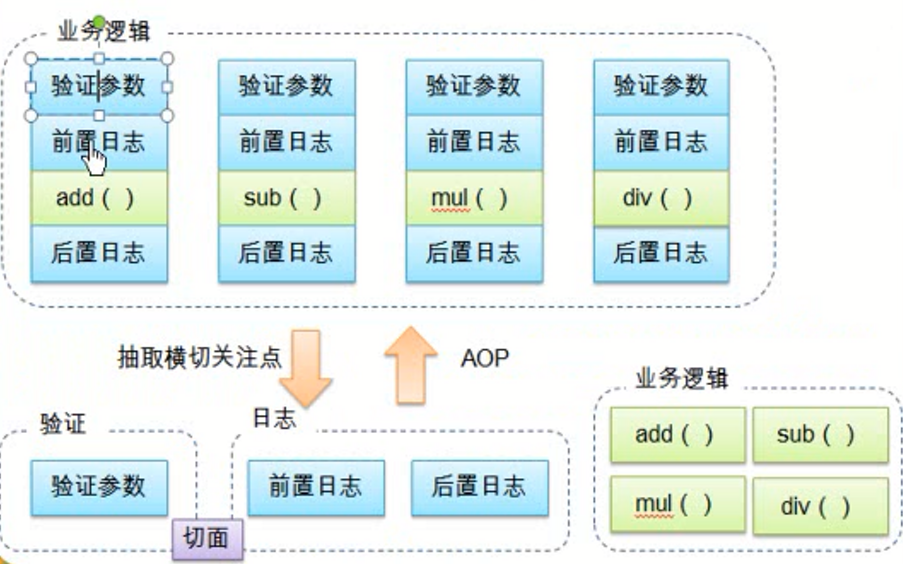
AOP(Aspect-Oriented-Programming,面向切面编程)是一种新的方法论,是对传统OOP(Object-Oriented-Programming,面向对象编程)的补充。
AOP的主要编程对象是切面(Aspect),而切面是模块化横切关注点。
在应用AOP编程时,仍然需要定义公共功能,但是可以明确地定义这个功能在哪里,以什么方式应用,并且不必修改受影响的类,这样一来,横切关注点就被模块化到特殊的对象(切面)里。
AOP好处:
-每个事物逻辑错位与一个位置,代码不分散,便于维护和升级
-业务模块更简洁,只包含核心的业务代码
AOP术语
切面(Aspect):横切关注点(跨越应用程序多个模块的功能)被模块化的特殊对象。
通知(Advice):切面必须要完成的工作。
目标(Target):被通知的对象。
代理(Proxy):向目标对象应用通知之后创建的对象。
连接点(Joinpoint):程序执行的每个特定位置:如类某个方法调用前,调用后,方法抛出异常等等,连接点由两个信息确定:方法表示的程序的执行点,相对点表示的方位,例如ArithmeticCalculator#add()方法执行前的连接点执行点为ArithmeticCalculator#add();方位为该方法执行前的位置。
切点(pointcut):每个类都拥有多个连接点,例如:ArithmethicCalculator的所有方法实际上都是连接点,即连接点是程序类中客观存在的事务,AOP通过切点定位到特定的连接点。类比:连接点相当于数据库中的记录,切点相当于查询条件,切点和连接点不是一对一关系,一个切点匹配多个连接点,切点通过org.springframework.aop.Pointcut接口进行描述,它使用类和方法作为连接点的查询条件。
Spring入门第十七课的更多相关文章
- Spring入门第六课
XML配置里的Bean自动装配 Spring IOC容器可以自动装配Bean.需要做的仅仅是在<bean>的autowire属性里指定自动装配的模式 ByType(根据类型自动装配):若I ...
- Spring入门第五课
集合属性 在Spring中可以通过一组内置的xml标签(如:<list>,<set>,<map>)来配置集合属性. 配置java.util.List类型的属性,需要 ...
- Spring入门第四课
注入参数详解:null值和级联属性 可以使用专用的<null/>元素标签为Bean的字符串或其他对象类型的属性注入null值. 和Struts,Hiberante等框架一样,Spring支 ...
- Spring入门第三课
属性注入 属性注入就是通过setter方法注入Bean的属性值或依赖的对象. 属性植入使用<property>元素,使用name属性指定Bean的属性名称,value属性或者<val ...
- Spring入门第十三课
通过FactoryBean来配置Bean package logan.spring.study.factoryBean; public class Car { private String brand ...
- Spring入门第十一课
IOC容器中Bean的生命周期 Spring IOC容器可以管理Bean的生命周期,Spring允许在Bean生命周期的特定点执行定制的任务. Spring IOC容器对Bean的生命周期进行管理的过 ...
- Spring入门第十课
Spring表达式语言:SpEL Spring表达式语言(简称SpEL)是一个支持运行时查询和操作对象图的强大的表达式语言. 语法类似于EL:SpEL使用#{...}作为定界符,所有在大括号中的字符都 ...
- Spring入门第八课
看如下代码 <?xml version="1.0" encoding="UTF-8"?> <beans xmlns="http:// ...
- Spring入门第七课
Bean之间的关系:继承和依赖. 继承Bean配置 Spring允许继承bean的配置,被继承的bean称为父bean,继承这个父bean的Bean称为子Bean. 子Bean从父Bean中继承配置, ...
随机推荐
- HDU 6208 The Dominator of Strings 后缀自动机
The Dominator of Strings Time Limit: 3000/3000 MS (Java/Others) Memory Limit: 65535/32768 K (Java ...
- EasyDSS高性能流媒体服务器前端重构(五)- webpack + vue-router 开发单页面前端实现按需加载 - 副本
为了让页面更快完成加载, 第一时间呈现给客户端, 也为了帮助客户端节省流量资源, 我们可以开启 vue-router 提供的按需加载功能, 让客户端打开页面时, 只自动加载必要的资源文件, 当客户端操 ...
- Hadoop集群部署-Hadoop 运行集群后Live Nodes显示0
可以尝试以下步骤解决: 1 ,分别删除:主节点从节点的 /usr/local/hadoop-2.6.2/etc/tmp 下得所有文件; 2: 编辑cd usr/local/hadoop-2.6. ...
- 开启unity3D的学习之路
2014年5月11号.我開始了我的Unity3D的学习之路.我将在此记录我学习过程中各个进程,这样在将来的某天,自己忘记了某部分内容时.也能够回过头来复习一下.
- mongoDB多级子文档查询
db.getCollection('product').find({'coverage':{'$elemMatch':{'plan':{'$elemMatch':{'iscoverage':{'$in ...
- ZOJ - 4016 Mergeable Stack 【LIST】
题目链接 http://acm.zju.edu.cn/onlinejudge/showProblem.do?problemCode=4016 题意 模拟栈的三种操作 第一种 push 将指定元素压入指 ...
- C语言“快速排序”函数写法
代码是:C语言中快速排的写法,要加入头文件 <stdlib.h> qsort(数组名, 长度, 数据类型大小,比较算子 ): #include <stdio.h> #inc ...
- jquery 用addClass之后 class有对应的事件,为什么要重新绑定一下事件呢
假设有元素A,B,C,其中A和B都有class属性cls,如果在页面加载完成时,给具有class属性为cls的元素绑定某一事件,例如click,执行事件时调用alert.也就是说,页面加载完成后A和B ...
- 用gdisk调整gpt/ext4分区大小
主机: CentOS release 6.4 (Final) 目的:从/home分区分出100G来创建新分区/vm 参考: http://ryanclouser.com/?p=66 http://fa ...
- JS获取首字母
function pySegSort(arr, empty) { if (!String.prototype.localeCompare) return null; var letters = &qu ...