
POJ:1330-Nearest Common Ancestors(LCA在线、离线、优化算法)
传送门:http://poj.org/problem?id=1330
Nearest Common Ancestors
Time Limit: 1000MS Memory Limit: 10000K
Description
A rooted tree is a well-known data structure in computer science and engineering. An example is shown below:
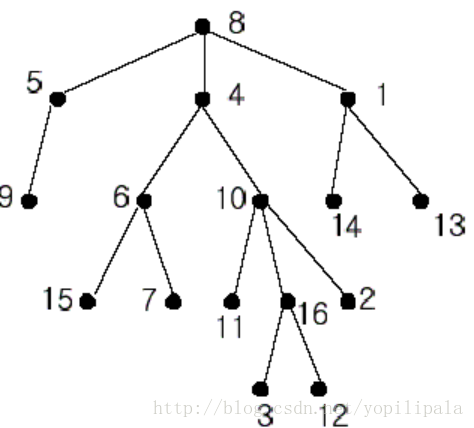
In the figure, each node is labeled with an integer from {1, 2,…,16}. Node 8 is the root of the tree. Node x is an ancestor of node y if node x is in the path between the root and node y. For example, node 4 is an ancestor of node 16. Node 10 is also an ancestor of node 16. As a matter of fact, nodes 8, 4, 10, and 16 are the ancestors of node 16. Remember that a node is an ancestor of itself. Nodes 8, 4, 6, and 7 are the ancestors of node 7. A node x is called a common ancestor of two different nodes y and z if node x is an ancestor of node y and an ancestor of node z. Thus, nodes 8 and 4 are the common ancestors of nodes 16 and 7. A node x is called the nearest common ancestor of nodes y and z if x is a common ancestor of y and z and nearest to y and z among their common ancestors. Hence, the nearest common ancestor of nodes 16 and 7 is node 4. Node 4 is nearer to nodes 16 and 7 than node 8 is.
For other examples, the nearest common ancestor of nodes 2 and 3 is node 10, the nearest common ancestor of nodes 6 and 13 is node 8, and the nearest common ancestor of nodes 4 and 12 is node 4. In the last example, if y is an ancestor of z, then the nearest common ancestor of y and z is y.
Write a program that finds the nearest common ancestor of two distinct nodes in a tree.
Input
The input consists of T test cases. The number of test cases (T) is given in the first line of the input file. Each test case starts with a line containing an integer N , the number of nodes in a tree, 2<=N<=10,000. The nodes are labeled with integers 1, 2,…, N. Each of the next N -1 lines contains a pair of integers that represent an edge –the first integer is the parent node of the second integer. Note that a tree with N nodes has exactly N - 1 edges. The last line of each test case contains two distinct integers whose nearest common ancestor is to be computed.
Output
Print exactly one line for each test case. The line should contain the integer that is the nearest common ancestor.
Sample Input
2
16
1 14
8 5
10 16
5 9
4 6
8 4
4 10
1 13
6 15
10 11
6 7
10 2
16 3
8 1
16 12
16 7
5
2 3
3 4
3 1
1 5
3 5
Sample Output
4
3
解题心得:
- 这是一个LCA的裸题,可以用用离线算法,也就是tarjan来做这个题,运用并查集,一棵树上的点分为三种,一种是已经找过的点,一种是正在找的点,还有一种是没有找过的点,如果其中一个点是没有找过的就不管,继续找下去,如果一个点是找过的,就直接用并查集回到他们共同的根节点(两个点必然在同一棵子树下),如果两个点都是正在找的点,那么其中一个点就是其最近祖先。
- 还有一种就是使用倍增法来做这个题,使用倍增法需要知道当前点的深度和父节点。两个点的最近公共祖先就是他们一起向上走第一次遇到的地方,运用这个性质就可以先将两个点的深度调到相同,然后一起向上走,第一次遇到的地方就是其最近公共祖先。
- 优化的思想也很简单,两个点一步一步的向上走是不是太慢了,可不可以多走几步,那怎么走呢?就可以想到使用RMQ的思想,按照二进制来走,在统一深度的时候可以将深度大的的那个点,走深度小的那个点的二进制中没有1的位置。然后一起向上面走二进制的步数,找打到第一个不是公共祖先的点然后返回他的父节点。思想比较简单,还是看实现过程吧。
tarjan写法:
#include<cstring>

#include<stdio.h>

#include<vector>

using namespace std;

const int maxn = 1e4+100;

int father[maxn],q1,q2,ans,n;

bool vis[maxn];

vector <int> ve[maxn];

void init()

{

    memset(vis,0,sizeof(vis));

    memset(father,0,sizeof(father));

    for(int i=0;i<maxn;i++)

        ve[i].clear();

    for(int i=1;i<n;i++)

    {

        int a,b;

        scanf("%d%d",&a,&b);

        ve[a].push_back(b);

        vis[b] = true;

    }

    scanf("%d%d",&q1,&q2);

}

int find(int x)

{

    if(x == father[x])

        return x;

    return father[x] = find(father[x]);

}

void tarjan(int x)

{

    father[x] = x;

    for(int i=0;i<ve[x].size();i++)

    {

        int v = ve[x][i];

        tarjan(v);

        father[v] = x;

    }

    if(x == q1 || x == q2)

    {

        if(x != q1)

            swap(q1,q2);

        if(father[q2])//如果其中一个点没被找到那么就继续找下去

            ans = find(father[q2]);

    }

}

int main()

{

    int t;

    scanf("%d",&t);

    while(t--)

    {

        scanf("%d",&n);

        init();

        for(int i=1;i<=n;i++)

        {

            if(!vis[i])

            {

                tarjan(i);

                break;

            }

        }

        printf("%d\n",ans);

    }

    return 0;

}
倍增写法(无优化)
#include<stdio.h>

#include<cstring>

#include<vector>

using namespace std;

const int maxn = 1e4+100;

vector <int> ve[maxn];

int n,father[maxn],dep[maxn];

bool vis[maxn];

void init()

{

    for(int i=0;i<=n;i++)

        ve[i].clear();

    memset(father,0,sizeof(father));

    memset(dep,0,sizeof(dep));

    memset(vis,0,sizeof(vis));

    for(int i=0;i<n-1;i++)

    {

        int a,b;

        scanf("%d%d",&a,&b);

        vis[b] = true;

        ve[a].push_back(b);

    }

}

int dfs(int u,int f,int d)

{

    father[u] = f;//记录父节点

    dep[u] = d;//记录深度

    for(int i=0;i<ve[u].size();i++)

    {

        int v = ve[u][i];

        if(v == f)//主要是处理单向边

            continue;

        dfs(v,u,d+1);

    }

}

void LCA(int q,int p)

{

    if(dep[p] > dep[q])

        swap(q,p);

    while(dep[q] > dep[p])//调节到同一深度

        q = father[q];

    while(p != q)//一起向上走

    {

        p = father[p];

        q = father[q];

    }

    printf("%d\n",q);

}

int main()

{

    int t;

    scanf("%d",&t);

    while(t--)

    {

        scanf("%d",&n);

        init();

        for(int i=1;i<=n;i++)

            if(!vis[i])

            {

                dfs(i,-1,0);

                break;

            }

        int q,p;

        scanf("%d%d",&q,&p);

        LCA(q,p);

    }

}
LCA进过优化后的代码:
#include<stdio.h>

#include<cstring>

#include<vector>

#include<algorithm>

using namespace std;

const int maxn = 1e4+100;

const int LOG = 33;

int p[maxn][33],dep[maxn],n;

bool vis[maxn];

vector <int> ve[maxn];

void init()

{

    for(int i=0;i<=n;i++)

        ve[i].clear();

    memset(dep,0,sizeof(dep));

    memset(p,0,sizeof(p));

    memset(vis,0,sizeof(vis));

    for(int i=1;i<n;i++)

    {

        int a,b;

        scanf("%d%d",&a,&b);

        ve[a].push_back(b);

        vis[b] = true;

    }

}

void dfs(int u,int f,int d)

{

    p[u][0] = f;//u点向前移动2的0次方位为它的父节点

    dep[u] = d;

    for(int i=0;i<ve[u].size();i++)

    {

        int v = ve[u][i];

        if(v == f)

            continue;

        dfs(v,u,d+1);

    }

}

int LCA(int x,int y)

{

    for(int i=0;i+1<LOG;i++)

        for(int j=1;j<=n;j++)

            if(p[j][i] < 0) p[j][i+1] = -1;//树中的节点向上移动超出了根节点都为-1

            else p[j][i+1] = p[p[j][i]][i];//否则RMQ思想

    if(dep[y] > dep[x])

        swap(y,x);

    for(int i=0;i<LOG;i++)

        if(dep[x] - dep[y] >> i & 1)//向上移动到同一深度的时候,将更深的节点二进制表示中多出部分的1移走就行了

            x = p[x][i];

    if(x == y)//同一深度的时候已经合一了

        return x;

    for(int i=LOG-1;i>=0;i--)//找到向上移动中最大祖先的下面第一个节点

    {

        if(p[x][i] != p[y][i])

        {

            x = p[x][i];

            y = p[y][i];

        }

    }

    return p[x][0];

}

int main()

{

    int t;

    scanf("%d",&t);

    while(t--)

    {

        scanf("%d",&n);

        init();

        for(int i=1;i<=n;i++)

            if(!vis[i])

            {

                dfs(i,-1,0);

                break;

            }

        int p,q;

        scanf("%d%d",&p,&q);

        printf("%d\n",LCA(p,q));

    }

}
POJ:1330-Nearest Common Ancestors(LCA在线、离线、优化算法)的更多相关文章
- poj 1330 Nearest Common Ancestors lca 在线rmq
Nearest Common Ancestors Description A rooted tree is a well-known data structure in computer scienc ...
- POJ.1330 Nearest Common Ancestors (LCA 倍增)
POJ.1330 Nearest Common Ancestors (LCA 倍增) 题意分析 给出一棵树,树上有n个点(n-1)条边,n-1个父子的边的关系a-b.接下来给出xy,求出xy的lca节 ...
- POJ 1330 Nearest Common Ancestors LCA题解
Nearest Common Ancestors Time Limit: 1000MS Memory Limit: 10000K Total Submissions: 19728 Accept ...
- POJ 1330 Nearest Common Ancestors (LCA,倍增算法,在线算法)
/* *********************************************** Author :kuangbin Created Time :2013-9-5 9:45:17 F ...
- poj 1330 Nearest Common Ancestors LCA
题目链接:http://poj.org/problem?id=1330 A rooted tree is a well-known data structure in computer science ...
- POJ 1330 Nearest Common Ancestors(LCA模板)
给定一棵树求任意两个节点的公共祖先 tarjan离线求LCA思想是,先把所有的查询保存起来,然后dfs一遍树的时候在判断.如果当前节点是要求的两个节点当中的一个,那么再判断另外一个是否已经访问过,如果 ...
- POJ 1330 Nearest Common Ancestors / UVALive 2525 Nearest Common Ancestors (最近公共祖先LCA)
POJ 1330 Nearest Common Ancestors / UVALive 2525 Nearest Common Ancestors (最近公共祖先LCA) Description A ...
- POJ 1330 Nearest Common Ancestors 倍增算法的LCA
POJ 1330 Nearest Common Ancestors 题意:最近公共祖先的裸题 思路:LCA和ST我们已经很熟悉了,但是这里的f[i][j]却有相似却又不同的含义.f[i][j]表示i节 ...
- POJ - 1330 Nearest Common Ancestors(基础LCA)
POJ - 1330 Nearest Common Ancestors Time Limit: 1000MS Memory Limit: 10000KB 64bit IO Format: %l ...
- POJ 1330 Nearest Common Ancestors(lca)
POJ 1330 Nearest Common Ancestors A rooted tree is a well-known data structure in computer science a ...
随机推荐
- Java基础:(八)异常
Throwable可以用来表示任何可以作为异常抛出的类,分为两种:Error和Exception.其中Error用来表示JVM无法处理的错误, Exception又分为两种: 受检异常:需要用try. ...
- 零基础逆向工程21_PE结构05_数据目录表_导出表
数据目录 1.我们所了解的PE分为头和节,在每个节中,都包含了我们写的一些代码和数据,但还有一些非常重要 的信息是编译器替我们加到PE文件中的,这些信息可能存在在任何可以利用的地方. 2.这些信息之所 ...
- 微软大礼包 | 集合在线学习资源,助你秒变AI达人
编者按:人工智能的浪潮正如火如荼地袭来,未来人工智能将大有所为,人们的生活轨迹也正在技术不断向前推进的过程中逐渐改变.人工智能不是科研人员或开发人员的专属,微软希望能够将人工智能带给每个人,从开发者到 ...
- Python3+Selenium3+webdriver学习笔记14(等待判断 鼠标事件 )
!/usr/bin/env python -*- coding:utf-8 -*-'''Selenium3+webdriver学习笔记14(等待判断 鼠标事件 )'''from selenium im ...
- tsung基准测试方法、理解tsung.xml配置文件、tsung统计报告简介
网上搜集的资料,资料来源于:http://blog.sina.com.cn/ishouke 1.tsung基准测试方法 https://pan.baidu.com/s/1Ne3FYo8XyelnJy8 ...
- 基于Activiti5.15.1 自定义用户、组(User,Group)实现
基于Activiti5.15.1 自定义用户.组(User,Group)实现 本人刚接触Activiti,最近工作中需要将Activiti中原有的用户,组(ACT_ID_USER,ACT_ID_GRO ...
- CF Gym 100463B Music Mess (思路)
好题,当时想了半个小时,我往图论方面去想了,把出现过的字符串当场点,然后相互连边,那么就构成了一个三角形,一个大于三个点的连通分量里有以下结论:度为二的点可能是track,度为大于二的点一定不是tra ...
- [web开发] 利用微信小程序开发上海大学失物招领平台
我从开始学微信小程序到最后完全写完这个小程序耗时四天,可以说开发难度非常之低,门槛也非常低,之前从来没接触过微信小程序,重新写下开发记录. 先放图: 1.前端开发 前端我用到了iview的ui框架,因 ...
- nginx之HTTP模块配置
listen 指令只能使用与server字段里 如果本地调用可以监听本地Unix套接字文件,性能更加,因为不用走内核网络协议栈 listen unix:/var/run/nginx.sock; ...
- python-下拉框
首先,从selenium.webdriver.support.ui里调用Select类,如下: 其次,找到下拉框元素,再找下拉框里要最终选择的元素,如下: 注意:调用Select类后,不必再加clic ...