
NIO 组件Buffer
重要属性
| 属性 | 描述 |
|---|---|
| Capacity | 容量, 即可以容纳的最大数据量; 在缓冲区创建时被设定并且不能改变 |
| Limit | 表示缓冲区的当前终点, 不能对缓冲区超过极限的位置进行读写操作, 且极限是可以修改的。 |
| Position | 位置, 下一个要被读或写的元素的索引, 每次读写缓冲区数据时都会改变数值, 为下次读写做准备 |
| Mark | 标记 |
简单demo
- 代码:
package com.ronnie.nio;

import java.nio.IntBuffer;

public class BasicBuffer {

    public static void main(String[] args) {

        // 举例说明Buffer 的使用

        // 创建一个Buffer, 大小为n, 即可存放n个int

        IntBuffer intBuffer = IntBuffer.allocate(10);

        // 向buffer 存放数据

        for (int i = 0; i < intBuffer.capacity(); i++){

            intBuffer.put( i * 2);

        }

        // 将buffer转换, 读写切换(很重要)

        intBuffer.flip();

        intBuffer.position(1);

        // 设置limit为3, 到不了3

        intBuffer.limit(3);

        while (intBuffer.hasRemaining()){

            System.out.println(intBuffer.get());

        }

    }
- 输出结果: 2 4
- 感觉这个思想和golang里面的channel好像差不多, 不过go的channel好像并不需要flip, 若不指定方向就是双向的。
源码解读
属性
    /**

     * The characteristics of Spliterators that traverse and split elements

     * maintained in Buffers.

     * Spliterators 是一个可分割迭代器, 此处用于遍历并分割Buffer中的元素, 此类有三种

     * 特征的Spliterators: 尺寸固定的, 小尺寸的, 有序的三种, 进去看一下都是16进制数

     */

    static final int SPLITERATOR_CHARACTERISTICS =

        Spliterator.SIZED | Spliterator.SUBSIZED | Spliterator.ORDERED;

    // Invariants: mark <= position <= limit <= capacity 不变性排序

    private int mark = -1;

    private int position = 0;

    private int limit;

    private int capacity;

    // Used only by direct buffers 只能直接被buffers使用

    // NOTE: hoisted here for speed in JNI GetDirectBufferAddress

    // 挂在这用于提升 JNI(Java Native Interface) 中直接获取buffer地址方法的执行速度

    long address;
常用方法
public final int capacity(){}: 返回此缓冲区的容量
 /**

     * Returns this buffer's capacity.

     *

     * @return  The capacity of this buffer

     */

    public final int capacity() {

        return capacity;

    }
public final int position(){}: 返回此缓冲区的位置
/**

     * Returns this buffer's position.

     *

     * @return  The position of this buffer

     */

    public final int position() {

        return position;

    }
public final Buffer position(int newPosition){}: 设置此缓冲区的位置
    /**

     * Sets this buffer's position.  If the mark is defined and larger than

     * the new position then it is discarded.

     * 设置该buffer的位置, 如果此标记已经被定义, 且大于新定义的位置, 那么它就会被

     * 抛弃。

     *

     * @param  newPosition

     *         The new position value; must be non-negative

     *         and no larger than the current limit

     *

     * @return  This buffer

     *

     * @throws  IllegalArgumentException

     *          If the preconditions on <tt>newPosition</tt> do not hold

     */

    public final Buffer position(int newPosition) {

        if ((newPosition > limit) || (newPosition < 0))

            throw new IllegalArgumentException();

        position = newPosition;

        if (mark > position) mark = -1;

        return this;

    }
public final int limit(){}: 返回此缓冲区的限制
  /**

     * Returns this buffer's limit.

     *

     * @return  The limit of this buffer

     */

    public final int limit() {

        return limit;

    }
public final Buffer limit(int newLimit){}: 设置此缓冲区的限制
 /**

     * Sets this buffer's limit.

     * If the position is larger than the new limit then it is set to the new

     * limit.

     * 如果位置大于新的limit, 那么就将位置设为新的limit

     * If the mark is defined and larger than the new limit then it is

     * discarded.

     * 如果此标记已经被定义, 且大于新定义的位置, 那么它就会被抛弃。

     *

     * @param  newLimit

     *         The new limit value; must be non-negative

     *         and no larger than this buffer's capacity

     *

     * @return  This buffer

     *

     * @throws  IllegalArgumentException

     *          If the preconditions on <tt>newLimit</tt> do not hold

     */

    public final Buffer limit(int newLimit) {

        if ((newLimit > capacity) || (newLimit < 0))

            throw new IllegalArgumentException();

        limit = newLimit;

        if (position > limit) position = limit;

        if (mark > limit) mark = -1;

        return this;

    }
public final Buffer clear(){}: 清除此缓冲区, 即将各个标记恢复到初始状态, 但是数据并没有真正擦除。
    /**

     * Clears this buffer.

     * The position is set to zero, the limit is set to the capacity, and the

     * mark is discarded.

     * 位置被设为0, limit被设置为容量, 并且标记被丢弃。

     *

     * <p> Invoke this method before using a sequence of channel-read or

     * <i>put</i> operations to fill this buffer.  For example:

     *

     * <blockquote><pre>

     * buf.clear();     // Prepare buffer for reading

     * in.read(buf);    // Read data</pre></blockquote>

     *

     * <p> This method does not actually erase the data in the buffer, but it

     * is named as if it did because it will most often be used in situations

     * in which that might as well be the case. </p>

     *

     * @return  This buffer

     */

    public final Buffer clear() {

        position = 0;

        limit = capacity;

        mark = -1;

        return this;

    }
public abstract boolean hasArray(){}: 告知此缓冲区是否具有可访问的底层实现数组
 /**

     * Tells whether or not this buffer is backed by an accessible

     * array.

     *

     * <p> If this method returns <tt>true</tt> then the {@link #array() array}

     * and {@link #arrayOffset() arrayOffset} methods may safely be invoked.

     * </p>

     *

     * @return  <tt>true</tt> if, and only if, this buffer

     *          is backed by an array and is not read-only

     *

     * @since 1.6

     */

    public abstract boolean hasArray();
public abstract Object array(){}: 返回此缓冲区的底层实现数组
/**
* Returns the array that backs this
* buffer <i>(optional operation)</i>.
*
* <p> This method is intended to allow array-backed buffers to be
* passed to native code more efficiently.
* 该方法的目的是允许 底层的 实现数组缓冲区 更有效地被传送到本地编码中。
* Concrete subclasses provide more strongly-typed return values for this
* method.
* 实体的子类为该方法提供了更多强类型的返回值
*
* <p> Modifications to this buffer's content will cause the returned
* array's content to be modified, and vice versa.
* 修改该buffer的内容会导致返回的数组的内容也被改变, 反之亦然。
*
* <p> Invoke the {@link #hasArray hasArray} method before invoking this
* method in order to ensure that this buffer has an accessible backing
* array. </p>
* 在调用此方法前请调用hasArray方法来保证该buffer有一个可获取的底层实现数组
*
* @return The array that backs this buffer
*
* @throws ReadOnlyBufferException
* If this buffer is backed by an array but is read-only
*
* @throws UnsupportedOperationException
* If this buffer is not backed by an accessible array
*
* @since 1.6
*/
public abstract Object array();
其他方法
public final Buffer mark(){}: 在此缓冲区的位置设置标记
 /**

     * Sets this buffer's mark at its position.

     *

     * @return  This buffer

     */

    public final Buffer mark() {

        mark = position;

        return this;

    }
public final Buffer reset(){}: 将此缓冲区的位置重置为以前标记的位置(后悔药?)
 /**

     * Resets this buffer's position to the previously-marked position.

     *

     * <p> Invoking this method neither changes nor discards the mark's

     * value. </p>

     *

     * @return  This buffer

     *

     * @throws  InvalidMarkException

     *          If the mark has not been set

     */

    public final Buffer reset() {

        int m = mark;

        if (m < 0)

            throw new InvalidMarkException();

        // 将位置设为之前的标记

        position = m;

        return this;

    }
public final Buffer rewind(){}: 重绕此缓冲区
    /**

     * Rewinds this buffer.

     * The position is set to zero and the mark is discarded.

     * 位置被设为0并且标记被丢弃

     *

     * <p> Invoke this method before a sequence of channel-write or <i>get</i>

     * operations, assuming that the limit has already been set

     * appropriately.  For example:

     *

     * <blockquote><pre>

     * out.write(buf);    // Write remaining data

     * buf.rewind();      // Rewind buffer

     * buf.get(array);    // Copy data into array</pre></blockquote>

     *

     * @return  This buffer

     */

    public final Buffer rewind() {

        position = 0;

        mark = -1;

        return this;

    }
public final int remaining(){}: 返回当前位置与限制之间的元素数量
    /**

     * Returns the number of elements between the current position and the

     * limit.

     *

     * @return  The number of elements remaining in this buffer

     */

    public final int remaining() {

        return limit - position;

    }
public abstract int arrayOffset(){}: 返回此缓冲区的底层实现数组中第一个缓冲区元素的偏移量
/**
* Returns the offset within this buffer's backing array of the first
* element of the buffer <i>(optional operation)</i>.
* 返回此缓冲区的底层实现数组中第一个缓冲区元素的偏移量
*
* <p> If this buffer is backed by an array then buffer position <i>p</i>
* corresponds to array index <i>p</i> + <tt>arrayOffset()</tt>.
*
* <p> Invoke the {@link #hasArray hasArray} method before invoking this
* method in order to ensure that this buffer has an accessible backing
* array. </p>
* 在调用此方法前请调用hasArray方法来保证该buffer有一个可获取的底层实现数组
*
* @return The offset within this buffer's array
* of the first element of the buffer
*
* @throws ReadOnlyBufferException
* If this buffer is backed by an array but is read-only
*
* @throws UnsupportedOperationException
* If this buffer is not backed by an accessible array
*
* @since 1.6
*/
public abstract int arrayOffset();
public abstract boolean isDirect(){}: 告知此缓冲区是否为直接缓冲区
    /**

     * Tells whether or not this buffer is

     * <a href="ByteBuffer.html#direct"><i>direct</i></a>.

     *

     * @return  <tt>true</tt> if, and only if, this buffer is direct

     *

     * @since 1.6

     */

    public abstract boolean isDirect();
ByteBuffer
是最常用的ByteBuffer类(二进制数组)
常用方法:
缓冲区创建相关:
public static ByteBuffer allocateDirect(int capacity){}: 创建直接缓冲区
    /**

     * Allocates a new direct byte buffer.

     *

     * <p> The new buffer's position will be zero, its limit will be its

     * capacity, its mark will be undefined, and each of its elements

     * will be initialized to zero.

     * 新缓冲区的位置将会为0, 它的limit会是它的容量, 它的标签未被定义, 每个它

     * 元素都会被定义为0.

     * Whether or not it has a {@link #hasArray backing array} is

     * unspecified.

     * 是否有底层数组未知

     *

     * @param  capacity

     *         The new buffer's capacity, in bytes

     *

     * @return  The new byte buffer

     *

     * @throws  IllegalArgumentException

     *          If the <tt>capacity</tt> is a negative integer

     */

    public static ByteBuffer allocateDirect(int capacity) {

        return new DirectByteBuffer(capacity);

    }
public static ByteBuffer allocate(int capacity){}: 设置缓冲区的初始容量
    /**

     * Allocates a new byte buffer.

     *

     * <p> The new buffer's position will be zero, its limit will be its

     * capacity, its mark will be undefined, and each of its elements

     * will be initialized to zero.

     * 新缓冲区的位置将会为0, 它的limit会是它的容量, 它的标签未被定义, 每个它

     * 元素都会被定义为0.

     * It will have a {@link #array backing array},and its {@link

     * #arrayOffset array offset} will be zero.

     * 它会有一个底层数组, 并且它的数组偏移量为0

     *

     * @param  capacity

     *         The new buffer's capacity, in bytes

     *

     * @return  The new byte buffer

     *

     * @throws  IllegalArgumentException

     *          If the <tt>capacity</tt> is a negative integer

     */

    public static ByteBuffer allocate(int capacity) {

        if (capacity < 0)

            throw new IllegalArgumentException();

        return new HeapByteBuffer(capacity, capacity);

    }
缓存区存取相关:
public abstract byte get(){}: 从当前位置position上get, get之后, position会自动+1
    // -- Singleton get/put methods -- get/put 都是操作单例对象的

    /**

     * Relative <i>get</i> method.

     * Reads the byte at this buffer's current position, and then

     * increments the position.

     * 读该字节数组在此buffer的当前位置, 并提升位置

     *

     * @return  The byte at the buffer's current position

     *

     * @throws  BufferUnderflowException

     *          If the buffer's current position is not smaller than its limit

     */

    public abstract byte get();
public abstract byte get(int index){}: 从绝对位置get, position不会自动+1
 /**

     * Absolute <i>get</i> method.  Reads the byte at the given

     * index.

     *

     * @param  index

     *         The index from which the byte will be read

     *

     * @return  The byte at the given index

     *

     * @throws  IndexOutOfBoundsException

     *          If <tt>index</tt> is negative

     *          or not smaller than the buffer's limit

     */

    public abstract byte get(int index);
public abstract ByteBuffer put(byte b){}: 从当前位置上添加, put之后, position会自动 +1
/**
* Relative <i>put</i> method <i>(optional operation)</i>.
*
* <p> Writes the given byte into this buffer at the current
* position, and then increments the position. </p>
* 将获取的字节数组写入到该buffer中的当前位置, 并将位置上升
*
* @param b
* The byte to be written
*
* @return This buffer
*
* @throws BufferOverflowException
* If this buffer's current position is not smaller than its limit
*
* @throws ReadOnlyBufferException
* If this buffer is read-only
*/
public abstract ByteBuffer put(byte b);public abstract ByteBuffer put(int index, byte b){}: 从绝对位置上put, position不会自动+1
/**
* Absolute <i>put</i> method <i>(optional operation)</i>.
*
* <p> Writes the given byte into this buffer at the given
* index. </p>
*
* @param index
* The index at which the byte will be written
*
* @param b
* The byte value to be written
*
* @return This buffer
*
* @throws IndexOutOfBoundsException
* If <tt>index</tt> is negative
* or not smaller than the buffer's limit
*
* @throws ReadOnlyBufferException
* If this buffer is read-only
*/
public abstract ByteBuffer put(int index, byte b);
咦, 咋么都是抽象方法呐, 自习看一下层级结构:
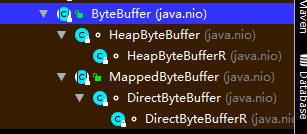
稍微看了一下, 它们的实现类在HeapByteBuffer和DirectByteBuffer中, 后者还调用了sun.misc.unsafe魔术类的方法, 在此就不做衍生了, 有兴趣的自己去撸源码。
NIO 组件Buffer的更多相关文章
- Java NIO 之 Buffer
Java NIO 之 Buffer Java NIO (Non Blocking IO 或者 New IO)是一种非阻塞IO的实现.NIO通过Channel.Buffer.Selector几个组件的协 ...
- Java NIO之Buffer(缓冲区)
Java NIO中的缓存区(Buffer)用于和通道(Channel)进行交互.数据是从通道读入缓冲区,从缓冲区写入到通道中的. 缓冲区本质上是一块可以写入数据,然后可以从中读取数据的内存.这 ...
- NIO组件之buffer
Java NIO指的是new IO ,相对OIO,也称non-blocking IO,对应四种基本IO类型中的IO多路复用,主要有有三大核心组件,Channel(管道),Buffer(缓冲区),sel ...
- NIO组件Selector详解
Selector(选择器)是Java NIO中能够检测一到多个NIO通道,并能够知晓通道是否为诸如读写事件做好准备的组件.这样,一个单独的线程可以管理多个channel,从而管理多个网络连接. 下面是 ...
- JAVA NIO简介-- Buffer、Channel、Charset 、直接缓冲区、分散和聚集、文件锁
IO 是主存和外部设备 ( 硬盘.终端和网络等 ) 拷贝数据的过程. IO 是操作系统的底层功能实现,底层通过 I/O 指令进行完成. Java标准io回顾 在Java1.4之前的I/O系统中,提供 ...
- Java NIO教程 Buffer
缓冲区本质上是一块可以写入数据,然后可以从中读取数据的内存,这块内存中有很多可以存储byte(或int.char等)的小单元.这块内存被包装成NIO Buffer对象,并提供了一组方法,用来方便的访问 ...
- Java基础知识强化之IO流笔记74:NIO之 Buffer
Java NIO中的Buffer用于和NIO通道进行交互.如你所知,数据是从通道读入缓冲区,从缓冲区写入到通道中的. 缓冲区本质上是一块可以写入数据,然后可以从中读取数据的内存.这块内存被包装成NIO ...
- NIO组件Selector调用实例
*对于nio的非阻塞I/O操作,使用Selector获取哪些I/O准备就绪,注册的SelectionKey集合记录关联的Channel这些信息.SelectionKey记录Channel对buffer ...
- java nio之Buffer(一)
Buffer是一个包装了基本数据元素数组的对象,它以及它的子类定义了一系列API用于处理数据缓存. 一.属性 Buffer有四个基本属性: 1.capacity 容量,buffer能够容纳的最大元素 ...
随机推荐
- Linux 7 和 CentOS 7 收到重要内核安全更新
导读 Red Hat 和 CentOS 宣布了其 Red Hat Enterprise Linux 7 和 CentOS Linux 7 操作系统系列重要内核安全更新的可用性. 据悉,这些更新解决了两 ...
- kubernetes 使用flannel网络模式 错误分析
今天按照网上和书上的要求,将目前的kubernetes网络换成flannel.其实配置起来还是很简单的,但是一旦出现了问题,将很难解决. 配置方法我这边不给出了.因为网上这样的教程一大把,在说下去也无 ...
- 算法设计与分析 - AC 代码 - 第 6 弹(重复第 3 弹)
PTA-算法设计与分析 - c++(g++) #include<bits/stdc++.h> using namespace std; long max3(long a,long b,lo ...
- 配置web应用全局的错误页面
- c# 事件3
1.什么是事件,使对象或者类具有通知功能的成员.//为了解决字段在外部被滥用,推出了事件 事件的功能能=通知+可选的事件参数(具体的详细信息,包括谁发送了消息,发送的什么消息) 使用:用于对象或者类件 ...
- linux零散知识
1.Linux的“| ”管道符用法 上一条命令的输出,作为下一条命令参数 方式:command1 | command2 Linux所提供的管道符“|”将两个命令隔开,管道符左边命令的输出就会作为管道符 ...
- hibernate中简单的增删改查
项目的整体结构如下 1.配置文件 hibernate.cfg.xml <!DOCTYPE hibernate-configuration PUBLIC "-//Hibernate/Hi ...
- DatePicker和DataPickerDialog以及AutoCompleteTextView的基本使用方法
1.DatePicker和DatePickerDialog的基本使用方法: main.xml: <?xml version="1.0" encoding="utf- ...
- BOM--location对象、history对象
location对象 location 是最有用的BOM 对象之一,它提供了与当前窗口中加载的文档有关的信息,还提供了一些导航功能. 事实上,location 对象是很特别的一个对象,因为它既是win ...
- java的基本类型和对应的封装类
封装,是java这门语言的重要核心思想之一,封装也是对面向对象这一思想很好的体现. 在很多情况下,我们需要对数据进行一些转换,如:将一字符串"123"转换成int类型的123,或者 ...