
dataset的reparation和coalesce
  /**

   * Returns a new Dataset that has exactly `numPartitions` partitions, when the fewer partitions

   * are requested. If a larger number of partitions is requested, it will stay at the current

   * number of partitions. Similar to coalesce defined on an `RDD`, this operation results in

   * a narrow dependency, e.g. if you go from 1000 partitions to 100 partitions, there will not

   * be a shuffle, instead each of the 100 new partitions will claim 10 of the current partitions.

   *

   * However, if you're doing a drastic coalesce, e.g. to numPartitions = 1,

   * this may result in your computation taking place on fewer nodes than

   * you like (e.g. one node in the case of numPartitions = 1). To avoid this,

   * you can call repartition. This will add a shuffle step, but means the

   * current upstream partitions will be executed in parallel (per whatever

   * the current partitioning is).

   *

   * @group typedrel

   * @since 1.6.0

   */

  def coalesce(numPartitions: Int): Dataset[T] = withTypedPlan {

    Repartition(numPartitions, shuffle = false, planWithBarrier)

  }
关于coalsece:
1、用于减少分区数量,如果设置的numPartitions超过目前实际有的分区数,则分区数保持不变。
2、窄依赖,不会发生shuffle
3、极端的coalsece可能会影响性能,比如coalsece(1),则只会在一个节点上运行单个任务。这种情况下建议使用repartition,
虽然repartition会发生shuffle,但是repartition对上游的计算,还是多分区并行执行的。
4、应用场景:多用于对一个大数据集filter以后,执行coalsece
  /**

   * Returns a new Dataset that has exactly `numPartitions` partitions.

   *

   * @group typedrel

   * @since 1.6.0

   */

  def repartition(numPartitions: Int): Dataset[T] = withTypedPlan {

    Repartition(numPartitions, shuffle = true, planWithBarrier)

  }
关于repartition:
跟coalsece一样,都是用于明确设置多少个分区,但是repartition是个宽依赖,会发生shuffle。主要注意的地方就是repartition不影响上游计算的分区
如果想极端的控制生成的文件数量来避免太多的小文件,建议repartition
测试:对一个大表查询,将查询的结果写到一张表
coalsece测试,coalsece(100),可以看到只有一个stage,并且并行度是100

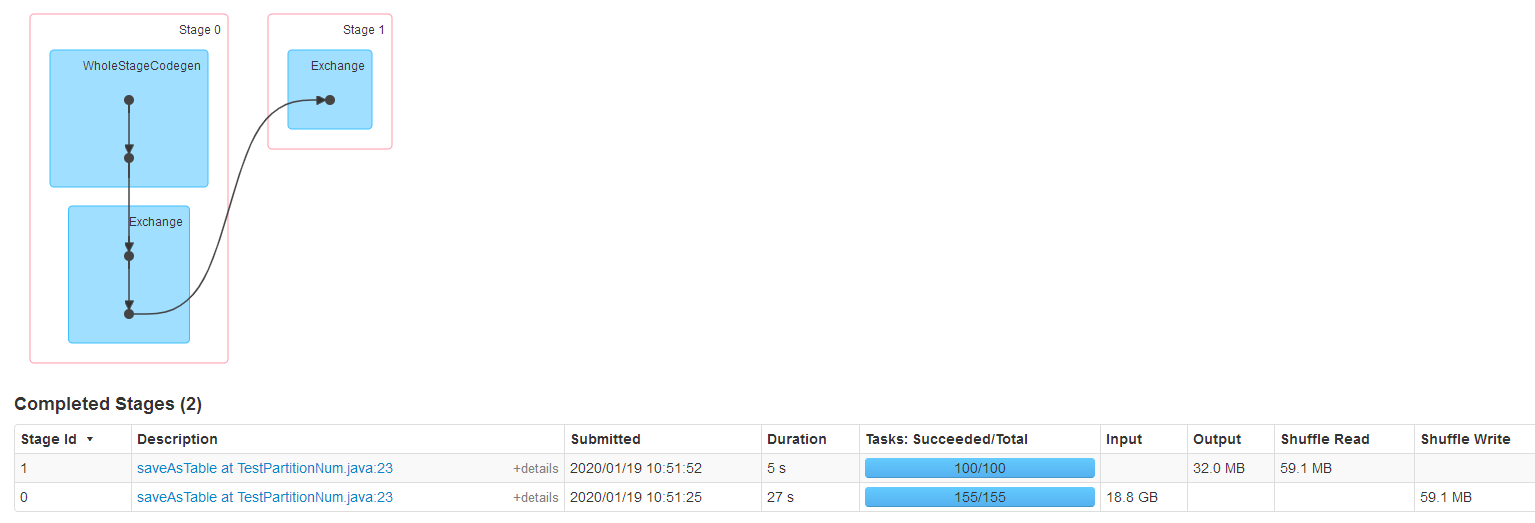
repartition测试,repartition(100),发生了shuffle。两个stage,stage0对大表指定条件查询,对应的并行度默认是大表的数据量/128M,在repartition将结果输出到表的时候并行度为我们设置的repartition(100),然后shuffle数据,最后输出
  /**

   * Return a new RDD that has exactly numPartitions partitions.

   *

   * Can increase or decrease the level of parallelism in this RDD. Internally, this uses

   * a shuffle to redistribute data.

   *

   * If you are decreasing the number of partitions in this RDD, consider using `coalesce`,

   * which can avoid performing a shuffle.

   *

   * TODO Fix the Shuffle+Repartition data loss issue described in SPARK-23207.

   */

  def repartition(numPartitions: Int)(implicit ord: Ordering[T] = null): RDD[T] = withScope {

    coalesce(numPartitions, shuffle = true)

  }

  /**

   * Return a new RDD that is reduced into `numPartitions` partitions.

   *

   * This results in a narrow dependency, e.g. if you go from 1000 partitions

   * to 100 partitions, there will not be a shuffle, instead each of the 100

   * new partitions will claim 10 of the current partitions. If a larger number

   * of partitions is requested, it will stay at the current number of partitions.

   *

   * However, if you're doing a drastic coalesce, e.g. to numPartitions = 1,

   * this may result in your computation taking place on fewer nodes than

   * you like (e.g. one node in the case of numPartitions = 1). To avoid this,

   * you can pass shuffle = true. This will add a shuffle step, but means the

   * current upstream partitions will be executed in parallel (per whatever

   * the current partitioning is).

   *

   * @note With shuffle = true, you can actually coalesce to a larger number

   * of partitions. This is useful if you have a small number of partitions,

   * say 100, potentially with a few partitions being abnormally large. Calling

   * coalesce(1000, shuffle = true) will result in 1000 partitions with the

   * data distributed using a hash partitioner. The optional partition coalescer

   * passed in must be serializable.

   */

  def coalesce(numPartitions: Int, shuffle: Boolean = false,

               partitionCoalescer: Option[PartitionCoalescer] = Option.empty)

              (implicit ord: Ordering[T] = null)

      : RDD[T] = withScope {

    require(numPartitions > 0, s"Number of partitions ($numPartitions) must be positive.")

    if (shuffle) {

      /** Distributes elements evenly across output partitions, starting from a random partition. */

      val distributePartition = (index: Int, items: Iterator[T]) => {

        var position = new Random(hashing.byteswap32(index)).nextInt(numPartitions)

        items.map { t =>

          // Note that the hash code of the key will just be the key itself. The HashPartitioner

          // will mod it with the number of total partitions.

          position = position + 1

          (position, t)

        }

      } : Iterator[(Int, T)]

      // include a shuffle step so that our upstream tasks are still distributed

      new CoalescedRDD(

        new ShuffledRDD[Int, T, T](mapPartitionsWithIndex(distributePartition),

        new HashPartitioner(numPartitions)),

        numPartitions,

        partitionCoalescer).values

    } else {

      new CoalescedRDD(this, numPartitions, partitionCoalescer)

    }

  }
dataset的reparation和coalesce的更多相关文章
- Spark编程指南分享
转载自:https://www.2cto.com/kf/201604/497083.html 1.概述 在高层的角度上看,每一个Spark应用都有一个驱动程序(driver program).驱动程序 ...
- Spark学习笔记之SparkRDD
Spark学习笔记之SparkRDD 一. 基本概念 RDD(resilient distributed datasets)弹性分布式数据集. 来自于两方面 ① 内存集合和外部存储系统 ② ...
- Spark-RDD之Partition源码分析
概要 Spark RDD主要由Dependency.Partition.Partitioner组成,Partition是其中之一.一份待处理的原始数据会被按照相应的逻辑(例如jdbc和hdfs的spl ...
- spark(二)
一.spark的提交模式 --master(standalone\YRAN\mesos) standalone:-client -cluster 如果我们用client模式去提交程序,我们在哪个地方 ...
- Spark:JavaRDD 转化为 Dataset<Row>的两种方案
JavaRDD 转化为 Dataset<Row>方案一: 实体类作为schema定义规范,使用反射,实现JavaRDD转化为Dataset<Row> Student.java实 ...
- Spark入门之DataFrame/DataSet
目录 Part I. Gentle Overview of Big Data and Spark Overview 1.基本架构 2.基本概念 3.例子(可跳过) Spark工具箱 1.Dataset ...
- Update(Stage4):sparksql:第3节 Dataset (DataFrame) 的基础操作 & 第4节 SparkSQL_聚合操作_连接操作
8. Dataset (DataFrame) 的基础操作 8.1. 有类型操作 8.2. 无类型转换 8.5. Column 对象 9. 缺失值处理 10. 聚合 11. 连接 8. Dataset ...
- SQL Server-分页方式、ISNULL与COALESCE性能分析(八)
前言 上一节我们讲解了数据类型以及字符串中几个需要注意的地方,这节我们继续讲讲字符串行数同时也讲其他内容和穿插的内容,简短的内容,深入的讲解,Always to review the basics. ...
- HTML5 数据集属性dataset
有时候在HTML元素上绑定一些额外信息,特别是JS选取操作这些元素时特别有帮助.通常我们会使用getAttribute()和setAttribute()来读和写非标题属性的值.但为此付出的代价是文档将 ...
随机推荐
- vs2017 vs2019配置sqlite3连接引擎(驱动)指南(二)vs2019续集
在写完上一篇博客后,一觉醒来,又又又又不行了,介绍一个终极大招,如果你的fuck vs又提示无法打开sqlite3.h的问题 环境win10 vs2019 debug x86 实在没心情写文字了,直 ...
- [todo0211]c语言指针,结构体的疑问
#include <stdio.h> #include <mm_malloc.h> struct ListNode { int val; struct ListNode *ne ...
- EBCDIK,EBCDIC,ASCII,shift JIS間の変換
http://itdoc.hitachi.co.jp/manuals/3020/3020759580/G5950334.HTM#ID01056
- 多项式输出 (0)<P2009_1>
多项式输出 (poly.pas/c/cpp) [问题描述] 一元n次多项式可用如下的表达式表示: 其中,称为i次项,ai称为i次项的系数.给出一个一元多项式各项的次数和系数,请按照如下规定的格式要求输 ...
- 笔记-JavaScript与HTML DOM
引用源:https://www.cnblogs.com/propheterLiu/p/5966791.html 笔记-JavaScript和HTML DOM 区别: javascript JavaSc ...
- 吴裕雄--天生自然ORACLE数据库学习笔记:表分区与索引分区
create table ware_retail_part --创建一个描述商品零售的数据表 ( id integer primary key,--销售编号 retail_date date,--销售 ...
- 【剑指Offer面试编程题】题目1356:孩子们的游戏(圆圈中最后剩下的数)--九度OJ
题目描述: 每年六一儿童节,JOBDU都会准备一些小礼物去看望孤儿院的小朋友,今年亦是如此.HF作为JOBDU的资深元老,自然也准备了一些小游戏.其中,有个游戏是这样的:首先,让小朋友们围成一个大圈. ...
- spring boot 中 Cache 的使用
参考:https://blog.csdn.net/qq_38974634/article/details/80650810 一.JSR107 Java Caching 定义5个核心的接口,分别是Cac ...
- Linux CentOS7 rsync通过服务同步、linux系统日志、screen工具
一.rsync通过服务同步 rsyncd.conf配置文件详解 port:指定在哪个端口启动rsyncd服务,默认是873端口. log file:指定日志文件. pid file:指定pid文件,这 ...
- 解题报告:luogu P5543 [USACO19FEB]The Great Revegetation S
题目链接:P5543 [USACO19FEB]The Great Revegetation S 好坑啊,都身败名裂了. 思路一: 考虑染色法,跑一遍搜所就好了,不给代码了. 思路二: 考虑并查集,我想 ...