
The 2018 Nobel prizesThe Nobel prize for economics is awarded for work on the climate and economic growth
The 2018 Nobel prizesThe Nobel prize for economics is awarded for work on the climate and economic growth
Paul Romer and William Nordhaus share the glory
Business and finance
Oct 8th 2018
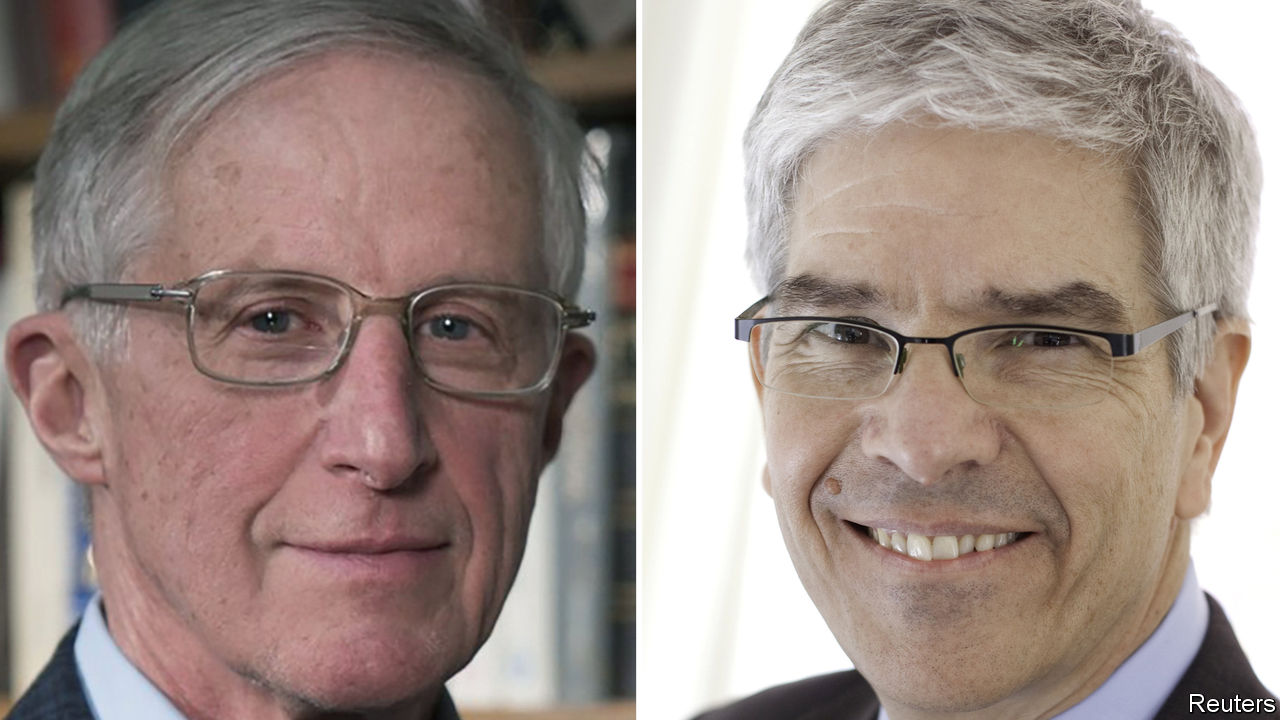
WHY do economies grow, and why might growth outstrip the natural world’s capacity to sustain it? The answers to such questions have long eluded economists. But the profession’s progress towards cracking them is in large part because of this year’s recipients of the Nobel prize for economic sciences, Paul Romer (pictured, right) and William Nordhaus (pictured, left).
At first glance, the two scholars might not seem a natural pairing. But the Sveriges Riksbank, which awards the economics prize, hailed them for “integrating innovation and climate with economic growth”. Both men, in other words, have improved the way their profession thinks about the operation of impossibly complex, crucially important systems.
Upgrade your inbox and get our Daily Dispatch and Editor's Picks.
Latest stories
Mieko Kawakami is Japan’s brightest new literary star
Prospero3 hours agoHow NFL contracts give players so little power
The Economist explains7 hours agoThe website of British Airways needs to become clearer
Gulliver17 hours agoThe Nobel prize for economics is awarded for work on the climate and economic growth
Business and finance20 hours agoA right-wing populist is poised to become Brazil’s next president
Americas20 hours agoSuicides among British pensioners are falling
Graphic detail21 hours ago
Mr Romer’s attention has ranged widely over the course of his career, but his focus has never strayed far from the nature of economic growth. Dismal scientists used to think that sustained growth over the long run depended on technological progress, which was in turn related to the creation of new ideas. But they struggled to pin down how new ideas emerged, and how innovation interacted with other market activity.
Mr Romer searched for answers by probing the “non-rivalrous” nature of new knowledge: the fact that ideas can be exploited endlessly. The firms or people who come up with new ideas can only capture a small share of the benefits arising from them; before long, competitors copy their brainwave and whittle away the innovators’ profits. In Mr Romer’s models of growth, the market generates new ideas. But the pace at which they are generated, and the way in which they are translated into growth, depend on other factors—such as state support for research and development or intellectual-property protections.
The “endogenous growth models” produced by Mr Romer and those influenced by him were once hailed as a critical step towards understanding patterns of economic growth across the globe. They have not quite fulfilled that promise. But their shortcomings have themselves been useful because of what they say about complex systems. What stops, for example, useful and widely available knowledge from translating into broad prosperity? What prevents the diffusion of knowledge, or its translation into growth, in some contexts but not others? By highlighting that the creation and spread of ideas is necessary for growth, but not sufficient for it, Mr Romer identified a rich vein for other researchers to mine.
Mr Nordhaus’s work tackles the interplay of several different complex systems. Awareness of the dangers of environmental damage, and of the threat from climate change, has grown over the past half-century. Understanding the economic costs such damage imposes is essential to answering the question of how much society should be willing to pay to avert environmental destruction. Mr Nordhaus has applied himself to this daunting problem. His most significant work models the economic harms from carbon emissions. To do so, he combined mathematical descriptions of how emissions affect atmospheric carbon concentrations with those of how atmospheric carbon affects global temperature, and how changes in temperature interact with economic activity.
Having constructed such “integrated assessment models”, Mr Nordhaus could project how different trajectories for global carbon emissions would produce different global temperatures. That, in turn, allowed him to estimate the likely economic costs of these different scenarios—and thence what level of reduction in emissions would be economically optimal. His results set the basic framework for climate-policy discussions. He was the first to suggest that warming should be limited to no more than 2°C higher than the world’s pre-industrial temperatures.
As with Mr Romer’s work, Mr Nordhaus’s contributions are also notable for what their shortcomings reveal. His work has prompted vigorous debate about how best to think through the huge uncertainties associated with global warming, from how emissions translate into higher temperatures to how well society can adapt to rapid changes in climate. Both prize-winners made their names grappling with problems that the field both could not understand and could not afford not to understand. They blazed trails that scholars continue to follow—to the benefit of both economics and humanity.
The 2018 Nobel prizesThe Nobel prize for economics is awarded for work on the climate and economic growth的更多相关文章
- Buddy system伙伴分配器实现
wikipedia:http://en.wikipedia.org/wiki/Buddy_memory_allocation The buddy memory allocation technique ...
- S8-codelab02
import news_cnn_model import numpy as np import os import pandas as pd import pickle import shutil i ...
- ACM学习历程—NPU1045 2015年陕西省程序设计竞赛网络预赛(热身赛)C题 Graph Theory(递推 && 组合数学 && 大数)
Description In graph theory, a matching or independent edge set in a graph G = (V , E) is a set of e ...
- Browse Princeton's Series (by Date) in Princeton Economic History of the Western World
Browse Princeton's Series (by Date) in Princeton Economic History of the Western World Joel Mokyr, S ...
- Java中实现SAX解析xml文件到MySQL数据库
大致步骤: 1.Java bean 2.DBHelper.java 3.重写DefaultHandler中的方法:MyHander.java 4.循环写数据库:SAXParserDemo.java ① ...
- sentence patterns
第四部分 推理题 1.世界上每个角落的每个人都有立场,都有背景,都有推理性,能推理出一个人语言的真意,才成就了真正的推理能力: 2.换言之,如果你能通过一个人的说话推理出其身份职业,你的推理能 ...
- 100-days: sixteen
Title: The world's most expensive cities 生活成本最高的城市 For the first time in its 30-year history, the Wo ...
- en-zh(科学技术)science and technology
S Korea to roll out 5G韩国正式推5G商用服务 South Korea will become the first country to commercially launch f ...
- 每日英语:How to Save Detroit
Detroit is beautiful-though you probably have to be a child of the industrial Midwest, like me, to s ...
随机推荐
- php实现cookie加密解密
1.加密解密类 class Mcrypt { /** * 解密 * * @param string $encryptedText 已加密字符串 * @param string $key 密钥 * @r ...
- Angular 4.0 环境搭建
1.安装node 2.angular cli安装 sudo npm install -g @angular/cli 3. 使用ng -v 查看安装结果 4. 创建项目 ng new helloworl ...
- github 改位置
在设置里改位置后,先在本地库上右键"stop track this repo". 然后在在线库重新CLONE.
- Jq复选框选择(取复选框被选中的值)
<input type="button" id="btn5" value="获得选中的所有值"> <input typ ...
- wkhtmltopdf+itext实现html生成pdf文件的打印下载(适用于linux及windows)
目中遇到个根据html转Java的功能,在java中我们itext可以快速的实现pdf打印下载的功能,在itext中我们一般有以下三中方式实现 配置pdf模板,通过Adobe Acrobat 来设置域 ...
- adb命令查看app的日志
前言 在做app测试的时候,经常会遇到异常,此时如果开发没有异常保存,那么测试就得通过adb命令来查看日志信息.基于Windows平台的操作: logcat输出日志 一.把日志输出到手机指定目录 其命 ...
- selenium除错
1.使用命令行启动selenium 下载selenium jar包 http://selenium-release.storage.googleapis.com/index.html 此处下载的是se ...
- Game of War - Fire Age 有何特别之处?
作者:福克斯007 链接:https://www.zhihu.com/question/21611550/answer/52458767来源:知乎著作权归作者所有.商业转载请联系作者获得授权,非商业转 ...
- python学习菜单
一.python简介 二.python字符串 三.列表 四.集合.元组.字典 五.函数 六.python 模块 七.python 高阶函数 八.python 装饰器 九.python 迭代器与生成器 ...
- 使用 Nmon 监控 Linux 的系统性能
Nmon(得名于 Nigel 的监控器)是IBM的员工 Nigel Griffiths 为 AIX 和 Linux 系统开发的一款计算机性能系统监控工具.Nmon 可以把操作系统的统计数据展示在屏幕上 ...