
String类对象的比较
1.字符串比较,是按照字符串(String)中每一个字符(char)的字段表顺序进行比较
/**
* Compares two strings lexicographically(字典序,按照字典顺序).
* The comparison is based on the Unicode value of each character in
* the strings. The character sequence represented by this
* {@code String} object is compared lexicographically to the
* character sequence represented by the argument string. The result is
* a negative integer if this {@code String} object
* lexicographically precedes(先于) the argument string. The result is a
* positive integer if this {@code String} object lexicographically
* follows the argument string. The result is zero if the strings
* are equal; {@code compareTo} returns {@code 0} exactly when
* the {@link #equals(Object)} method would return {@code true}.
* <p>
* This is the definition of lexicographic ordering. If two strings are
* different, then either they have different characters at some index
* that is a valid index for both strings, or their lengths are different,
* or both. If they have different characters at one or more index
* positions, let <i>k</i> be the smallest such index; then the string
* whose character at position <i>k</i> has the smaller value, as
* determined by using the < operator, lexicographically precedes the
* other string. In this case, {@code compareTo} returns the
* difference of the two character values at position {@code k} in
* the two string -- that is, the value:
* <blockquote><pre>
* this.charAt(k)-anotherString.charAt(k)
* </pre></blockquote>
* If there is no index position at which they differ, then the shorter
* string lexicographically precedes the longer string. In this case,
* {@code compareTo} returns the difference of the lengths of the
* strings -- that is, the value:
* <blockquote><pre>
* this.length()-anotherString.length()
* </pre></blockquote>
*
* @param anotherString the {@code String} to be compared.
* @return the value {@code 0} if the argument string is equal to
* this string; a value less than {@code 0} if this string
* is lexicographically less than the string argument; and a
* value greater than {@code 0} if this string is
* lexicographically greater than the string argument.
*/
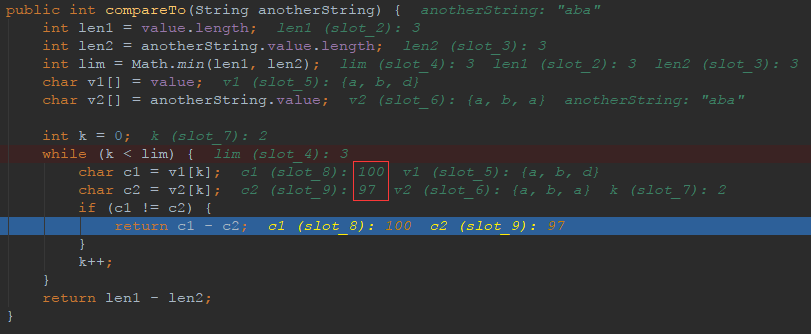
public int compareTo(String anotherString) {
int len1 = value.length;
int len2 = anotherString.value.length;
int lim = Math.min(len1, len2);
char v1[] = value;
char v2[] = anotherString.value; int k = 0;
while (k < lim) {
char c1 = v1[k];
char c2 = v2[k];
if (c1 != c2) {
return c1 - c2;
}
k++;
}
return len1 - len2;
}
String str1 = "abd";

String str2 = "aba";

int res1 = str1.compareTo(str2);

//

System.out.println(res1);
String str1 = "Abd";

String str2 = "aba";

int res1 = str1.compareTo(str2);

//-32

System.out.println(res1);
2.比较时忽略大小写
/**

 * Compares two strings lexicographically, ignoring case

 * differences. This method returns an integer whose sign is that of

 * calling {@code compareTo} with normalized versions of the strings

 * where case differences have been eliminated by calling

 * {@code Character.toLowerCase(Character.toUpperCase(character))} on

 * each character.

 * <p>

 * Note that this method does <em>not</em> take locale into account,

 * and will result in an unsatisfactory ordering for certain locales.

 * The java.text package provides <em>collators</em> to allow

 * locale-sensitive ordering.

 *

 * @param   str   the {@code String} to be compared.

 * @return  a negative integer, zero, or a positive integer as the

 *          specified String is greater than, equal to, or less

 *          than this String, ignoring case considerations.

 * @see     java.text.Collator#compare(String, String)

 * @since   1.2

 */

public int compareToIgnoreCase(String str) {

    return CASE_INSENSITIVE_ORDER.compare(this, str);

}
String str1 = "Abd";

String str2 = "aba";

int res = str1.compareToIgnoreCase(str2);

//

System.out.println(res);
String类对象的比较的更多相关文章
- 反射消除String类对象的不可变特性
大家都知道,在JAVA中字符串一旦声明就不可改变,如果尝试修改字符串的内容,将会重新实例化一个新的字符串对象,这也是为了安全性和效率. 由于字符串在程序之中被大量使用,所以JAVA引入了一个字符串常量 ...
- java笔记--String类对象解析与运用
--如果朋友您想转载本文章请注明转载地址"http://www.cnblogs.com/XHJT/p/3877236.html "谢谢-- 1.String中的equals和==的 ...
- String类对象两种实例化方式比较
第一种:直接赋值 String str = "hello!" ; 在java中,有一个字符串常量池,对于这种直接赋值的,会直接写进常量池(常量池里面不存在其value,) 自JD ...
- JAVA笔记3__字符串String类/对象一对一关联
import java.lang.String; import java.util.Scanner; public class Main { public static void main(Strin ...
- c++中string类对象和字符数组之间的相互转换
string类在c++中是一个模板类,位于名字空间std中,注意这里不是string.h,string.h是C字符串头文件. 将string类型转换为字符数组char arr[10];string s ...
- String类对象相加时做了什么
我们都知道java中的加号操作符除了加法.表示正数之外,还可以用作字符串的连接.初学java时,你很可能会碰到类似下面的题目: 以下这段代码产生了几个String对象: String str1 = & ...
- Scanner类、匿名对象、Random类、ArrayList集合、String类、static静态类、math类和Arrays工具类
一.Scanner类 1.除了八种基本数据类型,其他都是引用类型: 引用类型使用三步骤: 2.Scanner类 引用jdk提供的类,Scanner在java.util包下,不在java.lang包(S ...
- String类和StringBuffer类的区别
首先,String和StringBuffer主要有2个区别: (1)String类对象为不可变对象,一旦你修改了String对象的值,隐性重新创建了一个新的对象,释放原String对象,StringB ...
- 【Java 进阶篇】【第一课】String类
引用 String类包含在java.lang包中.这个包会在Java启动的时候自动import,所以可以当做一个内置类(built-in class).我们不需要显式的使用import引入String ...
随机推荐
- Caused by: org.springframework.context.annotation.ConflictingBeanDefinitionException
org.springframework.context.annotation.ConflictingBeanDefinitionException: Annotation-specified bean ...
- Linux下 rz 和 sz 命令的安装与使用
目录 Linux下 rz 和 sz 命令的安装与使用 rz/sz命令的安装 sz命令-发送文件到本地(下载): rz命令-本地上传文件到服务器(上传): 声明 Linux下 rz 和 sz 命令的安装 ...
- 41-2:和为S的连续正数序列
import java.util.ArrayList; /** * 面试题41-题目2:和为S的连续正数序列 * 小明很喜欢数学,有一天他在做数学作业时,要求计算出9~16的和,他马上就写出了正确答案 ...
- MySQL用户授权 和 bin-log日志 详解和实战
看了上一篇博文的发布时间,到目前已经有三个月没更新博文了.这三个月经历了很多事情,包括工作.生活和感情等等.由于个人发展的原因,这个月准备换工作啦.在这段时间,我会把Web大型项目中所接触到的技术都总 ...
- DNS 设置
用上 ip 靓号1.1.1.1,Cloudflare 花了多少钱? ipv4: 1.1.1.1 和 1.0.0.1 是目前最快的 DNS. 通过ipv6***之二--使用IPv6 DNS服务器
- CSUOJ 1162 Balls in the Boxes 快速幂
Description Mr. Mindless has many balls and many boxes,he wants to put all the balls into some of th ...
- python面向对象中类对象、实例对象、类变量、实例变量、类方法、实例方法、静态方法
1. 类对象和实例对象 Python中一切皆对象,Python类本身也是一种对象,类定义完成后,会在当前作用域中定义一个以类名为名字的命名空间.类对象具有以下两种操作: 可以通过“类名()”的方式实例 ...
- JAVAEE——宜立方商城03:商品类目选择、Nginx端口或域名区分虚拟机、Nginx反向代理、负载均衡、keepalived实现高可用
1. 学习计划 第三天: 1.商品类目选择(EasyUI的tree实现) 2.图片上传 a) 图片服务器FastDFS(Nainx部分) 2. 商品类目选择 2.1. 原型 2.2. 功能分析 展示商 ...
- 批量ping工具fping
批量ping工具fping ping是各个系统自带的基于ICMP协议的主机探测工具.但该工具一次只能检测一个主机,不满足渗透测试批量探测的需要.Kali Linux提供一款批量探测工具fping. ...
- leetcode 202. 快乐数 python实现
思想: 对输入数据 把每个位数平方求和 得到结果如果是1 就返回真 否则 对这个结果递归 啥时候事后返回假: 返回假 说明进入无限循环了. 啥时候会无限循环? 某一次求平方和的结果,之前得到过这个结果 ...