
机器学习算法 --- Pruning (decision trees) & Random Forest Algorithm
一、Table for Content
在之前的文章中我们介绍了Decision Trees Agorithms,然而这个学习算法有一个很大的弊端,就是很容易出现Overfitting,为了解决此问题人们找到了一种方法,就是对Decision Trees 进行 Pruning(剪枝)操作。
为了提高Decision Tree Agorithm的正确率和避免overfitting,人们又尝试了对它进行集成,即使用多棵树决策,然后对于分类问题投票得出最终结果,而对于回归问题则计算平均结果。下面是几条是本篇要讲的主要内容。
- Pruning (decision trees)
- What is Random forest algorithm?
- Why Random Forest algorithm?
- How Random Forest algorithm works?
- Advantages of Random Forest algorithm.
- Random Forest algorithm real life example.
本文主要参考一下几篇文章,有能力的读者可自行前往阅读原文:
1. Wikipedia上的Pruning (decision trees) 和 Random Froest algorithm。
2. Dataaspirant上的《HOW THE RANDOM FOREST ALGORITHM WORKS IN MACHINE LEARNING》
3. medium上的《How Random Forest Algorithm Works in Machine Learning》
同时推荐读者去阅读《The Random Forest Algorithm》,因为这篇文章讲解了在scikit-learn中Random Forest Agorithm常用的重要参数。
二、Pruning(decision trees)
- Pre-pruning that stop growing the tree earlier, before it perfectly classifies the training set.
- Post-pruning that allows the tree to perfectly classify the training set, and then post prune the tree.
Pre-pruning(预剪枝),该方法是在建立决策树的过程中,判断当决策树的node满足一定条件(比如当树的深度达到事先设定的值,或者当该node下的样例个数小于等于某个数)时,不在继续建立子树,所以也叫Early stopping。
Post-pruning(后剪枝),对于此方法,先建立完整的决策树,然后通过一定的算法,将某个非leaf node设为leaf node(即将该node下的子树丢弃)实现pruning。
由于Pre-pruning较为简单就不做具体介绍,所以介绍一下Cost complexity pruning(通过此方法选择某个node设为leaf node,此方法来自wikipedia),当然还有许多其他的方法就不一一介绍了,读者可自行查阅。
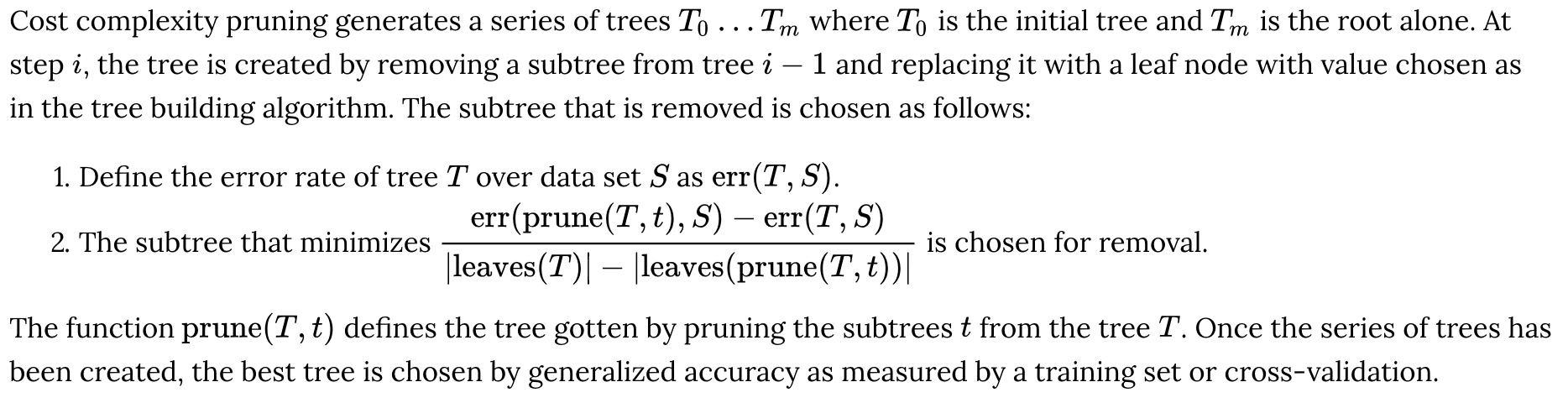
三、What is Random Forest algorithm?
关于Random Froest algorithm(随机森林)算法的介绍,很多文章的介绍用例都大同小异,所以在这里也就不另起炉灶了,参考某篇文章的介绍,并做本土特色化翻译如下:
假设有一名学生叫小明,他今年暑假准备去旅游,但他不知道该去哪儿,于是就去问自己的好朋友小刚的意见,小刚则问他一些问题,比如你以前去过哪儿啊,你对要去地方的天气有什么要求啊等等,然后小刚通过这些问题给小明一个建议。决策树就是这样一种思想,通过对样本数据的各个特征值建立一定的规则,让后使用这些规则对新数据做出决策,跟此例非常相似。
但是小明觉得只是一个人的建议,可能比较片面,于是他就问去问了一下他的其他几个朋友,而这几个朋友也问了他一些问题,这些问题有的跟小刚的问题一样,有的不一样,然后他们各自给出了建议,小明拿到这些建议后,综合了一下,有5个朋友建议他去西安,3个朋友建议他去重庆,2个朋友建议他去成都,他最终就决定这个暑假去西安游玩。Random Froest algorithm(随机森林)算法也是如此,很多颗树使用随机样本的随机特征值建立不同的规则,然后各树对于新数据得出不同的结果,最终结果取综合(分类投票,回归取平均)。
Random Froest algorithm(随机森林)的维基百科定义如下:
Random forests or random decision forests are an ensemble learningmethod for classification, regression and other tasks, that operate by constructing a multitude of decision trees at training time and outputting the class that is the mode of the classes (classification) or mean prediction (regression) of the individual trees.
四、Why Random Forest algorithm?
关于这个问题,主要有以下几点理由:
- The same random forest algorithm or the random forest classifier can use for both classification and the regression task.
- Random forest classifier will handle the missing values.
- When we have more trees in the forest, random forest classifier won’t overfit the model.
- Can model the random forest classifier for categorical values also.
五、How Random Forest algorithm works?
建立随机森林的过程如下图:
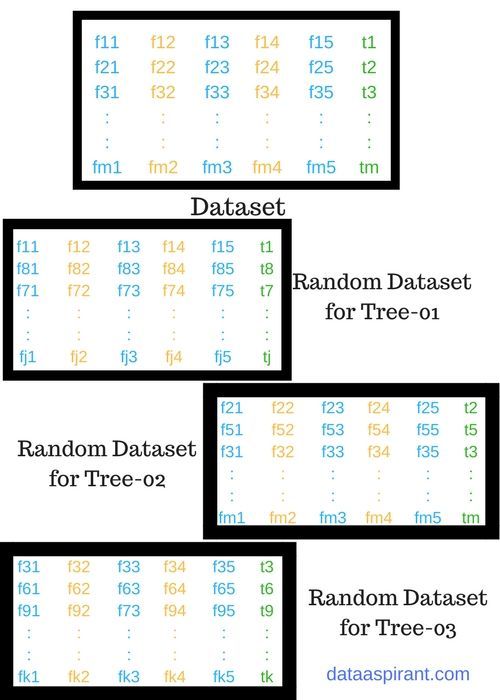
对左图中的Dataset创建包含三棵树的随机森林,过程如下:
step1:在Dataset的众多特征中,随机选取5个特征,在随机选取j个样本数据。
step2: 然后以这些数据构建一颗decesion tree。
step3:重做step1, step2,直到森林中树的数目满足要求。
所以构建Random Forest的通用算法如下:
1. Randomly select “K” features from total “m” features where k << m, then randomly seletct “J” samples from total “n” samples .
2. Among the “K” features of “J” samples, calculate the node “d” using the best split point.
3. Split the node into daughter nodes using the best split.
4. Repeat the 1 to 3 steps until “l” number of nodes has been reached.
5. Build forest by repeating steps a to d for “q” number times to create “q” number of trees.
Random Forest classifier的使用步骤如下:
1. Takes the test features and use the rules of each randomly created decision tree to predict the outcome and stores the predicted outcome(target).
2. Calculate the votes for each predicted target.
3. Consider the high voted predicted target as the final prediction from the random forest algorithm.
六、Advantages of Random Forest algorithm
至于Random Forest algorithm的优点,跟使用它的理由比较相似,主要如下:
1. 对于分类问题,永远不会出现overfitting。
2. 相同的Random Forest algorithm,对于分类问题和回归问题都适用。
3. 它可以识别出数据集中最重要的特征,这也叫feature engineering。
七、Random Forest algorithm real life example
主要应用场景如下:

1. 对于银行业务,它可以被用来分析诚信客户与欺诈客户,对于诚信客户可以给予他们更高的信用额度,而欺诈客户,将面临风险。
2. 对于医药行业,可以使用它来分析制药配方,或者对病人进行病情分析。
3. 对于股市,可以根据以往的数据记录预测将来的趋势,用来做获益或损失的决策。
4. 对于电子商务,那就更不用说了,可以对用户以往的交易记录、浏览记录做定制的广告推送。
机器学习算法 --- Pruning (decision trees) & Random Forest Algorithm的更多相关文章
- [ML学习笔记] 决策树与随机森林(Decision Tree&Random Forest)
[ML学习笔记] 决策树与随机森林(Decision Tree&Random Forest) 决策树 决策树算法以树状结构表示数据分类的结果.每个决策点实现一个具有离散输出的测试函数,记为分支 ...
- 机器学习技法笔记:10 Random Forest
Roadmap Random Forest Algorithm Out-Of-Bag Estimate Feature Selection Random Forest in Action Summar ...
- Bootstrap,Bagging and Random Forest Algorithm
Bootstrap Method:在统计学中,Bootstrap从原始数据中抽取子集,然后分别求取各个子集的统计特征,最终将统计特征合并.例如求取某国人民的平均身高,不可能测量每一个人的身高,但却可以 ...
- 机器学习技法笔记:Homework #7 Decision Tree&Random Forest相关习题
原文地址:https://www.jianshu.com/p/7ff6fd6fc99f 问题描述 程序实现 13-15 # coding:utf-8 # decision_tree.py import ...
- 机器学习技法-随机森林(Random Forest)
课程地址:https://class.coursera.org/ntumltwo-002/lecture 重要!重要!重要~ 一.随机森林(RF) 1.RF介绍 RF通过Bagging的方式将许多个C ...
- [Machine Learning & Algorithm] 随机森林(Random Forest)
1 什么是随机森林? 作为新兴起的.高度灵活的一种机器学习算法,随机森林(Random Forest,简称RF)拥有广泛的应用前景,从市场营销到医疗保健保险,既可以用来做市场营销模拟的建模,统计客户来 ...
- [Machine Learning & Algorithm] 随机森林(Random Forest)-转载
作者:Poll的笔记 博客出处:http://www.cnblogs.com/maybe2030/ 阅读目录 1 什么是随机森林? 2 随机森林的特点 3 随机森林的相关基础知识 4 随机森林的生成 ...
- 机器学习技法:10 Random Forest
Roadmap Random Forest Algorithm Out-Of-Bag Estimate Feature Selection Random Forest in Action Summar ...
- Logistic Regression vs Decision Trees vs SVM: Part II
This is the 2nd part of the series. Read the first part here: Logistic Regression Vs Decision Trees ...
随机推荐
- C# winform webbrowser如何指定内核为IE11?
1)假设你应用程序的名字为MyApplication.exe 2)运行Regedit,打开注册表,找到 HKEY_LOCAL_MACHINE\SOFTWARE\Wow6432Node\Microsof ...
- 最新版的Chrome 69.0 设置始终开启flash而不是先询问
## 69.0 之前的版本 ## 1.打开 chrome://settings/content/flash 2.禁止网站运行Flash -> 改为“Ask (Default)” 3. ...
- 20145203盖泽双 《Java程序设计》第四周学习总结
20145203盖泽双 <Java程序设计>第四周学习总结 教材学习内容总结 1.多个类中存在相同属性和行为时,将这些内容抽取到单独一个类中,那么多个类无需再定义这些属性和行为,只要继承单 ...
- 集合之Map总结
在前面LZ详细介绍了HashMap.HashTable.TreeMap的实现方法,从数据结构.实现原理.源码分析三个方面进行阐述,对这个三个类应该有了比较清晰的了解,下面LZ就Map做一个简单的总结. ...
- webpack超详细配置, 使用教程(图文)
流程 webpack安装 Step 1: 首先安装Node.js, 可以去Node.js官网下载. Step2: 在Git或者cmd中输入下面这段代码, 通过全局先将webpack指令安装进电脑中np ...
- nagios 在nrpe中自定义脚本
监控第三方端口(22000) #!/bin/bash#author:xiaoweige#check 140 22000 result=`sleep 1|telnet 10.2.1.140 22000| ...
- .Net实现Word文档及导出
参考网址: http://www.jb51.net/article/25062.htm(实用性) http://wenku.baidu.com/link?url=44O7Dua49DrZ-PF2QU7 ...
- UVA - 11927 Games Are Important (SG)
Description Games Are Important One of the primary hobbies (and research topics!) among Computing ...
- linux查看日志文件内容命令(面试被常问到的问题)
tail -f test.log 你会看到屏幕不断有内容被打印出来. 这时候中断第一个进程Ctrl-C, linux 如何显示一个文件的某几行(中间几行) 从第3000行开始,显示1000行.即显示3 ...
- WebLogic远程命令执行
靶机说明 目标ip:172.16.53.28(window 2003) 本靶机所针对的序列化漏洞系列以及常见安全问题如下: 弱口令登陆控制台部署war包webshell CVE-2018-2893 C ...