
JSP中四种属性保存范围(1)
一、四种属性范围
在JSP中提供了四种属性保存范围
page:在一个页面内保存属性,跳转之后无效
request:在一次服务请求范围内,服务器跳转后依然有效
session:-在一次会话范围内,无论何种跳转都可以使用,但是新开浏览器无法使用
application:在整个服务器上保存,所有用户都可以使用
|
名称 |
作用域 |
|
application |
在所有应用程序中有效 |
|
session |
在当前会话中有效 |
|
request |
在当前请求中有效 |
|
page |
在当前页面有效 |
置统一的请求编码:request.setCharacterEncoding("GBK");
- 请求方式:<%=request.getMethod()%><br>
- 请求的资源:<%=request.getRequestURI()%><br>
- 请求用的协议:<%=request.getProtocol()%><br>
- 请求的文件名:<%=request.getServletPath()%><br>
- 请求的服务器的IP:<%=request.getServerName()%><br>
- 请求服务器的端口:<%=request.getServerPort()%><br>
- 客户端IP地址:<%=request.getRemoteAddr()%><br>
- 客户端主机名:<%=request.getRemoteHost()%><br>
 四种属性范围:

     page(pageContext):只在一个页面中保存属性。                      跳转之后无效。

     request:只在一次请求中有效,服务器跳转之后有效。                    客户端跳无效

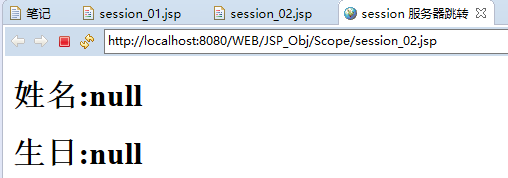
     session:再一次会话中有效。服务器跳转、客户端跳转都有效。    网页关闭重新打开无效

     application:在整个服务器上保存,所有用户都可使用。            重启服务器后无效

     注意:如果设置过多的application属性范围会影响服务器性能

 page(pageContext)对象:

     pageContext.PAGE_SCOPE

     pageContext.REQUEST_SCOPE

     pageContext.SESSION_SCOPE

     pageContext.APPLICATION_SCOPE

     pageContext.setAttribute("name", "liuyang", pageContext.APPLICATION_SCOPE);

 request对象:

     通过地址重写的方式进行传值:

     要访问的网页地址?参数1=值1&参数2=值2&...

     Request常用的方法:

     1.01 getParameter(String strTextName) 获取表单提交的信息。

         String strName=request.getParameter("name");

     1.02 getProtocol() 获取客户使用的协议。

         String strProtocol=request.getProtocol();

     1.03 getServletPath() 获取客户提交信息的页面。

         String strServlet=request.getServletPath();

     1.04 getMethod() 获取客户提交信息的方式,get|post。

         String strMethod = request.getMethod();

     1.05 getHeade() 获取HTTP头文件中的accept、accept-encoding和Host的值。

         String strHeader = request.getHeader("accept");

     1.06 getRermoteAddr() 获取客户的IP地址。

         String strIP = request.getRemoteAddr();

     1.07 getRemoteHost() 获取客户机的名称。

         String clientName = request.getRemoteHost();

     1.08 getServerName() 获取服务器名称。

         String serverName = request.getServerName();

     1.09 getServerPort() 获取服务器的端口号。

         int serverPort = request.getServerPort();

     1.10 getParameterNames() 获取客户端提交的所有参数的名字。

         Enumeration enum = request.getParameterNames();

           while(enum.hasMoreElements()){

                   String s=(String)enum.nextElement();

                   out.println(s);

          }

     1.11 getParameterValues()获取客户端提交的所有参数的名字对应的值。

         String[] inst = request.getParameterValues(paramName);

           for(String ss:inst){

                System.out.println(ss);

           }

 response对象:

     设置头信息setHeader():

         response.setHeader("refresh","5; url=hello.jsp"); 5秒后自动跳转(jsp)

         <meta http-equiv="refresh" content="5;url=hello.jsp" >  5秒后自动跳转(html)

     <jsp:forward/> 与  sendRedirect 区别:

         <jsp:forward page="hello.jsp"></jsp:forward> 执行到该语句立即跳转,后面的语句不执行

         response.sendRedirect("hello.jsp");    重定向。 执行完此页面再进行跳转

     cookie: 设置在客户端,安全性比较低

     一个客户端上最多只能保存300个cookie。

         addCookie();

         setHeader("Set-Cookie","名字=值");
       response.setHeader("refresh","1"); //每隔1秒刷新一次
       response.addCookie();
       Cookie [] c = request.getCookies();
 session对象:每一个session代表了一个用户。

     获取session ID:

         String id = session.getId();
String id = session.getId(); 获取session ID Manager 可以将session保存在本地上
      long start = session.getCreationTime(); //创建此会话的时间
      long end = session.getLastAccessedTime();//客户端上一次发送与此会话关联的请求的时间,最后一次操作此会话时间
1.page属性范围:
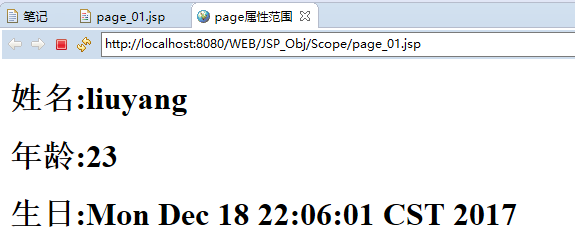
 1.设置page无跳转 属性范围,在当前jsp页面有效
 1 <%@ page language="java" contentType="text/html" pageEncoding="UTF-8"%>

 <%@ page  import="java.util.*" %>

 <!DOCTYPE html>

 <html>

     <head>

         <title>page属性范围</title>

     </head>

     <body>

         <%

             //设置page 属性范围,在当前jsp页面有效

             pageContext.setAttribute("name", "liuyang");

             pageContext.setAttribute("age", "23");

             pageContext.setAttribute("birthday", new Date());

         %>

         <%

             String name=(String)pageContext.getAttribute("name");

             int age=Integer.parseInt((String)pageContext.getAttribute("age"));

             Date birthday = (Date)pageContext.getAttribute("birthday");

         %>

         <h1>姓名:<%=name %></h1>

         <h1>年龄:<%=age %></h1>

         <h1>生日:<%=birthday %></h1>

     </body>

 </html>
2.设置page 属性范围-服务器跳转,服务器跳转后无效
   // page02.jsp
 1 <%@ page language="java" contentType="text/html" pageEncoding="UTF-8"%>

 <%@ page  import="java.util.*" %>

 <!DOCTYPE html>

 <html>

     <head>

         <title>page属性范围-服务器跳转</title>

     </head>

     <body>

         <%

             //设置page(pageContext) 属性范围,在当前jsp页面有效,只在一个页面中保存属性。 跳转之后无效。

             pageContext.setAttribute("name", "liuyang");

             pageContext.setAttribute("birthday", new Date());

         %>

         <jsp:forward page="page_03.jsp"></jsp:forward>

     </body>

 </html>
//page03.jsp
 <%@ page language="java" contentType="text/html" pageEncoding="UTF-8"%>

 <%@ page  import="java.util.*" %>

 <!DOCTYPE html>

 <html>

     <head>

         <title>page属性范围-服务器跳转</title>

     </head>

     <body>

             <%

             String name=(String)pageContext.getAttribute("name");

             Date birthday = (Date)pageContext.getAttribute("birthday");

             %>

             <h1>姓名:<%=name %></h1>

             <h1>生日:<%=birthday %></h1>

     </body>

 </html>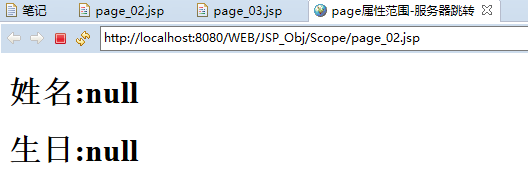
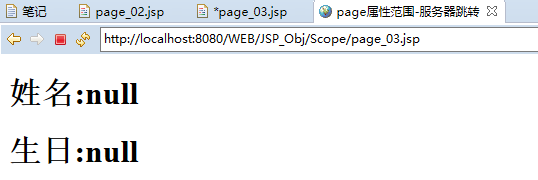
3.设置page 属性范围-客户端跳转,客户端跳转后无效
 <%@ page language="java" contentType="text/html" pageEncoding="UTF-8"%>

 <%@ page  import="java.util.*" %>

 <!DOCTYPE html>

 <html>

     <head>

         <title>page属性范围-客户端跳转</title>

     </head>

     <body>

         <%

             //设置page(pageContext) 属性范围,在当前jsp页面有效,只在一个页面中保存属性。 跳转之后无效。

             pageContext.setAttribute("name", "liuyang");

             pageContext.setAttribute("birthday", new Date());

         %>

         <a href="page_03.jsp">跳转</a>

     </body>

 </html>
 <%@ page language="java" contentType="text/html" pageEncoding="UTF-8"%>

 <%@ page  import="java.util.*" %>

 <!DOCTYPE html>

 <html>

     <head>

         <title>page属性范围-客户端跳转</title>

     </head>

     <body>

             <%

             String name=(String)pageContext.getAttribute("name");

             Date birthday = (Date)pageContext.getAttribute("birthday");

             %>

             <h1>姓名:<%=name %></h1>

             <h1>生日:<%=birthday %></h1>

     </body>

 </html>
2.request属性范围:
1.设置request 属性范围 - 服务器跳转,服务器跳转后有效, 客户端跳转后无效
 <%@ page language="java" contentType="text/html" pageEncoding="UTF-8"%>

 <%@ page  import="java.util.*" %>

 <!DOCTYPE html>

 <html>

     <head>

         <title>request属性范围—服务器跳转</title>

     </head>

     <body>

         <%

             //request:只在一次请求中有效,服务器跳转之后有效。

             request.setAttribute("name", "liuyang");

             request.setAttribute("birthday", new Date());

         %>

         <jsp:forward page="request_02.jsp"></jsp:forward>

     </body>

 </html>
 <%@ page language="java" contentType="text/html" pageEncoding="UTF-8"%>

 <%@ page  import="java.util.*" %>

 <!DOCTYPE html>

 <html>

     <head>

         <title>request属性范围—服务器跳转</title>

     </head>

     <body>

             <%

             //request:只在一次请求中有效,服务器跳转之后有效。  客户端跳转后无效

             String name=(String)request.getAttribute("name");

             Date birthday = (Date)request.getAttribute("birthday");

             %>

             <h1>姓名:<%=name %></h1>

             <h1>生日:<%=birthday %></h1>

     </body>

 </html>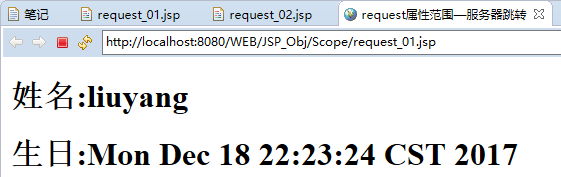
2.设置request 属性范围 客户端跳转,客户端跳转后无效
 <%@ page language="java" contentType="text/html" pageEncoding="UTF-8"%>

 <%@ page  import="java.util.*" %>

 <!DOCTYPE html>

 <html>

     <head>

         <title>request属性范围—客户端跳转</title>

     </head>

     <body>

         <%

             //request:只在一次请求中有效,服务器跳转之后有效。  客户端跳无效

             request.setAttribute("name", "liuyang");

             request.setAttribute("birthday", new Date());

         %>

         <a href="request_02.jsp">跳转</a>

     </body>

 </html>
 <%@ page language="java" contentType="text/html" pageEncoding="UTF-8"%>

 <%@ page  import="java.util.*" %>

 <!DOCTYPE html>

 <html>

     <head>

         <title>request属性范围—客户端跳转</title>

     </head>

     <body>

             <%

             //request:只在一次请求中有效,服务器跳转之后有效。  客户端跳转后无效

             String name=(String)request.getAttribute("name");

             Date birthday = (Date)request.getAttribute("birthday");

             %>

             <h1>姓名:<%=name %></h1>

             <h1>生日:<%=birthday %></h1>

     </body>

 </html>

3.session属性范围:
1.session:服务器跳转。 再一次会话中有效。服务器跳转、客户端跳转都有效。 浏览器关闭重新打开无效
 <%@ page language="java" contentType="text/html" pageEncoding="UTF-8"%>

 <%@ page  import="java.util.*" %>

 <!DOCTYPE html>

 <html>

     <head>

         <title>session 服务器跳转</title>

     </head>

     <body>

         <%

             //session:再一次会话中有效。服务器跳转、客户端跳转都有效。    网页关闭重新打开无效

             session.setAttribute("name", "liuyang");

             session.setAttribute("birthday", new Date());

         %>

         <jsp:forward page="session_02.jsp"></jsp:forward>

     </body>

 </html>
 <%@ page language="java" contentType="text/html" pageEncoding="UTF-8"%>

 <%@ page  import="java.util.*" %>

 <!DOCTYPE html>

 <html>

     <head>

         <title>session 服务器跳转</title>

     </head>

     <body>

             <%

             //session:再一次会话中有效。服务器跳转、客户端跳转都有效。    网页关闭重新打开无效

             String name=(String)session.getAttribute("name");

             Date birthday = (Date)session.getAttribute("birthday");

             %>

             <h1>姓名:<%=name %></h1>

             <h1>生日:<%=birthday %></h1>

     </body>

 </html>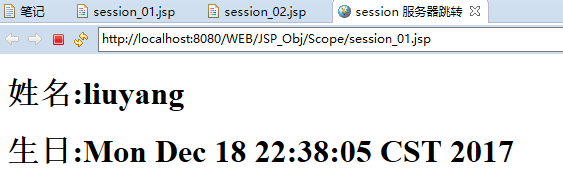
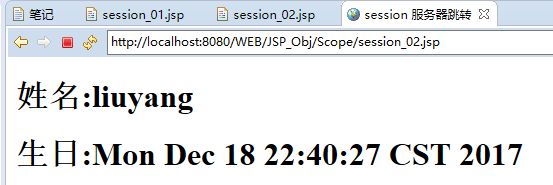
2.session 客户端跳转
 <%@ page language="java" contentType="text/html" pageEncoding="UTF-8"%>

 <%@ page  import="java.util.*" %>

 <!DOCTYPE html>

 <html>

     <head>

         <title>session 客户端跳转</title>

     </head>

     <body>

         <%

             //session:再一次会话中有效。服务器跳转、客户端跳转都有效。    网页关闭重新打开无效

             session.setAttribute("name", "liuyang");

             session.setAttribute("birthday", new Date());

         %>

         <a href="session_02.jsp">跳转</a>

     </body>

 </html>
 <%@ page language="java" contentType="text/html" pageEncoding="UTF-8"%>

 <%@ page  import="java.util.*" %>

 <!DOCTYPE html>

 <html>

     <head>

         <title>session 客户端跳转</title>

     </head>

     <body>

             <%

             //session:再一次会话中有效。服务器跳转、客户端跳转都有效。    网页关闭重新打开无效

             String name=(String)session.getAttribute("name");

             Date birthday = (Date)session.getAttribute("birthday");

             %>

             <h1>姓名:<%=name %></h1>

             <h1>生日:<%=birthday %></h1>

     </body>

 </html>
3.关闭浏览器重新打开进入session_02.jsp无效
4.application属性范围:
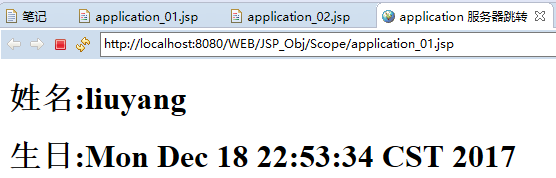
1.application:服务器跳转 在整个服务器上保存,所有用户都可使用。 重启服务器后无效
 <%@ page language="java" contentType="text/html" pageEncoding="UTF-8"%>

 <%@ page  import="java.util.*" %>

 <!DOCTYPE html>

 <html>

     <head>

         <title>application 服务器跳转</title>

     </head>

     <body>

         <%

             //application:在整个服务器上保存,所有用户都可使用。            重启服务器后无效

             //application.setAttribute("name", "liuyang");

             pageContext.setAttribute("name", "liuyang", pageContext.APPLICATION_SCOPE);

             application.setAttribute("birthday", new Date());

         %>

         <jsp:forward page="application_02.jsp"></jsp:forward>

     </body>

 </html>
 <%@ page language="java" contentType="text/html" pageEncoding="UTF-8"%>

 <%@ page  import="java.util.*" %>

 <!DOCTYPE html>

 <html>

     <head>

         <title>application 服务器跳转</title>

     </head>

     <body>

             <%

             //application:在整个服务器上保存,所有用户都可使用。            重启服务器后无效

             String name=(String)application.getAttribute("name");

             Date birthday = (Date)application.getAttribute("birthday");

             %>

             <h1>姓名:<%=name %></h1>

             <h1>生日:<%=birthday %></h1>

     </body>

 </html>
2.application:客户端跳转 在整个服务器上保存,所有用户都可使用。 重启服务器后无效
 <%@ page language="java" contentType="text/html" pageEncoding="UTF-8"%>

 <%@ page  import="java.util.*" %>

 <!DOCTYPE html>

 <html>

     <head>

         <title>application 客户端跳转</title>

     </head>

     <body>

         <%

             //application:在整个服务器上保存,所有用户都可使用。            重启服务器后无效

             //application.setAttribute("name", "liuyang");

             pageContext.setAttribute("name", "liuyang", pageContext.APPLICATION_SCOPE);

             application.setAttribute("birthday", new Date());

         %>

         <a href="application_02.jsp">跳转</a>

     </body>

 </html>
 <%@ page language="java" contentType="text/html" pageEncoding="UTF-8"%>

 <%@ page  import="java.util.*" %>

 <!DOCTYPE html>

 <html>

     <head>

         <title>application 客户端跳转</title>

     </head>

     <body>

             <%

             //application:在整个服务器上保存,所有用户都可使用。            重启服务器后无效

             String name=(String)application.getAttribute("name");

             Date birthday = (Date)application.getAttribute("birthday");

             %>

             <h1>姓名:<%=name %></h1>

             <h1>生日:<%=birthday %></h1>

     </body>

 </html>
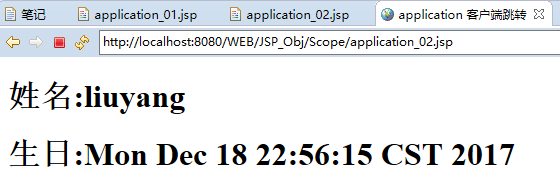
3.application:关闭浏览器重新进入application_02.jsp 在整个服务器上保存,所有用户都可使用。 重启服务器后无效
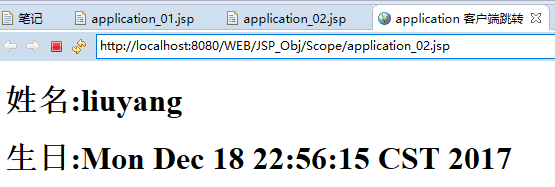
4.application:重启服务器后 重新进入application_02.jsp 在整个服务器上保存,所有用户都可使用。 重启服务器后无效
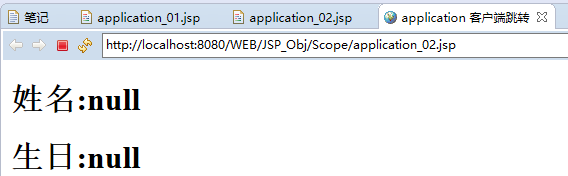
四种属性范围:page(pageContext):只在一个页面中保存属性。 跳转之后无效。
request:只在一次请求中有效,服务器跳转之后有效。 客户端跳无效
session:再一次会话中有效。服务器跳转、客户端跳转都有效。网页关闭重新打开无效
application:在整个服务器上保存,所有用户都可使用。重启服务器后无效
注意:如果设置过多的application属性范围会影响服务器性能
page(pageContext): 对象
pageContext.REQUEST_SCOPE
pageContext.SESSION_SCOPE
pageContext.APPLICATION_SCOPE
pageContext.setAttribute("name", "liuyang", pageContext.APPLICATION_SCOPE);
request对象:
通过地址重写的方式进行传值:要访问的网页地址?参数1=值1&参数2=值2&...
Request常用的方法:
1.01 getParameter(String strTextName) 获取表单提交的信息。
String strName=request.getParameter("name");
1.02 getProtocol() 获取客户使用的协议。
String strProtocol=request.getProtocol()
;1.03 getServletPath() 获取客户提交信息的页面。
String strServlet=request.getServletPath();
1.04 getMethod() 获取客户提交信息的方式,get|post。
String strMethod = request.getMethod();
1.05 getHeade() 获取HTTP头文件中的accept、accept-encoding和Host的值。
String strHeader = request.getHeader("accept");
1.06 getRermoteAddr() 获取客户的IP地址。
String strIP = request.getRemoteAddr();1.07 getRemoteHost() 获取客户机的名称。
String clientName = request.getRemoteHost();1.08 getServerName() 获取服务器名称。
String serverName = request.getServerName();1.09 getServerPort() 获取服务器的端口号。
int serverPort = request.getServerPort();1.10 getParameterNames() 获取客户端提交的所有参数的名字。
Enumeration enum = request.getParameterNames();
while(enum.hasMoreElements()){
String s=(String)enum.nextElement();
out.println(s); }
1.11 getParameterValues()获取客户端提交的所有参数的名字对应的值。
String[] inst = request.getParameterValues(paramName);
for(String ss:inst){
System.out.println(ss);
}
response对象:
设置头信息setHeader():
response.setHeader("refresh","5; url=hello.jsp");5秒后自动跳转(jsp)
<meta http-equiv="refresh" content="5;url=hello.jsp" > 5秒后自动跳转(html)
<jsp:forward/> 与 sendRedirect 区别:
<jsp:forward page="hello.jsp"></jsp:forward> 执行到该语句立即跳转,后面的语句不执行
response.sendRedirect("hello.jsp");重定向。 执行完此页面再进行跳转
cookie: 设置在客户端,安全性比较低一个客户端上最多只能保存300个cookie。
addCookie();
setHeader("Set-Cookie","名字=值");
session对象:每一个session代表了一个用户。
获取session ID:String id = session.getId();
JSP中四种属性保存范围(1)的更多相关文章
- JSP中四种属性保存范围(2)
1.session <%@ page language="java" contentType="text/html" pageEncoding=" ...
- jsp中四种传递参数的方法
jsp中四种传递参数的方法如下: 1.form表单 2.request.setAttribute();和request.getAttribute(); 3.超链接:<a herf="i ...
- css样式表中四种属性选择器
学习此连接的总结http://developer.51cto.com/art/201009/226158.htmcss样式表中四种属性选择器1> 简易属性 tag[class]{ font-we ...
- (转)JSP中四种传递参数的方法:
1.form表单 2.request.setAttribute();和request.getAttribute(); 3.超链接:<a herf="index.jsp"?a= ...
- JSP中四种传递参数中文乱码问题
查看来源:http://blog.csdn.net/hackerain/article/details/6776083
- JSP九大内置对象和四种属性范围解读
林炳文Evankaka原创作品.转载请注明出处http://blog.csdn.net/evankaka 摘要:本文首先主要解说了JSP中四种属性范围的概念.用法与实例. 然后在这个基础之上又引入了九 ...
- Jsp学习总结(1)——JSP九大内置对象和四种属性范围解读
一.四种属性范围 1.1.在JSP中提供了四种属性保存范围 page:在一个页面内保存属性,跳转之后无效 request:在一次服务请求范围内,服务器跳转后依然有效 session:-在一次会话范围内 ...
- jsp四种属性范围
在JSP提供了四种属性的保存范围.所谓的属性保存范围,指的就是一个设置的对象,可以在多个页面中保存并可以继续使用.它们分别是:page.request.session.appliction. 1.pa ...
- JavaScript中四种不同的属性检测方式比较
JavaScript中四种不同的属性检测方式比较 1. 用in方法 var o = {x:1}; "x" in o; //true "y" in o; //fa ...
随机推荐
- 《jmeter:菜鸟入门到进阶系列》
jmeter是我从事软件测试工作以来接触的第一个性能测试工具,也是耗费时间精力最多的一个工具,当然,学习jmeter过程中,由于知识储备不够,也顺带学习了很多其他相关的一些知识. 一直有个想法,就是把 ...
- 关于java的数组
一定要写成 int[] arr = new int[30] 这样每个元素默认为0; 介样子的 如果写成 int[] arr = {1,2,3,4}; 那么他的长度就是4
- 【题解】Oh My Holy FFF
题目大意 有\(n\)个士兵(\(1 \leq n \leq 10^5\)),第\(i\)个士兵的身高为\(h_{i}\),现在要求把士兵按照原来的顺序分成连续的若干组,要求每组的士兵数量不超过\ ...
- 在react中用装饰器来装饰connect
假设我们在react中有如下header组件: import React, { PureComponent } from 'react'; import { connect } from 'react ...
- Vue组件通信方式(一)
组件与组件的关系,通常有父子关系,兄弟关系以及隔代关系. 针对不同的场景,如何选用适合的通信方式呢? (一) props/$emit parentComponent ==> childCompo ...
- .NET平台 C# ASP.NET
.NET 平台 根据微软的定义: .NET is a“ revolutionary new platform, built on open Internet protocols and standar ...
- Html5移动端页面自适应布局详解(rem布局)
在移动设备上进行网页的重构或开发,首先得搞明白的就是移动设备上的viewport,通读网上的各种对于viewport的解释之后 大概viewport可以理解为三种 1.layout viewport ...
- vue传值(小demo)
vue+element ui实现的.解释大多在代码中(代码臭且长,有错误请指正)-- 代码如下: <template> <div class="userList" ...
- 使用myBase Desktop来管理电脑上的资料
下载链接:下载链接:http://www.wjjsoft.com/download.html 选择自己的操作系统下的myBase Desktop 这里是下载的是安装包,有解压的版本的. 这里就简单介绍 ...
- python 安装 pip ,并使用pip 安装 filetype
闲话少说,直接上操作. python版本为2.7.6 可以直接到官网下载,我也提供一个百度云的下载地址 https://pan.baidu.com/s/1kWPXG8Z 这个是window版本,lin ...