
perl-basic-数据类型&引用
我觉得这一系列的标题应该是:PERL,从入门到放弃
USE IT OR U WILL LOSE IT
参考资料:
https://qntm.org/files/perl/perl.html
在线perl编译器:
https://www.tutorialspoint.com/execute_perl_online.php
use strict;

use warnings;

# no block comments

# variables: use 'my' for declaration

# 1. scalars: undef(like NULL), number, string, reference to any other variables

# no distinguish between float and int

my $num = 12.34;

# use '.' for string concatenation

my $str = "hello, "."m'lady";

print $str."\n";

# no boolean type. but "false" in condition means: 0,"","0",undef

# 2. arrays: use @variableName

# trailing comma is OK

my @arr = (1, "hi", 3,);

# use '$' because it's scala when retrived

print $arr[0]."\n";

# negative index means retriving from backend

print "$arr[-2]\n";

# '' will not interpret, just output raw string

# "" will interpret variables

# they're same: print 'Hello \$str \@arr'

print "Hello \$str \@arr"

# OPERATORS

# Numerical operators:  <,  >, <=, >=, ==, !=, <=>, +, *

# String operators:    lt, gt, le, ge, eq, ne, cmp, ., x
啦啦啦今天继续啊
数组长度:
my @arr = (2, "Hi", "my", "lady", "!");

# the length of array

print scalar @arr;

print "\n";

# the end index of array. aka, length-1

print $#arr;
- hash Tables:
use strict;

use warnings;

# hash variable

my %hashTable = ("1st" => "hi",

"2nd" => "my",

"3rd" => "lady");

# since some element is a scalar

print $hashTable{"1st"};
use strict;

use warnings;

my %hashTable = (1=>"hi", 2=>"my", "3rd"=>"lady");

# convert to array

my @arr = %hashTable;

# 1hi2my3rdlady

print @arr;

# output 1

print $arr[0];

# 索引时hash用{},array[],""有无无所谓;构建时两者都用()

#print $hashTable{1};

#print $hashTable{"1"};
- list
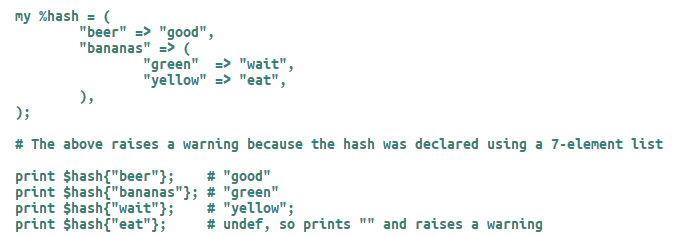
列表指的是用()构建的东西,array和hash都是。列表可以作为一个元素放在列表中间,但是会失去层次结构。hash的话,
use strict;

use warnings;

my @array = (

	"apples",

	"bananas",

	(

		"inner",

		"list",

		"several",

		"entries",

	),

	"cherries",

);

my $i = 0;

while ($i <= $#array) {

    print "array[$i] is ".$array[$i]."\n";

    $i = $i + 1;

    }
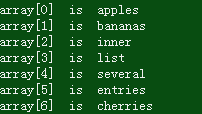
但其实list与array还是不同的,如下例:
my @arr = ("alpha", "beta", "gamma", "pie");

# 这里得到arr的长度

my $num = @arr;

print "$num\n";

# output: pie $num1存的是最后一项

my $num1 = ("alpha", "beta", "gamma", "pie");

print "$num1\n";
Every expression in Perl is evaluated either in scalar context or list context
而对很多函数来说,对scalar和list的处理方式是不同的,如reverse:
# link. no reverse

print reverse "hello, my lady", 3, " ";

print "\n";

# reverse each letter

my $scalar = reverse "hello, my lady";

print "$scalar\n";
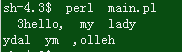
可以在前面强制加scalar,让函数可以按照scalar的方式处理:
print scalar reverse "hello world"; # "dlrow olleh"
而在下面的例子中,给$outer[3]赋值时,由于它是scalar,所以取得的值只能是数组长度,而非数组。
my @outer = ("Sun", "Mercury", "Venus", undef, "Mars");

my @inner = ("Earth", "Moon");

$outer[3] = @inner;

print $outer[3]; # "2"
好吧,为了解决这个问题,使用引用:
my $colour    = "Indigo";

# add reference

my $scalarRef = \$colour;

print $colour;         # "Indigo"

print $scalarRef;      # e.g. "SCALAR(0x182c180)"

print ${ $scalarRef }; # "Indigo"

# 如果不会混淆,可以省略{}

print $$scalarRef;

my @colours = ("Red", "Orange", "Yellow", "Green", "Blue");

my $arrayRef = \@colours;

print $colours[0];       # direct array access

print ${ $arrayRef }[0]; # use the reference to get to the array

print $arrayRef->[0];    # exactly the same thing

my %atomicWeights = ("Hydrogen" => 1.008, "Helium" => 4.003, "Manganese" => 54.94);

my $hashRef = \%atomicWeights;

print $atomicWeights{"Helium"}; # direct hash access

print ${ $hashRef }{"Helium"};  # use a reference to get to the hash

print $hashRef->{"Helium"};     # exactly the same thing - this is very common
我们希望定义自己的数据类型,类似C++里类的概念,所以我们这样做:
# Braces denote an anonymous hash

my $owner1Ref = {

	"name" => "Santa Claus",

	"DOB"  => "1882-12-25",

};

my $owner2Ref = {

	"name" => "Mickey Mouse",

	"DOB"  => "1928-11-18",

};

# Square brackets denote an anonymous array

my $ownersRef = [ $owner1Ref, $owner2Ref ];

my %account = (

	"number" => "12345678",

	"opened" => "2000-01-01",

	"owners" => $ownersRef,

);
注意,这里$owner1Ref和$owner2Ref存的其实是一个匿名hash的引用,$ownersRef存的则是匿名array的引用。既然时候引用,
它们的实际值就是地址。所以%account中才能够保存完整的信息。等价于:
my %account = (

	"number" => "31415926",

	"opened" => "3000-01-01",

	"owners" => [

		{

			"name" => "Philip Fry",

			"DOB"  => "1974-08-06",

		},

		{

			"name" => "Hubert Farnsworth",

			"DOB"  => "2841-04-09",

		},

	],

);
如何打印?使用->
print "Account #", $account{"number"}, "\n";

print "Opened on ", $account{"opened"}, "\n";

print "Joint owners:\n";

print "\t", $account{"owners"}->[0]->{"name"}, " (born ", $account{"owners"}->[0]->{"DOB"}, ")\n";

print "\t", $account{"owners"}->[1]->{"name"}, " (born ", $account{"owners"}->[1]->{"DOB"}, ")\n";
perl-basic-数据类型&引用的更多相关文章
- Delphi、C C++、Visual Basic数据类型的对照 转
Delphi.C C++.Visual Basic数据类型的对照 变量类型 Delphi C/C++ Visual Basic 位有符号整数 ShortInt char -- 位无符号整数 Byte ...
- [Perl系列—] 2. Perl 中的引用使用方法
Perl 中的引用,为什么要使用引用? 对于熟悉C语言的开发人员来说, 指针这个概念一定不陌生. Perl 的引用就是指针,能够指向变量.数组.哈希表甚至子程序. Perl5中的两种Perl引用类型为 ...
- perl 对象 bless 引用
[root@dr-mysql01 ~]# cat aa.pl use LWP::UserAgent; use Data::Dumper; my $ua = LWP::UserAgent->new ...
- perl 函数回调 引用$client->run(sub {$client->sync});
匿名函数引用: [root@wx03 wx]# perl a1.pl CODE(0x2077b30) test [root@wx03 wx]# cat a1.pl $ref= sub {return ...
- 【转载】Perl中的引用
为什么使用引用? 在perl4中,hash表中的value字段只能是scalar,而不能是list,这对于有些情况是很不方便的,比如有下面的数据: Chicago, USAFrankfurt, Ger ...
- perl 中的引用
perl 语言中的引用共分为两类: 声明引用时只需要在对象的前面加上反斜杠 第一列是数组的引用: 代码示例: , , ); my $array_ref = \@array; 第二种是哈希的引用 代码示 ...
- perl的匿名引用
perl中列表不能嵌套,只能通过引用的方式构建复杂的结构.引用其实就是c中的指针,只不过perl中对指针,也就是一个地址的声明和取值有自己的一套方法. 1.先复习普通标量的引用方法: [vagrant ...
- perl 引用(数组和hash引用) --- perlreftut - Mark 的一个简单的'引用'教程 ---Understand References Today. --Mark Jason Dominus, Plover Systems (mjd-perl-ref+@plover.com)
https://blog.csdn.net/fangwei1235/article/details/8570886 首页 博客 学院 下载 论坛 APP 问答 商城 活动 VIP会员 招聘 ITeye ...
- Java入门(6)——集合、基本数据类型和引用数据类型的相互转换
集合: 1.HashMap ----> 类 概述: 通过key可以找到value, key就是键, values就是值. 俗称键值对. 特点: 无序的 值可以重复 键不可以重复的 如 ...
- 6、perl创建模块(Exporter)及路径 引用 嵌套 查询模块
参考博客:http://www.cnblogs.com/xudongliang/tag/perl/ 1.perl 模块的创建以及制定perl 模块的路径 (1)创建一个Myfun.pm模块. #/us ...
随机推荐
- springboot集成log4j
需求: 1.springboot集成log4j 2.mybatis 打印 sql 实现: pom.xml <dependency> <groupId>org.springfra ...
- Linux+.NetCore+Nginx
Linux+.NetCore+Nginx搭建集群 本篇和大家分享的是Linux+NetCore+Nginx搭建负载集群,对于netcore2.0发布后,我一直在看官网的文档并学习,关注有哪些新增的东西 ...
- Ubuntu系统修改服务器的静态ip地址
Ubuntu 16.04 #vi /etc/network/interfaces auto lo iface lo inet loopback auto ens3 iface ens3 inet st ...
- Json规范
标准格式 书写使用首字母小写驼峰式 {" status":0 //状态 大于0代表正常.小于等于0代表异常 "message":"",/ ...
- 解决win10下python3和python2共存pip的问题
经过在查阅网友的各种经验,发现仍然解决不了问题,python2和python3在win10下的安装就不再演示了,直接在python的官网下载就好,我机器上使用的是python2.7.15和python ...
- NPOI导出EXCEL后公式无结果,公式重新计算开关
但其实这个选项是可以控制的.在NPOI中,这个属性叫做XSSFSheet.ForceFormulaRecalculation. 打开该选项的话,代码为 sheet1.ForceFormulaRecal ...
- Java 多线程概念
1.为什么要使用多线程: 更多的处理器核心. 更快的响应时间. 更好的变成模型. 2.线程的优先级: 现代操作系统基本采用时分的形式调度运行的线程,操作系统会分出一个个的时间片,线程会分配到若干时间片 ...
- Uncaught Error: Bootstrap's JavaScript requires jQuery
在写bootstarp的时候,一直报 Uncaught Error: Bootstrap's JavaScript requires jQuery 查看了自己引入的文件路径是对的,也可以使用jquer ...
- nodejs 中的异步之殇
nodejs 中的异步之殇 终于再次回到 nodejs 异步中,以前我以为异步在我写的文章中,已经写完了,现在才发现,还是有很多的地方没有想清楚,下面来一一说明. 模块同步与连接异步 大家应该,经常使 ...
- sqlserver 数据库 的数据库个数统计 表个数统计 表的数据量统计(转载)
http://www.cnblogs.com/qinche/archive/2012/08/09/app.html 由于今天要监控数据,急需统计实例中1有多少库2库里有多少表3每个表有多少数据 --将 ...