
hdu 3157 Crazy Circuits 网络流
题目链接:http://acm.hdu.edu.cn/showproblem.php?pid=3157
You’ve just built a circuit board for your new robot, and now you need to power it. Your robot circuit consists of a number of electrical components that each require a certain amount of current to operate. Every component has a + and a - lead, which are connected on the circuit board at junctions. Current flows through the component from + to - (but note that a component does not "use up" the current: everything that comes in through the + end goes out the - end).
The junctions on the board are labeled 1, ..., N, except for
two special junctions labeled + and - where the power supply terminals are
connected. The + terminal only connects + leads, and the - terminal only
connects - leads. All current that enters a junction from the - leads of
connected components exits through connected + leads, but you are able to
control how much current flows to each connected + lead at every junction
(though methods for doing so are beyond the scope of this problem1).
Moreover, you know you have assembled the circuit in such a way that there are
no feedback loops (components chained in a manner that allows current to flow in
a loop).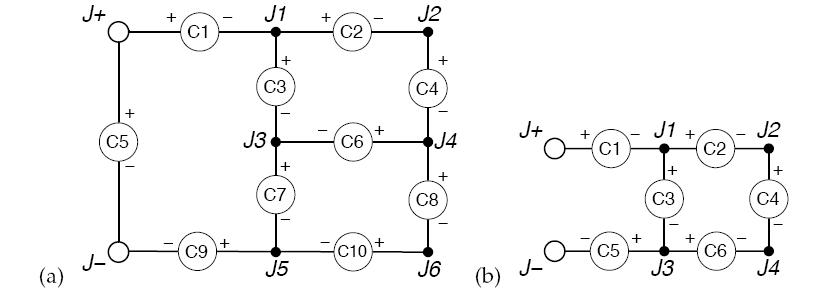
In the interest of saving power, and also to ensure that your circuit does not overheat, you would like to use as little current as possible to get your robot to work. What is the smallest amount of current that you need to put through the + terminal (which you can imagine all necessarily leaving through the - terminal) so that every component on your robot receives its required supply of current to function?
1 For
those who are electronics-inclined, imagine that you have the ability to adjust
the potential on any componentwithout altering its current requirement, or
equivalently that there is an accurate variable potentiometer connected in
series with each component that you can adjust. Your power supply will have
ample potential for the circuit.
 #include<iostream>

 #include<cstdio>

 #include<cstring>

 #include<cstdlib>

 #include<cmath>

 #include<algorithm>

 #include<queue>

 #define inf 0x7fffffff

 using namespace std;

 const int maxn=;

 const int M = +;

 struct Edge

 {

     int to,cap,next;

 }edge[M*];

 int head[maxn],edgenum;

 int n,m,from,to,vnum,s,t;

 void add(int u,int v,int cap)

 {

     edge[edgenum].to=v;

     edge[edgenum].cap=cap;

     edge[edgenum].next=head[u];

     head[u]=edgenum++;

     edge[edgenum].to=u;

     edge[edgenum].cap=;

     edge[edgenum].next=head[v];

     head[v]=edgenum++;

 }

 int level[maxn];

 int gap[maxn];

 void bfs(int to)

 {

     memset(level,-,sizeof(level));

     memset(gap,,sizeof(gap));

     level[to]=;

     gap[level[to] ]++;

     queue<int> Q;

     Q.push(to);

     while (!Q.empty())

     {

         int u=Q.front() ;Q.pop() ;

         for (int i=head[u] ;i!=- ;i=edge[i].next)

         {

             int v=edge[i].to;

             if (level[v] != -) continue;

             level[v]=level[u]+;

             gap[level[v] ]++;

             Q.push(v);

         }

     }

 }

 int cur[maxn];

 int pre[maxn];

 int SAP(int from,int to)

 {

     bfs(to);

     memset(pre,-,sizeof(pre));

     memcpy(cur,head,sizeof(head));

     int u=pre[from]=from,flow=,aug=inf;

     gap[from]=vnum;

     while (level[from]<vnum)

     {

         bool flag=false;

         for (int &i=cur[u] ;i!=- ;i=edge[i].next)

         {

             int v=edge[i].to;

             if (edge[i].cap && level[u]==level[v]+)

             {

                 flag=true;

                 aug=min(aug,edge[i].cap);

                 pre[v]=u;

                 u=v;

                 if (v==to)

                 {

                     flow += aug;

                     for (u=pre[u] ;v!=from ;v=u ,u=pre[u])

                     {

                         edge[cur[u] ].cap -= aug;

                         edge[cur[u]^ ].cap += aug;

                     }

                     aug=inf;

                 }

                 break;

             }

         }

         if (flag) continue;

         int minlevel=vnum;

         for (int i=head[u] ;i!=- ;i=edge[i].next)

         {

             int v=edge[i].to;

             if (edge[i].cap && level[v]<minlevel)

             {

                 minlevel=level[v];

                 cur[u]=i;

             }

         }

         if (--gap[level[u] ]==) break;

         level[u]=minlevel+;

         gap[level[u] ]++;

         u=pre[u];

     }

     return flow;

 }

 int main()

 {

     while (scanf("%d%d",&n,&m)!=EOF)

     {

         if (!n && !m) break;

         memset(head,-,sizeof(head));

         edgenum=;

         char c[],c2[];

         int u,v;

         int cap,f=M;

         s= ;t=n+ ;from=t+ ;to=from+ ;

         vnum=to+;

         int sum=;

         for (int i= ;i<m ;i++)

         {

             scanf("%s%s%d",&c,&c2,&cap);

             sum += cap;

             if (c[]=='+') u=s;

             else sscanf(c,"%d",&u);

             if (c2[]=='-') v=t;

             else sscanf(c2,"%d",&v);

             add(u,v,f-cap);

             add(from,v,cap);

             add(u,to,cap);

             //cout<<"debug"<<endl;

         }

         int Maxflow=SAP(from,to);

         int d=edgenum;

         add(t,s,inf);

         Maxflow += SAP(from,to);

         int flag=;

         for (int i=head[from] ;i!=- ;i=edge[i].next)

         {

             if (edge[i].cap) {flag=;break; }

         }

         if (Maxflow==sum) printf("%d\n",edge[(d^)].cap);

         else printf("impossible\n");

     }

     return ;

 }
hdu 3157 Crazy Circuits 网络流的更多相关文章
- HDU 3157 Crazy Circuits(有源汇上下界最小流)
HDU 3157 Crazy Circuits 题目链接 题意:一个电路板,上面有N个接线柱(标号1~N),还有两个电源接线柱 + -.给出一些线路,每一个线路有一个下限值求一个能够让全部部件正常工作 ...
- HDU 3157 Crazy Circuits
Crazy Circuits Time Limit: 2000ms Memory Limit: 32768KB This problem will be judged on HDU. Original ...
- HDU 3157 Crazy Circuits (有源汇上下界最小流)
题意:一个电路板,上面有N个接线柱(标号1~N) 还有两个电源接线柱 + - 然后是 给出M个部件正负极的接线柱和最小电流,求一个可以让所有部件正常工作的总电流. 析:这是一个有源汇有上下界的 ...
- POJ 3801/HDU 3157 Crazy Circuits | 有下界的最小流
题目: POJ最近总是炸 所以还是用HDU吧http://acm.hdu.edu.cn/showproblem.php?pid=3157 题解: 题很长,但其实就是给个有源汇带下界网络流(+是源,-是 ...
- hdu 3157 Crazy Circuits 有源汇和下界的最小费用流
题目链接 题意:有n个节点,m个用电器.之后输入m行每行三个整数a,b,c; 节点a为正极(或者a 为 '+'即总的正极),b为该用电器的负极(b = '-'表示总的负极),c为该用电器要正常工作最小 ...
- hdoj 3157 Crazy Circuits 【有下界最小流】
题目:hdoj 3157 Crazy Circuits 题意:如今要制造一个电路板.电路板上有 n 个电子元件,各个元件之间有单向的电流流向.然后有一个 + .电流进入, -- 电流汇入,然后推断能不 ...
- hdu Crazy Circuits
Crazy Circuits 题目: 给出一个电路板,从+极出发到负极. 如今给你电路板上的最小电流限制,要你在电流平衡的时候求得从正极出发的最小电流. 算法: 非常裸的有源汇最小流.安有源汇最大流做 ...
- HDU 3605 Escape (网络流,最大流,位运算压缩)
HDU 3605 Escape (网络流,最大流,位运算压缩) Description 2012 If this is the end of the world how to do? I do not ...
- HDU 4289 Control (网络流,最大流)
HDU 4289 Control (网络流,最大流) Description You, the head of Department of Security, recently received a ...
随机推荐
- Cassandra 的压缩策略STCS,LCS 和 DTCS
更新说明: 本文编写时最新的Cassandra版本为2.2,最新的稳定版本为2.1.8 2016年6月23日,增加一篇译文,当下最新版本为3.7 最新的Cassandra 2.1 或者更高的版本支持3 ...
- Java找出所有的水仙花数并输出
水仙花数是三位数,它的各位数字的立方和等于这个三位数本身,例如:371=33+73+13,371就是一个水仙花数. 要判断是否是水仙花数,首先得得到它的每一位上的数.个位数即为对10取余:十位数为对1 ...
- gRPC Client的负载均衡器
一.gRPC是什么? gRPC是一个高性能.通用的开源RPC框架,其由Google主要面向移动应用开发并基于HTTP/2协议标准而设计,基于ProtoBuf(Protocol Buffers)序列化协 ...
- python时间-time模块
time是python自带的模块,用于处理时间问题,提供了一系列的操作时间的函数. 以下说明针对于 python2.7,其他版本可能有所差异. 模块提供了两个种表示时间的格式: 1.时间戳,是以秒表示 ...
- Python开发【第一篇】Python基础之生成器和迭代器
生成器和迭代器 1.生成器 一个函数调用时返回一个迭代器,那这个函数就叫做生成器(generator):如果函数中包含yield语法,那这个函数就会变成生成器: def func(): yield 1 ...
- 测试C#代码执行时间
这个测试方法不是太精确,不过在同等环境下 可以测试下C#代码逻辑的执行性能吧 网上Copy来的. System.Diagnostics.Stopwatch stopwatch = new System ...
- kettle报错 ../deploy does not exist, please create it.
具体错误如下: Xlib: extension "RANDR" missing on display "localhost:10.0". ::, INFO [K ...
- oracle 临时表空间
环境: OS: Oracle Linux Server release 5.7 DB: Oracle Database 11g Enterprise Edition Release 11.2.0.3. ...
- db2建立表空间
--缓冲池 CREATE BUFFERPOOL EMP_BUF_POOL IMMEDIATE ALL DBPARTITIONNUMS SIZE 250 NUMBLOCKPAGES 0 PAG ...
- Knockout应用开发指南 第一章:入门
2011-11-21 14:20 by 汤姆大叔, 20165 阅读, 17 评论, 收藏, 编辑 1 Knockout简介 (Introduction) Knockout是一个轻量级的UI类 ...