
Jenkins系列——定时构建
1.环境说明
操作系统:win7旗舰版64bit
jdk:sun JDK1.7.0_80 64bit
tomcat:apache-tomcat-8.0.41
jenkins:2.32.3LST
本系列教程如果没有特殊说明,都会默认采用此环境。
2.定时构建的写法
勾选『Poll SCM』,点击输入框右边的帮助图标:
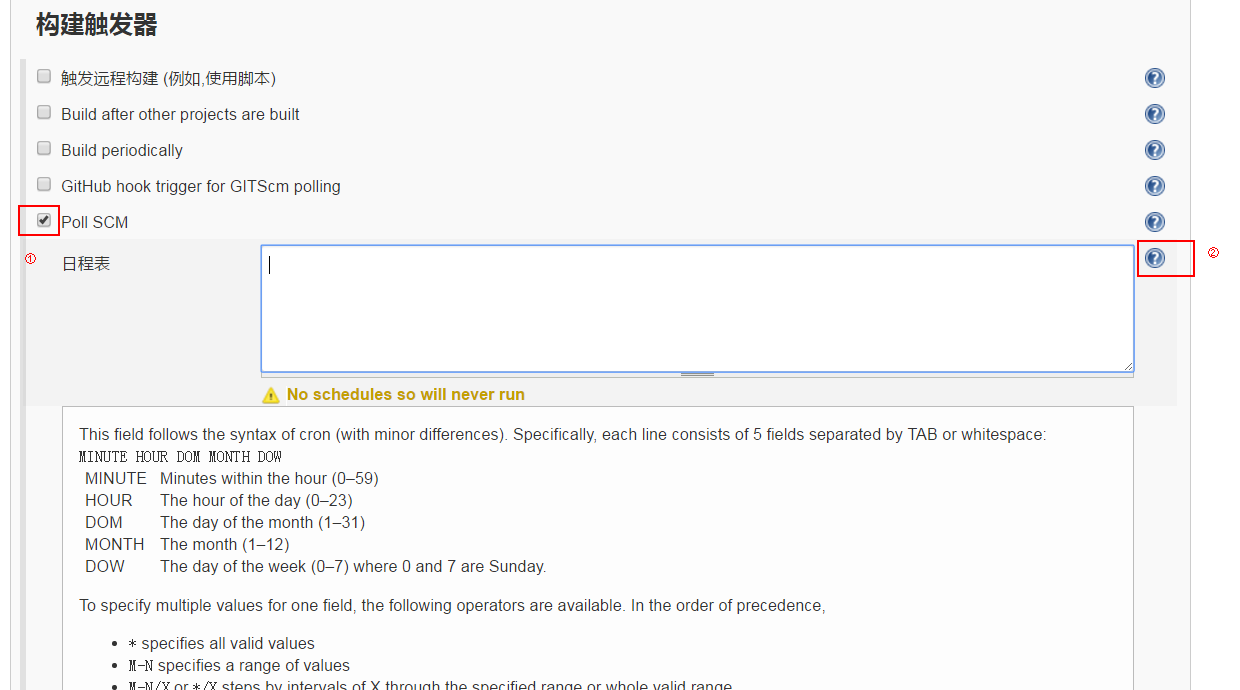
弹出的内容中详细解释了定时构建的用法,并给出了几个例子:
This field follows the syntax of cron (with minor differences). Specifically, each line consists of  fields separated by TAB or whitespace:

MINUTE HOUR DOM MONTH DOW

MINUTE    Minutes within the hour (–)

HOUR    The hour of the day (–)

DOM    The day of the month (–)

MONTH    The month (–)

DOW    The day of the week (–) where  and  are Sunday.

To specify multiple values for one field, the following operators are available. In the order of precedence,

* specifies all valid values

M-N specifies a range of values

M-N/X or */X steps by intervals of X through the specified range or whole valid range

A,B,...,Z enumerates multiple values

To allow periodically scheduled tasks to produce even load on the system, the symbol H (for “hash”) should be used wherever possible. For example, using   * * * for a dozen daily jobs will cause a large spike at midnight. In contrast, using H H * * * would still execute each job once a day, but not all at the same time, better using limited resources.

The H symbol can be used with a range. For example, H H(-) * * * means some time between : AM (midnight) to : AM. You can also use step intervals with H, with or without ranges.

The H symbol can be thought of as a random value over a range, but it actually is a hash of the job name, not a random function, so that the value remains stable for any given project.

Beware that for the day of month field, short cycles such as */ or H/ will not work consistently near the end of most months, due to variable month lengths. For example, */ will run on the 1st, 4th, …31st days of a long month, then again the next day of the next month. Hashes are always chosen in the - range, so H/ will produce a gap between runs of between  and  days at the end of a month. (Longer cycles will also have inconsistent lengths but the effect may be relatively less noticeable.)

Empty lines and lines that start with # will be ignored as comments.

In addition, @yearly, @annually, @monthly, @weekly, @daily, @midnight, and @hourly are supported as convenient aliases. These use the hash system for automatic balancing. For example, @hourly is the same as H * * * * and could mean at any time during the hour. @midnight actually means some time between : AM and : AM.

Examples:

# every fifteen minutes (perhaps at :, :, :, :)

H/ * * * *

# every ten minutes in the first half of every hour (three times, perhaps at :, :, :)

H(-)/ * * * *

# once every two hours at  minutes past the hour starting at : AM and finishing at : PM every weekday.

 -/ * * -

# once in every two hours slot between  AM and  PM every weekday (perhaps at : AM, : PM, : PM, : PM)

H H(-)/ * * -

# once a day on the 1st and 15th of every month except December
3.示例
在22:21新建的项目,希望在22:22触发构建。

Jenkins系列——定时构建的更多相关文章
- 【Jenkins】定时构建语法
跟cron定时任务语法基本类似 一.字段有哪些 每行包含5个字段,用制表符或空格隔开,从左至右依次是: 分 时 天 月 星期 二.每个字段的取值范围 分钟 (0–59) 时 (0–23) 天 (1–3 ...
- Jenkins配置定时构建项目
general: 源码管理: 构建触发器: 构建后操作:
- Jenkins之定时构建
参考文章:https://blog.csdn.net/ZZY1078689276/article/details/77520441 第一个*表示分钟,取值0~59 第二个*表示小时,取值0~23 第三 ...
- Jenkins环境搭建(4)-配置定时构建
每次手动触发job构建,是很麻烦的一件事情,job中可以配置定时构建,今天就来分享下定时构建:构建分为两种:定时构建和轮询SCM. 一.定时构建 Jenkins采用了著名的UNIX任务调度工具CRON ...
- Jenkins 定时构建语法规则
1.Jenkins自由风格任务定时构建 2.语法规则 定时构建语法 * * * * * 第一个*表示分钟,取值0~59 第二个*表示小时,取值0~23 第三个*表示一个月的第几天,取值1~31 第四个 ...
- jenkins持续集成:定时构建语法
构建位置:选择或创建工程_设置_构建触发器 1. 定时构建语法:* * * * * (五颗星,多个时间点,中间用逗号隔开)第一个*表示分钟,取值0~59第二个*表示小时,取值0~23第三个*表示一个月 ...
- git+jenkins持续集成三-定时构建语法
构建位置:选择或创建工程_设置_构建触发器 1. 定时构建语法:* * * * * (五颗星,多个时间点,中间用逗号隔开)第一个*表示分钟,取值0~59第二个*表示小时,取值0~23第三个*表示一个月 ...
- git+jenkins持续集成二-jenkins定时构建语法:定时构建语法
构建位置:选择或创建工程_设置_构建触发器 1. 定时构建语法:* * * * * (五颗星,多个时间点,中间用逗号隔开)第一个*表示分钟,取值0~59第二个*表示小时,取值0~23第三个*表示一个月 ...
- Jenkins系列之-—06 Ant构建
一.Ant 简介&构建环境 Apache Ant 是由 Java 语言开发的工具 构建ant环境: 1). 安装jdk,设置JAVA_HOME ,PATH ,CLASS_PATH 2). 下载 ...
随机推荐
- Django 模版中如何对主菜单进行选中?
问题描叙: 在实际模版中,返回的页面我们想要主菜单保持一种状态,这个主菜单进去的子页面,都需要保持主菜单选择状态 例如 主菜单是 课程, 下面展现的章节和视频页面时候, 课程这个主菜单在展现这个菜单下 ...
- scrapy_数据收集
什么是数据收集器? 数据以key/value形式存在,收集一些状态,简化数据收集的状态 计算到底发送了多少request等等统计信息 如何对404页面进行设置? 通过response.status等于 ...
- CSS深入理解学习笔记之float
1.float的历史 float设计的初衷仅仅是为了文字环绕效果. 示例代码: <!DOCTYPE html PUBLIC "-//W3C//DTD XHTML 1.0 Transit ...
- js swipeDelete 滑动删除
先上图看看整体实际效果 看看用法 与参数 默认参数 var defaults = { distance:80, //滑动距离 units:'px', //默认单位 touchStart:functio ...
- strstr()与find()
- MS SQL 批量给存储过程/函数授权
在工作当中遇到一个类似这样的问题:要对数据库账户的权限进行清理.设置,其中有一个用户Test,只能拥有数据库MyAssistant的DML(更新.插入.删除等)操作权限,另外拥有执行数据库存储过程.函 ...
- java 网络编程之TCP通信和简单的文件上传功能
*/ .hljs { display: block; overflow-x: auto; padding: 0.5em; color: #333; background: #f8f8f8; } .hl ...
- ulua c#调用lua中模拟的类成员函数
项目使用ulua,我神烦这个东西.lua单纯在lua环境使用还好,一旦要跟外界交互,各种月经不调就来了.要记住贼多的细节,你才能稍微处理好.一个破栈,pop来push去,位置一会在-1,一会在-3,2 ...
- mvn 手动安装jar 到本地库
安装: mvn install:install-file -DgroupId=com.oracle -DartifactId=ojdbc6 -Dversion=11.1.0.7.0 -Dpackagi ...
- Oracle Rac创建表空间及用户
1. 创建表空间: BEGIN DECLARE cnt integer := 0; BEGIN SELECT 1 INTO cnt FROM dual WHERE exists(SELECT * FR ...