
4.React生命周期
4.React生命周期
4.1引出生命周期
    class Life extends React.Component {

        state = {

            opacity:0.5

        }

        death = () => {

            // 卸载定时器

            // clearInterval(this.timer)

            // 卸载组件

            ReactDOM.unmountComponentAtNode(document.getElementById('test'))

        }

        // 生命周期钩子函数

        // 组件挂载完调用

        componentDidMount(){

            this.timer = setInterval(()=>{

                // 获取原状态

                let {opacity} = this.state

                // 减小0.1

                opacity -= 0.1

                // 设置新的透明度

                if (opacity <= 0) opacity = 1

                this.setState({opacity})

            }, 200)

        }

        // 组件将要卸载操作

        componentWillUnmount(){

            // 卸载定时器

            clearInterval(this.timer)

        }

        render(){

            return (

                <div>

                    <h2 style={{opacity: this.state.opacity}}>yeyang is da hanbi</h2>

                    <button onClick={this.death}>don't life</button>

                </div>

            )

        }

    }
4.2 react生命周期(旧)(17.0版本之前)
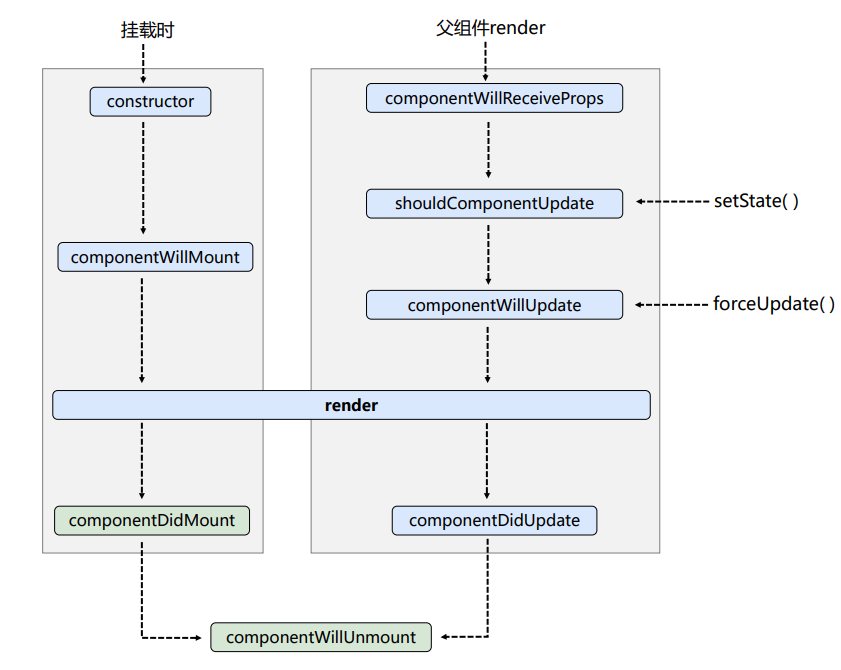
    /*

    1. 初始化阶段: 由ReactDOM.render()触发---初次渲染

        1.	constructor()

        2.	componentWillMount()

        3.	render()

        4.	componentDidMount() ====> 常用

                ---  一般在这个钩子做一些初始化的事,例如:开启定时器,发送网络请求,订阅消息

	2. 更新阶段: 由组件内部this.setSate()或父组件重新render触发

        1.	shouldComponentUpdate()

        2.	componentWillUpdate()

        3.	render()  ====>  必须使用的一个

        4.	componentDidUpdate()

	3. 卸载组件: 由ReactDOM.unmountComponentAtNode()触发

        1.	componentWillUnmount() ====> 常用

                ----  一般在这个钩子中做一些收尾的事,如关闭定时器、取消订阅消息

     */

    class Count extends React.Component {

        constructor(props) {

            console.log('Count---constructor')

            super(props);

            this.state = {

                count: 0

            }

        }

        // state = {

        //     count: 0

        // }

        add = () => {

            const {count} = this.state

            this.setState({

                count: count+1

            })

        }

        death = () => {

            ReactDOM.unmountComponentAtNode(document.getElementById('test'))

        }

        force = () => {

            this.forceUpdate()  // 强制更新钩子

        }

        // 组件将要挂载的钩子

        componentWillMount(){

            console.log('Count---componentWillMount')

        }

        // 组件挂载完成的钩子

        componentDidMount(){

            console.log('Count---componentDidMount')

        }

        // 组件将要卸载时的钩子

        componentWillUnmount(){

            console.log('Count---componentWillUnmount')

        }

        // 控制组件更新的阀门: 是否更新组件钩子

        shouldComponentUpdate(){

            console.log('Count---shouldComponentUpdate')

            return true

        }

        // 组件将要更新的钩子

        componentWillUpdate(){

            console.log('Count---componentWillUpdate')

        }

        // 组件更新完的钩子

        componentDidUpdate(){

            console.log('Count---componentDidUpdate')

        }

        render(){

            console.log('Count---render')

            const {count} = this.state

            return (

                <div>

                    <h2> 当前求和为{count}</h2>

                    <button onClick={this.add}>点我+1</button>

                    <button onClick={this.death}>卸载组件</button>

                    <button onClick={this.force}>强制更新</button>

                </div>

            )

        }

    }

    // 父组件A

    class A extends React.Component{

        state = {

            carName: 'benz'

        }

        changeCar = () => {

             this.setState({

                 carName: 'bmw'

             })

        }

        render(){

            return (

                <div>

                  <div>我是A组件</div>

                    <button onClick={this.changeCar}>换车</button>

                    <B carName={this.state.carName}/>

                </div>

            )

        }

    }

    // 子组件B

    class B extends React.Component{

        // 组件将要接收新的props的钩子

        componentWillReceiveProps(props){

            console.log('B---componentWillReceiveProps', props)

        }

        shouldComponentUpdate(){

            console.log('B---shouldComponentUpdate')

            return true

        }

        // 组件将要更新的钩子

        componentWillUpdate(){

            console.log('B---componentWillUpdate')

        }

        // 组件更新完的钩子

        componentDidUpdate(){

            console.log('B---componentDidUpdate')

        }

        render(){

            return (

                <div>

                     我是B组件, 接收的车是:{this.props.carName}

                </div>

            )

        }

    }

    // ReactDOM.render(<Count />, document.getElementById('test'))

    ReactDOM.render(<A />, document.getElementById('test'))
4.3 react生命周期(新)(17.0版本之后)
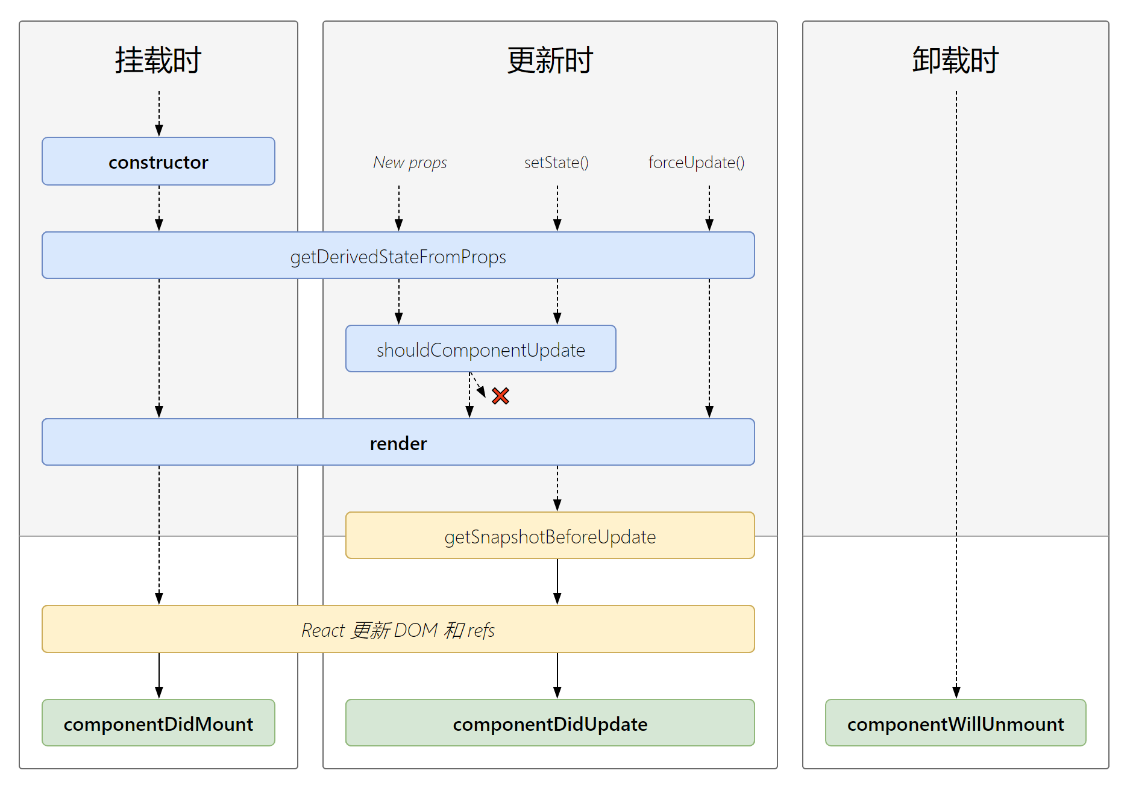
    /*

    1. 初始化阶段: 由ReactDOM.render()触发---初次渲染

        1.	constructor()

        2.	getDerivedStateFromProps

        3.	render()

        4.	componentDidMount()

	2. 更新阶段: 由组件内部this.setSate()或父组件重新render触发

        1.	getDerivedStateFromProps

        2.	shouldComponentUpdate()

        3.	render()

        4.	getSnapshotBeforeUpdate

        5.	componentDidUpdate()

	3. 卸载组件: 由ReactDOM.unmountComponentAtNode()触发

        1.	componentWillUnmount()

    */

    class Count extends React.Component {

        constructor(props) {

            console.log('Count---constructor')

            super(props);

            this.state = {

                count: 0

            }

        }

        // state = {

        //     count: 0

        // }

        add = () => {

            const {count} = this.state

            this.setState({

                count: count+1

            })

        }

        death = () => {

            ReactDOM.unmountComponentAtNode(document.getElementById('test'))

        }

        force = () => {

            this.forceUpdate()  // 强制更新钩子

        }

        // 若state的值在任何时候都取决于props,可以使用该方法

        static getDerivedStateFromProps(props ,state){

            console.log('Count---getDerivedStateFromProps', props, state)

            return null   // 返回 state对象或者null

        }

        // 在更新之前获取快照

        getSnapshotBeforeUpdate(){

            console.log('Count---getSnapshotBeforeUpdate')

            return 'abc'

        }

        // 组件挂载完成的钩子

        componentDidMount(){

            console.log('Count---componentDidMount')

        }

        // 组件将要卸载时的钩子

        componentWillUnmount(){

            console.log('Count---componentWillUnmount')

        }

        // 控制组件更新的阀门: 是否更新组件钩子

        shouldComponentUpdate(){

            console.log('Count---shouldComponentUpdate')

            return true

        }

        // 组件更新完的钩子

        componentDidUpdate(preProps, preState, snapshotValue){

            console.log('Count---componentDidUpdate', preProps, preState, snapshotValue)

        }

        render(){

            console.log('Count---render')

            const {count} = this.state

            return (

                <div>

                    <h2> 当前求和为{count}</h2>

                    <button onClick={this.add}>点我+1</button>

                    <button onClick={this.death}>卸载组件</button>

                    <button onClick={this.force}>强制更新</button>

                </div>

            )

        }

    }

    ReactDOM.render(<Count count={199}/>, document.getElementById('test'))
4.4 getSnapshotBeforeUpdate使用场景
拖动滚动条让滚动条停留在当前数据位置
    class NewList extends React.Component {

        state = {

            newsArr: []

        }

        componentDidMount() {

            setInterval(() => {

                // 获取原状态

                const {newsArr} = this.state

                // 模拟一条新闻

                const news = '新闻' + (newsArr.length + 1)

                // 更新状态

                this.setState({

                    newsArr: [news, ...newsArr]

                })

            }, 1000)

        }

        getSnapshotBeforeUpdate() {

            return this.refs.list.scrollHeight

        }

        componentDidUpdate(preProps, preState, height) {

            console.log(preProps, preState, height)

            console.log(this.refs.list.scrollTop) // 当前距离滚动条顶端的距离

            this.refs.list.scrollTop += (this.refs.list.scrollHeight - height)

            // this.refs.list.scrollTop += 30

        }

        render() {

            console.log('NewList---render')

            const {newsArr} = this.state

            return (

                <div className="list" ref='list'>

                    {

                        newsArr.map((n, index) => {

                            return <div key={index} className="news">{n}</div>

                        })

                    }

                </div>

            )

        }

    }

    ReactDOM.render(<NewList/>, document.getElementById('test'))
4.React生命周期的更多相关文章
- React生命周期
在react生命周期中,分2段执行,一个挂载的生命周期,一个是组件发生了数据变动,或者事件触发而引发的更新生命周期. 注:react生命周期很重要,对于很多组件场景的应用发挥重要作用,而且不熟悉生命周 ...
- React 生命周期
前言 学习React,生命周期很重要,我们了解完生命周期的各个组件,对写高性能组件会有很大的帮助. Ract生命周期 React 生命周期分为三种状态 1. 初始化 2.更新 3.销毁 初始化 1.g ...
- React生命周期详解
React生命周期图解: 一.旧版图解: 二.新版图解: 从图中,我们可以清楚知道React的生命周期分为三个部分: 实例化.存在期和销毁时. 旧版生命周期如果要开启async rendering, ...
- React生命周期简单详细理解
前言 学习React,生命周期很重要,我们了解完生命周期的各个组件,对写高性能组件会有很大的帮助. Ract生命周期 React 生命周期分为三种状态 1. 初始化 2.更新 3.销毁 初始化 1.g ...
- 22.1 、react生命周期(一)
在每个react组件中都有以下几个生命周期方法~我们需要在不同阶段进行讨论 组件生命周期概述 1.初始化 在组件初始化阶段会执行 constructor static getDerivedStateF ...
- react 生命周期钩子里不要写逻辑,否则不生效
react 生命周期钩子里不要写逻辑,否则不生效,要把逻辑写在函数里,然后在钩子里调用函数,否则会出现问题.
- react复习总结(2)--react生命周期和组件通信
这是react项目复习总结第二讲, 第一讲:https://www.cnblogs.com/wuhairui/p/10367620.html 首先我们来学习下react的生命周期(钩子)函数. 什么是 ...
- React生命周期执行顺序详解
文章内容转载于https://www.cnblogs.com/faith3/p/9216165.html 一.组件生命周期的执行次数是什么样子的??? 只执行一次: constructor.compo ...
- vue生命周期和react生命周期对比
一 vue的生命周期如下图所示(很清晰)初始化.编译.更新.销毁 二 vue生命周期的栗子 注意触发vue的created事件以后,this便指向vue实例,这点很重要 <!DOCTYPE ht ...
- react生命周期知识点
react生命周期知识点 一个React组件的生命周期分为三个部分:实例化.存在期和销毁时. 实例化 组件在客户端被实例化,第一次被创建时,以下方法依次被调用: 1.getDefaultProps2. ...
随机推荐
- webpack 安装使用简例
1. 新建项目文件夹,如 webpack-demo 2. cd 到安装项目根目录,即进入webpack-demo文件夹,命令行工具输入"npm install webpack webpack ...
- [考试总结]noip模拟17
爆零了! 菜爆了 弱展了 垃爆了 没有什么可以掩饰你的菜了 这次考试为我带来了第一个 \(\color{red}{ \huge{0}}\) 分,十分欣慰.... 最近的暴力都打不对,你还想什么正解?? ...
- 防止因提供的sql脚本有问题导致版本bvt失败技巧
发版本时,可能会由于测试库和开发库表结构不一样而导致数据库脚本在测试那边执行时出错,导致版本BVT失败,以下技巧可解决此问题. 步骤:备份目标库,在备份库中执行将要提供的sql脚本看有无问题,若没问题 ...
- mongoose基础使用
mongoose与mongodb 首先,要明确mongoose和mongodb是什么? mongodb是一种文档数据库:而mongoose是一种能在node环境中优雅地操作mongodb的对象模型工具 ...
- [CTF] CTF入门指南
CTF入门指南 何为CTF ? CTF(Capture The Flag)夺旗比赛,在网络安全领域中指的是网络安全技术人员之间进行技术竞技的一种比赛形式.CTF起源于1996年DEFCON全球黑客大会 ...
- C语言复习(一)
类型为void*的指针代表对象的地址,而不是类型 如果需要使用另一个源文件中定义的变量,那么只需要在定义变量前加上extern关键字 ex: extern int x;//x在其他文件中定义 左值表达 ...
- user-agent随笔
常用的user-agent: 一.pc端的user-agent汇总,各大浏览器 1.safari 5.1 – MAC Mozilla/5.0 (Macintosh; U; Intel Mac OS X ...
- Thunder DLL Hijacking
简记 原理基础啥的俺也不写了 1.寻找DLL 生成恶意dll文件 拿calc测试 2.放入 3.打开
- vulnhub-DC:8靶机渗透记录
准备工作 在vulnhub官网下载DC:8靶机DC: 8 ~ VulnHub 导入到vmware,设置成NAT模式 打开kali准备进行渗透(ip:192.168.200.6) 信息收集 利用nmap ...
- .NET 6 预览版 7:新功能已完成 ,将专注于改进
.NET 团队的项目经理 Richard Lander在宣布 .NET 6 Preview 7 时说:"这是 .NET 预览的又一季的结束.", 中文翻译:.NET 6 预览版 7 ...