
Coax Transformers[转载]

Coax Transformers
How to determine the needed Z for a wanted Quarter Wave Lines tranformation ratio

Some applied examples
1.  From 50 ohms feedline to 12.5 ohms Yagi with straight split DE?

    Z = sqrt ( 50 ohms x 12.5 ohms) = 25 ohms

    This we can produce by using two 50 ohms Quarter Wave Lines in parallel

2.  From 50 ohms feedline to 28 ohms Yagi with straight split DE?

    Z = sqrt ( 50 ohms  x  28 ohms) = 37.4 ohms

    This we nearly can produce by using two 75 ohms Quarter Wave Lines in parallel

3.  And finally the trivial case:

    From 50 ohms feedline to 50 ohms Yagi with straight split DE?

    Z = sqrt ( 50 ohms x 50 ohms) = 50 ohms
How to transform from 50 ohms to 12.5 ohms using parallel Quarter Wave Lines

How to transform from 50 ohms to 28 ohms using parallel Quarter Wave Lines (aka DK7ZB - Match)

How to transform from 50 ohms to 200 ohms using parallel Quarter Wave Lines // corrected 2014-09-23, tnx DH1LM,
who showed me that the old sketch was wrong. Hopefully this one does ...
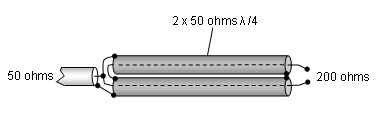
Using Quarter Wave Lines this way works as a series collection actually, Z is 100 ohms, Za = 50 ohms, Zb = 200 ohms
How to transform from 50 ohms to 75 ohms using parallel Twelfth Wave Lines


How produce Ferrite RF Transformers for various impedances transformation ratios
• Ferrite Transformer
Image shows a 1:1 transformer as blue and black wires windings
ratio is 1:1. This one is for Shortwave use. For VHF / UHF dimensions must be much smaller.

Windings N1/N2 ratio by square is transformation ratio for impedance:
Example: Za = 50 ohms, Zb = 200 ohms ...
Na = 6 wdg; Nb = 12 wdg => Na/Nb = 6/12 = 0.5
Transformation ratio = (Na/Nb)xy2 = 0.25 = 1/4 or 1:4
200 ohms x 0.25 = 50 ohms
• Balun Transformer

The Balun transformer is a two-in-one device:
The transformation ratio is same as described above, but now the 50 ohms side is unbalanced (coax feed)
while the 200 ohms side is balanced or symmetrical.
An often seeked for transformation ratio might be 50 to 75 ohms.
This could be acheived using 6 and 9 wdg. respectively 6 + 3 wdg on the Balun Transformer.
• What about the size of the ferrite then?
For any receiving purpose it may be very small. Same to the wire diameters. A tiny ferrite bead equipped with 0.12 mm or so enameled copper wire will do for most purposes. For handling transmitting power or limits issuing intermodulation there is one rule: The ferrite must not saturate. Big is beautiful and size does matter here. Unlike with applications for short wave where ferrite baluns in transmitting antennas are widely used we have only few data and less working ferrite materials when we talk VHF / UHF applications. A rule of thumbs is .. it must not heat up much, it shall not get hot of very warm during transmitting. Having large size ferrites and wires wrapped around is in contradiction to the need for shortest wires on VHF / UHF. That is why we find receiving purpose small ferrite bead based transformers often, but power handling transmitting transformer very seldom here.
Real dimensions: using very small double hole ferrites in a 144 MHz RX frontend
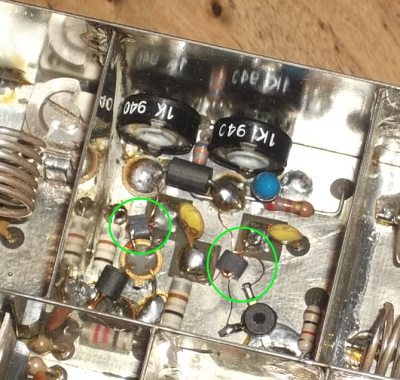
they do not need to be as tiny as that, but to give an impression ...

However here is a little table holding some suitable types, makes and sizes for VHF / UHF transmitting purpose ferrite transformers
Size Amidon T37 or T50, inner diam. = 5.21 / 7.70 mm fit RG58 and RG142 B/U Teflon coax.
Size Amidon T80, inner diam. = 12.60 mm fits RG213 coax, Aircell ...
Code T50-0 (color code: brown) covers 50-300 MHz
Material 43 is for blocking VHF/UHF frequencies
A good choice are the following cores:
FT 50 B-43 inner diam. 7.9 mm, outer diam 12.7 mm, length 12.7 mm (approx EUR 3 pp.)
FB-43-5621 inner diam. 6.4 mm, outer diam. 14.3 mm, length 28.6 mm
FB 43-1020 inner diam. 12.7 mm, outer diam. 25.4 mm, length 28.2 mm
A commerially made broad band Transformer to match 75 ohms feedline coax to a 300 ohms UHF TV antenna
PCB with inductances.
Designing something like this is rather complex and usually done using an 'EM' software like Sonnet EM, FEKO, ADS ... . So I just show an example. For those who want to dig themselfs into the topic: There are free, limited in size of analysed object versions like 'Sonnet EM Lite' available.
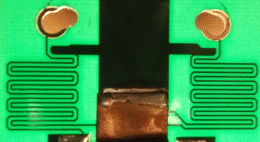
For an etched on PCB solution for 70 cm Amateur Radio Band that does 50 to 28 ohms see here 
How to transform from 50 ohms to 200 ohms to feed a Folded Dipole as Driven Element

The transformation ratio of a Half Wave "Diversion" Line is 1:4.
What to avoid feeding a Folded DE

Do not attach the feeding coax in a way as shown above so that the coax loop forms anything close to Quarter Wave Line in series to the Balun. Being close to Quarter Lambda it might interfere seriously with the Balun and you end up with bad VSWR on a nice antenna probably. Most attention must be paid if the Balun side of the FD is free floating i.e. not connected to gnd respectively boom.
Tape it to the boom right from the connector or box on, or leave it hanging for much longer than λ/4 x v-factor.
Note: Any odd multiple of λ/4 such as 5/4 λ or 7/4 λ will transform exactly as the sole λ/4 line. Why so?
Because a half wave line does not change anything, apart from losses. Any odd number of λ/4 can be seen as a number of half wave lines plus a single λ/4 wave line.

Practical hint: I used a quality coaxial 432 MHz 4 x power splitter for joining four 1296 MHz Yagis on serveral contest occasions with good success.
Same would apply to 144 MHz splitters to use on 432 Mhz and so forth. Any tripple frequency ... just mind connecting bushings pins inductances or coax pigtails that have more impact on that tripple frequency.
Feeding stacked Antennas with Coax
How to feed two 25 ohm Antennas from 50 ohm coax

How to feed two 50 ohm Antennas from 50 ohm coax
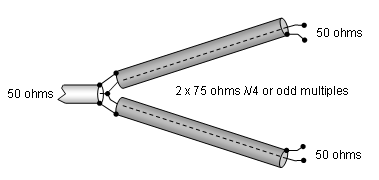
How to feed four 50 ohm Antennas from 50 ohm coax
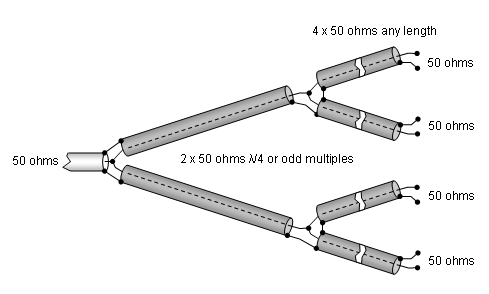
A conventient way to feed a 4 Yagi stack. 4 x 50 ohms any length means any length but all four of same length.
How to feed four 50 ohm Antennas in typical H-configuration from 50 ohm coax in style

A classical 4 Yagi stack may be fed and phased using 50 ohms coax efficiently when using odd multiples of λ/4 like 5/4 λ for making the horizontal phasing lines. An example: At a given stacking distance of 3.0 m the 5/4 λ equals 5 x 0.34 m = 1.7 m roughly on 144 MHz whe taking the v-factor for PE coax into account. That makes it 1.7 m to the left plus 1.7 m to the right. Enough to bridge over the two H-frame tubes.
How to get four Folded Dipoles fed in phase

It is understood that all feeding coaxes must be of similar length and impedances must be transformed as shown above or using a Power Splitter
• All shields are to be connected on same side
• All Folded Dipoles are facing upwards
... which in typical H-frame 4 bay configuration involves turning the struts of the lower pair upside down while elements and Dipole stay as on the upper pair. Or simply put: all dipole boxes or Matches face down.
How to get four Straight Split Dipoles fed in phase
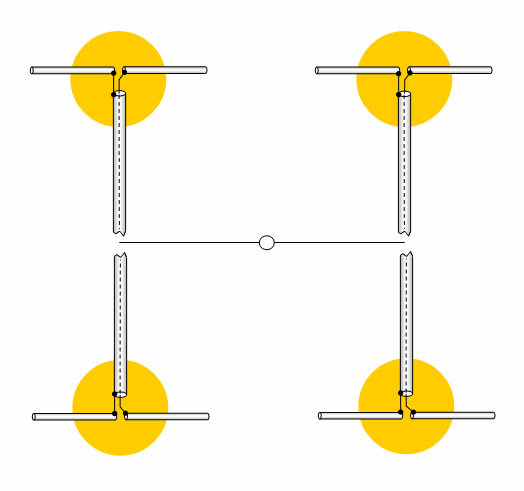
It is understood that all feeding coaxes must be of similar length and impedances must be transformed as shown above or using a Power Splitter
• All shields are to be connected on same side
How to get a vertical 4 Yagi stack fed in phase
In General:
It is understood that all feeding coaxes (1,2,3,4) must be of similar length and impedances must be transformed as shown above or using a Power Splitter
Specificly:
Using similar lengths for all four feeding coaxes needs somehow winding up # 2 and 3. We find a remedy here using a length of minus full 360 degr. for the inner coaxes # 2, 3. As 360 degr. or even multiples of that do not change anything according feeding phase. With a lag of n x 360 degr. we are just at the same point on the sinus we find on the outer Yagis. Which in practise means we are feeding all dipoles in phase.
An example: 360 degr. is just 1.0 wavelength, multiplied with real velocity factor of coax to be used at designated frequency. Likewise v = 0.82 of some foam insulated coax on 144.1 MHz (2.080 m) makes 360 degr. of runtime on coax be equivalent to a length of 1.706 m Simply put: coaxes # 2, 3 can be 1.706 m shorter than the coaxes # 1, 4 feeding the outer dipoles.
• All shields are to be connected on same side
Coax Transformers[转载]的更多相关文章
- maven package 知识(转载)
“打包“这个词听起来比较土,比较正式的说法应该是”构建项目软件包“,具体说就是将项目中的各种文件,比如源代码.编译生成的字节码.配置文件.文档,按照规范的格式生成归档,最常见的当然就是JAR包和WAR ...
- Hibernate使用原生SQL(转载)
本文转载,出处如下:http://bhdweb.iteye.com/blog/801084 HQL尽管容易使用,但是在一些复杂的数据操作上功能有限.特别是在实现复杂的报表统计与计算,以及多表连接查询上 ...
- [转载] Kafka+Storm+HDFS整合实践
转载自http://www.tuicool.com/articles/NzyqAn 在基于Hadoop平台的很多应用场景中,我们需要对数据进行离线和实时分析,离线分析可以很容易地借助于Hive来实现统 ...
- [转载] 基于Dubbo框架构建分布式服务
转载自http://shiyanjun.cn/archives/1075.html Dubbo是Alibaba开源的分布式服务框架,我们可以非常容易地通过Dubbo来构建分布式服务,并根据自己实际业务 ...
- 转载maven安装,配置,入门
转载:http://www.cnblogs.com/dcba1112/archive/2011/05/01/2033805.html 本书代码下载 大家可以从我的网站下载本书的代码:http://ww ...
- Crystal Clear Applied: The Seven Properties of Running an Agile Project (转载)
作者Alistair Cockburn, Crystal Clear的7个成功要素,写得挺好. 敏捷方法的关注点,大家可以参考,太激动所以转载了. 原文:http://www.informit.com ...
- RTP与RTCP协议介绍(转载)
RTSP发起/终结流媒体.RTP传输流媒体数据 .RTCP对RTP进行控制,同步.RTP中没有连接的概念,本身并不能为按序传输数据包提供可靠的保证,也不提供流量控制和拥塞控制,这些都由RTCP来负责完 ...
- 《Walking the callstack(转载)》
本文转载自:https://www.codeproject.com/articles/11132/walking-the-callstack Download demo project with so ...
- [转载]MVVM模式原理分析及实践
没有找到很好的MVVM模式介绍文章,简单找了一篇,分享一下.MVVM实现了UI\UE设计师(Expression Blend 4设计界面)和软件工程师的合理分工,在SilverLight.WPF.Wi ...
随机推荐
- vim编辑器,管道,输入输出重定向
1.vim的认识及其一些常用指令 a, 认识vim的命令行模式和插入模式: 当vim运行后默认进入该模式,他可以控制屏幕光标的移动,字符.字或行的删除,移动复制某区段及进入Insert mode下,或 ...
- php中的引用类型和值类型
PHP中的四种简单类型和复杂类型array都是值类型.同类型间赋值传递的是值,即创建一个副本给新变量. 例如: $int1 = 123; $int2 = $int1;//直接传递的是值,只是做了一个叫 ...
- [moka学习笔记]yii2设置语言和时区
1.在web/index.php中 (new yii\web\Application($config))->run(); $app = new \yii\web\Application($con ...
- jquery 拓展
1. 概述 jquery允许拓展自定义的方法, 绑定到$.fn对象上, 编写一个jQuery插件的原则: 给$.fn绑定函数,实现插件的代码逻辑: 插件函数最后要return this;以支持链式调用 ...
- 在博客中使用MathJax写数学公式
前言 总结一些在博客园使用MathJax写数学公式的经验. 博客园 设置使用数学公式 进入你的博客:管理 > 选项 里面有个启用数学公式支持,选上后保存. 这时,你就可以在你的博客里写数学公式了 ...
- mongodb学习4---索引
1,mongodb的性能分析 db.active.find({id:'sdfasdf6jh67j353g346hkfgh6'}).explain('executionStats') "mil ...
- Asp.Net MVC开源论坛中文版
支持多国语言 支持多种数据库,开盖即饮(因为EF支持),无需安装. 积分 等级 权限 角色 标签 Rss 表情 附件 审核 问答 投票 收藏 日志 排行榜与热点 主题,默认Bootstrap响应式 最 ...
- windows 7文件误删shift+delete后找回
昨天要还电脑了,结果脑子一抽,某个目录还没拷贝,shift+delete了整个目录,删除到一半,完了...我的源码都在里面还没出来啊...这TMD要命啊... 赶紧搜了一把,windows文件误删恢复 ...
- Angular 核心概念
module(模块) 作用 通过模块对页面进行业务上的划分,根据不同的功能划分不同的模块. 将重复使用的指令或者过滤器之类的代码做成模块,方便复用 注意必须指定第二个参数,否则变成找到已经定义的模块 ...
- 简单理解JavaScript闭包
很多关于JS的书籍例如<JavaScript权威指南>或者<高程>都把闭包解释的晦涩难懂,萌新们是怎么也看不懂啊!不过别怕,今天我就用很简单的方式给大家讲解下到底什么是闭包.这 ...