
[Advanced Python] 14 - "Generator": calculating prime
高性能编程
几个核心问题
• 生成器是怎样节约内存的?
• 使用生成器的最佳时机是什么?
• 我如何使用 itertools 来创建复杂的生成器工作流?
• 延迟估值何时有益,何时无益?
From: https://www.dataquest.io/blog/python-generators-tutorial/
• The basic terminology needed to understand generators
• What a generator is
• How to create your own generators
• How to use a generator and generator methods
• When to use a generator
表示数列
有限数列情况
案例一:xrange,节省内存
自定义xrange使用yield,采用的方法是依次计算。
目前的range具备了这个特性。
In [16]: def xrange(start, stop, step=1):

    ...:     while start < stop:

    ...:         yield start

    ...:         start += step

    ...:

In [17]: for i in xrange(1,100):

    ...:     print(i)
无限数列情况
案例二:Fibonacci Sequence
def fibonacci(n):

    a, b = 0, 1

    while n > 0:

        yield b

        a, b = b, a + b

        n -= 1

def Fibonacci_Yield(n):

    # return [f for i, f in enumerate(Fibonacci_Yield_tool(n))]

    return list(fibonacci(n))
案例三:fibonacci中有几个奇数
for 循环中的自定义序列。
def fibonacci_transform():

  count = 0

  for f in fibonacci():

    if f > 5000:

      break

    if f % 2 == 1:

      count += 1

  return count
生成器的延时估值
—— 主要关注如何处理大数据,并具备什么优势。
Ref: Python Generators
Big Data. This is a somewhat nebulous term, and so we won’t delve into the various Big Data definitions here. Suffice to say that any Big Data file is too big to assign to a variable.
尤其是List不方便一下子装载到内存的时候。
各种形式的生成器
- Load beer data in big data.
beer_data = "recipeData.csv"
lines =  (line for line in open(beer_data, encoding="ISO-8859-1"))
建议把这里的open事先改为:with ... as。
- Laziness and generators
Once we ask for the next value of a generator, the old value is discarded.
Once we go through the entire generator, it is also discarded from memory as well.
进化历程
- Build pipeline
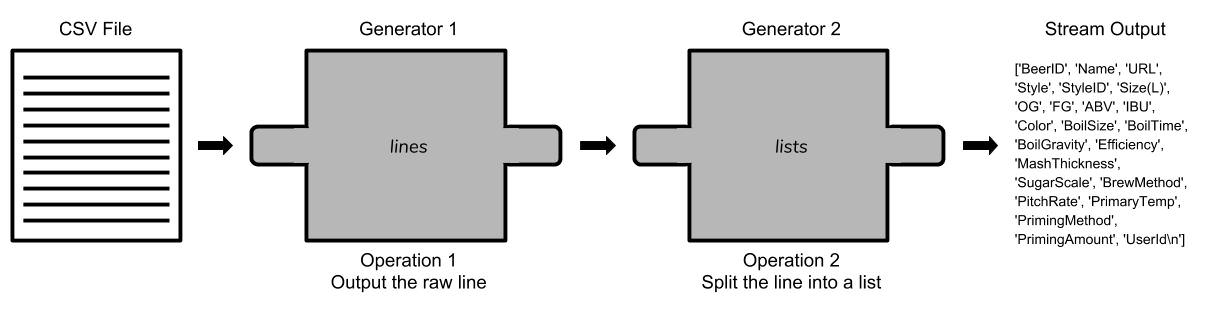
beer_data = "recipeData.csv"

lines = (line for line in open(beer_data, encoding="ISO-8859-1"))  # (1) 获得了“一行”

lists = (l.split(",") for l in lines)                              # (2) 对这“一行”进行分解
- Operation in pipeline
(1) 先获得第一行的title,也就是column将作为key;然后从第二行开始的值作为value。
['BeerID', 'Name', 'URL', ..., 'PrimaryTemp', 'PrimingMethod', 'PrimingAmount', 'UserId\n']
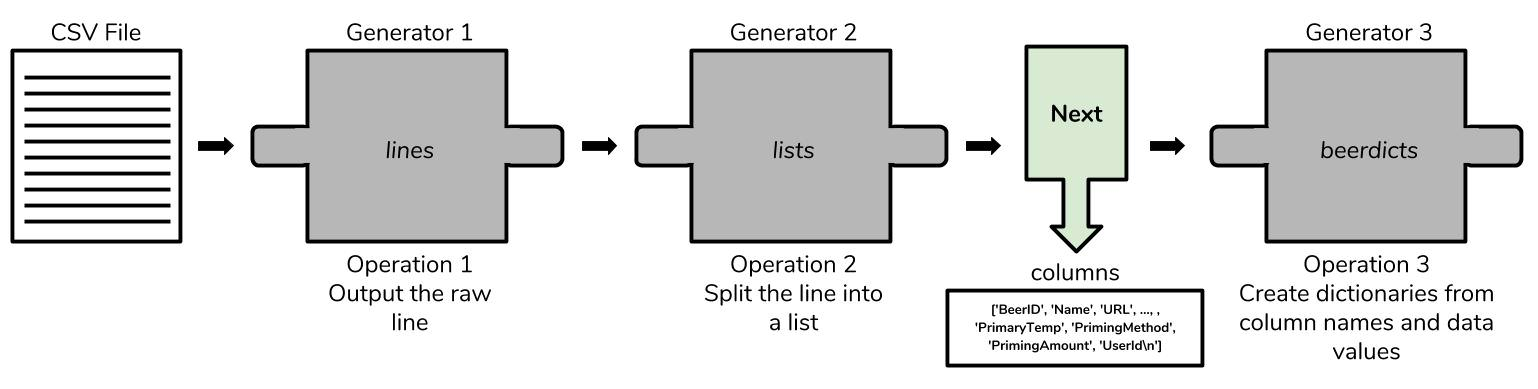
zip()将两个list的元素配对,然后转换为dict。
# 样例模板
beer_data = "recipeData.csv"

lines = (line for line in open(beer_data, encoding="ISO-8859-1"))

lists = (l.split(",") for l in lines)


#-----------------------------------------------------------------------------

# Take the column names out of the generator and store them, leaving only data

columns = next(lists)    # 取第一行单独出来用

# Take these columns and use them to create an informative dictionar

beerdicts = ( dict( zip(columns, line) ) for line in lists )
(2) 一行数据结合一次“标题栏” 构成了一条新的数据。然后,开始统计。
bd["Style"] 作为每一条数据的类别的key,拿来做统计用。

# 遍历每一条,并统计beer的类型

beer_counts = {}

for bd in beerdicts:

    if bd["Style"] not in beer_counts:

        beer_counts[bd["Style"]] = 1

    else:

        beer_counts[bd["Style"]] += 1

# 得到beer类型的统计结果:beer_counts

most_popular = 0

most_popular_type = None

for beer, count in beer_counts.items():

    if count > most_popular:

        most_popular      = count

        most_popular_type = beer

most_popular_type

>>> "American IPA"


# 再通过这个结果,处理相关数据

abv = (float(bd["ABV"]) for bd in beerdicts if bd["Style"] == "American IPA")
质数生成 - prime number
next 结合 yield
定义了一个“内存环保”的计算素数的函数primes()。
def _odd_iter():

    n = 1

    while True:

        n = n + 2

        yield n


# 保存一个breakpoint,下次在此基础上计算

def _not_divisible(n):

    return lambda x: x % n > 0

# 对每一个元素x 都去做一次处理,参数是n

def primes():

    yield 2

    it = _odd_iter()                        # (1).初始"惰性序列"

    while True:

        n = next(it)                        # (2).n是在历史记录的基础上计算而得

        yield n

        it = filter(_not_divisible(n), it)  # (3).构造新序列,it代表的序列是无限的;

p = primes()
next(p)
next(p)
这里妙在,在逻辑上保证了it代表的序列是个无限序列,但实际上在物理意义上又不可能。
例如,当n = 9时?首选,n不可能等于9,因为后面会“不小心”yield出去。
闭包带来的问题
Stack Overflow: How to explain this “lambda in filter changes the result when calculate primes"
此问题涉及到 Lambda如何使用,以及闭包的风险:[Python] 07 - Statements --> Functions
# odd_iter = filter(not_divisible(odd), odd_iter)  # <--(1)

odd_iter = filter((lambda x: x%odd>0) , odd_iter)  # <--(2)
当yield的这种lazy机制出现时,谨慎使用lambda;注意保护好”内部变量“。
质数生成的"高效方案"
# Sieve of Eratosthenes

# Code by David Eppstein, UC Irvine, 28 Feb 2002

# http://code.activestate.com/recipes/117119/

def gen_primes():

    """ Generate an infinite sequence of prime numbers.

    """

    # Maps composites to primes witnessing their compositeness.

    # This is memory efficient, as the sieve is not "run forward"

    # indefinitely, but only as long as required by the current

    # number being tested.

    #

    D = {}

    # The running integer that's checked for primeness

    q = 2

    while True:
        if q not in D:

            # q is a new prime.

            # Yield it and mark its first multiple that isn't

            # already marked in previous iterations

            #

            yield q

            D[q * q] = [q]

        else:

            # q is composite. D[q] is the list of primes that

            # divide it. Since we've reached q, we no longer

            # need it in the map, but we'll mark the next

            # multiples of its witnesses to prepare for larger

            # numbers

            #

            for p in D[q]:

                D.setdefault(p + q, []).append(p)
                print("else: {}, {}".format(q, D))
del D[q]

        q += 1
...

loop: 2, {}

2

loop: 3, {4: [2]}

3

loop: 4, {4: [2], 9: [3]}

else: 4, {4: [2], 9: [3], 6: [2]}

loop: 5, {9: [3], 6: [2]}

5

loop: 6, {9: [3], 6: [2], 25: [5]}

else: 6, {9: [3], 6: [2], 25: [5], 8: [2]}

loop: 7, {9: [3], 25: [5], 8: [2]}

7

loop: 8, {9: [3], 25: [5], 8: [2], 49: [7]}

else: 8, {9: [3], 25: [5], 8: [2], 49: [7], 10: [2]}

loop: 9, {9: [3], 25: [5], 49: [7], 10: [2]}

else: 9, {9: [3], 25: [5], 49: [7], 10: [2], 12: [3]}

loop: 10, {25: [5], 49: [7], 10: [2], 12: [3]}

else: 10, {25: [5], 49: [7], 10: [2], 12: [3, 2]}

loop: 11, {25: [5], 49: [7], 12: [3, 2]}

11

loop: 12, {25: [5], 49: [7], 12: [3, 2], 121: [11]}

else: 12, {25: [5], 49: [7], 12: [3, 2], 121: [11], 15: [3]}

else: 12, {25: [5], 49: [7], 12: [3, 2], 121: [11], 15: [3], 14: [2]}

loop: 13, {25: [5], 49: [7], 121: [11], 15: [3], 14: [2]}

13

loop: 14, {25: [5], 49: [7], 121: [11], 15: [3], 14: [2], 169: [13]}

else: 14, {25: [5], 49: [7], 121: [11], 15: [3], 14: [2], 169: [13], 16: [2]}

loop: 15, {25: [5], 49: [7], 121: [11], 15: [3], 169: [13], 16: [2]}

else: 15, {25: [5], 49: [7], 121: [11], 15: [3], 169: [13], 16: [2], 18: [3]}

loop: 16, {25: [5], 49: [7], 121: [11], 169: [13], 16: [2], 18: [3]}

else: 16, {25: [5], 49: [7], 121: [11], 169: [13], 16: [2], 18: [3, 2]}

loop: 17, {25: [5], 49: [7], 121: [11], 169: [13], 18: [3, 2]}

17

loop: 18, {25: [5], 49: [7], 121: [11], 169: [13], 18: [3, 2], 289: [17]}

else: 18, {25: [5], 49: [7], 121: [11], 169: [13], 18: [3, 2], 289: [17], 21: [3]}

else: 18, {25: [5], 49: [7], 121: [11], 169: [13], 18: [3, 2], 289: [17], 21: [3], 20: [2]}

loop: 19, {25: [5], 49: [7], 121: [11], 169: [13], 289: [17], 21: [3], 20: [2]}

19

loop: 20, {25: [5], 49: [7], 121: [11], 169: [13], 289: [17], 21: [3], 20: [2], 361: [19]}

else: 20, {25: [5], 49: [7], 121: [11], 169: [13], 289: [17], 21: [3], 20: [2], 361: [19], 22: [2]}

loop: 21, {25: [5], 49: [7], 121: [11], 169: [13], 289: [17], 21: [3], 361: [19], 22: [2]}

else: 21, {25: [5], 49: [7], 121: [11], 169: [13], 289: [17], 21: [3], 361: [19], 22: [2], 24: [3]}

loop: 22, {25: [5], 49: [7], 121: [11], 169: [13], 289: [17], 361: [19], 22: [2], 24: [3]}

else: 22, {25: [5], 49: [7], 121: [11], 169: [13], 289: [17], 361: [19], 22: [2], 24: [3, 2]}

loop: 23, {25: [5], 49: [7], 121: [11], 169: [13], 289: [17], 361: [19], 24: [3, 2]}

23

loop: 24, {25: [5], 49: [7], 121: [11], 169: [13], 289: [17], 361: [19], 24: [3, 2], 529: [23]}

else: 24, {25: [5], 49: [7], 121: [11], 169: [13], 289: [17], 361: [19], 24: [3, 2], 529: [23], 27: [3]}

else: 24, {25: [5], 49: [7], 121: [11], 169: [13], 289: [17], 361: [19], 24: [3, 2], 529: [23], 27: [3], 26: [2]}

loop: 25, {25: [5], 49: [7], 121: [11], 169: [13], 289: [17], 361: [19], 529: [23], 27: [3], 26: [2]}

else: 25, {25: [5], 49: [7], 121: [11], 169: [13], 289: [17], 361: [19], 529: [23], 27: [3], 26: [2], 30: [5]}

loop: 26, {49: [7], 121: [11], 169: [13], 289: [17], 361: [19], 529: [23], 27: [3], 26: [2], 30: [5]}

else: 26, {49: [7], 121: [11], 169: [13], 289: [17], 361: [19], 529: [23], 27: [3], 26: [2], 30: [5], 28: [2]}

loop: 27, {49: [7], 121: [11], 169: [13], 289: [17], 361: [19], 529: [23], 27: [3], 30: [5], 28: [2]}

else: 27, {49: [7], 121: [11], 169: [13], 289: [17], 361: [19], 529: [23], 27: [3], 30: [5, 3], 28: [2]}

loop: 28, {49: [7], 121: [11], 169: [13], 289: [17], 361: [19], 529: [23], 30: [5, 3], 28: [2]}

else: 28, {49: [7], 121: [11], 169: [13], 289: [17], 361: [19], 529: [23], 30: [5, 3, 2], 28: [2]}

loop: 29, {49: [7], 121: [11], 169: [13], 289: [17], 361: [19], 529: [23], 30: [5, 3, 2]}

29
End.
[Advanced Python] 14 - "Generator": calculating prime的更多相关文章
- 【Python注意事项】如何理解python中间generator functions和yield表情
本篇记录自己的笔记Python的generator functions和yield理解表达式. 1. Generator Functions Python支持的generator functions语 ...
- Debug 路漫漫-11:Python: TypeError: 'generator' object is not subscriptable
调试程序,出现以下错误: Python: TypeError: 'generator' object is not subscriptable “在Python中,这种一边循环一边计算的机制,称为生成 ...
- [Advanced Python] 15 - "Metaclass": ORM
From: 使用元类 动态创建类 与静态语言最大的不同,就是函数和类的定义,不是编译时定义的,而是运行时动态创建的. 一 .type()动态创建 我们说class的定义是运行时动态创建的: 而创建cl ...
- 【python之路29】python生成器generator与迭代器
一.python生成器 python生成器原理: 只要函数中存在yield,则函数就变为生成器函数 #!usr/bin/env python # -*- coding:utf-8 -*- def xr ...
- python yield generator 详解
本文将由浅入深详细介绍yield以及generator,包括以下内容:什么generator,生成generator的方法,generator的特点,generator基础及高级应用场景,genera ...
- python enhanced generator - coroutine
本文主要介绍python中Enhanced generator即coroutine相关内容,包括基本语法.使用场景.注意事项,以及与其他语言协程实现的异同. enhanced generator 在上 ...
- python 生成器generator
关于生成器,主要有以下几个 关键点的内容 一.什么是generator ,为什么要有generator? 二.两种创建生成器方式 三.yield关键字 四.generator 两个调用方法 next( ...
- python生成器(generator)、迭代器(iterator)、可迭代对象(iterable)区别
三者联系 迭代器(iterator)是一个更抽象的概念,任何对象,如果它的类有next方法(next python3)和__iter__方法返回自己本身,即为迭代器 通常生成器是通过调用一个或多个yi ...
- 流畅的python 14章可迭代的对象、迭代器 和生成器
可迭代的对象.迭代器和生成器 迭代是数据处理的基石.扫描内存中放不下的数据集时,我们要找到一种惰性获取数据项的方式,即按需一次获取一个数据项.这就是迭代器模式(Iterator pattern). 迭 ...
随机推荐
- SpringBoot项目中如何异步执行一个方法
1. SpringBoot上加上开启异步方法注解:@EnableAsync 2. 在需要异步执行的方法上,加上异步方法注解 @Async 3. 测试 5. 测试结果为,访问127.0.0.1:8888 ...
- Codeforces 1204C
题意略. 思路:我的想法是逐步地找出这个序列中的重要点,我要判断当前这个点能不能删去,就要看上一个重要点和当前这个点 i 在序列中的下一个点 i + 1之间的距离 是否是最短距离,如果是,那么我们就可 ...
- Codeforces 976C
题意略. 思路:由于题中只要让我们找出嵌套的段就行了,那么我们只需要排序一下就好了. 排序方式:按左端由小到大排,左端一样的时候,右端小的排在前. 如果你担心1会因为2的阻隔而不能嵌套3的话,那么2可 ...
- 操作系统-IO管理疑难点
IO管理疑难点 一.分配设备 首先根据IO请求中的物理设备名查找系统设备表(SDT),从中找出该设备的DCT(设备控制表),再根据DCT中的设备状态字段,可知该设备是否正忙.若忙,便将请求IO进程的P ...
- Leetcode之二分法专题-367. 有效的完全平方数(Valid Perfect Square)
Leetcode之二分法专题-367. 有效的完全平方数(Valid Perfect Square) 给定一个正整数 num,编写一个函数,如果 num 是一个完全平方数,则返回 True,否则返回 ...
- NLP(五) 词性标注和文法
NLTK内置词性标注器 用nltk.pos_tag()函数进行词性标注 import nltk nltk.download('averaged_perceptron_tagger') simpleSe ...
- kafka消息分发策略分析
当我们使用kafka向指定Topic发送消息时,如果该Topic具有多个partition,无论消费者有多少,最终都会保证一个partition内的消息只会被一个Consumer group中的一个C ...
- 导航控制器的根控制器 是滚动性&普通的frame区别
当一个控制器有navigationBar&tabBar: 1.当导航控制器根控制器是tableViewController时,tableView 的frame原点是屏幕左上角,当向tableV ...
- WebApi使用OAuth2认证
本篇文章实现了四种认证方式中的客户端模式和密码模式,未实现token持久化 未介绍OAuth2的相关概念,全部是干货,可自己在网上搜索OAuth2相关知识,在这不做过多阐述 一.引用OAuth2所需的 ...
- CF993A Two Squares 几何 第二道 暴力或判断条件(*)
Two Squares time limit per test 1 second memory limit per test 256 megabytes input standard input ou ...