
MySQL MGR集群单主模式的自动搭建和自动化故障修复
随着MySQL MGR的版本的升级以及技术成熟,在把MHA拉下神坛之后, MGR越来越成为MySQL高可用的首选方案。
MGR的搭建并不算很复杂,但是有一系列手工操作步骤,为了简便MGR的搭建和故障诊断,这里完成了一个自动化的脚本,来实现MGR的自动化搭建,自动化故障诊断以及修复。
MGR自动化搭建
为了简便起见,这里以单机多实例的模式进行测试,
先装好三个MySQL实例,端口号分别是7001,7002,7003,其中7001作为写节点,其余两个节点作为读节,8000节点是笔者的另外一个测试节点,请忽略。
在指明主从节点的情况下,如下为mgr_tool.py一键搭建MGR集群的测试demo

MGR故障模拟1
MGR节点故障自动监测和自愈实现,如下是搭建完成后的MGR集群,目前集群处于完全正常的状态中。
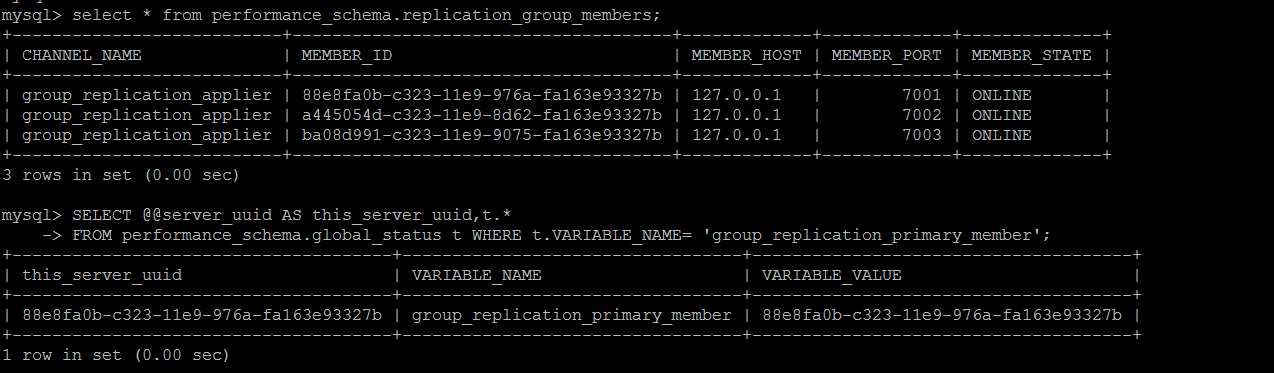
主观造成主从节点间binlog的丢失
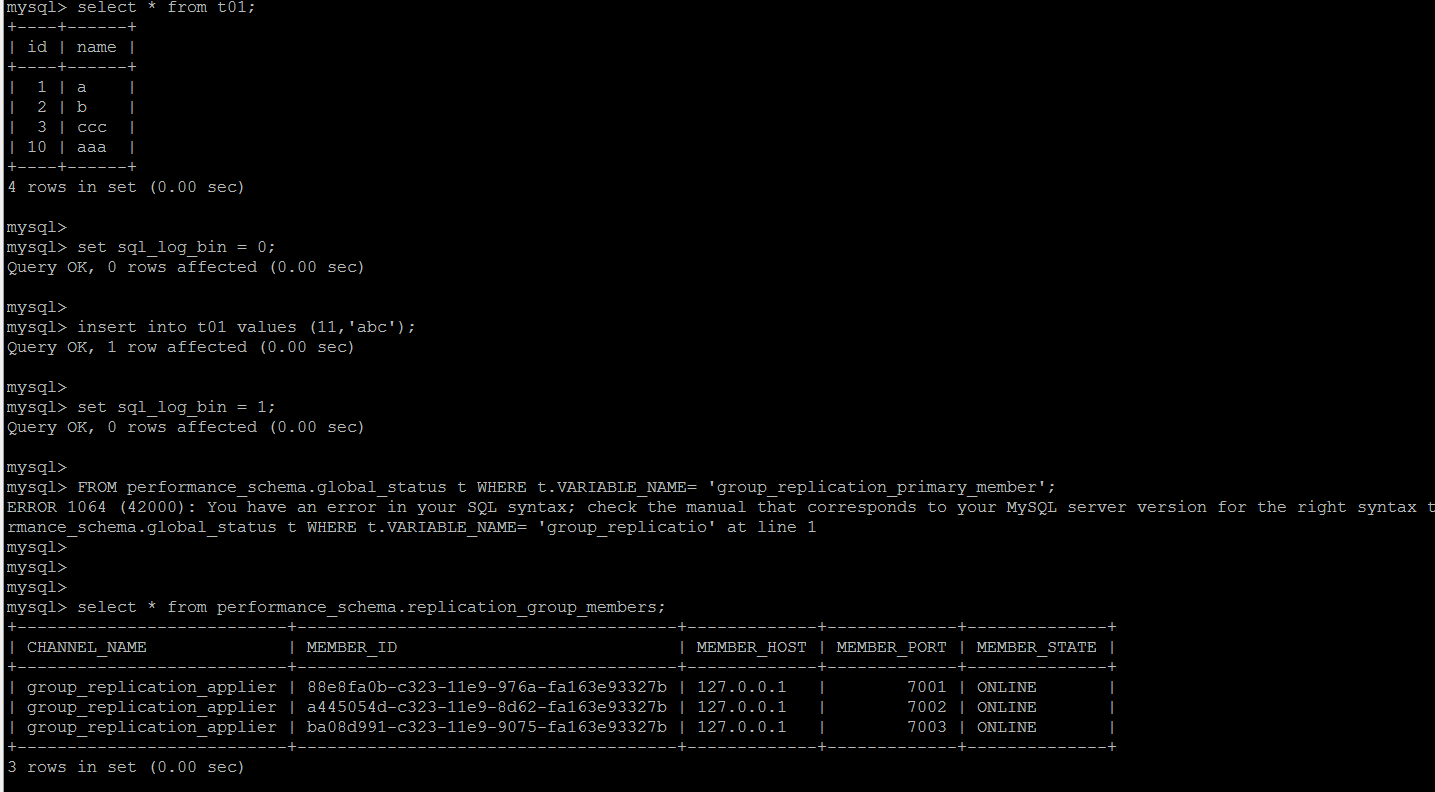
在主节点上对于对于从节点丢失的数据操作,GTID无法找到对应的数据,组复制立马熄火
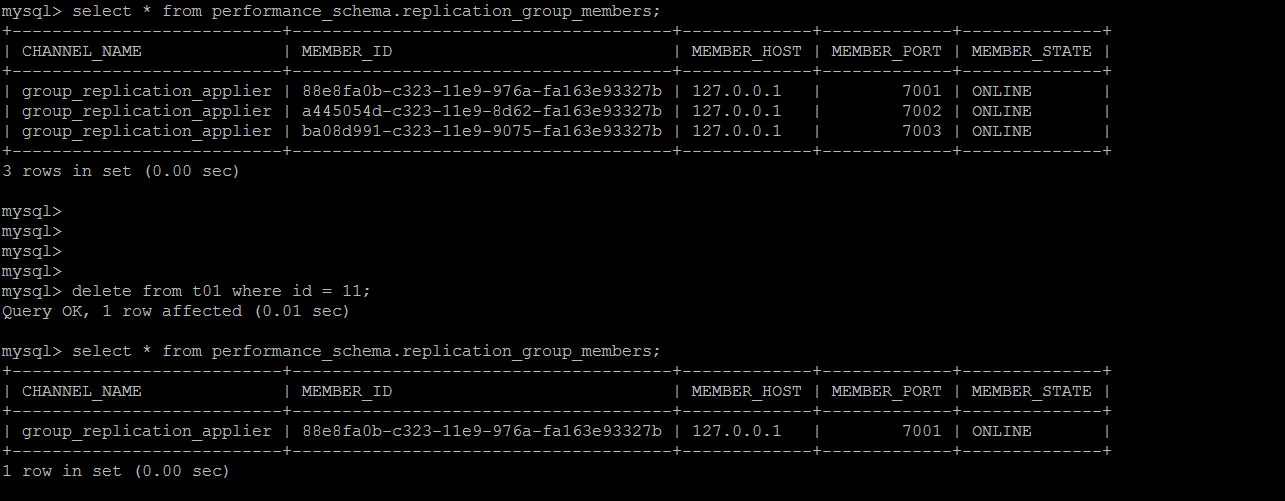
非写入节点出现错误
看下errorlog
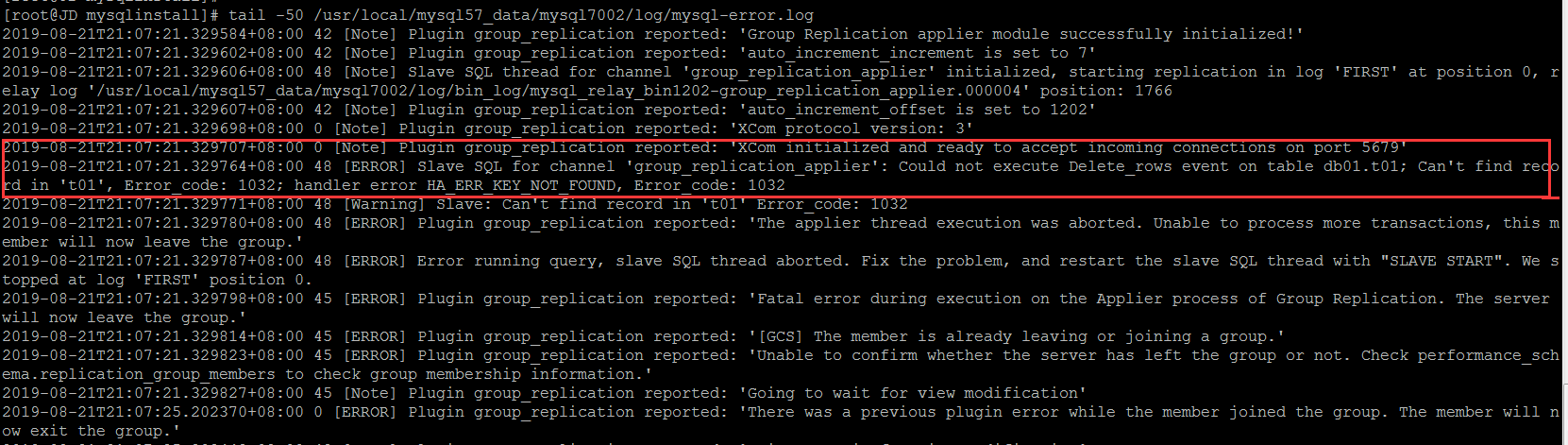
如果是手动解决的话,还是GTID跳过错误事物的套路,master上的GTID信息

尝试跳过最新的一个事物ID,然后重新连接到组,可以正常连接到组,另外一个节点仍旧处于error状态
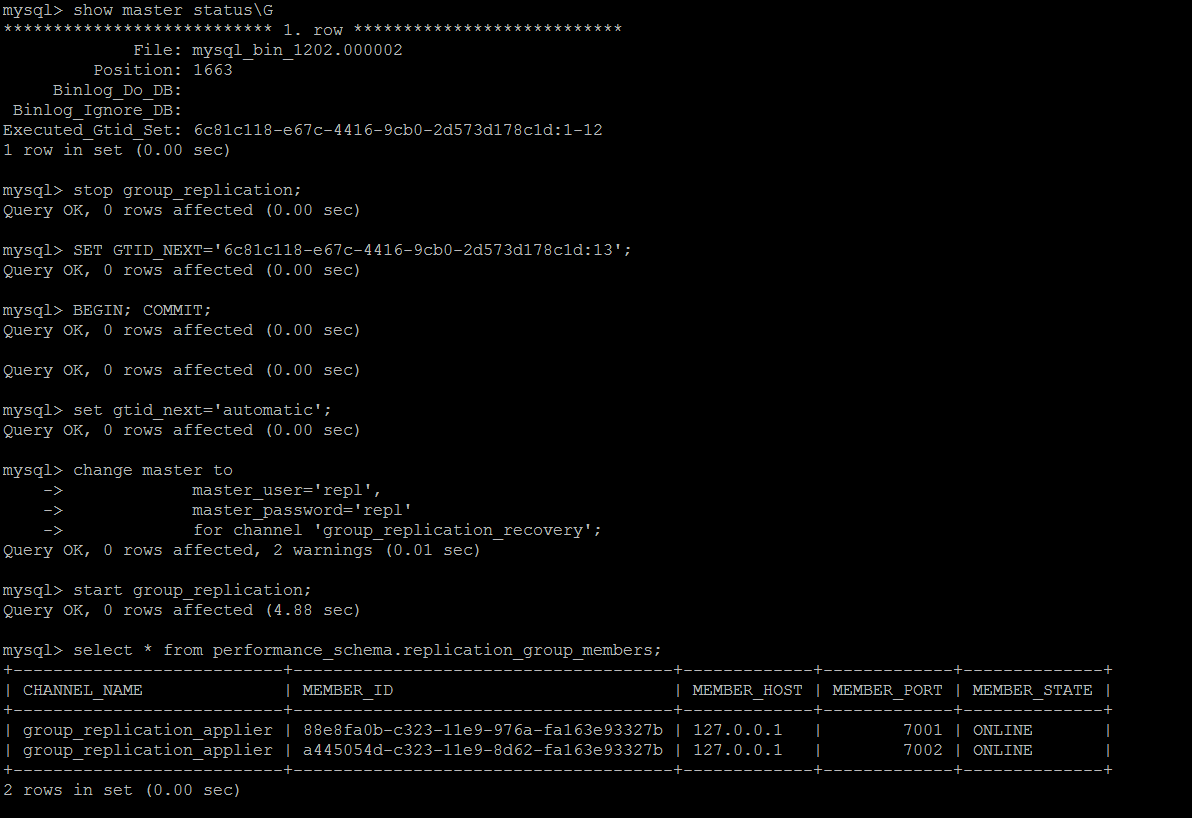
另外一个节点类似,依次解决。
MGR故障模拟2
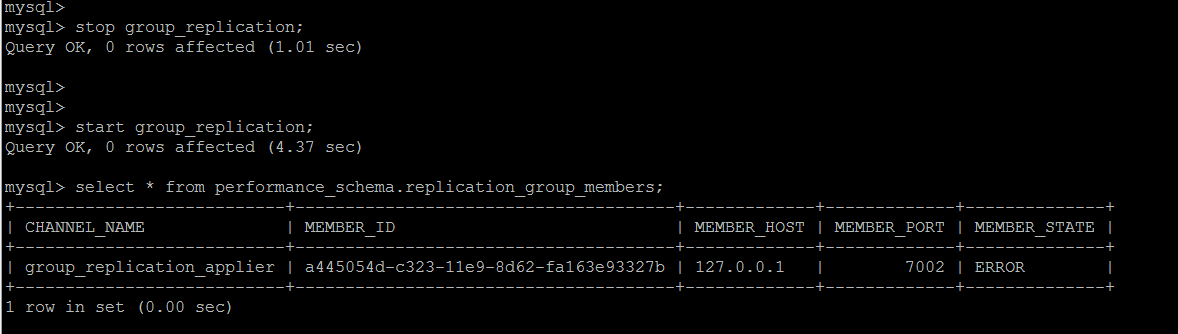
从节点脱离Group
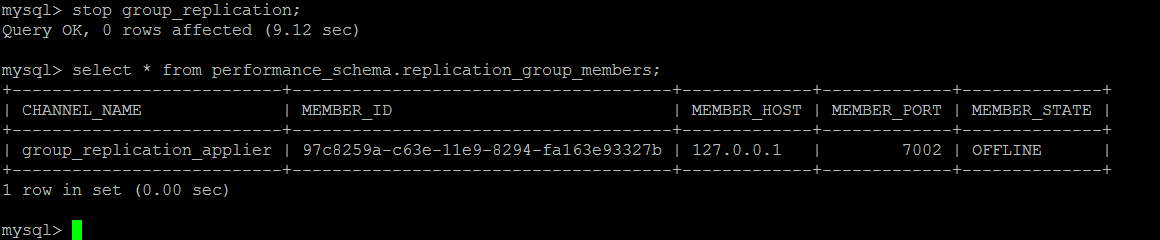
这种情况倒是比较简单,重新开始组复制即可,start group_replication
MGR故障自动检测和修复
对于如上的两种情况,
1,如果是从节点丢失主节点的事物,尝试在从节点上跳过GTID,重新开始复制即可
2,如果是从节点非丢失主节点事物,尝试在从节点重新开始组复制即可
实现代码如下
def auto_fix_mgr_error(conn_master_dict,conn_slave_dict):

    group_replication_status = get_group_replication_status(conn_slave_dict)

    if(group_replication_status[0]["MEMBER_STATE"]=="ERROR" or group_replication_status[0]["MEMBER_STATE"] == "OFFLINE"):

        print(conn_slave_dict["host"]+str(conn_slave_dict["port"])+'------>'+group_replication_status[0]["MEMBER_STATE"])

        print("auto fixing......")

        while 1 > 0:

            master_gtid_list = get_gtid(conn_master_dict)

            slave_gtid_list = get_gtid(conn_slave_dict)

            master_executed_gtid_value = int((master_gtid_list[-1]["Executed_Gtid_Set"]).split("-")[-1])

            slave_executed_gtid_value = int(slave_gtid_list[-1]["Executed_Gtid_Set"].split("-")[-1])

            slave_executed_gtid_prefix = slave_gtid_list[-1]["Executed_Gtid_Set"].split(":")[0]

            slave_executed_skiped_gtid = slave_executed_gtid_value + 1

            if (master_executed_gtid_value > slave_executed_gtid_value):

                print("skip gtid and restart group replication,skiped gtid is "

                      + slave_gtid_list[-1]["Executed_Gtid_Set"].split(":")[-1].split("-")[0]

                      + ":"+str(slave_executed_skiped_gtid))

                slave_executed_skiped_gtid = slave_executed_gtid_prefix+":"+str(slave_executed_skiped_gtid)

                skip_gtid_on_slave(conn_slave_dict,slave_executed_skiped_gtid)

                time.sleep(10)

                start_group_replication(conn_slave_dict)

                if(get_group_replication_status(conn_slave_dict)[0]["MEMBER_STATE"]=="ONLINE"):

                    print("mgr cluster fixed,back to normal")

                    break

            else:

                start_group_replication(conn_slave_dict)

                if(get_group_replication_status(conn_slave_dict)[0]["MEMBER_STATE"]=="ONLINE"):

                    print("mgr cluster fixed,back to normal")

                break

    elif (group_replication_status[0]['MEMBER_STATE'] == 'ONLINE'):

        print("mgr cluster is normal,nothing to do")

        check_replication_group_members(conn_slave_dict)
对于故障类型1,GTID事物不一致的自动化修复

对于故障类型2从节点offline的自动化修复
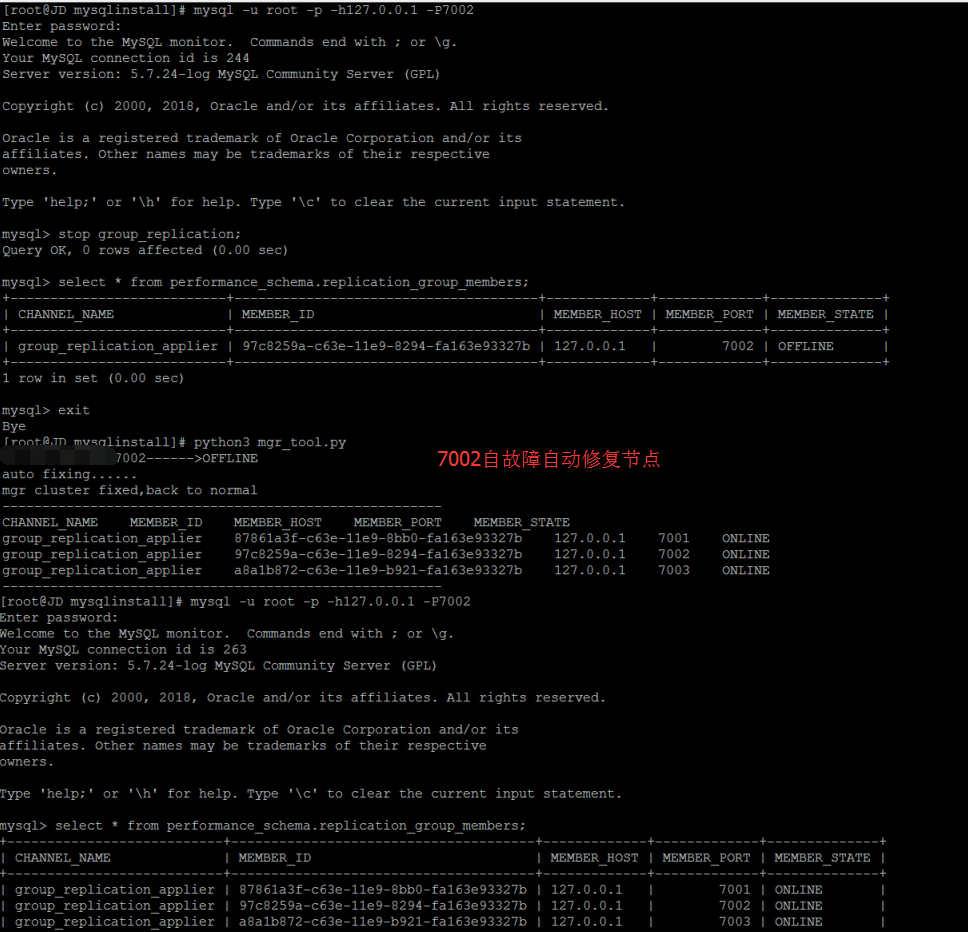
完整的实现代码
该过程要求MySQL实例必须满足MGR的基本条件,如果环境本身无法满足MGR,一切都无从谈起,因此要非常清楚MGR环境的最基本要求
完成的实现代码如下,花了一个下午写的,目前来说存在以下不足
1,创建复制用户的时候,没有指定具体的slave机器,目前直接指定的%:create user repl@'%' identified by repl
2,对于slave的修复,目前无法整体修复,只能一台一台修复,其实就是少了一个循环slave机器判断的过程
3,目前搭建之前都会reset master(不管主从,主要是清理可能的残留GTID),因此只适合新环境的搭建
4,目前只支持offline和gtid事物冲突的错误类型修复,无法支持其他MGR错误类型的修复
5,开发环境是单机多实例模式测试,没有在多机单实例模式下充分测试
以上都会逐步改善&加强。
# -*- coding: utf-8 -*-

import pymysql

import logging

import time

import decimal

def execute_query(conn_dict,sql):

    conn = pymysql.connect(host=conn_dict['host'],

                           port=conn_dict['port'],

                           user=conn_dict['user'],

                           passwd=conn_dict['password'],

                           db=conn_dict['db'])

    cursor = conn.cursor(pymysql.cursors.DictCursor)

    cursor.execute(sql)

    list = cursor.fetchall()

    cursor.close()

    conn.close()

    return list

def execute_noquery(conn_dict,sql):

    conn = pymysql.connect(host=conn_dict['host'],

                           port=conn_dict['port'],

                           user=conn_dict['user'],

                           passwd=conn_dict['password'],

                           db=conn_dict['db'])

    cursor = conn.cursor()

    cursor.execute(sql)

    conn.commit()

    cursor.close()

    conn.close()

    return list

def get_gtid(conn_dict):

    sql = "show master status;"

    list = execute_query(conn_dict,sql)

    return list

def skip_gtid_on_slave(conn_dict,gtid):

    sql_1 = 'stop group_replication;'

    sql_2 = '''set gtid_next='{0}';'''.format(gtid)

    sql_3 = 'begin;'

    sql_4 = 'commit;'

    sql_5 = '''set gtid_next='automatic';'''

    try:

        execute_noquery(conn_dict, sql_1)

        execute_noquery(conn_dict, sql_2)

        execute_noquery(conn_dict, sql_3)

        execute_noquery(conn_dict, sql_4)

        execute_noquery(conn_dict, sql_5)

    except:

        raise

def get_group_replication_status(conn_dict):

    sql = '''select MEMBER_STATE from performance_schema.replication_group_members

            where (MEMBER_HOST = '{0}' or ifnull(MEMBER_HOST,'') = '')

            AND (MEMBER_PORT={1} or ifnull(MEMBER_PORT,'') ='') ; '''.format(conn_dict["host"], conn_dict["port"])

    result = execute_query(conn_dict,sql)

    if result:

        return result

    else:

        return None

def check_replication_group_members(conn_dict):

    print('-------------------------------------------------------')

    result = execute_query(conn_dict, " select * from performance_schema.replication_group_members; ")

    if result:

        column = result[0].keys()

        current_row = ''

        for key in column:

            current_row += str(key) + "    "

        print(current_row)

        for row in result:

            current_row = ''

            for key in row.values():

                current_row += str(key) + "    "

            print(current_row)

    print('-------------------------------------------------------')

def auto_fix_mgr_error(conn_master_dict,conn_slave_dict):

    group_replication_status = get_group_replication_status(conn_slave_dict)

    if(group_replication_status[0]["MEMBER_STATE"]=="ERROR" or group_replication_status[0]["MEMBER_STATE"] == "OFFLINE"):

        print(conn_slave_dict["host"]+str(conn_slave_dict["port"])+'------>'+group_replication_status[0]["MEMBER_STATE"])

        print("auto fixing......")

        while 1 > 0:

            master_gtid_list = get_gtid(conn_master_dict)

            slave_gtid_list = get_gtid(conn_slave_dict)

            master_executed_gtid_value = int((master_gtid_list[-1]["Executed_Gtid_Set"]).split("-")[-1])

            slave_executed_gtid_value = int(slave_gtid_list[-1]["Executed_Gtid_Set"].split("-")[-1])

            slave_executed_gtid_prefix = slave_gtid_list[-1]["Executed_Gtid_Set"].split(":")[0]

            slave_executed_skiped_gtid = slave_executed_gtid_value + 1

            if (master_executed_gtid_value > slave_executed_gtid_value):

                print("skip gtid and restart group replication,skiped gtid is "

                      + slave_gtid_list[-1]["Executed_Gtid_Set"].split(":")[-1].split("-")[0]

                      + ":"+str(slave_executed_skiped_gtid))

                slave_executed_skiped_gtid = slave_executed_gtid_prefix+":"+str(slave_executed_skiped_gtid)

                skip_gtid_on_slave(conn_slave_dict,slave_executed_skiped_gtid)

                time.sleep(10)

                start_group_replication(conn_slave_dict)

                if(get_group_replication_status(conn_slave_dict)[0]["MEMBER_STATE"]=="ONLINE"):

                    print("mgr cluster fixed,back to normal")

                    break

            else:

                start_group_replication(conn_slave_dict)

                if(get_group_replication_status(conn_slave_dict)[0]["MEMBER_STATE"]=="ONLINE"):

                    print("mgr cluster fixed,back to normal")

                break

    elif (group_replication_status[0]['MEMBER_STATE'] == 'ONLINE'):

        print("mgr cluster is normal,nothing to do")

        check_replication_group_members(conn_slave_dict)

'''

reset master

'''

def reset_master(conn_dict):

    try:

        execute_noquery(conn_dict, "reset master;")

    except:

        raise

def install_group_replication_plugin(conn_dict):

    get_plugin_sql = "SELECT name,dl FROM mysql.plugin WHERE name = 'group_replication';"

    install_plugin_sql = '''install plugin group_replication soname 'group_replication.so'; '''

    try:

        result = execute_query(conn_dict, get_plugin_sql)

        if not result:

            execute_noquery(conn_dict, install_plugin_sql)

    except:

        raise

def create_mgr_repl_user(conn_master_dict,user,password):

    try:

        reset_master(conn_master_dict)

        sql_exists_user = '''select user from mysql.user where user = '{0}'; '''.format(user)

        user_list = execute_query(conn_master_dict,sql_exists_user)

        if not user_list:

            create_user_sql = '''create user {0}@'%' identified by '{1}'; '''.format(user,password)

            grant_privilege_sql = '''grant replication slave on *.* to {0}@'%';'''.format(user)

            execute_noquery(conn_master_dict,create_user_sql)

            execute_noquery(conn_master_dict, grant_privilege_sql)

            execute_noquery(conn_master_dict, "flush privileges;")

    except:

        raise

def set_super_read_only_off(conn_dict):

    super_read_only_off = '''set global super_read_only = 0;'''

    execute_noquery(conn_dict, super_read_only_off)

def open_group_replication_bootstrap_group(conn_dict):

    sql = '''select variable_name,variable_value from performance_schema.global_variables where variable_name = 'group_replication_bootstrap_group';'''

    result = execute_query(conn_dict, sql)

    open_bootstrap_group_sql = '''set @@global.group_replication_bootstrap_group=on;'''

    if result and result[0]['variable_value']=="OFF":

        execute_noquery(conn_dict, open_bootstrap_group_sql)

def close_group_replication_bootstrap_group(conn_dict):

    sql = '''select variable_name,variable_value from performance_schema.global_variables where variable_name = 'group_replication_bootstrap_group';'''

    result = execute_query(conn_dict, sql)

    close_bootstrap_group_sql = '''set @@global.group_replication_bootstrap_group=off;'''

    if result and result[0]['variable_value'] == "ON":

        execute_noquery(conn_dict, close_bootstrap_group_sql)

def start_group_replication(conn_dict):

    start_group_replication = '''start group_replication;'''

    group_replication_status = get_group_replication_status(conn_dict)

    if not (group_replication_status[0]['MEMBER_STATE'] == 'ONLINE'):

        execute_noquery(conn_dict, start_group_replication)

def connect_to_group(conn_dict,repl_user,repl_password):

    connect_to_group_sql = '''change master to

                                    master_user='{0}',

                                    master_password='{1}'

                                    for channel 'group_replication_recovery'; '''.format(repl_user,repl_password)

    try:

        execute_noquery(conn_dict, connect_to_group_sql)

    except:

        raise

def start_mgr_on_master(conn_master_dict,repl_user,repl_password):

    try:

        set_super_read_only_off(conn_master_dict)

        reset_master(conn_master_dict)

        create_mgr_repl_user(conn_master_dict,repl_user,repl_password)

        connect_to_group(conn_master_dict,repl_user,repl_password)

        open_group_replication_bootstrap_group(conn_master_dict)

        start_group_replication(conn_master_dict)

        close_group_replication_bootstrap_group(conn_master_dict)

        group_replication_status = get_group_replication_status(conn_master_dict)

        if (group_replication_status[0]['MEMBER_STATE'] == 'ONLINE'):

            print("master added in mgr and run successfully")

            return True

    except:

        raise

        print("############start master mgr error################")

        exit(1)

def start_mgr_on_slave(conn_slave_dict,repl_user,repl_password):

    try:

        set_super_read_only_off(conn_slave_dict)

        reset_master(conn_slave_dict)

        connect_to_group(conn_slave_dict,repl_user,repl_password)

        start_group_replication(conn_slave_dict)

        # wait for 10

        time.sleep(10)

        # then check mgr status

        group_replication_status = get_group_replication_status(conn_slave_dict)

        if (group_replication_status[0]['MEMBER_STATE'] == 'ONLINE'):

            print("slave added in mgr and run successfully")

        if (group_replication_status[0]['MEMBER_STATE'] == 'RECOVERING'):

            print("slave is recovering")

    except:

        print("############start slave mgr error################")

        exit(1)

def auto_mgr(conn_master,conn_slave_1,conn_slave_2,repl_user,repl_password):

    install_group_replication_plugin(conn_master)

    master_replication_status = get_group_replication_status(conn_master)

    if not (master_replication_status[0]['MEMBER_STATE'] == 'ONLINE'):

        start_mgr_on_master(conn_master,repl_user,repl_password)

    slave1_replication_status = get_group_replication_status(conn_slave_1)

    if not (slave1_replication_status[0]['MEMBER_STATE'] == 'ONLINE'):

        install_group_replication_plugin(conn_slave_1)

        start_mgr_on_slave(conn_slave_1, repl_user, repl_user)

    slave2_replication_status = get_group_replication_status(conn_slave_2)

    if not (slave2_replication_status[0]['MEMBER_STATE'] == 'ONLINE'):

        install_group_replication_plugin(conn_slave_2)

        start_mgr_on_slave(conn_slave_2, repl_user, repl_user)

    check_replication_group_members(conn_master)

if __name__ == '__main__':

    conn_master  = {'host': '127.0.0.1', 'port': 7001, 'user': 'root', 'password': 'root', 'db': 'mysql', 'charset': 'utf8mb4'}

    conn_slave_1 = {'host': '127.0.0.1', 'port': 7002, 'user': 'root', 'password': 'root', 'db': 'mysql', 'charset': 'utf8mb4'}

    conn_slave_2 = {'host': '127.0.0.1', 'port': 7003, 'user': 'root', 'password': 'root', 'db': 'mysql', 'charset': 'utf8mb4'}

    repl_user = "repl"

    repl_password = "repl"

    #auto_mgr(conn_master,conn_slave_1,conn_slave_2,repl_user,repl_password)

    auto_fix_mgr_error(conn_master,conn_slave_1)

    check_replication_group_members(conn_master)
/*
the waiting game:尽管人生如此艰难,不要放弃;不要妥协;不要失去希望
*/
MySQL MGR集群单主模式的自动搭建和自动化故障修复的更多相关文章
- MySQL集群MGR架构for单主模式
本文转载自: https://www.93bok.com MGR简介 MySQL Group Replication(简称MGR)是MySQL官方于2016年12月推出的一个全新的高可用与高扩展的解决 ...
- MySQL MGR集群搭建
本文来自网易云社区,转载务必请注明出处. 本文将从零开始搭建一个MySQL Group Replication集群,包含3个节点.简单介绍如何查询MGR集群状态信息.并介绍如何进行MGR节点上下线操作 ...
- Mysql组复制之单主模式(一)
环境 系统:CentOS release 6.9 (Final) Mysql:5.7 机器: S1 10.0.0.7 lemon S2 10.0.0.8 lemon2 S3 10.0.0.9 lemo ...
- MySQL MGR 集群从数据库显示RECOVRING
因为断电 或者 其他瞎折腾 导致: 从节点显示RECOVRING 查看错误日志显示: Slave SQL for channel 'group_replication_recovery': Error ...
- MySQL+MGR 单主模式和多主模式的集群环境 - 部署手册 (Centos7.5)
MySQL Group Replication(简称MGR)是MySQL官方于2016年12月推出的一个全新的高可用与高扩展的解决方案.MGR是MySQL官方在5.7.17版本引进的一个数据库高可用与 ...
- 多云部署多主模式的MGR集群,每个云一个MGR 节点,满足业务单元化改造的需求
欢迎来到 GreatSQL社区分享的MySQL技术文章,如有疑问或想学习的内容,可以在下方评论区留言,看到后会进行解答 GreatSQL社区原创内容未经授权不得随意使用,转载请联系小编并注明来源. 本 ...
- MySQL集群MGR架构for多主模式
本文转载自: https://www.93bok.com MGR简介 MySQL Group Replication(简称MGR)是MySQL官方于2016年12月推出的一个全新的高可用与高扩展的解决 ...
- [MGR——Mysql的组复制之单主模式 ]详细搭建部署过程
1,关于MySQL Group Replication 基于组的复制(Group-basedReplication)是一种被使用在容错系统中的技术.Replication-group(复制组)是由 ...
- MySQL MGR 单主模式下master角色切换规则
MGR单主模式,master节点可读可写,其余节点都是只读.当配置MGR为单主模式,非master节点自动开启super_read_only 当可读可写的节点异常宕机,会进行怎样的切换?在选择新的可写 ...
随机推荐
- 用Python和Pandas以及爬虫技术统计历史天气
背景 最近在计划明年从北京rebase到深圳去,所以最近在看深圳的各个方面.去年在深圳呆过一段时间,印象最深的是,深圳总是突然就下雨,还下好大的雨.对于我这种从小在南方长大但是后面又在北京呆了2年多的 ...
- [小米OJ] 9. 移除 K 位得到最小值
思路: 重复k次: 1.找到并且删除第一个 num[i] > num[i+1] 的第i位数字. 2.若删除过程中,序列变成递增序列,则直接删除最后一位. 注意除去字符串头的0 def solut ...
- 哥们,B/S了解吗?——啥玩意,我是敲代码的
了解B/S和C/S 前言:......“学好长时间编程了,JavaSE学完了,前端也简单学了”.....“那你学这么多,讲讲B/S吧”......“B/S?这是个啥玩意?没听过”......“靠,牛逼 ...
- 如何优雅关闭 Spring Boot 应用
## 前言 随着线上应用逐步采用 SpringBoot 构建,SpringBoot应用实例越来多,当线上某个应用需要升级部署时,常常简单粗暴地使用 kill 命令,这种停止应用的方式会让应用将所有处理 ...
- 【Java中级】(三)IO
1. 流分为字节流和字符流 2. 字节流下面常用的又有数据流和对象流 3. 字符流下面常用的又有缓存流 文件对象 文件和文件夹都用File表示 //file path : 文件的绝对路径或相对路径Fi ...
- 基于 Github 存储附件的 wordpress 插件
前言 插件名称 wp-github-gos, 本插件核心功能使用了 GitHub API 设置页面和核心业务逻辑主要参考插件 wordpress-qcloud-cos 的实现,替换了其中 腾讯云 CO ...
- Python 学习笔记(1)Python容器:列表、元组、字典与集合
Python容器:列表.元组.字典与集合 列表: 1.列表 的创建 使用[ ] 或者 list()创建列表:empty_list = [ ] 或者 empty_list= list() 使用list( ...
- Unity3D热更新之LuaFramework篇[07]--怎么让unity对象绑定Lua脚本
前言 在上一篇文章 Unity3D热更新之LuaFramework篇[06]--Lua中是怎么实现脚本生命周期的 中,我分析了由LuaBehaviour来实现lua脚本生命周期的方法. 但在实际使用中 ...
- spark 源码分析之十--Spark RPC剖析之TransportResponseHandler、TransportRequestHandler和TransportChannelHandler剖析
spark 源码分析之十--Spark RPC剖析之TransportResponseHandler.TransportRequestHandler和TransportChannelHandler剖析 ...
- [填坑] ubuntu检测不到外接显示器
笔记本是win10+ubuntu18双系统,今天ubuntu(开启nivida独显状态)突然无法连外接屏幕,但切换win10就可以显示. 贴吧找到的简单解决方法,不需要重装驱动,记录分享在这里: su ...