
Spring Event事件驱动
Spring事件驱动模型,简单来说类似于Message-Queue消息队列中的Pub/Sub发布/订阅模式,也类似于Java设计模式中的观察者模式。
自定义事件
Spring的事件接口位于org.springframework.context.ApplicationEvent,源码如下:
public abstract class ApplicationEvent extends EventObject {

	private static final long serialVersionUID = 7099057708183571937L;

	private final long timestamp;

	public ApplicationEvent(Object source) {

		super(source);

		this.timestamp = System.currentTimeMillis();

	}

	public final long getTimestamp() {

		return this.timestamp;

	}

}
继承了Java的事件对象EventObject,所以可以使用getSource()方法来获取到事件传播对象。
自定义Spring事件
public class CustomSpringEvent extends ApplicationEvent {

    private String message;

    public CustomSpringEvent(Object source, String message) {

        super(source);

        this.message = message;

    }

    public String getMessage() {

        return message;

    }

}
然后定义事件监听器,该监听器实际上等同于消费者,需要交给Spring容器管理。
@Component

public class CustomSpringEventListener implements ApplicationListener<CustomSpringEvent> {

    @Override

    public void onApplicationEvent(CustomSpringEvent event) {

        System.out.println("Received spring custom event - " + event.getMessage());

    }

}
最后定义事件发布者
@Component

public class CustomSpringEventPublisher {

    @Autowired

    private ApplicationEventPublisher applicationEventPublisher;

    public void doStuffAndPublishAnEvent(final String message) {

        System.out.println("Publishing custom event. ");

        CustomSpringEvent customSpringEvent = new CustomSpringEvent(this, message);

        applicationEventPublisher.publishEvent(customSpringEvent);

    }

}
创建测试类
@RunWith(SpringRunner.class)

@SpringBootTest

public class CustomSpringEventPublisherTest {

    @Autowired

    private CustomSpringEventPublisher publisher;

    @Test

    public void publishStringEventTest() {

        publisher.doStuffAndPublishAnEvent("111");

    }

}
运行测试类,可以看到控制台打印了两条重要信息
//发布事件

Publishing custom event.

//监听器得到了事件,并相应处理

Received spring custom event - 111
由于Spring事件是发布/订阅的模式,而发布订阅模式有以下三种情况
- 1生产者 - 1消费者
- 1生产者 - 多消费者
- 多生产者 - 多消费者
上面举的例子是第一种情况,我们来试试其他两个情况
继续创建一个事件监听器作为消费者:
@Component

public class CustomSpringEventListener2 implements ApplicationListener<CustomSpringEvent> {

    @Override

    public void onApplicationEvent(CustomSpringEvent event) {

        System.out.println("CustomSpringEventListener2 Received spring custom event - " + event.getMessage());

    }

}
运行测试类后,可以观察到,控制台顺序打印了两条消费信息:
Publishing custom event.

CustomSpringEventListener1 Received spring custom event - 111

CustomSpringEventListener2 Received spring custom event - 111
说明,Spring的发布订阅模式是广播模式,所有消费者都能接受到消息,并正常消费
再试试第三种多生产者 - 多消费者的情况
继续创建一个发布者,
@Component

public class CustomSpringEventPublisher2 {

    @Autowired

    private ApplicationEventPublisher applicationEventPublisher;

    public void doStuffAndPublishAnEvent(final String message) {

        System.out.println("CustomSpringEventPublisher2 Publishing custom event. ");

        CustomSpringEvent customSpringEvent = new CustomSpringEvent(this, message);

        applicationEventPublisher.publishEvent(customSpringEvent);

    }

}
控制台输出:
CustomSpringEventPublisher Publishing custom event.

CustomSpringEventListener1 Received spring custom event - 111

CustomSpringEventListener2 Received spring custom event - 111

CustomSpringEventPublisher2 Publishing custom event.

CustomSpringEventListener1 Received spring custom event - 222

CustomSpringEventListener2 Received spring custom event - 222
从以上输出内容,我们可以猜测到,Spring的事件发布订阅机制是同步进行的,也就是说,事件必须被所有消费者消费完成之后,发布者的代码才能继续往下走,这显然不是我们想要的效果,那有没有异步执行的事件呢?
Spring中的异步事件
要使用Spring 的异步事件,我们需要自定义异步事件配置类
@Configuration

public class AsynchronousSpringEventsConfig {

    @Bean(name = "applicationEventMulticaster")

    public ApplicationEventMulticaster simpleApplicationEventMulticaster() {

        SimpleApplicationEventMulticaster eventMulticaster

                = new SimpleApplicationEventMulticaster();

        eventMulticaster.setTaskExecutor(new SimpleAsyncTaskExecutor());

        return eventMulticaster;

    }

}
发布和订阅的代码不用变动,直接运行测试类,控制台将打印出:
CustomSpringEventPublisher Publishing custom event.

CustomSpringEventPublisher2 Publishing custom event.

CustomSpringEventListener1 Received spring custom event - 111

CustomSpringEventListener2 Received spring custom event - 111

CustomSpringEventListener2 Received spring custom event - 222

CustomSpringEventListener1 Received spring custom event - 222
可以看到,两个发布者几乎同时运行,证明监听器是异步执行的,没有阻塞住发布者的代码。准确的说,监听器将在一个单独的线程中异步处理事件。
Spring自带的事件类型
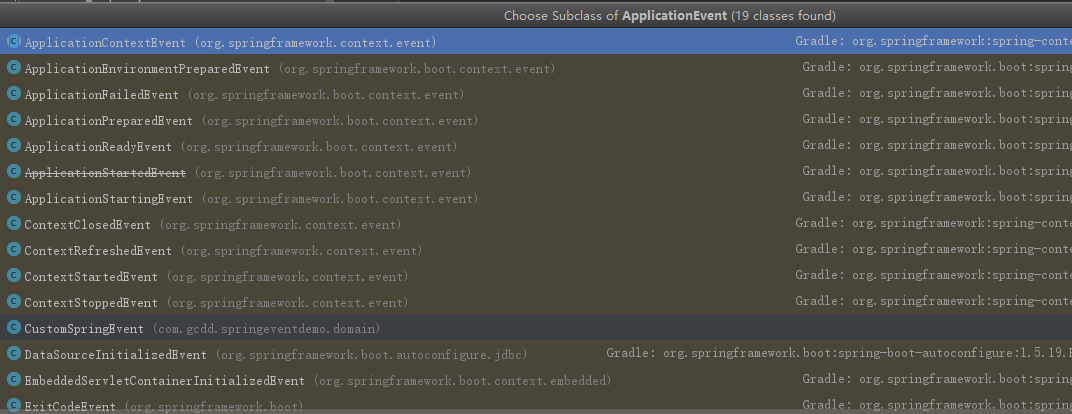
事件驱动在Spring中是被广泛采用的,我们查看ApplicationEvent的子类可以发现许多Event事件,在此不赘述。
注解驱动的监听器
从Spring 4.2开始,事件监听器不需要是实现ApplicationListener接口的bean,它可以通过@EventListener注解在任何被Spring容器管理的bean的公共方法上。
@Component

public class AnnotationDrivenContextStartedListener {

    @EventListener

    public void handleContextStart(CustomSpringEvent cse) {

        System.out.println("Handling Custom Spring Event.");

    }

}
控制台输出结果:
CustomSpringEventPublisher Publishing custom event.

Handling Custom Spring Event.

CustomSpringEventPublisher2 Publishing custom event.

Handling Custom Spring Event.
同样的,我们可以看出,这个事件监听器是同步执行的,如果要改为异步监听器,在事件方法上加上@Async,并且在Spring应用中开启异步支持(在SpringBootApplication上添加@EnableAsync)。
@Component

public class AnnotationDrivenContextStartedListener {

    @Async

    @EventListener

    public void handleContextStart(CustomSpringEvent cse) {

        System.out.println("Handling Custom Spring Event.");

    }

}
再次运行测试类:
CustomSpringEventPublisher Publishing custom event.

CustomSpringEventPublisher2 Publishing custom event.

Handling Custom Spring Event.

Handling Custom Spring Event.
泛型支持
创建一个通用泛型事件模型
@Data

public class GenericSpringEvent<T> {

    private T message;

    protected boolean success;

    public GenericSpringEvent(T what, boolean success) {

        this.message = what;

        this.success = success;

    }

}
注意GenericSpringEvent和CustomSpringEvent之间的区别。我们现在可以灵活地发布任何任意事件,并且不再需要从ApplicationEvent扩展。
这样的话,我们无法像之前一样,通过继承ApplicationListener的方式来定义一个监听器,因为ApplicationListener定义了事件必须是ApplicationEvent的子类。所以,我们只能使用注解驱动的监听器。
通过在@EventListener注释上定义布尔SpEL表达式,也可以使事件监听器成为条件。在这种情况下,只会为成功的String的GenericSpringEvent调用事件处理程序:
@Component

public class AnnotationDrivenEventListener {

    @EventListener(condition = "#event.success")

    public void handleSuccessful(GenericSpringEvent<String> event) {

        System.out.println("Handling generic event (conditional).");

    }

}
定义具体类型的事件:
public class StringGenericSpringEvent extends GenericSpringEvent<String> {

    public StringGenericSpringEvent(String message, boolean success) {

        super(message, success);

    }

}
定义发布者:
@Component

public class StringGenericSpringEventPublisher {

    @Autowired

    private ApplicationEventPublisher applicationEventPublisher;

    public void doStuffAndPublishAnEvent(final String message, final boolean success) {

        System.out.println("CustomSpringEventPublisher Publishing custom event. ");

        StringGenericSpringEvent springEvent = new StringGenericSpringEvent(message, success);

        applicationEventPublisher.publishEvent(springEvent);

    }

}
测试类:
@RunWith(SpringRunner.class)

@SpringBootTest

public class CustomSpringEventPublisherTest {

    @Autowired

    private StringGenericSpringEventPublisher publisher;

    @Test

    public void publishStringEventTest() {

        publisher.doStuffAndPublishAnEvent("success", true);

        publisher.doStuffAndPublishAnEvent("failed", false);

    }

}
运行结果:
CustomSpringEventPublisher Publishing custom event.

Handling generic event (conditional) success

CustomSpringEventPublisher Publishing custom event.
监听器只处理了成功的事件,成功忽略掉了失败的事件。这样的好处是,可以为同一个事件定义成功和失败不同的操作。
Spring事件的事务绑定
从Spring 4.2开始,框架提供了一个新的@TransactionalEventListener注解,它是@EventListener的扩展,允许将事件的侦听器绑定到事务的一个阶段。绑定可以进行以下事务阶段:
- AFTER_COMMIT(默认的):在事务成功后触发
- AFTER_ROLLBACK:事务回滚时触发
- AFTER_COMPLETION:事务完成后触发,不论是否成功
- BEFORE_COMMIT:事务提交之前触发
总结
- Spring中处理事件的基础知识:创建一个简单的自定义事件,发布它,然后在监听器中处理它。
- 在配置中启用事件的异步处理。
- Spring 4.2中引入的改进,例如注释驱动的侦听器,更好的泛型支持以及绑定到事务阶段的事件。
Spring Event事件驱动的更多相关文章
- EventBus VS Spring Event
EventBus VS Spring Event 本地异步处理,采用事件机制 可以使 代码解耦,更易读.事件机制实现模式是 观察者模式(或发布订阅模式),主要分为三部分:发布者.监听者.事件. Gua ...
- spring event
昨天看到了一遍关于spring event的帖子,觉得很好,就照着敲了一份代码,感觉对spring event有了进一步的认识.帖子链接:https://segmentfault.com/a/1190 ...
- 自定义Spring event
通过Spring自定义event 首先我们定义我们的event类 package com.hyenas.spring.custom.event; import org.springframework. ...
- nginx源代码分析--event事件驱动初始化
1.在nginx.c中设置每一个核心模块的index ngx_max_module = 0; for (i = 0; ngx_modules[i]; i++) { ngx_modules[i]-> ...
- spring的事件驱动模型
在工作中会遇到这样的业务,生成一个订单后需要给指定的用户发送短信或者邮件,但是短信或者邮件发送失败又不会影响正常的业务: 这里介绍通过ApplicationContext和spring的@EventL ...
- 配置Apache运行在event事件驱动模式下
(1)启用MPM Include conf/extra/httpd-mpm.conf (2)配置evnet MPM参数 <IfModule event.c> #default 3 Ser ...
- spring事件驱动模型--观察者模式在spring中的应用
spring中的事件驱动模型也叫作发布订阅模式,是观察者模式的一个典型的应用,关于观察者模式在之前的博文中总结过,http://www.cnblogs.com/fingerboy/p/5468994. ...
- spring中自定义Event事件的使用和浅析
在我目前接触的项目中,用到了许多spring相关的技术,框架层面的spring.spring mvc就不说了,细节上的功能也用了不少,如schedule定时任务.Filter过滤器. intercep ...
- 从spring框架中的事件驱动模型出发,优化实际应用开发代码
一.事件起源 相信很多人在使用spring框架进行开发时,都会遇到这样的需求:在spring启动后,立即加载部分资源(例如:spring启动后立刻加载资源初始化到redis中).当我去解决这个问题时发 ...
随机推荐
- 《Python学习手册 第五版》 -第10章 Python语句简介
前面在开始讲解数据类型的时候,有说过Python的知识结构,在此重温一下 Python知识结构: 程序由模块组成 模块包含语句 语句包含表达式 表达式创建并处理对象 关于知识结构,前面已经说过我自己的 ...
- Go语言实现:【剑指offer】正则表达式匹配
该题目来源于牛客网<剑指offer>专题. 请实现一个函数用来匹配包括 . 和 * 的正则表达式.模式中的字符.表示任意一个字符,而 * 表示它前面的字符可以出现任意次(包含0次). 在本 ...
- 突破CRUD | 万能树工具类封装
0.学完本文你或许可以收获 感受一个树工具从初始逐步优化完善的过程 树工具封装的设计思考与实现思路 最后收获一款拿来即用的树工具源代码 对于前端树组件有一定了解和使用过的同学可直接跳跃到第3章节开始. ...
- vue学习(一)项目搭建
首先需要配置node和npm,如果没有安装的话,百度一下安装教程. 如果感觉npm下载速度慢,可以使用淘宝镜像cnpm,链接地址: http://npm.taobao.org/ 安装cnpm npm ...
- 038.Python关于TCP黏包问题
黏包现象 1 黏包现象演示 服务端 #服务端 import socket sk = socket.socket() # 注册主机到网络 sk.bind( ("127.0.0.1", ...
- 基于MATLAB的单级倒立摆仿真
有关代码及word文档请关注公众号“浮光倾云”,后台回复A010.02即可获取 一.单级倒立摆概述 倒立摆是处于倒置不稳定状态,人为控制使其处于动态平衡的一种摆,是一类典型的快速.多变量.非线性.强耦 ...
- 开源堡垒机jumpserver的配置和使用
开源跳板机jumpserver配置和使用 http://docs.jumpserver.org/zh/docs/quick_start.html#id9 系统设置 基本设置 # 修改url 的&quo ...
- [CSS]important提升直选标签优先级
<style> #identity{ color: purple; } p { color: yellowgreen !important; } </style> <!- ...
- IP切换脚本
1. 新建bat文件: 2. 将下面内容拷贝进bat文件: 3. 运行bat文件: @echo off color 00title IP切换脚本:start @echo --------------- ...
- android手机遍历安装应用
/** * 遍历程序列表,判断是否安装安全支付服务 * * @return */ public boolean isMobile_spExist() { PackageManager manager ...