
【Java集合系列三】Vector-Stack解析
2017-07-29 12:59:14
一、简介
1、Vector继承关系

2、Vector类扩容
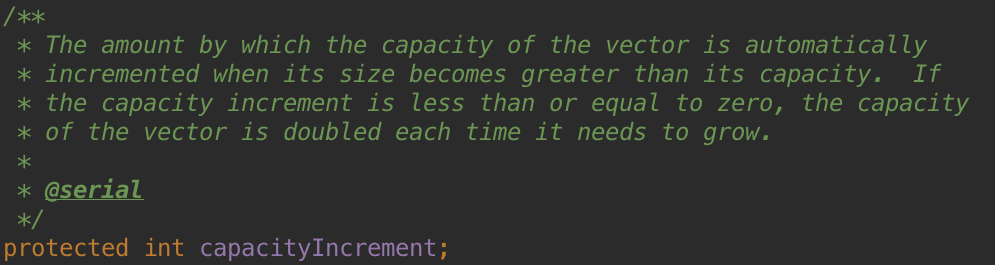
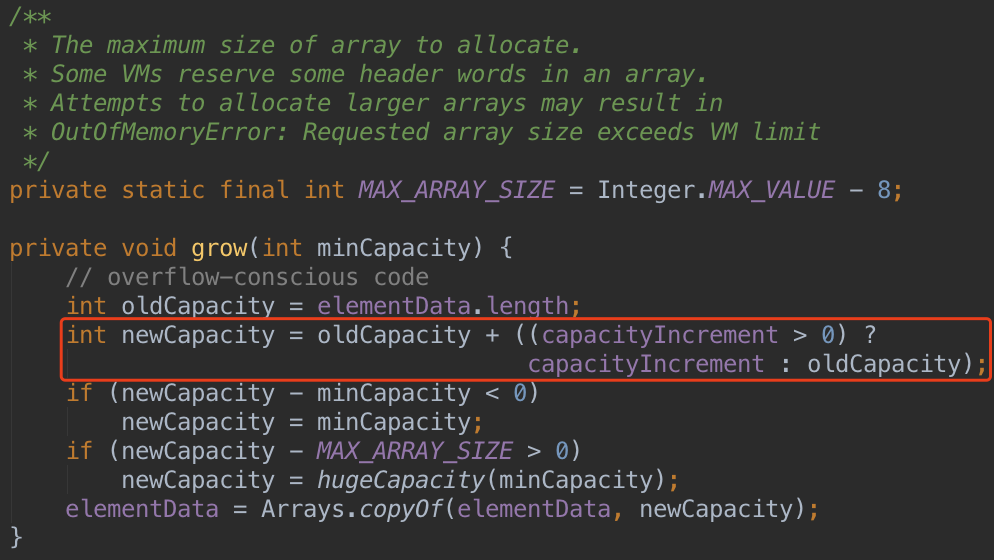
Vector类的实现和ArrayList极其相似,都使用数组存储元素,但是扩容策略不一样,ArrayList基本是按照1.5倍的思路扩容,Vector是按照创建Vector对象时设置的capacityIncrement值递增的,如果该值没有设置或者为0,则直接Double,如下:
3、Vector的线程安全性
Vector号称是线程安全的,它的安全性来自于几乎给每个方法都添加了synchronized关键字,由于锁对象是当前对象,只要有一个线程在执行某一个加锁的方法,也就是获得到当前对象这个锁对象,其他线程基本都不能再使用这个Vector对象了...这是一种很残暴的设计,估计这可能是synchronized刚出来之时,JDK团队的一时兴奋之作吧~
举几个例子:
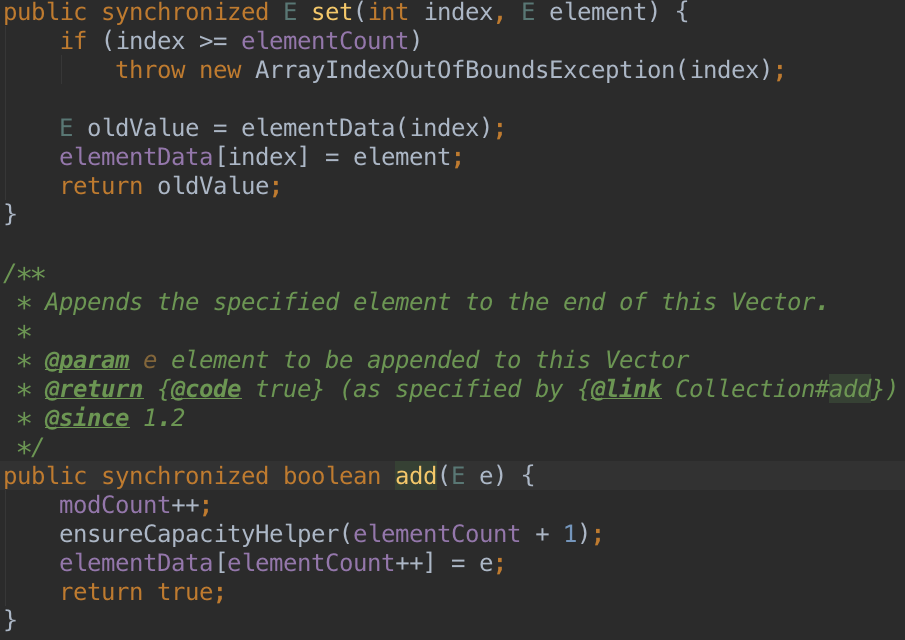
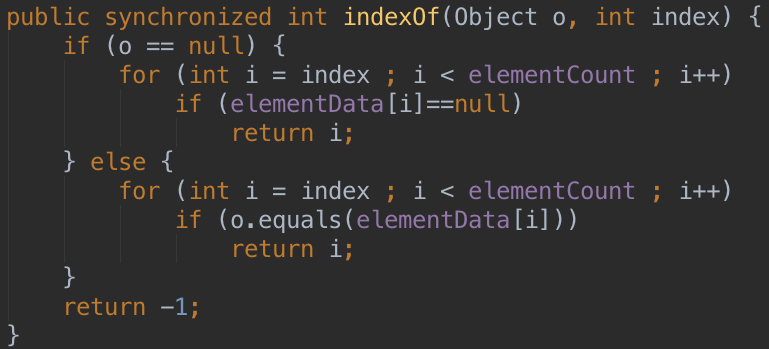
即便是有一些方法没有直接加synchronized关键字,至少它所调用的方法都是加了的。
4、Stack
Stack继承自Vector,提供了pop、push、peek、search等栈的特殊操作,源码如下:
 package java.util;

 /**

  * The <code>Stack</code> class represents a last-in-first-out

  * (LIFO) stack of objects. It extends class <tt>Vector</tt> with five

  * operations that allow a vector to be treated as a stack. The usual

  * <tt>push</tt> and <tt>pop</tt> operations are provided, as well as a

  * method to <tt>peek</tt> at the top item on the stack, a method to test

  * for whether the stack is <tt>empty</tt>, and a method to <tt>search</tt>

  * the stack for an item and discover how far it is from the top.

  * <p>

  * When a stack is first created, it contains no items.

  *

  * <p>A more complete and consistent set of LIFO stack operations is

  * provided by the {@link Deque} interface and its implementations, which

  * should be used in preference to this class.  For example:

  * <pre>   {@code

  *   Deque<Integer> stack = new ArrayDeque<Integer>();}</pre>

  *

  * @author  Jonathan Payne

  * @since   JDK1.0

  */

 public

 class Stack<E> extends Vector<E> {

     /**

      * Creates an empty Stack.

      */

     public Stack() {

     }

     /**

      * Pushes an item onto the top of this stack. This has exactly

      * the same effect as:

      * <blockquote><pre>

      * addElement(item)</pre></blockquote>

      *

      * @param   item   the item to be pushed onto this stack.

      * @return  the <code>item</code> argument.

      * @see     java.util.Vector#addElement

      */

     public E push(E item) {

         addElement(item);

         return item;

     }

     /**

      * Removes the object at the top of this stack and returns that

      * object as the value of this function.

      *

      * @return  The object at the top of this stack (the last item

      *          of the <tt>Vector</tt> object).

      * @throws  EmptyStackException  if this stack is empty.

      */

     public synchronized E pop() {

         E       obj;

         int     len = size();

         obj = peek();

         removeElementAt(len - 1);

         return obj;

     }

     /**

      * Looks at the object at the top of this stack without removing it

      * from the stack.

      *

      * @return  the object at the top of this stack (the last item

      *          of the <tt>Vector</tt> object).

      * @throws  EmptyStackException  if this stack is empty.

      */

     public synchronized E peek() {

         int     len = size();

         if (len == 0)

             throw new EmptyStackException();

         return elementAt(len - 1);

     }

     /**

      * Tests if this stack is empty.

      *

      * @return  <code>true</code> if and only if this stack contains

      *          no items; <code>false</code> otherwise.

      */

     public boolean empty() {

         return size() == 0;

     }

     /**

      * Returns the 1-based position where an object is on this stack.

      * If the object <tt>o</tt> occurs as an item in this stack, this

      * method returns the distance from the top of the stack of the

      * occurrence nearest the top of the stack; the topmost item on the

      * stack is considered to be at distance <tt>1</tt>. The <tt>equals</tt>

      * method is used to compare <tt>o</tt> to the

      * items in this stack.

      *

      * @param   o   the desired object.

      * @return  the 1-based position from the top of the stack where

      *          the object is located; the return value <code>-1</code>

      *          indicates that the object is not on the stack.

      */

     public synchronized int search(Object o) {

         int i = lastIndexOf(o);

         if (i >= 0) {

             return size() - i;

         }

         return -1;

     }

     /** use serialVersionUID from JDK 1.0.2 for interoperability */

     private static final long serialVersionUID = 1224463164541339165L;

 }
5、结尾
Vector和ArrayList的异同:
1、扩容策略不同;
2、线程安全的;
3、提供了一些独特的如removeElement()之类的方法;
4、其他方法的实现与ArrayList几乎是一致的,毕竟都是对数组的操作;
5、忽略这个类即可;
【Java集合系列三】Vector-Stack解析的更多相关文章
- Java 集合系列 05 Vector详细介绍(源码解析)和使用示例
java 集合系列目录: Java 集合系列 01 总体框架 Java 集合系列 02 Collection架构 Java 集合系列 03 ArrayList详细介绍(源码解析)和使用示例 Java ...
- Java 集合系列07之 Stack详细介绍(源码解析)和使用示例
概要 学完Vector了之后,接下来我们开始学习Stack.Stack很简单,它继承于Vector.学习方式还是和之前一样,先对Stack有个整体认识,然后再学习它的源码:最后再通过实例来学会使用它. ...
- 【转】 Java 集合系列07之 Stack详细介绍(源码解析)和使用示例
概要 学完Vector了之后,接下来我们开始学习Stack.Stack很简单,它继承于Vector.学习方式还是和之前一样,先对Stack有个整体认识,然后再学习它的源码:最后再通过实例来学会使用它. ...
- Java集合系列(三):HashSet、LinkedHashSet、TreeSet的使用方法及区别
本篇博客主要讲解Set接口的三个实现类HashSet.LinkedHashSet.TreeSet的使用方法以及三者之间的区别. 注意:本文中代码使用的JDK版本为1.8.0_191 1. HashSe ...
- Java 集合系列之 Vector详细介绍(源码解析)和使用示例
Vector简介 Vector 是矢量队列,它是JDK1.0版本添加的类.继承于AbstractList,实现了List, RandomAccess, Cloneable这些接口. Vector 继承 ...
- 【Java集合系列五】HashMap解析
2017-07-31 19:36:00 一.简介 1.HashMap作用及使用场景 HashMap利用数组+单向链表的方式,实现了key-value型数据的存储功能.HashMap的size永远是2^ ...
- 【Java集合系列二】LinkedList解析
一.简介 1.LinkedList继承关系 2.LinkedList底层实现 LinkedList使用双向链表存储数据,所以没有默认的容量,也不会有扩容一说.只有两个指针,永远指向链表的两端:firs ...
- 【Java集合系列六】LinkedHashMap解析
2017-08-14 16:30:10 1.简介 LinkedHashMap继承自HashMap,能保证迭代顺序,支持其他Map可选的操作.采用双向链表存储元素,默认的迭代序是插入序.重复插入一个已经 ...
- 【Java集合系列一】ArrayList解析
一.基础简介 1.ArrayList继承关系 2.底层用数组来存储数据,数据会在ArrayList创建的时候一并初始化.如果创建ArrayList的时候,没有设置容量,则会delay到第一次add数据 ...
随机推荐
- NOIP2015跳石头
题目描述 Description 一年一度的“跳石头”比赛又要开始了! 这项比赛将在一条笔直的河道中进行,河道中分布着一些巨大岩石.组委会已经选择好了两块岩石作为比赛起点和终点.在起点和终点之间,有N ...
- 微信小程序上传与下载文件
需要准备的工作: ①.建立微信小程序工程,编写以下代码. ②.通过IDE建立springboot+web工程,编写接收文件以及提供下载文件的方式,并将上传的文件相关信息记录在mysql数据库中.具体请 ...
- 20190402 管道符,分号,单引号,双引号,&&的使用
:分号叫顺序执行 格式:命令:命令 && :前一条命令执行成功,后面命令继续执行:前面命令执行失败,后者不执行 格式:命令+空格&&空格+命令 || :两管道逻辑执行, ...
- 外网访问内网Elasticsearch WEB
外网访问内网Elasticsearch WEB 本地安装了Elasticsearch,只能在局域网内访问其WEB,怎样从外网也能访问本地Elasticsearch? 本文将介绍具体的实现步骤. 1. ...
- java 全局变量 的小结
利用关键字final声明常量,对于全局的常量(即在整个项目中都可用)通常按以下模式声明:public static final int MAX_VALUE=512 如果某常量只在本类使用,则应将其定义 ...
- HTML5中 audio标签的样式修改
由于html5的流行,现在移动端大多数的需求都可以使用audio来播放音频,但您可能只是需要很简单的播放/停止效果,但不同的浏览器上的audio样式却不尽人意,那么要怎么改变这个样式呢,其实它的原理比 ...
- nrm 安装与使用
1.使用 npm install nrm -global 全局安装 2.安装完成后使用 nrm ls命令查看其维护的镜像地址列表 3.* 星号表示在使用 npm下载资源的时候,默认使用的地址 这里需要 ...
- C# 可指定并行度任务调度器
可指定并行度的任务调度器 https://social.msdn.microsoft.com/Forums/zh-CN/b02ba3b4-539b-46b7-af6b-a5ca3a61a309/tas ...
- Learning-Python【20】:Python常用模块(3)—— shelve、pickle、json、xml、configparser
什么是序列化/反序列化? 序列化就是将内存中的数据结构转换成一种中间格式存储到硬盘或者基于网络传输,反序列化就是硬盘中或者网络中传来的一种数据格式转换成内存中数据结构 为什么要有序列化/反序列化? 1 ...
- centos7安装node
centos7安装node 二进制文件安装 node=v10.13.0 file=node-${node}-linux-x64 wget https://nodejs.org/dist/${node} ...