
ADC for programmable logic uses one capacitor
Many electronic devices require user input for setting the application properties. Typical input devices include pushbuttons, potentiometers, and touchscreens. To minimize overall project cost, you may have to select low-range microcontrollers, FPGAs (field-programmable gate arrays), or PLDs (programmable-logic devices). These devices don’t provide a wide range of peripherals and often lack analog-to-digital-conversion capability, which can prove annoying when trying to acquire user input. This Design Idea describes a method for adding a low-end ADC to a single programmable-logic I/O pin. The circuit charges a capacitor through a resistor while measuring the time to charge the capacitor to a certain voltage.
Before each measurement, the capacitor discharges to 0V. A single I/O pin can perform both the discharging and the timing. For an FPGA or a PLD, you can perform a discharge by setting the I/O as an output pin and forcing a zero at that pin. You can charge the capacitor by setting the I/O as an input pin, which gives it a high impedance. The capacitor charges through the potentiometer (Figure 1).
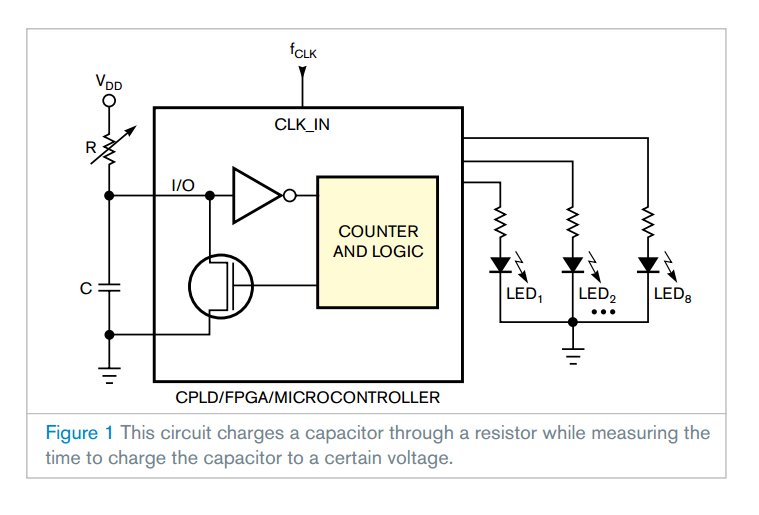
Meanwhile, a counter starts, and the CPLD monitors the input voltage. As soon as the capacitor voltage reaches the threshold, the counter stops at a value that is a measure of the charging time. The charging time or counter value relates to the clock frequency, the value of the resistor, the value of the capacitor, and the input threshold voltage:
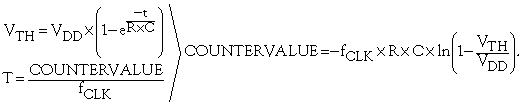
If you assume that the capacitor value, the input threshold voltage, and the clock frequency remain fairly constant over the operating range, the charging time is linearly dependent on the value of the resistor. If you replace the resistor with a potentiometer, a counter value depends on the potentiometer position. The application uses a Xilinx XC9500 XL CPLD (Figure 2).

The I/O, which VHDL (very-high-speed-IC hardware-description language) declares as a tristate buffer, first shorts the capacitor. Hardware limits the output short-circuit current of the I/O pins to ±10 mA, so the capacitor’s shorting should last long enough to guarantee a full discharge. You can calculate the minimum shorting time using the capacitor value, short-circuit current, and discharge voltage, assuming that the threshold voltage must discharge from the capacitor:

The discharge delay can be realized with a small counter. After the discharge time, the I/O pin acts as an input, which causes the capacitor to charge through a pullup potentiometer. Meanwhile, the internal counter starts. When the capacitor voltage reaches the input threshold voltage, the counter stops. Eight LEDs show the 8-bit value. In this application, a 10-kΩ potentiometer in series with a 1-kΩ resistor charges a 22-nF capacitor. The input clock of the PLD is 1.8432 MHz. The input threshold is 1.5V at a supply of 3.3V. This arrangement allows a measurement range between a counter value of 25 and 270, equivalent to a resolution of almost 8 bits.
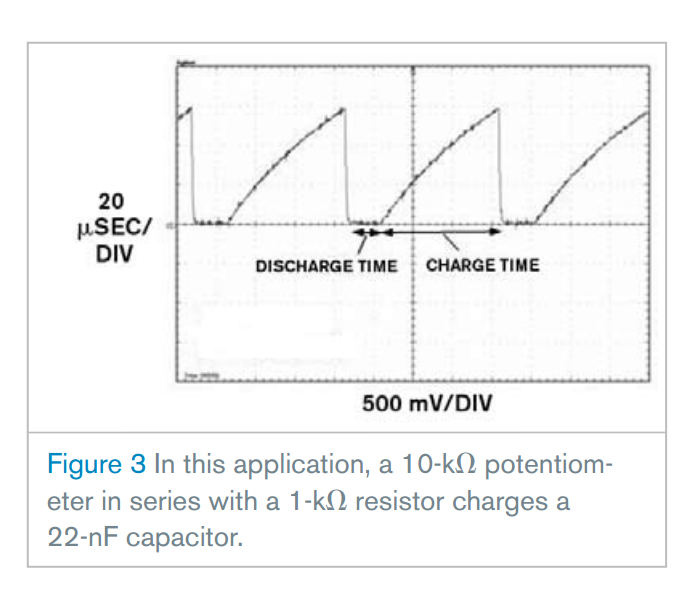
Figure 3 shows the capacitor charging/discharging waveform.
Every IC’s I/O pin has a certain bias sink or source current, causing a voltage drop over the charging resistor. This situation limits the charge voltage to VDD–RCHARGE×IBIAS. In other words, if the charging resistance is too large, the capacitor doesn’t charge above the input-pin threshold voltage, stopping the circuit’s operation. Similar applications for microcontrollers or PLDs (references 1 through 5) include adding multiple inputs to a single I/O pin and using a different pullup-resistor value for each input. By discriminating the charging times for each resistor, the PLD can decide which resistor or combination of resistors the user has actuated.
Another application for microcontrollers is temperature measurement. By replacing the pullup resistor with a PTC (positive-temperature-coefficient) or an NTC (negative-temperature-coefficient) resistor, you can derive the temperature from the charging time after calibration. You can also use these devices to make true analog-to-digital measurements. By replacing the pullup resistor with a voltage-controlled current source, an input-voltage change causes a linear change in the charging time, providing a real analog-to-digital conversion.
| References |
|
ADC for programmable logic uses one capacitor的更多相关文章
- FPGA LVDS I/O as an Analog Programmable Comparator
http://www.eetimes.com/author.asp?section_id=36&doc_id=1320289 Seeing the new ADC IP being bandi ...
- DAC Essentials
http://e2e.ti.com/blogs_/b/analogwire/archive/tags/DAC%2bEssentials DAC Essentials: A new blog serie ...
- JTAG 引脚自动识别 JTAG Finder, JTAG Pinout Tool, JTAG Pin Finder, JTAG pinout detector, JTAGULATOR, Easy-JTAG, JTAG Enumeration
JTAG Finder Figuring out the JTAG Pinouts on a Device is usually the most time-consuming and frustra ...
- 中国计算机学会CCF推荐国际学术会议
中国计算机学会推荐国际学术会议 (计算机系统与高性能计算) 一.A类 序号 会议简称 会议全称 出版社 网址 1 ASPLOS Architectural Support for Programmin ...
- 关于CPLD与FPGA的对比分析
1.PLD/FPGA/CPLD PLD(Programmable Logic Device):可编程逻辑器件,数字集成电路半成品,芯片上按照一定的排列方式集成了大量的门和触发器等基本逻辑元件,使用者按 ...
- OrCAD Capture使用记录
1.安装 ①修改host_ID为主机名称(如果填不对,安装过程会提示你再填一次):其后跟的是机子的MAC地址,用ipconfig /all 可以查看. ②下一行的FLEMlm,后面跟的是文件cdslm ...
- 浅谈用ModelSim+Synplify+Quartus来实现Altera FPGA的仿真
浅谈用ModelSim+Synplify+Quartus来实现Altera FPGA的仿真 工作内容: Mentor公司的ModelSim是业界最优秀的HDL语言仿真软件,它能提供友好的仿真环境,是业 ...
- CCF推荐国际学术会议
类别如下计算机系统与高性能计算,计算机网络,网络与信息安全,软件工程,系统软件与程序设计语言,数据库.数据挖掘与内容检索,计算机科学理论,计算机图形学与多媒体,人工智能与模式识别,人机交互与普适计算, ...
- 10 notorious computer virus
The history of computer virus is the same as computer history. With more and more powerful computers ...
随机推荐
- Crypt加密函数简介(C语言)
定义函数 char * crypt (const char *key,const char * salt); 函数说明 crypt是个密码加密函数,它是基于Data Encryption Standa ...
- 画弧线DrawArc的研究-我自己 -- 直线交接圆角
procedure TForm4.Button7Click(Sender: TObject); var pwith: Integer; //画笔的宽度 hx1, hy1: Integer; //横线第 ...
- Delphi 绘图对象
来自:http://blog.csdn.net/lailai186/article/details/8755430 ========================================== ...
- 下划线css
/* <div class="text">header</div> */ .text { /* 作用元素 */ display: inline-block; ...
- CCTF部分赛题分析
这次算是跟着师傅们全程打完了CCTF的线上赛,一些强队的WriteUp也放了出来.这篇文章主要是想跟着大牛的思路把那些题重新再过一遍. PWN3 这个是格式化字符串漏洞的题.printf的格式化串直接 ...
- 【转】servlet/filter/listener/interceptor区别与联系
原文:https://www.cnblogs.com/doit8791/p/4209442.html 一.概念: 1.servlet:servlet是一种运行服务器端的java应用程序,具有独立于平台 ...
- Python/Anaconda多版本共存的解决方案
博客中的文章均为 meelo 原创,请务必以链接形式注明 本文地址 虽然Python2大势已去,众多项目都已经支持Python3,但总有一些教程和项目只支持Python2.通常情况是计算机里既装着Py ...
- css写无缝滚动
html结构: <div class="authority"> <ul> <li> <img src="./images/rep ...
- HadoopMR-Spark-HBase-Hive
 YARN资源调度: 三种 FIFO 大任务独占 一堆小任务独占 capacity 弹性分配 :计算任务较少时候可以利用全部的计算资源,当队列的任务多的时候会按照比例进行资源平衡. 容量保证:保证队 ...
- Eclipse酷炫项目、最新趋势介绍
作为Eclipse基金组织的执行董事,我需要经常审阅每一个新提交的Eclipse项目协议书.作为Eclipse的一分子,我很乐意与加入我们团队的新开发人员互动.这也是我工作中的乐趣之一.2013年,我 ...