
Go for Pythonistas Go and the Zen of Python 禅
Go for Pythonistas
https://talks.golang.org/2013/go4python.slide#1
Things I don't like about Python (it'll be short)
Beautiful and simple
Dynamic typing - nice because it's concise, like Python.
a = "hello"

b = 1

# but also

a = 2
Static typing - can be verbose, like Java or C++.
Foo foo = new Foo();
Static typing with inferred types, like Go.
a := "hello"

b := 1

// but no

a = 2
Statically-typed Python? Check mypy and Cython.
Run time pyrotechnics
name = 'pythonista'

# This code only works half of the time.

if random.random() > 0.5:

    print 'hey '+name+', you win!'

else:

    print 'sorry '+nane+', you lose'
I don't want start a flame war here but ...
100% code coverage is a symptom
- Code coverage should point you to untested cases.
- Not a way to find typos!
- 100% code coverage doesn't mean bug free.
Other things I don't like
- Deploying - managing dependencies.
- Performance - "not too slow" is often not fast enough.
- Magic! (e.g.:
__magic__:**kargs,__getattr__)
A list of magic methods in Python:
www.rafekettler.com/magicmethods.html
And I *do* like concurrency!
A lot has been said about Python's infamous Global Interpreter Lock.
You should watch Mindblowing Python GIL, by David Beazley.
Things I like about Python
Things I like about Python
- The Zen of Python. (Go and the Zen of Python)
- Hashes and arrays are part of the language.
- The standard library.
- Magic! A bit of code can do a lot.
A bit of code
fib.py
Have you ever heard of Fibonacci?
def fib(n):

    a, b = 0, 1

    for i in range(n):

        a, b = b, a + b

    return b

def fib_rec(n):

    if n <= 1:

        return 1

    else:

        return fib_rec(n-1) + fib_rec(n-2)

for x in range(10):

    print fib(x), fib_rec(x)
fib.go
Something familiar?
func fib(n int) int {

    a, b := 0, 1

    for i := 0; i < n; i++ {

        a, b = b, a+b

    }

    return b

}

func fibRec(n int) int {

    if n <= 1 {

        return 1

    }

    return fibRec(n-1) + fibRec(n-2)

}

func main() {

    for i := 0; i < 10; i++ {

        fmt.Println(fib(i), fibRec(i))

    }

}
Fibonacci without generators? What?
Python generators are awesome.
def fib(n):

    a, b = 0, 1

    for i in range(n):

        a, b = b, a + b

        yield a
Mechanically complex.
f = fib(10)

try:

    while True:

        print f.next()

except StopIteration:

    print 'done'
But very easy to use.
for x in fib(10):

    print x

print 'done'
Python generators
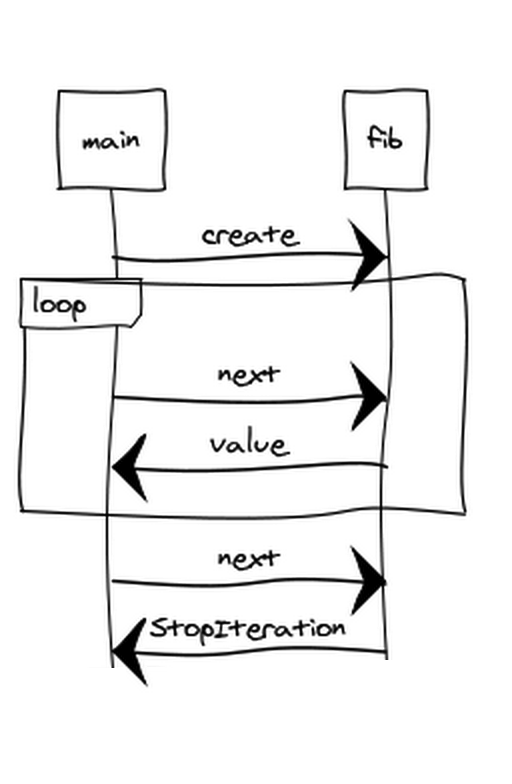
Note the generator executes concurrently. Hmm... I like concurrency.
Go concurrency
Based on goroutines and channels.
- Goroutines: very light processing actors (the gophers).
- Channels: typed, synchronized, thread-safe pipes (the arrows).
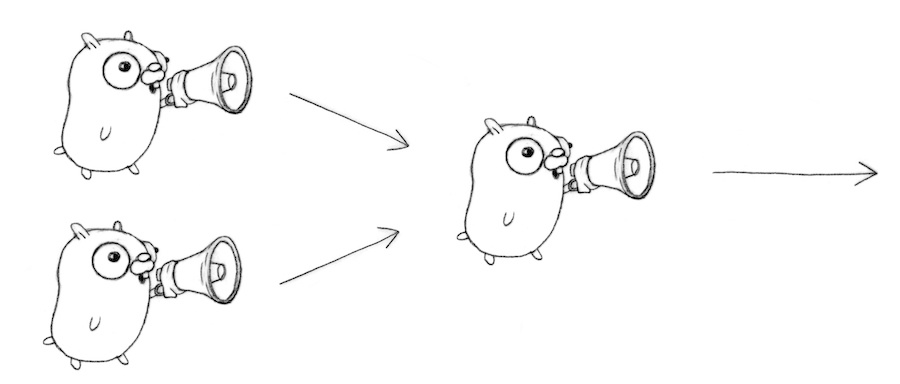
"Generator" goroutines
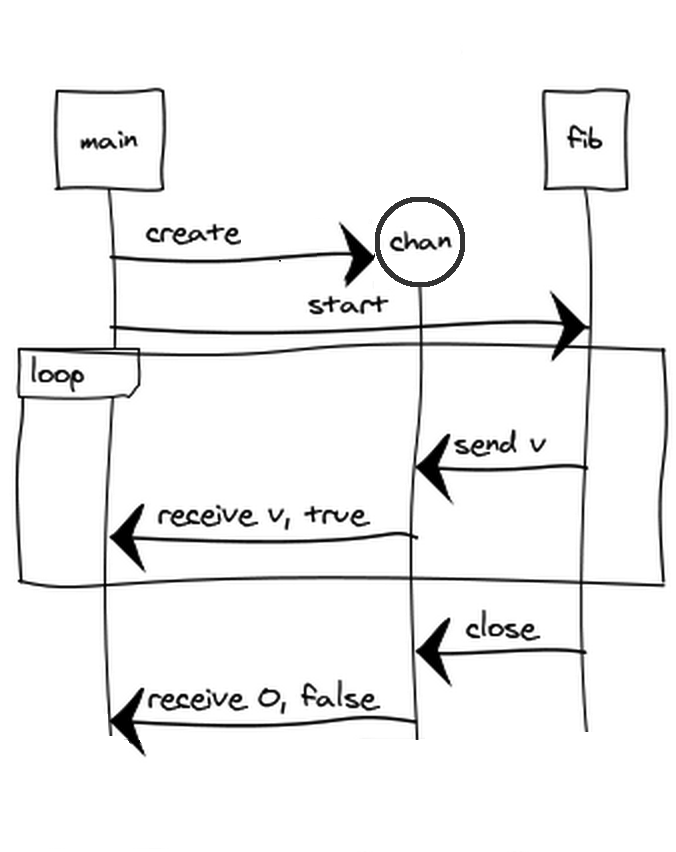
"Generator" goroutines
Uses a channel send instead of yield.
func fib(c chan int, n int) {

    a, b := 0, 1

    for i := 0; i < n; i++ {

        a, b = b, a+b

        c <- a

    }

    close(c)

}
func main() {

    c := make(chan int)

    go fib(c, 10)

    for x := range c {

        fmt.Println(x)

    }

}
"Generator" goroutines
A more generator-like style:
func fib(n int) chan int {

    c := make(chan int)

    go func() {

        a, b := 0, 1

        for i := 0; i < n; i++ {

            a, b = b, a+b

            c <- a

        }

        close(c)

    }()

    return c

}

func main() {

    for x := range fib(10) {

        fmt.Println(x)

    }

}
Exercise: generating prime numbers
Write a function that returns a channel and sends the first n prime numbers on
it.
Given the function prime:
// prime returns true if n is a prime number.

func prime(n int) bool {

    for i := 2; i < n; i++ {

        if n%i == 0 {

            return false

        }

    }

    return true

}
Use the Go playground:
Solution: generating prime numbers
func primes(n int) chan int {

    c := make(chan int)

    go func() {

        for i := 1; n > 0; i++ {

            if prime(i) {

                c <- i

                n--

            }

        }

        close(c)

    }()

    return c

}
func main() {

    for p := range primes(10) {

        fmt.Println(p)

    }

}
Exercise: Fibonacci primes
Write a filterPrimes function that takes a channel of ints as a
parameter and returns another channel of ints.
All the prime numbers that filterPrimes receives from the input channel are
sent into the output channel.
Complete this code snippet:
Solution: Fibonacci primes
func filterPrimes(cin chan int) chan int {

    cout := make(chan int)

    go func() {

        for v := range cin {

            if prime(v) {

                cout <- v

            }

        }

        close(cout)

    }()

    return cout

}
func main() {

    for p := range filterPrimes(fib(20)) {

        fmt.Println(p)

    }

}
But there's much more
Goroutines and channels aren't just for generators. They can be used to model
all kinds of concurrent systems.
To learn more:
- Concurrency patterns, by Rob Pike
- Advanced Concurrency Patterns, by Sameer Ajmani
Object-oriented Go
Object-oriented Go
A type declaration.
type Name struct {

    First  string

    Middle string

    Last   string

}
A method declaration.
func (n Name) String() string {

    return fmt.Sprintf("%s %c. %s", n.First, n.Middle[0], strings.ToUpper(n.Last))

}
Constructing a Name and using it.
    n := Name{"William", "Mike", "Smith"}

    fmt.Printf("%s", n.String())
Methods on anything
There's more to types than structs.
type SimpleName string
You can define methods on any type.
func (s SimpleName) String() string { return string(s) }
Or almost any type.
func (s string) NoWay()
You can only define methods on types within the same package.
Duck typing
Duck typing
If it walks like a duck ...
What defines a duck?
- Is there an explicit list of "duck" features?
- What if the duck is not exactly a duck?
s/duck/file-like object/g
Go interfaces
Simply a set of methods.
From the fmt package:
type Stringer interface {

    String() string

}
fmt.Println calls the String method if the parameter is a Stringer.
    n = Name{"William", "Mike", "Smith"}

    fmt.Println(n)
A type with all the methods of the interface implements the interface.
Implicit satisfaction == No "implements"
Structural typing: it doesn't just sound like a duck, it is a duck.
And that's checked at compile time.
Decorators
Decorators
A convenient way to wrap a function.
def auth_required(myfunc):

    def checkuser(self):

        user = parse_qs(urlparse(self.path).query).get('user')

        if user:

            self.user = user[0]

            myfunc(self)

        else:

            self.wfile.write('unknown user')

    return checkuser
A function can be decorated using @.
class myHandler(BaseHTTPRequestHandler):

    @auth_required

    def do_GET(self):

        self.wfile.write('Hello, %s!' % self.user)
Decorators
If we run it.
try:

    server = HTTPServer(('', PORT_NUMBER), myHandler)

    server.serve_forever()

except KeyboardInterrupt:

    server.socket.close()
This is unauthorized:
This is authorized:
Decorators in Go?
Not exactly, but close enough.
Go doesn't provide decorators in the language, but its function literal syntax and simple scoping rules make it easy to do something similar.
var hiHandler = authRequired(

    func(w http.ResponseWriter, r *http.Request) {

        fmt.Fprintf(w, "Hi, %v", r.FormValue("user"))

    },

)
A wrapper function.
func authRequired(f http.HandlerFunc) http.HandlerFunc {

    return func(w http.ResponseWriter, r *http.Request) {

        if r.FormValue("user") == "" {

            http.Error(w, "unknown user", http.StatusForbidden)

            return

        }

        f(w, r)

    }

}
Decorators in Go?
func main() {

    http.HandleFunc("/hi", hiHandler)

    http.ListenAndServe(":8080", nil)

}
This is unauthorized:
This is authorized:
Exercise: errors in HTTP handlers
In Go, functions can return errors to indicate that something bad happened.
The net/http package from the standard library defines the type HandlerFunc.
type HandlerFunc func(ResponseWriter, *Request)
But it's often useful to unify the error handling into a single function to avoid
repetition.
type errorHandler func(http.ResponseWriter, *http.Request) error
Write a decorator that given a errorHandler returns a http.HandlerFunc.
If an error occurs it logs it and returns an http error page.
Exercise: errors in HTTP handlers (continuation)
Given the function handler.
func handler(w http.ResponseWriter, r *http.Request) error {

    name := r.FormValue("name")

    if name == "" {

        return fmt.Errorf("empty name")

    }

    fmt.Fprintln(w, "Hi,", name)

    return nil

}
We want to use it as follows.
http.HandleFunc("/hi", handleError(handler))
Implement handleError using the playground.
Solution: errors in HTTP handlers
func handleError(f errorHandler) http.HandlerFunc {

    return func(w http.ResponseWriter, r *http.Request) {

        err := f(w, r)

        if err != nil {

            log.Printf("%v", err)

            http.Error(w, "Oops!", http.StatusInternalServerError)

        }

    }

}
    // Fake request without 'name' parameter.

    r := &http.Request{}

    w := newDummyResp()

    handleError(handler)(w, r)

    fmt.Println("resp a:", w)
    // Fake request with 'name' parameter 'john'.

    r.Form["name"] = []string{"john"}

    w = newDummyResp()

    handleError(handler)(w, r)

    fmt.Println("resp b:", w)
Monkey patching
Monkey patching
"A monkey patch is a way to extend or modify the run-time code of dynamic languages without altering the original source code." - Wikipedia
Monkey patching
Also known as "duck punching" ... poor duck.
Often used for testing purposes.
For example, say we want to test this function:
def say_hi(usr):

    if auth(usr):

        print 'Hi, %s' % usr

    else:

        print 'unknown user %s' % usr
Which depends on a function that makes an HTTP request:
def auth(usr):

    try:

        r = urllib.urlopen(auth_url + '/' + usr)

        return r.getcode() == 200

    except:

        return False
Monkey patching
We can test say_hi without making HTTP requests by stubbing out auth:
def sayhitest():

    # Test authenticated user

    globals()['auth'] = lambda x: True

    say_hi('John')

    # Test unauthenticated user

    globals()['auth'] = lambda x: False

    say_hi('John')
Gopher punching!
The same effect can be achieved in Go.
func sayHi(user string) {

    if !auth(user) {

        fmt.Printf("unknown user %v\n", user)

        return

    }

    fmt.Printf("Hi, %v\n", user)

}
Which depends on
var auth = func(user string) bool {

    res, err := http.Get(authURL + "/" + user)

    return err == nil && res.StatusCode == http.StatusOK

}
Gopher punching!
Our test code can change the value of auth easily.
func TestSayHi() {

    auth = func(string) bool { return true }

    sayHi("John")

    auth = func(string) bool { return false }

    sayHi("John")

}
Conclusion
Go is a bit like Python
- simple
- flexible
- fun
but a bit different too
- fast
- concurrent
- statically typed
Disclaimer :
- "No pythons, ducks, monkeys or gophers were harmed while writing this talk"
Try it
Next steps
Learn Go from your browser
The community: golang-nuts
groups.google.com/d/forum/golang-nuts
Go and the Zen of Python
https://talks.golang.org/2012/zen.slide#1
Go for Pythonistas Go and the Zen of Python 禅的更多相关文章
- Zen of Python
Zen of Python $ python Python 3.5.2 (v3.5.2:4def2a2901a5, Jun 25 2016, 22:01:18) [MSC v.1900 32 bit ...
- funny_python 00 The Zen of Python
# 打算每天多动的时候尽量搜索一些和coding相关的funny stuff Day 00 - PEP 20 The Zen of Python 在shell里面输入python -m this 回车 ...
- python之禅 the zen of python
>>> import this The Zen of Python, by Tim Peters Beautiful is better than ugly. Explicit is ...
- Python import this : The Zen of Python
>>> import thisThe Zen of Python, by Tim Peters Beautiful is better than ugly.Explicit is b ...
- Python彩蛋--zen of python
今天早上在公交上浏览博客的时候,发现了python里面的一个小彩蛋--zen of python 一首python之歌 我们来看一看... 是不是很简单,在python shell 里 输入 im ...
- Zen of Python(Python的19条哲学)
The Zen of Python Beautiful is better than ugly. Explicit is better than implicit. Simple is better ...
- 趣闻|Python之禅(The Zen of Python)
在Python解释器中输入“import this”会发生什么?如果你不知道这个彩蛋,推荐继续阅读这篇文章. 2001年秋,Foretec(一家会议组织公司)正在准备召开第十届Internationa ...
- Python的设计哲学--zen of Python
Python的设计哲学--zen of Python Beautiful is better than ugly. 优美胜于丑陋 Explicit is better than ...
- Import This - The Zen of Python
The Zen of Python -- by Tim Peters Beautiful is better than ugly.Explicit is better than implicit.Si ...
随机推荐
- 卷积神经网络CNN-学习1
卷积神经网络CNN-学习1 十年磨一剑,霜刃未曾试. 简介:卷积神经网络CNN学习. CNN中文视频学习链接:卷积神经网络工作原理视频-中文版 CNN英语原文学习链接:卷积神经网络工作原理视频-英文版 ...
- CentOS7安装Elasticsearch7
下载地址:https://www.elastic.co/cn/downloads/elasticsearch 使用YUM安装 # 下载并安装公共签名密钥 rpm --import https://ar ...
- Layui关闭弹出层对话框--刷新父界面
在毕设的开发中,添加用户.添加权限等等一些地方需要类似于bootstrap中的模态框.然而开发用的却是layui 在layui中有弹出层可以实现其中的效果. 但是,一般用的时候都是提交后关闭窗口,刷新 ...
- Java学习日报8.2
package user;import java.util.*; public class User { private String kouling; private String u; priva ...
- 解析STM32的库函数
意法半导体在推出STM32微控制器之初,也同时提供了一套完整细致的固件开发包,里面包含了在STM32开发过程中所涉及到的所有底层操作.通过在程序开发中引入这样的固件开发包,可以使开发人员从复杂冗余的底 ...
- HTML学习案例-仿慕课网网页制作(一)
概述:仿制慕课网头部导航栏和分支导航栏的外观 考察知识点: 1.消除浮动的原因:如果最上面的块级元素不清楚浮动的话就会影响下面的块级元素的布局 对subnav块使用了float,结果subnav块飞到 ...
- 达梦数据库学习(一、linux操作系统安装及数据库安装)
达梦数据库学习(一.linux操作系统安装及数据库安装) 环境介绍: 使用VM12+中标麒麟V7.0操作系统+达梦8数据库 一.linux系统搭建 本部分没有需要着重介绍,注意安装时基本环境选择&qu ...
- Command3
压缩和解压 gzip gunzip .gz 指定文件必须带后缀 gzip file filename.gz zip unzip .zip unzip filename.zip directory zi ...
- thinkphp3.2框架运行原理
thinkphp3.2是使用率非常普遍的国产php框架,以简单易于上手闻名,那么它框架结构是怎样的? tp3.2设计简单来说就是CBD,core(框架核心文件),bebavior(行为,tp3.2一大 ...
- SpringBoot2.+restful风格请求方式设置以及表单中日期格式设置
1).SpringBoot在自动配置很多组件的时候,先看容器中有没有用户自己配置的(@Bean.@Component)如果有就用用户配置的,如果没有,才自动配置:如果有些组件可以有多个(ViewR ...