
少标签数据学习:宾夕法尼亚大学Learning with Few Labeled Data

原文链接 小样本学习与智能前沿 。 在这个公众号后台回复“200527”,即可获得课件电子资源。
Few-shot image classification
Three regimes of image classification

Problem formulation
Training set consists of labeled samples from lots of “tasks”, e.g., classifying cars, cats, dogs, planes . . .
Data from the new task, e.g., classifying strawberries has:

Few-shot setting considers the case when s is small.
A flavor of current few-shot algorithms
Meta-learning forms the basis for almost all current algorithms. Here’s one successful instantiation.
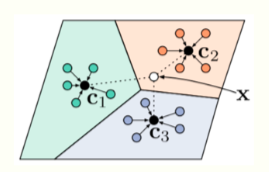
Prototypical Networks [Snell et al., 2017]
- Collect a meta-training set, this consists of a large number of related tasks
- Train one model on all these tasks to ensure that the clustering of features of this model correctly classifies the task
- If the test task comes from the same distribution as the meta-training tasks, we can use the clustering on the new task to classify new classes
How well does few-shot learning work today?

The key idea
A classifier trained on a dataset \(D_s\) is a function F that classifies data x using

The parameters \(θ^∗ = θ(D_s )\) of the classifier are a statistic of the dataset Ds obtained after training. Maintaining this statistic avoids having to search over functions F at inference time.
We cannot learn a good (sufficient) statistic using few samples. So we will search over functions at test-time more explicitly

Transductive Learning
 ## A very simple baseline
- Train a large deep network on the meta-training dataset with the standard classification loss
- Initialize a new “classifier head” on top of the logits to handle new classes
- Fine-tune with the few labeled data from the new task
- Perform transductive learning using the unlabeled test data
with a few practical tricks like cosine annealing of step-sizes,
mixup regularization, 16-bit training, very heavy data augmentation, and label smoothing cross-entrop
An example

Results on benchmark datasets

The ImageNet-21k dataset

1-shot, 5-way accuracies are as high as 89%, 1-shot 20-way accuracies are about 70%.
A proposal for systematic evaluation

A thermodynamical view of representation learning
表征学习的热力学观点
Transfer learning
Let’s take an example from computer vision
(.Zamir, A. R., Sax, A., Shen, W., Guibas, L. J., Malik, J., & Savarese, S. Taskonomy: Disentangling task transfer learning. CVPR 2018)

Information Bottleneck Principle
信息瓶颈原则
A generalization of rate-distortion theory for learning relevant representations of data [Tishby et al., 2000]

Z is a representation of the data X. We want
- Z to be sufficient to predict the target Y , and
- Z to be small in size, e.g., few number of bits.

Doing well on one task requires throwing away nuisance information [Achille & Soatto, 2017].
The key idea
The IB Lagrangian simply minimizes \(I(X;Z)\), it does not let us measure what was thrown away.
Choose a canonical task to measure discarded information. Setting
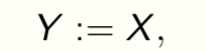
i.e., reconstruction of data, gives a special task. It is the superset of all tasks and forces the model to learn lossless representations.
The architecture we will focus on is

An auto-encoder
Shanon entropy measures the complexity of data
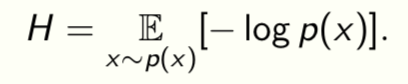
Distortion D measures the quality of reconstruction

Rate R measures the average excess bits used to encode the representation

Rate-Distortion curve
We know that [Alemi et al., 2017]

this is the well-known ELBO (evidence lower-bound). Let

This is a Lagrange relaxation of the fact that given a variational family and data there is an optimal value R = func(D) that best sandwiches (1).

Rate-Distortion-Classification (RDC) surface
Let us extend the Lagrangian to

where the classification loss is

Can also include other quantities like the entropy S of the model parameters


The existence of a convex surface func(R,D,C,S) = 0 tying together these functionals allows a formal connection to thermodynamics [Alemi and Fischer 2018]

Just like energy is conserved in physical processes, information is conserved in the model, either it is in the encoder-classifier pair or it is in the decoder.
Equilibrium surface of optimal free-energy
The RDC surface determines all possible representations that can be learnt from given data. Can solve the variational problem for F(λ,γ) to get

and

This is called the “equilibrium surface” because training converges to some point on this surface. We now construct ways to travel on the surface
 The surface depends on data p(x,y).
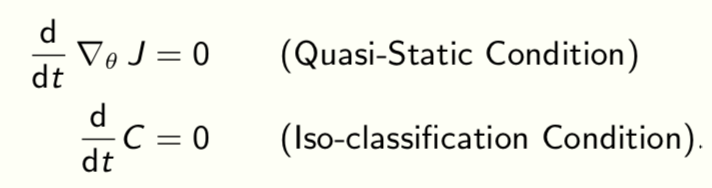
An iso-classification loss process
A quasi-static process happens slowly enough for the system to remain in equilibrium with its surroundings, e.g., reversible expansion of an ideal gas.
We will create a quasi-static process to travel on the RDC surface. This constraint is

e.g., if we want classification loss to be constant in time, we need
……
更多精彩,请下载 资源文件 了解。
关注公众号“小样本学习与智能前沿”,回台回复“200527” ,即可获取资源文件“Learning with Few Labeled Data.pdf”

Summary
Simple methods such as transductive fine-tuning work extremely well for few-shot learning. This is really because of powerful function approximators such as neural networks.
The RDC surface is a fundamental quantity and enables principled methods for transfer learning. Also unlocks new paths to understanding regularization and properties of neural architecture for classical supervised learning.
We did well in the era of big data without understanding much about data; this is unlikely to work in the age of little data.
Email questions to pratikac@seas.upenn.edu Read more at
- Dhillon, G., Chaudhari, P., Ravichandran, A., and Soatto, S. (2019). A baseline for few-shot image classification. arXiv:1909.02729. ICLR 2020.
- Li, H., Chaudhari, P., Yang, H., Lam, M., Ravichandran, A., Bhotika, R., & Soatto, S. (2020). Rethinking the Hyperparameters for Fine-tuning. arXiv:2002.11770. ICLR 2020.
- Fakoor, R., Chaudhari, P., Soatto, S., & Smola, A. J. (2019). Meta-Q-Learning. arXiv:1910.00125. ICLR 2020.
- Gao, Y., and Chaudhari, P. (2020). A free-energy principle for representation learning. arXiv:2002.12406.
少标签数据学习:宾夕法尼亚大学Learning with Few Labeled Data的更多相关文章
- 【转载】 迁移学习(Transfer learning),多任务学习(Multitask learning)和端到端学习(End-to-end deep learning)
--------------------- 作者:bestrivern 来源:CSDN 原文:https://blog.csdn.net/bestrivern/article/details/8700 ...
- PU Learning简介:对无标签数据进行半监督分类
当只有几个正样本,你如何分类无标签数据 假设您有一个交易业务数据集.有些交易被标记为欺诈,其余交易被标记为真实交易,因此您需要设计一个模型来区分欺诈交易和真实交易. 假设您有足够的数据和良好的特征,这 ...
- 联邦学习(Federated Learning)
联邦学习简介 联邦学习(Federated Learning)是一种新兴的人工智能基础技术,在 2016 年由谷歌最先提出,原本用于解决安卓手机终端用户在本地更新模型的问题,其设计目标是 ...
- 零次学习(Zero-Shot Learning)入门(转)
很久没有更文章了,主要是没有找到zero-shot learning(ZSL)方面我特别想要分享的文章,且中间有一段时间在考虑要不要继续做这个题目,再加上我懒 (¬_¬),所以一直拖到了现在. 最近科 ...
- 小样本学习(few-shot learning)在文本分类中的应用
1,概述 目前有效的文本分类方法都是建立在具有大量的标签数据下的有监督学习,例如常见的textcnn,textrnn等,但是在很多场景下的文本分类是无法提供这么多训练数据的,比如对话场景下的意图识别, ...
- 【47】迁移学习(Transfer Learning)
迁移学习(Transfer Learning) 如果你要做一个计算机视觉的应用,相比于从头训练权重,或者说从随机初始化权重开始,如果你下载别人已经训练好网络结构的权重,你通常能够进展的相当快,用这个作 ...
- 多视图学习(multiview learning)
多视图学习(multi-view learning) 前期吹牛:今天这一章我们就是来吹牛的,刚开始老板在和我说什么叫多视图学习的时候,我的脑海中是这么理解的:我们在欣赏妹子福利照片的时候,不能只看45 ...
- 深度学习(Deep Learning)资料大全(不断更新)
Deep Learning(深度学习)学习笔记(不断更新): Deep Learning(深度学习)学习笔记之系列(一) 深度学习(Deep Learning)资料(不断更新):新增数据集,微信公众号 ...
- 读李宏毅《一天看懂深度学习》——Deep Learning Tutorial
大牛推荐的入门用深度学习导论,刚拿到有点懵,第一次接触PPT类型的学习资料,但是耐心看下来收获还是很大的,适合我这种小白入门哈哈. 原PPT链接:http://www.slideshare.net/t ...
随机推荐
- 从小白到 6 个 offer,我究竟是怎么刷题的?
最近自习室里又兴起了一阵刷题潮,大家相约刷题~ 今天和大家系统分享下我去年转行时的一个刷题过程和方法,希望对你有所帮助. 首先介绍下我的编程基础,我学的是金融工程专业,硕士时学过 C++ 的课,这也是 ...
- SQL中WHERE子句中为什么不能使用聚合函数?
我们先来看一下这个代码: SELECT * FROM product WHERE SUM(slae_price) > 1000 GROUP BY product_type; 这样子会报错: SE ...
- linux-gcc简要知识点 **
目录 交叉编译 简要知识点 ** 一些概念 GCC编译器 GCC简要使用 GCC编译过程 ** 常用的编译选项 编译多个文件 制作.使用动态库 制作.使用静态库 很有用的选项 参考 交叉编译 使用不同 ...
- 3、Django之路由层
一 路由的作用 路由即请求地址与视图函数的映射关系,如果把网站比喻为一本书,那路由就好比是这本书的目录,在Django中路由默认配置在urls.py中. 二 简单的路由配置 # urls.py fro ...
- ubuntu18.04下stlink的一种安装方法
安装前准备: 从软件包存储库中安装以下软件包: git gcc或clang或mingw32-gcc或mingw64-gcc(C编译器:很可能已经存在gcc) build-essential (在基于D ...
- Boltzmann Machine 玻尔兹曼机入门
Generative Models 生成模型帮助我们生成新的item,而不只是存储和提取之前的item.Boltzmann Machine就是Generative Models的一种. Boltzma ...
- Java基础 之一 基本知识
Java基础 之一 基本知识 1.数据类型 Java有8种基本数据类型 int.short .long.byte.float.double.char.boolean 先说明以下单位之间的关系 1位 = ...
- CSS属性(字体与文本属性)
1.字体属性 (1)font-family 把要对这个网站要设置的字体都写上,如果这个浏览器支持第一个字体,则会用,如果不支持则会尝试第二个,如果设置的字体系统都不支持则会使用系统默认的字体作为网站的 ...
- 深度学习论文翻译解析(十四):SSD: Single Shot MultiBox Detector
论文标题:SSD: Single Shot MultiBox Detector 论文作者:Wei Liu, Dragomir Anguelov, Dumitru Erhan, Christian Sz ...
- 查看 /var/log目录下文件个数 命令tree 、cut
查看 /var/log目录下文件个数 方法1. [root@oldboy learn_shell]# tree -L 1 /var/log/ |tail -1 5 directories, 42 fi ...