
Operating system coordinated thermal management
A processor's performance state may be adjusted based on processor temperature. On transitions to a lower performance state due to the processor getting hotter, the processor's frequency is reduced prior to reducing the processor voltage. Thus, the processor's performance, as seen by the operating system, is reduced immediately. Conversely, on transitions to a higher performance state, due to the processor cooling down, the processor's frequency is not increased until the voltage is changed to a higher level. An interrupt event may be generated anytime the processor's phase locked loop relocks at a new frequency level. Thus, when the interrupt fires, the operating system can read the processor's performance state. As a result, interrupts are not generated that would cause processor performance to lag the interrupt event.
BACKGROUND
The invention relates to thermal management of processor-based systems.
Both hardware and software-controlled techniques exist for power and thermal management of processor-based systems. Software-based solutions are primarily utilized in connection with mobile platforms.
The software-controlled techniques involve an interrupt generated when a processor temperature setting is exceeded. The processor may be throttled after detecting an over temperature condition by polling processor temperature. Generally, the software-controlled solutions have a slower response time than the hardware-controlled solutions. In addition, there tends to be overshoot and undershoot problems with software-controlled solutions. The sensors utilized in software-controlled solutions are relatively slow and inaccurate. The on-die sensor (which is normally a diode) is not located on the hottest part of the processor die.
The hardware-controlled solution, used in systems other than mobile systems, involves a processor that automatically engages processor throttling, reducing the effective clock rate when a temperature condition is exceeded and disabling throttling when the processor is sufficiently cool. The hardware-controlled solution is based on an on-die binary sensor that indicates whether the processor is either hot or not hot. An interrupt capability may be available but is generally not utilized by the operating system due to the infrequency of throttling in desktop systems which are the primary applications for hardware-controlled solutions. As a result, operating systems may be unaware of hardware-controlled throttling.
The software-controlled solution is based on the premise that the platform exposes a variety of trip points to the operating system. A trip point is a temperature for a particular thermal region when some action should be taken. As the temperature goes above or below any trip point, the platform is responsible for notifying the operating system of this event and the operating system then takes an appropriate action.
When a temperature crosses a passive trip point, the operating system is responsible for implementing an algorithm to reduce the processor's temperature. It may do so by generating a periodic event at a variable frequency. The operating system then monitors the current temperature as well as the last temperature and applies an algorithm to make performance changes in order to keep the processor at the target temperature.
While current versions of hardware-controlled throttling reduce the frequency of the processor by rapidly stopping and starting the processor, future versions of hardware-controlled throttling may reduce the performance state of the processor by reducing both frequency and voltage. Because the hardware-controlled throttling is directly activated and has an extremely fast response time, the trip point for triggering the passive thermal management can be set near the high temperature specification of the processor (known as the junction temperature), thereby delivering high performance for most system designs.
Software-controlled throttling is exposed to the operating system, allowing the operating system to know the processor performance at all times. This becomes especially important with future operating systems that guarantee some quality of service based upon the processor performance to the executing applications. This concept is known as guaranteed bandwidth allocation and is based on the processor's current performance level.
Hardware-controlled throttling is advantageous in that it delivers the best possible performance in any given thermal solution, has extremely fast response time and does not throttle prematurely. A disadvantage to hardware-controlled throttling is that the operating system is completely unaware that the processor performance has been altered. Because of this, it may be expected that hardware-controlled throttling may cause issues with future operating systems that implement a guaranteed bandwidth scheduling.
Thus, there is a need for thermal management solutions that achieve advantages of both hardware and software-controlled techniques.
DETAILED DESCRIPTION
Referring to FIG. 1, a processor-based system 10 according to an embodiment of the invention includes one or more processors 12. The system 10 may include a general- or special-purpose computer, a microprocessor- or microcontroller-based system, a hand-held computing device, a set-top box, an appliance, a game system, or any controller-based device in which the controller may be programmable.
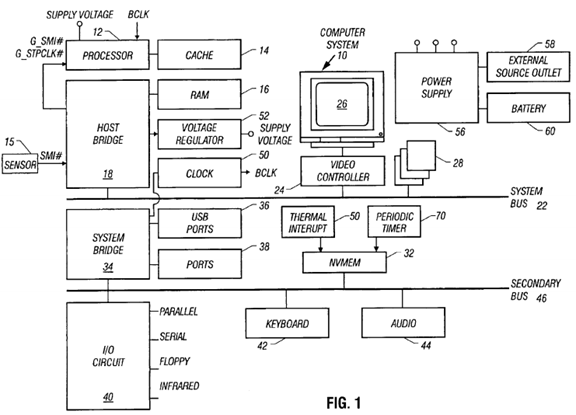
One or more temperature sensor units 15 monitor system temperature in one or more corresponding thermal zones, each capable of issuing an interrupt, e.g., a system management interrupt (SMI), a system controller interrupt (SCI), or some other notification when a sensed temperature rises above a preset target temperature Tt or falls below the target temperature Tt.
In one embodiment, when the monitored temperature is above Tt, a thermal engage SMI is generated. On the other hand, when the monitored temperature is below Tt, a thermal disengage SMI is generated. While the monitored temperature remains above or below Tt, the thermal engage or disengage SMI may be generated at periodic intervals to allow software or firmware to manage the performance level of the processor.
In alternative embodiments, other components (e.g., bridge controller chips, peripheral controllers) in the system may be transitioned between or among the different performance states as well as throttled for system thermal management. In addition, thermal management in the system 10 may be performed independently for multiple thermal zones.
In FIG. 1, the interrupt event generated by the temperature sensor unit 15 may be routed directly to the processor 12 or to a host bridge 18 coupled between the processor 12 and a system bus 22, which may in one embodiment be a Peripheral Component Interconnect (PCI) bus, as defined in the PCI Local Bus Specification, Production Version, Revision 2.1, published on Jun. 1, 1995. Alternatively, the interrupt event may be stored as a memory or I/O-mapped register bit that is polled by a software or firmware module.
To perform throttling, a clock control input (such as the stop clock input illustrated as G_STPCLK# in FIG. 1 to an 80×86 or Pentium® family processor from Intel Corporation) is activated and deactivated according to a preset duty cycle. The signal G_STPCLK# is generated by thermal management control logic and routed to the STPCLK# input pin of processors made by Intel for example. The STPCLK# internally gates clocks to the core of these processors. Activation of the clock control input (by driving G_STPCLK# low, for example) causes the processor 12 to enter a significantly reduced power mode in which an internal clock of the processor is stopped and most functions are disabled. Throttling is thus accomplished by activating the clock control input a certain percentage of the time to disable processor activity while allowing processor activity the rest of the time.
Other components of the system 10 include a clock generator 50 that generates a host clock BCLK to the processor 12 and a voltage regulator 52 that regulates the supply voltage of the processor 12. In one embodiment, the clock generator50, processor 12, and voltage regulator 52 are controllable to transition the system 10 between or among different performance states.
A cache memory 14 is coupled to the processor 14 and system memory 16 is controlled by a memory controller in the host bridge 18. The system bus 22 may be coupled to other components, including a video controller 24 coupled to a display 26 and peripheral devices coupled through slots 28. A secondary or expansion bus 46 is coupled by a system bridge 34 to the system bus 22. The system bridge 34 may include interface circuits to different ports, including a universal serial bus (USB) port 36 (as described in the Universal Serial Bus Specification, Revision 1.0, published in January 1996) and mass storage ports38 that may be coupled to mass storage devices such as a hard disk drive, compact disc (CD) or digital video disc (DVD) drives, and the like.
Other components coupled to the secondary bus 46 may include an input/output (I/O) circuit 40 connectable to a parallel port, serial port, floppy drive, and infrared port. A non-volatile memory 32 for storing Basic Input/Output System(BIOS) routines may be located on the bus 46, as may a keyboard device 42and an audio control device 44. The main power supply voltages in the system 10are provided by a power supply circuit 56 that is coupled to a battery 60 and an external power source outlet 58. References to specific components in the system 10 are for illustrative purposes—it is to be understood that other embodiments of the system 10 are possible.
Various software or firmware layers (formed of modules or routines, for example), including applications, operating system modules, device drivers, BIOS modules, and interrupt handlers, may be stored in one or more storage media in the system. The storage media includes the hard disk drive, CD or DVD drive, floppy drive, non-volatile memory, and system memory. The modules, routines, or other layers stored in the storage media contain instructions that when executed causes the system 10 to perform programmed acts.
The software or firmware layers, such as the thermal interrupt software 50 and the periodic timer software 70, can be loaded into the system 10 in one of many different ways. For example, code segments stored on floppy disks, CD or DVD media, the hard disk, or transported through a network interface card, modem, or other interface mechanism may be loaded into the system 10 and executed as corresponding software or firmware layers. In the loading or transport process, data signals that are embodied as carrier waves (transmitted over telephone lines, network lines, wireless links, cables, and the like) may communicate the code segments to the system 10.
Thermal interrupt software 50 initially determines whether a frequency change, high temperature or a low temperature interrupt has been received as indicated in diamond 52. High temperature and low temperature interrupts are conventional software-controlled interrupts. The frequency change interrupt is hardware-controlled but differs from conventional hardware-controlled interrupts in that the operating system is notified at an appropriate time, for example to enable guaranteed bandwidth allocation.
In some systems, rather than simply throttle the processor, the performance state of the processor 12 may be directly controlled. The performance state involves both the frequency and the voltage. In such case, throttling may directly reduce or increase the performance state as the processor 12 goes above or below the on-die sensor 15 trip point.
On transitions to a lower performance state (due to the processor getting hotter), the processor's frequency is reduced prior to reducing the processor voltage. The processor's performance, as seen by the operating system, will be reduced immediately. That is, the performance reduces as soon as the frequency is reduced.
On transitions to a higher performance state (due to the processor cooling down), the processor's frequency is not increased until the voltage is changed to a higher level. This voltage change is dependent on many factors. In general, it takes some amount of time to create the voltage change. As a result, the performance change would lag the interrupt event if the interrupt event were generated upon the voltage change.
Instead, the interrupt event may be generated any time the processor's phase locked loop (PLL) relocks at a new frequency level. Thus, when the interrupt fires, the operating system can read the processor's performance state, determine the new performance level of the processor, reschedule guaranteed bandwidth allocations as required and then resume normal operations.
Referring to FIG. 2, if an event is detected in diamond 52, the processor performance state is read. This may be done by accessing processor registers to determine the cause of the event as well as to take further action. The amount of code is small, bounded and can be page locked in physical memory in some embodiments.
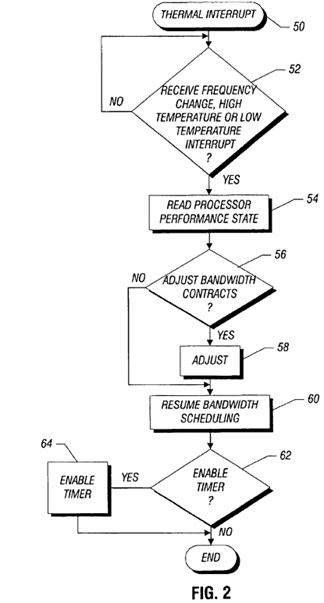
When the operating system receives any of the three sources of thermal management interrupt vectors, as determined in diamond 52, the processor can check whether the processor is hot or cold and look up the current performance state, as indicated in block 54, based upon registers defined already and take appropriate action. Typical registers may include on-die throttling control and the performance state status register.
In accordance with one embodiment of the present invention, the new interrupt may be added to existing interrupt models for hot and cold interrupt generation. The frequency change interrupt may have an enable bit to allow the operating system to enable or disable the event, but no status register may be needed in some embodiments.
Next, a check at diamond 56 determines whether the bandwidth contracts need to be adjusted in view of the current processor performance state. If so, the contracts are adjusted as indicated in block 58. Thereafter, the bandwidth scheduling may be resumed as indicated in block 60. A check at diamond 62determines whether a periodic timer should be implemented. The operating system may enable a periodic timer event to begin monitoring the processor temperature if the interrupt is indicative of a processor thermal event, as indicated block 64.
The periodic timer software 70, shown in FIG. 3, begins by incrementing the time as indicated in block 72. A check at diamond 74 determines whether a time out has occurred. If so, a check at diamond 76 determines whether the processor is still hot. If so, the operating system may decide to reduce the processor performance state and/or enable on-die throttling and/or increase the internal effective frequency of on-die throttling as indicated in block 78.
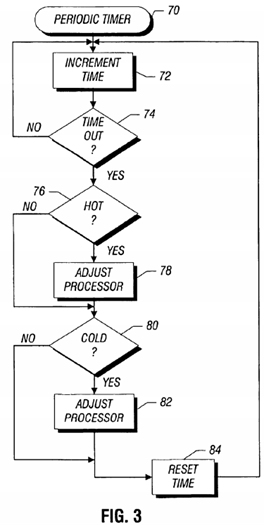
A check at diamond 80 determines whether the processor has now cooled off. If so, the operating system may decide to increase the processor performance state and/or disable on-die throttling and/or increase the internal effective frequency of on-die throttling as indicated in block 82. Thereafter, the time is reset as indicated in block 84 and the flow may recycle.
Particularly with mobile platforms, increased performance may be realized by utilizing the software and hardware-controlled solutions described above. By allowing hardware-controlled throttling to coexist with operating system dispatch algorithms, fast, efficient thermal management may be achieved in some embodiments while still enabling guaranteed bandwidth allocation schemes.
SRC=https://www.google.com.hk/patents/US6823240
Operating system coordinated thermal management的更多相关文章
- Operating system management of address-translation-related data structures and hardware lookasides
An approach is provided in a hypervised computer system where a page table request is at an operatin ...
- Multiprocessor Operating System Design Considerations SYMMETRIC MULTIPROCESSORS
COMPUTER ORGANIZATION AND ARCHITECTURE DESIGNING FOR PERFORMANCE NINTH EDITION An SMP operating syst ...
- PatentTips - Uncore thermal management
BACKGROUND The field of invention relates to the computer sciences, generally, and, more specificall ...
- Thermal management in a gaming machine
BACKGROUND OF THE INVENTION 1. Field of the Invention The present invention relates to wager gaming ...
- Full exploitation of a cluster hardware configuration requires some enhancements to a single-system operating system.
COMPUTER ORGANIZATION AND ARCHITECTURE DESIGNING FOR PERFORMANCE NINTH EDITION Operating System Desi ...
- PatentTips - Method for guest operating system integrity validation
BACKGROUND The embodiments relate to guest operating system integrity validation, and more particula ...
- General-Purpose Operating System Protection Profile
1 Protection Profile Introduction This document defines the security functionality expected to be ...
- Single-stack real-time operating system for embedded systems
A real time operating system (RTOS) for embedded controllers having limited memory includes a contin ...
- DBCC CHECKDB 遭遇Operating system error 112(failed to retrieve text for this error. Reason: 15105) encountered
我们一个SQL Server服务器在执行YourSQLDBa的作业YourSQLDba_FullBackups_And_Maintenance时遇到了错误: Exec YourSQLDba.Maint ...
随机推荐
- 1.12 Python基础知识 - 序列:字符串
字符串是一个有序的字符集合,即字符序列.Pythpn内置数据类型str,用于字符串处理,使用单引号或双引号括起来的字符,就是字符常量,Python解释器会自动创建str型对象实例. 字符串的定义: 1 ...
- 有关Canvas的一点小事—canvas和resize
之前就说了canvas设置大小的时候用的就是设置实打实的像素值,像图像一样设置百分比然后根据浏览器大小自己适应大小是不可能的——当然一般也不会想要cavans改变大小.不过项目之前有用到过,既然去了 ...
- (转) centos安装oracle11.2 pdksh软件包的说明
对于pdksh软件包,可从以下URL下载:ftp://fr2.rpmfind.net/linux/PLD/dists/ac/ready/i686/pdksh-5.2.14-33.i686.rpm由于该 ...
- APP测试10点
1.安装和卸载●应用是否可以在IOS不同系统版本或android不同系统版本上安装(有的系统版本过低,应用不能适配)●软件安装后是否可以正常运行,安装后的文件夹及文件是否可以写到指定的目录里.●安装过 ...
- 修改IIS7并发连接数目限制
转自原文 修改IIS7并发连接数目限制 1. 调整IIS 7应用程序池队列长度 由原来的默认1000改为65535. IIS Manager > ApplicationPools > Ad ...
- C_C++指针指针应用详解
前言:复杂类型说明 要了解指针,多多少少会出现一些比较复杂的类型,所以我先介绍一下如何完全理解一个复杂类型,要理解复杂类型其实很简单,一个类型里会出现很多运算符,他们也像普通的表达式一样,有优先级,其 ...
- (转)Nginx在RedHat中系统服务配置脚本
转自:http://binyan17.iteye.com/blog/1688308 以下代码是在前人的基础上,结合自己服务器实际情况修改的,本人服务器环境是:CentOS 6.31.创建启动脚本, ...
- Shiro的Filter机制详解---源码分析(转)
Shiro的Filter机制详解 首先从spring-shiro.xml的filter配置说起,先回答两个问题: 1, 为什么相同url规则,后面定义的会覆盖前面定义的(执行的时候只执行最后一个). ...
- 数据库中暂时表,表变量和CTE使用优势极其差别
1 在写SQL时常常会用到暂时表,表变量和CTE,这三者在使用时各有优势: 1. 暂时表:分为局部暂时表和全局暂时表. 1.1局部暂时表,创建时以#开头,在系统数据库tempdb中存储. 在当前的链接 ...
- gdbserver远程调试嵌入式linux应用程序方法
此处所讲的是基于gdb和gdbsever的远程调试方法.环境为:PC机:win7.虚拟机:10.04.下位机:飞嵌TE2440开发板. 嵌入式linux应用程序的开发一般都是在linux里面编写好代码 ...