
基于数组实现Java 自定义Stack栈类及应用
栈是存放对象的一种特殊容器,在插入与删除对象时,这种结构遵循后进先出( Last-in-first-out,LIFO)的原则。java本身是有自带Stack类包,为了达到学习目的已经更好深入了解stack栈,自己动手自建java stack类是个很好的学习开始:
自建Java Stack 类
Stack 类:
 package com.stack;

 import java.util.ArrayList;

 import java.util.Arrays;

 /**

  * Stack Class

  * @author ganyee

  *

  */

 public class Stack {

     //Define capacity constant:CAPACITY

     private static final int CAPACITY = 1024;

     //Define capacity

     private static int capacity;

     //Define the top position of stack

     //top = -1 meaning that the stack empty

     private static int top = -1;

     //Basic Object class array

     Object[] array;

     //Initialize the capacity of stack

     public Stack() {

         this.capacity = CAPACITY;

         array = new Object[capacity];

     }

     //Get the size of stack

     public int getSize(){

         if(isEmpty()){

             return 0;

         }else{

             return top + 1;

         }

     }

     //Get whether stack is empty

     public boolean isEmpty(){

         return (top < 0);

     }

     //Get the top element of stack

     public Object top() throws ExceptionStackEmpty{

         if(isEmpty()){

             throw new ExceptionStackEmpty("Stack is empty");

         }

         return array[top];

     }

     //Push element to stack

     public void push(Object element) throws ExceptionStackFull{

            if(getSize()== CAPACITY){

                throw new ExceptionStackFull("Stack is full");

            }

            array[++ top] = element;

     }

     //Pop element from stack

     public Object pop() throws ExceptionStackEmpty{

         if(isEmpty()){

             throw new ExceptionStackEmpty("Stack is empty");

         }

         return array[top --];

     }

     //Get the all elements of stack

     public String getAllElements() throws ExceptionStackEmpty{

         String[] arr = new String[top + 1];

         if(!isEmpty()){

             for(int i = 0;i < getSize();i ++){

                 arr[i] = (String)array[i];

             }

         }

         return Arrays.toString(arr);

     }

 }
自定义ExceptionStackEmpty异常类
 package com.stack;

 public class ExceptionStackEmpty extends Exception {

     //Constructor

     public ExceptionStackEmpty(){

     }

     //Define myself exception construct with parameters

     public ExceptionStackEmpty(String string){

         super(string);

     }

 }
自定义ExceptionStackFull异常类
 package com.stack;

 public class ExceptionStackFull extends Exception {

     //Constructor

         public ExceptionStackFull(){

         }

         //Define myself exception construct with parameters

         public ExceptionStackFull(String string){

             super(string);

         }

 }
测试类:
 package com.stack;

 public class StackTest {

     public static void main(String[] args) {

         // TODO Auto-generated method stub

         Stack stack= new Stack();

         System.out.println(stack.getSize());

         System.out.println(stack.isEmpty());

         try {

             stack.push(8);

             stack.push(3);

             stack.push(4);

             stack.push(7);

             stack.push(1);

             stack.push(8);

             stack.push(3);

             stack.push(4);

             stack.push(7);

             stack.push(1);

             System.out.println(stack.getSize());

             System.out.println(stack.top());

             System.out.println(stack.getAllElements());

             System.out.println(stack.pop());

             System.out.println(stack.pop());

             System.out.println(stack.pop());

             System.out.println(stack.pop());

             System.out.println(stack.pop());

             System.out.println(stack.pop());

             System.out.println(stack.pop());

             System.out.println(stack.pop());

             System.out.println(stack.pop());

             System.out.println(stack.pop());

         } catch (ExceptionStackFull e) {

             // TODO Auto-generated catch block

             e.printStackTrace();

         }catch (ExceptionStackEmpty e) {

             // TODO Auto-generated catch block

             e.printStackTrace();

         }

     }

 }
测试结果:
0

true

10

1

[8, 3, 4, 7, 1, 8, 3, 4, 7, 1]

1

7

4

3

8

1

7

4

3

8
栈的应用:符号匹配
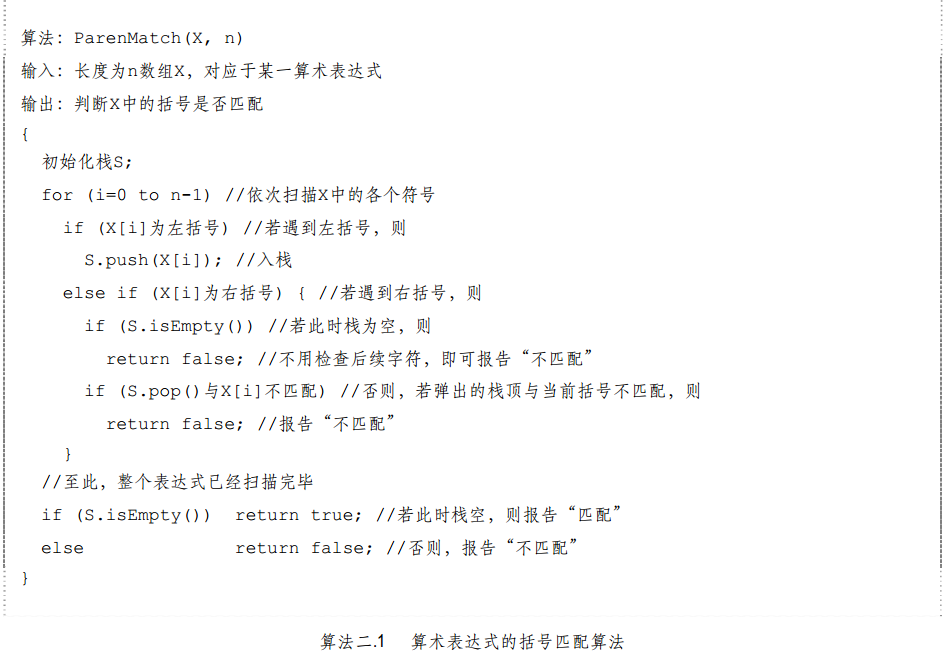
下面,我们将借助一个栈结构 S,通过对算术表达式自左向右的一遍扫描,检查其中的括号是否匹配。
假设算术表达式为 X = “x0x1x2…xn-1”,其中 xi 可以是括号、常数、变量名或者算术运算符。我们依次检查 X 中的各个符号,非括号的符号都可以忽略。若遇到左括号,则将其压入栈 S 中;若遇到右括号,则将栈顶符号弹出并与该右括号对比。如果发现某对括号不匹配,或者遇到右括号时栈为空,或者整个表达式扫描过后栈非空,都可以断定括号不匹配。
在按照以上规则扫描完所有字符后,若栈为空,则说明括号是匹配的。如果按照前面对栈的实现,每一 push()和 pop()操作都只需常数时间,因此对于长度为 n 的算术表达式,上述算法需要运行 O(n)的时间。
该算法的伪代码描述如 算法二.1 所示:
 package com.stack;

 public class MatchClass {

     public static boolean Match(String str) throws ExceptionStackFull, ExceptionStackEmpty{

         Stack stack = new Stack();

         str = str.replaceAll(" ","");

         char s;

         for(int i = 0;i < str.length();i ++){

             if(str.charAt(i) == '(' || str.charAt(i) == '{' || str.charAt(i) == '[')

                 stack.push(str.charAt(i));

             else{

                 if(stack.isEmpty())

                     return false;

                 else{

                     s = str.charAt(i);

                     switch(s){

                     case ')':

                         if((Character)stack.pop() != '(')

                             return false;

                         break;

                     case '}':

                         if((Character)stack.pop() != '{')

                             return false;

                         break;

                     case ']':

                         if((Character)stack.pop() != '[')

                             return false;

                         break;

                     }

                 }

             }

         }

         if(stack.isEmpty()){

             return true;

         }else{

             return false;

         }

     }

 }
 package com.stack;

 public class ParentMatch {

     public static void main(String[] args) {

         MatchClass match = new MatchClass();

         //String str = "()({})";  //Match

         //String str = "()({}) {([()[]])}";//Match

         //String str = "([]{)";//Not match

         //String str = ")([()] {}";//Not match

         String str = "([())]{}";//Not match

         try {

             if(!match.Match(str)){

                 System.out.println(str + ": Not Macth");

             }else{

                 System.out.println(str + ": Macth");

             }

         } catch (ExceptionStackFull e) {

             // TODO Auto-generated catch block

             e.printStackTrace();

         } catch (ExceptionStackEmpty e) {

             // TODO Auto-generated catch block

             e.printStackTrace();

         }

     }

 }
测试结果:
()({}): Macth

()({}) {([()[]])}: Macth

([]{): Not Macth

)([()] {}: Not Macth

([())]{}: Not Macth
基于数组实现Java 自定义Stack栈类及应用的更多相关文章
- java集合类——Stack栈类与Queue队列
Stack继承Vector类,它通过五个操作对类 Vector 进行了扩展. 栈是 后进先出的. 栈提供了通常的 push 和 pop 操作,以及取堆栈顶点的 peek 方法.测试堆栈是否为空的 em ...
- 如何给女朋友讲明白:Java 中 Stack(栈) 与 Heap(堆)
背景 Java 中 Stack(栈) 与 Heap(堆) 是面试中被经常问到的一个话题. 有没有对 Java 中 Stack(栈) 与 Heap(堆) 烂熟于心的童鞋,请举手!!!(怎么没人举手-) ...
- 用 LinkedList 实现一个 java.util.Stack 栈
用 LinkedList 实现一个 java.util.Stack 栈 import java.util.LinkedList; public class Stack<E> { priva ...
- Java数据类型Stack栈、Queue队列、数组队列和循环队列的比较
判断括号是否匹配:调用java本身 import java.util.Stack; public class Solution { public boolean isValid(String s){ ...
- java.util.Stack(栈)的简单使用
import java.util.Stack; import org.junit.Before; import org.junit.Test; /** * Stack(栈)继承了Vector类,底层实 ...
- Stack栈类与、Queue队列与线性表的区别和联系
栈和队列都属于特殊的线性表 一.定义 1.线性表(linear list): 是数据结构的一种,一个线性表是n个具有相同特性的数据元素的有限序列.数据元素是一个抽象的符号,其具体含义在不同的情 ...
- java 编程基础 Class对象 反射 :数组操作java.lang.reflect.Array类
java.lang.reflect包下还提供了Array类 java.lang.reflect包下还提供了Array类,Array对象可以代表所有的数组.程序可以通过使 Array 来动态地创建数组, ...
- Java自定义一个字典类(Dictionary)
标准Java库只包含Dictionary的一个变种,名为:Hashtable.(散列表) Java的散列表具有与AssocArray相同的接口(因为两者都是从Dictionary继承来的).但有一个方 ...
- 对于java自定义的工具类的提炼 注意事项
1.工具类的方法都用static修饰. 因为工具类一般不创建对象,直接类名.方法()使用 2.一些 定义的常亮需要 public static final 修饰. 3.一些与数据库的连接之类的设定 , ...
随机推荐
- MSP-EZ430U_02板子测试使用
1. 实物如下 2. 先上电,显示驱动没安装 3. 找到驱动的位置,不过实际上安装IAR for msp430之后,驱动就自动的识别了.
- mongdb基础
查看数据库 show dbs; 切换到需要使用的数据库:use local; 显示集合中的数据库表:show collections; 切换到数据库test,如果数据库不存在,则自动创建 插入数据 d ...
- 关于Eclipse在servlet中连接数据库时出现驱动加载失败的解决
问题:在队友发来的项目中想将他获取到的数据通过数据库储存,出现驱动加载失败问题 解决:首先百度了下相关情况,大多数都是说下载mysql-connector-java-5.1.39-bin.jar包,然 ...
- HTTP 两种基本请求方法 GET和 POST的区别
GET方法 1.GET交互方式是从服务器上获取数据,而并非修改数据,所以GET交互方式是安全的.就像数据库查询一样,从数据库查询数据,并不会影响数据库的数据信息,对数据库来说,也就是安全的.2.GET ...
- 如何在HPUX的终端提示符前显示当前登录用户信息和所在目录
修改/etc/default/profile文件,在最后加上如下内容: case $LOGNAME in 'root') PS1="$LOGNAME@$(hostname): ...
- sqlserver-查阻塞
模拟阻塞: 打开两个窗口: 窗口一: BEGIN TRANSACTION--开始事务 --等待1分钟 WAITFOR DELAY '00:1'; 窗口二: 查询阻塞:(当前被阻塞的进程id,不 ...
- 项目进行ing
1.我们的看板 2.立行会议 (1)照片 (2)时间:每天20:00 (3)地点:学校研发中心会议室 3.看板进展: 已有6个任务被移到Check Out栏中,详细情况如下: 梁植淋:构建项目架构,封 ...
- 软件工程android项目简介
我们的程序名字叫做“有爱”APP,英文名“you i”.意味着you and i,是一款旨在两人聊天,生活日记,记账工具,和对方通知的小软件. 1.首先我们的创意解决了用户什么需求? 答:在当今信息爆 ...
- flask验证登录学习过程(1)---准备
对应flask的接口开发,目前自己可以熟练的进行.但是深入到更基础的,从注册到验证登录的过程一直不是特别清楚. 趁着年度不是特别忙的时候,特意去学习加强一下.把这个过程记录在此处. 首先是规划一个项目 ...
- 【IdentityServer4文档】- 术语&演示服务器和测试
术语 你需要了解一下,规范.文档和对象模型使用的术语有哪些. IdentityServer IdentityServer 是一个 OpenID Connect 提供程序 - 它实现了 OpenID C ...