
OpenHarmony移植案例:如何适配服务启动引导部件bootstrap_lite
摘要:本文介绍了startup子系统之bootstrap_lite服务启动引导部件的移植适配案例及原理。
本文分享自华为云社区《OpenHarmony移植案例与原理 - startup子系统之bootstrap_lite服务启动引导部件》,作者:zhushy。
bootstrap_lite服务启动引导组件提供了各服务和功能的启动入口标识。在SAMGR(System ability manager,系统服务管理)启动时,会调用bootstrap_lite标识的入口函数,并启动系统服务。本文介绍下移植开发板时如何适配服务启动引导部件bootstrap_lite,并介绍下相关的运行机制原理。bootstrap_lite启动引导部件定义在build\lite\components\startup.json。bootstrap_lite启动引导部件源代码目录如下:
base/startup/bootstrap_lite/    # 启动引导组件

└── services

    └── source                  # 启动引导组件源文件目录
1、bootstrap_lite服务启动引导部件适配示例
1.1 产品解决方案配置启用部件
移植开发板适配startup子系统之bootstrap_lite服务启动引导部件时,需要在产品解决方案的config.json增加下述配置项,可以参考vendor\bestechnic\display_demo\config.json中的配置示例:
 {

      "subsystem": "startup",

      "components": [

        {

          "component": "bootstrap_lite"

        },

        ......

      ]

    },
1.2 使用bootstrap服务启动部件提供的初始化宏函数
然后就可以使用bootstrap服务启动部件提供的初始化宏函数SYS_SERVICE_INIT、APP_SERVICE_INIT等来自动初始化服务,示例代码可以参考device\board\fnlink\v200zr\liteos_m\at\at_wifi.c中的用法,片段如下,可以看到调用了宏函数来初始化RegisterCustomATCmd函数实现的服务。device\board\bearpi\bearpi_hm_nano\app\目录下有更多的使用示例。下文分析实现机制原理。
static void RegisterCustomATCmd()

{

    cmd_tbl_t cmd_list[] = {

        {"AT+IFCFG", 8, at_lwip_ifconfig, "AT+IFCFG - ifconfig\n"},

        {"AT+STARTAP", 7, at_start_softap, "AT+STARTAP - start wifi softap\n"},

        {"AT+STOPAP", 1, at_stop_softap, "AT+STOPAP - stop wifi softap\n"},

        {"AT+STARTSTA", 1, at_start_wifista, "AT+STARTSTA - start wifi sta\n"},

        {"AT+STOPSTA", 1, at_stop_wifista, "AT+STOPSTA - stop wifi sta\n"},

        {"AT+DHCP", 3, at_setup_dhcp, "AT+DHCP - dhcp\n"},

        {"AT+DHCPS", 3, at_setup_dhcps, "AT+DHCPS - dhcps\n"},

    };

    for (int i = 0; i < sizeof(cmd_list) / sizeof(cmd_tbl_t); i++) {

        console_cmd_add(&cmd_list[i]);

    }

}

SYS_SERVICE_INIT(RegisterCustomATCmd);
1.3 链接脚本中增加zInit代码段
适配bootstrap_lite部件时,还需要在链接脚本文件中手动新增如下段,链接脚本示例可以参考//device/soc/bestechnic/bes2600/liteos_m/sdk/bsp/out/best2600w_liteos/_best2001.lds,还可以参考device\soc\hisilicon\hi3861v100\sdk_liteos\build\link\link.ld.S。从链接脚本片段中可以看出,有.zinitcall.bsp、.zinitcall.device、.zinitcall.core、.zinitcall.sys.service、.zinitcall.sys.feature、.zinitcall.run、.zinitcall.app.service、.zinitcall.app.feature、.zinitcall.test和.zinitcall.exit等几种类型的段。
/* zInit code and data - will be freed after init */

 .zInit (.) :

 {

  __zinitcall_bsp_start = .;

  KEEP (*(.zinitcall.bsp0.init))

  KEEP (*(.zinitcall.bsp1.init))

  KEEP (*(.zinitcall.bsp2.init))

  KEEP (*(.zinitcall.bsp3.init))

  KEEP (*(.zinitcall.bsp4.init))

  __zinitcall_bsp_end = .;

  . = ALIGN(4);

  __zinitcall_device_start = .;

  KEEP (*(.zinitcall.device0.init))

  KEEP (*(.zinitcall.device1.init))

  KEEP (*(.zinitcall.device2.init))

  KEEP (*(.zinitcall.device3.init))

  KEEP (*(.zinitcall.device4.init))

  __zinitcall_device_end = .;

  . = ALIGN(4);

  __zinitcall_core_start = .;

  KEEP (*(.zinitcall.core0.init))

  KEEP (*(.zinitcall.core1.init))

  KEEP (*(.zinitcall.core2.init))

  KEEP (*(.zinitcall.core3.init))

  KEEP (*(.zinitcall.core4.init))

  __zinitcall_core_end = .;

  . = ALIGN(4);

  __zinitcall_sys_service_start = .;

  KEEP (*(.zinitcall.sys.service0.init))

  KEEP (*(.zinitcall.sys.service1.init))

  KEEP (*(.zinitcall.sys.service2.init))

  KEEP (*(.zinitcall.sys.service3.init))

  KEEP (*(.zinitcall.sys.service4.init))

  __zinitcall_sys_service_end = .;

  . = ALIGN(4);

  __zinitcall_sys_feature_start = .;

  KEEP (*(.zinitcall.sys.feature0.init))

  KEEP (*(.zinitcall.sys.feature1.init))

  KEEP (*(.zinitcall.sys.feature2.init))

  KEEP (*(.zinitcall.sys.feature3.init))

  KEEP (*(.zinitcall.sys.feature4.init))

  __zinitcall_sys_feature_end = .;

  . = ALIGN(4);

  __zinitcall_run_start = .;

  KEEP (*(.zinitcall.run0.init))

  KEEP (*(.zinitcall.run1.init))

  KEEP (*(.zinitcall.run2.init))

  KEEP (*(.zinitcall.run3.init))

  KEEP (*(.zinitcall.run4.init))

  __zinitcall_run_end = .;

  . = ALIGN(4);

  __zinitcall_app_service_start = .;

  KEEP (*(.zinitcall.app.service0.init))

  KEEP (*(.zinitcall.app.service1.init))

  KEEP (*(.zinitcall.app.service2.init))

  KEEP (*(.zinitcall.app.service3.init))

  KEEP (*(.zinitcall.app.service4.init))

  __zinitcall_app_service_end = .;

  . = ALIGN(4);

  __zinitcall_app_feature_start = .;

  KEEP (*(.zinitcall.app.feature0.init))

  KEEP (*(.zinitcall.app.feature1.init))

  KEEP (*(.zinitcall.app.feature2.init))

  KEEP (*(.zinitcall.app.feature3.init))

         KEEP (*(.zinitcall.app.feature4.init))

  __zinitcall_app_feature_end = .;

  . = ALIGN(4);

  __zinitcall_test_start = .;

  KEEP (*(.zinitcall.test0.init))

  KEEP (*(.zinitcall.test1.init))

  KEEP (*(.zinitcall.test2.init))

  KEEP (*(.zinitcall.test3.init))

  KEEP (*(.zinitcall.test4.init))

  __zinitcall_test_end = .;

  . = ALIGN(4);

  __zinitcall_exit_start = .;

  KEEP (*(.zinitcall.exit0.init))

  KEEP (*(.zinitcall.exit1.init))

  KEEP (*(.zinitcall.exit2.init))

  KEEP (*(.zinitcall.exit3.init))

  KEEP (*(.zinitcall.exit4.init))

  __zinitcall_exit_end = .;

  . = ALIGN(4);

 } > FLASH
1.4 配置编译时链接bootstrap库
另外,bootstrap_lite部件会编译//base/startup/bootstrap_lite/services/source/bootstrap_service.c,该文件中,通过SYS_SERVICE_INIT将Init函数符号指定到__zinitcall_sys_service_start和__zinitcall_sys_service_end段中,由于没有显式调用Init函数,所以需要将它强制链接到最终的镜像。可以参考device\board\goodix\gr5515_sk\liteos_m\config.gni文件中的链接选项。恒玄的开发板适配时,是配置到vendor\bestechnic\display_demo\config.json文件中的自己定义的配置项force_link_libs里,该配置项在device\soc\bestechnic\bes2600\BUILD.gn中被解析、链接。
board_ld_flags = [

....

  "-lbootstrap",
1.5 调用OHOS_SystemInit接口
函数void OHOS_SystemInit(void)定义在文件base\startup\bootstrap_lite\services\source\system_init.c中,在移植适配时,需要调用该接口。可以参考文件device\soc\bestechnic\bes2600\liteos_m\sdk\bsp\rtos\liteos\liteos_m\board.c中的使用示例。
int main(void);

extern void OHOS_SystemInit(void);

    ......

        OHOS_SystemInit();

    ......

    while (1) {

        osDelay(1000);

        TRACE(0, "main idle");

    }

}
2、bootstrap_lite服务启动引导部件实现原理之system_init
bootstrap_lite服务启动部件实现了服务的自动初始化,即服务的初始化函数无需显式调用,它是使用宏定义的方式申明,在系统启动时自动被执行。实现原理是将服务启动的函数通过宏申明之后,放在预定义好的zInit代码段中,系统启动的时候调用OHOS_SystemInit接口,遍历该代码段并调用其中的函数。因此在适配移植时,需要在device/soc/下面具体的芯片的链接脚本中添加zInit段,并且在main函数里调用OHOS_SystemInit接口。
2.1 bootstrap_lite服务启动引导部件的初始化宏
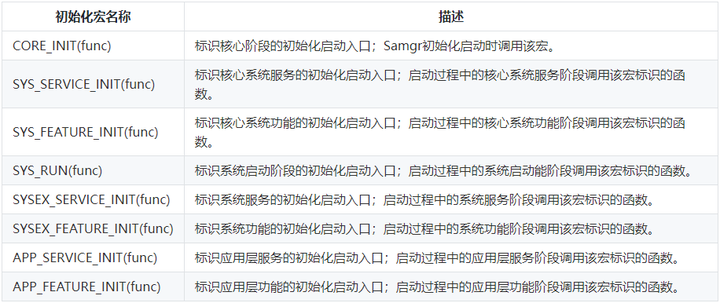
bootstrap_lite服务启动引导部件的初始化宏定义在文件utils\native\lite\include\ohos_init.h,片段如下。初始化函数宏SYS_SERVICE_INIT(func)用于标识核心系统服务的初始化入口,该宏识别的函数在启动过程中核心系统服务优先级2阶段被调用;初始化宏SYS_SERVICE_INIT_PRI(func, priority)可以指定优先级数值,优先级的取值范围为[0,5),调用顺序为0, 1, 2, 3, 4。
  /**

  * @brief Identifies the entry for initializing and starting a core system service by the

  * priority 2.

  *

  * This macro is used to identify the entry called at the priority 2 in the core system

  * service phase of the startup process. \n

  *

  * @param func Indicates the entry function for initializing and starting a core system service.

  * The type is void (*)(void).

  */

  #define SYS_SERVICE_INIT(func) LAYER_INITCALL_DEF(func, sys_service, "sys.service")

  /**

  * @brief Identifies the entry for initializing and starting a core system service by the

  * specified priority.

  *

  * This macro is used to identify the entry called at the specified priority in the core system

  * service phase of the startup process. \n

  *

  * @param func Indicates the entry function for initializing and starting a core system service.

  * The type is void (*)(void).

  * @param priority Indicates the calling priority when starting the core system service in the

  * startup phase. The value range is [0,5), and the calling sequence is 0, 1, 2, 3, and 4.

  */

  #define SYS_SERVICE_INIT_PRI(func, priority) LAYER_INITCALL(func, sys_service, "sys.service", priority)
更多的初始化宏见下文的列表,处理这些初始化宏,还有可以指定优先级的版本XXX_PRI。
2.2 LAYER_INITCALL宏定义
从上文已知,bootstrap_lite服务启动引导部件的初始化宏会调用LAYER_INITCALL_DEF和LAYER_INITCALL宏。这些宏的定义在文件utils\native\lite\include\ohos_init.h,代码片段如下。⑴处声明函数类型,无参无返回值。⑵处处理定义分层初始化共享库宏LAYER_INIT_SHARED_LIB的情况,如果没有定义该宏,则执行⑹。在文件foundation/distributedschedule/samgr_lite/samgr/BUILD.gn中定义了该宏,在移植适配芯片开发板时,没有定义这个宏。⑶处定义5个分层初始化级别,⑷处定义7个构建值(constructor value,简称CTOR Value)。⑸处是宏LAYER_INITCALL的定义,该宏需要4个参数,分别是初始化服务或功能函数func;layer是分层名称,支持的取值为device、core、sys_service、sys_feature、app_service、app_feature和run,拼装为CTOR_VALUE_XXX;clayer参数在定义宏LAYER_INIT_SHARED_LIB时未使用;priority是优先级参数。attribute((constructor))表示这段代码将在main函数前调用。当传入参数为(myFunc, sys_feature, “sys.feature”, 2)时,函数宏替换为:static __attribute__((constructor(130 + 2))) void BOOT_sys_featurer2myFunc {myFunc();}。等于定义个一个新的启动引导函数BOOT_sys_featurer2myFunc()。
当没有定义LAYER_INIT_SHARED_LIB宏时,执行⑹,当传入参数为(myFunc, sys_feature, “sys.feature”, 2)时,函数宏替换为:static const InitCall __attribute__((used)) __zinitcall_sys_feature_myFunc __attribute__((section(".zinitcall.sys.feature2.init"))) = myFunc,除了__attribute__部分,等于声明一个函数类型InitCall的变量__zinitcall_sys_feature_myFunc。该函数变量放入section段".zinitcall.sys.feature2.init"内,所以移植适配时,需要在芯片开发板的链接脚本里添加zInit代码段。
⑴  typedef void (*InitCall)(void);

    #define USED_ATTR __attribute__((used))

⑵  #ifdef LAYER_INIT_SHARED_LIB

⑶  #define LAYER_INIT_LEVEL_0 0

    #define LAYER_INIT_LEVEL_1 1

    #define LAYER_INIT_LEVEL_2 2

    #define LAYER_INIT_LEVEL_3 3

    #define LAYER_INIT_LEVEL_4 4

⑷  #define CTOR_VALUE_device 100

    #define CTOR_VALUE_core 110

    #define CTOR_VALUE_sys_service 120

    #define CTOR_VALUE_sys_feature 130

    #define CTOR_VALUE_app_service 140

    #define CTOR_VALUE_app_feature 150

    #define CTOR_VALUE_run  700

⑸  #define LAYER_INITCALL(func, layer, clayer, priority)                                     \

        static __attribute__((constructor(CTOR_VALUE_##layer + LAYER_INIT_LEVEL_##priority))) \

            void BOOT_##layer##priority##func() {func();}

    #else

⑹  #define LAYER_INITCALL(func, layer, clayer, priority)            \

        static const InitCall USED_ATTR __zinitcall_##layer##_##func \

            __attribute__((section(".zinitcall." clayer #priority ".init"))) = func

    #endif

    // Default priority is 2, priority range is [0, 4]

    #define LAYER_INITCALL_DEF(func, layer, clayer) \

        LAYER_INITCALL(func, layer, clayer, 2)
2.3 OHOS_SystemInit函数
函数OHOS_SystemInit()定义在文件base\startup\bootstrap_lite\services\source\system_init.c,代码如下。调用宏函数MODULE_INIT、SYS_INIT和函数SAMGR_Bootstrap()进行初始化启动。
void OHOS_SystemInit(void)

{

    MODULE_INIT(bsp);

    MODULE_INIT(device);

    MODULE_INIT(core);

    SYS_INIT(service);

    SYS_INIT(feature);

    MODULE_INIT(run);

    SAMGR_Bootstrap();

}
我们详细分析下宏函数MODULE_INIT和SYS_INIT的源代码,这2个宏函数在文件base\startup\bootstrap_lite\services\source\core_main.h中定义,代码如下。这些宏函数的参数大都为name和step,name取值为bsp、device、core、service、feature、run,step取值为0。从⑺和⑻处可以看出,分别调用SYS_CALL、MODULE_CALL两个宏,第二个参数设置为0。⑸处定义的MODULE_BEGIN函数,用于返回链接脚本中定义的代码段的开始地址,当传入参数为bsp时,返回&__zinitcall_bsp_start,MODULE_BEGIN函数被展开为如下片段:
{        extern InitCall __zinitcall_sys_start;      \

        InitCall *initCall = &__zinitcall_bsp_start; \

        (initCall);                                      \

}
⑹处定义的MODULE_END函数,用于返回链接脚本中定义的代码段的结束地址,当传入参数为bsp时,返回&__zinitcall_bsp_end,MODULE_END函数被展开为如下片段:
{        extern InitCall __zinitcall_bsp_end;      \

        InitCall *initCall = &__zinitcall_bsp_end; \

        (initCall);                                    \

}
⑶和⑷处定义的SYS_BEGIN、SYS_END代码类似,分于返回链接脚本中定义的标记系统服务或特性的代码段的开始、结束地址,即&__zinitcall_sys_service_start、&__zinitcall_sys_service_end、&__zinitcall_sys_feature_start、&__zinitcall_sys_feature_end。⑴处定义的SYS_CALL函数,分别获取链接脚本中zInit代码段的开始initcall和结束地址initend,这些地址存放的是初始化函数的地址,语句 (*initcall)()会循环调用执行这些初始化函数。⑵处MODULE_CALL宏类似。
⑴  #define SYS_CALL(name, step)                                      \

        do {                                                          \

            InitCall *initcall = (InitCall *)(SYS_BEGIN(name, step)); \

            InitCall *initend = (InitCall *)(SYS_END(name, step));    \

            for (; initcall < initend; initcall++) {                  \

                (*initcall)();                                        \

            }                                                         \

        } while (0)

⑵  #define MODULE_CALL(name, step)                                      \

        do {                                                             \

            InitCall *initcall = (InitCall *)(MODULE_BEGIN(name, step)); \

            InitCall *initend = (InitCall *)(MODULE_END(name, step));    \

            for (; initcall < initend; initcall++) {                     \

                (*initcall)();                                           \

            }                                                            \

        } while (0)

    ......

⑶  #define SYS_BEGIN(name, step)                                 \

        ({        extern InitCall __zinitcall_sys_##name##_start;       \

            InitCall *initCall = &__zinitcall_sys_##name##_start; \

            (initCall);                                           \

        })

⑷  #define SYS_END(name, step)                                 \

        ({        extern InitCall __zinitcall_sys_##name##_end;       \

            InitCall *initCall = &__zinitcall_sys_##name##_end; \

            (initCall);                                         \

        })

⑸  #define MODULE_BEGIN(name, step)                          \

        ({        extern InitCall __zinitcall_##name##_start;       \

            InitCall *initCall = &__zinitcall_##name##_start; \

            (initCall);                                       \

        })

⑹  #define MODULE_END(name, step)                          \

        ({        extern InitCall __zinitcall_##name##_end;       \

            InitCall *initCall = &__zinitcall_##name##_end; \

            (initCall);                                     \

        })

⑺  #define SYS_INIT(name)     \

        do {                   \

            SYS_CALL(name, 0); \

        } while (0)

⑻  #define MODULE_INIT(name)     \

        do {                      \

            MODULE_CALL(name, 0); \

        } while (0)
3、 bootstrap_lite服务启动引导部件实现原理之bootstrap_service
在文件base\startup\bootstrap_lite\services\source\bootstrap_service.h中定义了2个宏函数INIT_APP_CALL和INIT_TEST_CALL,分别用来调用代码段&__zinitcall_app_XXX_start、&__zinitcall_app_XXX_end和&__zinitcall_test_start、&__zinitcall_test_end之间的初始化启动函数。bootstrap_service.h文件中的宏和base\startup\bootstrap_lite\services\source\core_main.h文件中的宏类似,不再一一分析。
3.1 结构体struct Bootstrap
在文件base\startup\bootstrap_lite\services\source\bootstrap_service.c中定义了结构体struct Bootstrap,如下代码⑵处。其中结构体中的INHERIT_SERVICE定义在文件foundation/distributedschedule/samgr_lite/interfaces/kits/samgr/service.h,见代码片段⑴处。
⑴   #define INHERIT_SERVICE                                          \

        const char *(*GetName)(Service * service);                   \

        BOOL (*Initialize)(Service * service, Identity identity);    \

        BOOL (*MessageHandle)(Service * service, Request * request); \

        TaskConfig (*GetTaskConfig)(Service * service)

    ......

⑵  typedef struct Bootstrap {

        INHERIT_SERVICE;

        Identity identity;

        uint8 flag;

    } Bootstrap;
结构体Identity定义在文件foundation\distributedschedule\samgr_lite\interfaces\kits\samgr\message.h中,用于标识一个服务或特性。
/**

 * @brief Identifies a service and feature.

 *

 * You can use this structure to identity a {@link IUnknown} feature to which messages will be

 * sent through the asynchronous function of {@link IUnknown}. \n

 *

 */

struct Identity {

    /** Service ID */

    int16 serviceId;

    /** Feature ID */

    int16 featureId;

    /** Message queue ID */

    MQueueId queueId;

};
3.2 Init(void)函数
讲解移植适配示例时,我们已经知道,bootstrap_lite部件会编译//base/startup/bootstrap_lite/services/source/bootstrap_service.c,该文件通过函数宏SYS_SERVICE_INIT将Init()函数符号灌段到__zinitcall_sys_service_start和__zinitcall_sys_service_end代码段中,代码片段如下。下文再详细分析GetName、Initialize、MessageHandle和GetTaskConfig函数。
  static const char *GetName(Service *service);

  static BOOL Initialize(Service *service, Identity identity);

  static TaskConfig GetTaskConfig(Service *service);

  static BOOL MessageHandle(Service *service, Request *request);

  static void Init(void)

  {

      static Bootstrap bootstrap;

      bootstrap.GetName = GetName;

      bootstrap.Initialize = Initialize;

      bootstrap.MessageHandle = MessageHandle;

      bootstrap.GetTaskConfig = GetTaskConfig;

      bootstrap.flag = FALSE;

      SAMGR_GetInstance()->RegisterService((Service *)&bootstrap);

  }

  SYS_SERVICE_INIT(Init);
3.3 GetName和Initialize函数
GetName函数代码如下,其中BOOTSTRAP_SERVICE定义在文件foundation\distributedschedule\samgr_lite\interfaces\kits\samgr\samgr_lite.h中,取值为"Bootstrap",表示启动引导服务。
static const char *GetName(Service *service)

{

    (void)service;

    return BOOTSTRAP_SERVICE;

}
Initialize函数定义如下,用于设置启动引导服务的标识信息。
static BOOL Initialize(Service *service, Identity identity)

{

    Bootstrap *bootstrap = (Bootstrap *)service;

    bootstrap->identity = identity;

    return TRUE;

}
3.4 MessageHandle函数和GetTaskConfig函数
MessageHandle函数和GetTaskConfig函数代码如下,MessageHandle函数用于处理各种请求,请求消息编号定义request->msgId定义在文件foundation\distributedschedule\samgr_lite\interfaces\kits\samgr\samgr_lite.h中的枚举enum BootMessage,如下⑴处所示。在MessageHandle函数中,当请求的消息编号为BOOT_SYS_COMPLETED系统服务初始化完成时,检查应用服务是否加载。当应用没有加载时,执行INIT_APP_CALL宏函数调用zInit代码段上的应用服务和应用特性初始化函数。然后执行⑶,调用函数SAMGR_SendResponseByIdentity进行响应。GetTaskConfig函数用于获取任务配置。
⑴  typedef enum BootMessage {

        /** Message indicating that the core system service is initialized */

        /** 标识核心系统服务初始化完成 */

        BOOT_SYS_COMPLETED,

        /** Message indicating that the system and application-layer services are initialized */

        /** 标识应用层服务初始化完成 */

        BOOT_APP_COMPLETED,

        /** Message indicating service registration during running */

        /** 标识运行时的服务注册 */

        BOOT_REG_SERVICE,

        /** Maximum number of message IDs */

        /** 标识消息最大值,butt是烟蒂;屁股;枪托的意思,表示尾部吧 */

        BOOTSTRAP_BUTT

    } BootMessage;

    ......

  static BOOL MessageHandle(Service *service, Request *request)

  {

      Bootstrap *bootstrap = (Bootstrap *)service;

      switch (request->msgId) {

          case BOOT_SYS_COMPLETED:

⑵            if ((bootstrap->flag & LOAD_FLAG) != LOAD_FLAG) {

                  INIT_APP_CALL(service);

                  INIT_APP_CALL(feature);

                  bootstrap->flag |= LOAD_FLAG;

              }

⑶            (void)SAMGR_SendResponseByIdentity(&bootstrap->identity, request, NULL);

              break;

          case BOOT_APP_COMPLETED:

              (void)SAMGR_SendResponseByIdentity(&bootstrap->identity, request, NULL);

              break;

          case BOOT_REG_SERVICE:

              (void)SAMGR_SendResponseByIdentity(&bootstrap->identity, request, NULL);

              break;

          default:

              break;

      }

      return TRUE;

  }

  static TaskConfig GetTaskConfig(Service *service)

  {

      (void)service;

      // The bootstrap service uses a stack of 2 KB (0x800) in size and a queue of 20 elements.

      // You can adjust it according to the actual situation.

      TaskConfig config = {LEVEL_HIGH, PRI_NORMAL, 0x800, 20, SHARED_TASK};

      return config;

  }
参考站点
- OpenHarmony / startup_bootstrap_lite
- HarmonyOS Device > 文档 > 指南 > 基础能力: bootstrap服务启动组件
- 启动恢复子系统.md
- 轻量带屏解决方案之恒玄芯片移植案例
OpenHarmony移植案例:如何适配服务启动引导部件bootstrap_lite的更多相关文章
- OpenHarmony移植案例与原理:startup子系统之syspara_lite系统属性部件
摘要:本文介绍下移植开发板时如何适配系统属性部件syspara_lite,并介绍下相关的运行机制原理. 本文分享自华为云社区<openharmony移植案例与原理 - startup子系统之sy ...
- OpenHarmony移植:如何适配utils子系统之KV存储部件
摘要:本文介绍移植开发板时如何适配utils子系统之KV存储部件,并介绍相关的运行机制原理. 本文分享自华为云社区<OpenHarmony移植案例与原理 - utils子系统之KV存储部件> ...
- 【OpenHarmony移植案例与原理】XTS子系统之应用兼容性测试用例开发
摘要:本文主要介绍ACTS应用兼容性测试用例开发编译. 本文分享自华为云社区<移植案例与原理 - XTS子系统之应用兼容性测试用例开发>,作者: zhushy . XTS(X Test S ...
- OpenHarmony移植案例: build lite源码分析之hb命令__entry__.py
摘要:本文介绍了build lite 轻量级编译构建系统hb命令的源码,主要分析了_\entry__.py文件. 本文分享自华为云社区<移植案例与原理 - build lite源码分析 之 hb ...
- 案例十:shell编写nginx服务启动程序
使用源码包安装的Nginx没办法使用"service nginx start"或"/etc/init.d/nginx start"进行操作和控制,所以写了以下的 ...
- 玩转Windows服务系列——Windows服务启动超时时间
最近有客户反映,机房出现断电情况,服务器的系统重新启动后,数据库服务自启动失败.第一次遇到这种情况,为了查看是不是断电情况导致数据库文件损坏,从客户的服务器拿到数据库的日志,进行分析. 数据库工作机制 ...
- Mysql服务启动的时候 如何加载配置文件
Mysql服务启动的时候 如何引导配置文件 (启动加载顺序)
- AngularJS的启动引导过程
原文:http://www.angularjs.cn/A137?utm_source=ourjs.com 目录: 引导之前 自动引导启动框架 手工引导启动框架 引导第1步:创建注入器 引导第2步:创建 ...
- centos6服务启动脚本及开机启动过程
centos6服务启动脚本 centos6的服务启动脚本都放在/etc/rc.d/init.d/下,/etc/init.d/是/etc/rc.d/init.d/的软链接: centos6的服务启动脚本 ...
- 【图解源码】Zookeeper3.7源码分析,包含服务启动流程源码、网络通信源码、RequestProcessor处理请求源码
Zookeeper3.7源码剖析 能力目标 能基于Maven导入最新版Zookeeper源码 能说出Zookeeper单机启动流程 理解Zookeeper默认通信中4个线程的作用 掌握Zookeepe ...
随机推荐
- InnoDB 存储引擎之 Buffer Pool
Mysql 5.7 InnoDB 存储引擎整体逻辑架构图 一.Buffer Pool 概述 InnoDB 作为一个存储引擎,为了降低磁盘 IO,提升读写性能,必然有相应的缓冲池机制,这个缓冲池就是 B ...
- HarmonyOS原生分析能力,即开即用助力精细化运营
数据分析产品对开发者的价值呈现在两个层面,第一个是产品的层面,可以通过数据去洞察用户的行为,从而找到产品的优化点.另外一个就是运营层面,可以基于数据去驱动,来实现私域和公域的精细化运营. 在鸿蒙生态上 ...
- mysql 索引图
- Net 高级调试之五:如何在托管函数上设置断点
一.简介 今天是<Net 高级调试>的第五篇文章.今天这篇文章开始介绍如何在托管方法和非托管方法设置断点,我们要想调试程序,必须掌握调试的一些命令,动态调试的命令,我们在上一篇文章已经讲过 ...
- 聊一聊 tcp/ip 在.NET故障分析的重要性
一:背景 1. 讲故事 这段时间分析了几个和网络故障有关的.NET程序之后,真的越来越体会到计算机基础课的重要,比如 计算机网络 课,如果没有对 tcpip协议 的深刻理解,解决这些问题真的很难,因为 ...
- Java实现两字符串相似度算法
1.编辑距离 编辑距离:是衡量两个字符串之间差异的度量,它表示将一个字符串转换为另一个字符串所需的最少编辑操作次数(插入.删除.替换). 2.相似度 计算方法可以有多种,其中一种常见的方法是将编辑距离 ...
- 超实用:通过文字就可以操纵这款AI表格
公众号「架构成长指南」,专注于生产实践.云原生.分布式系统.大数据技术分享. 工具介绍 今天给大家分享超实用的AI表格ChatExcel,这个工具是由北大团队在2022年3月开始开发的AI表格处理神器 ...
- linux debian安装erlang和rabbitmq
debian系安装rabbitmq的服务端 安装erlang 本文讲rabbitmq. erlang语言环境就root快捷安装,方便学习(erlang版本23.x) apt install erlan ...
- 【Javaweb】了解link标签
link标签的属性 标签就是定义文档和外部的关系,常见用途是链接样式表.通常指存在于head部分. 规定被连接文档的位置 <link rel='stylesheet' href='./ease. ...
- Codeforces Round #656 (Div. 3) E. Directing Edges(拓扑排序)
题目传送门 首先发现初始图五有向环的话那么肯定是"YES",否则是"NO".然后找到一种满足要求地建树规则即可.这里采用拓扑排序建树,先dfs找出目前点的拓扑序 ...