
CF1916E Happy Life in University 题解
题目: CF1916E Happy Life in University
链接: 洛谷 或者 CF
前置知识点: 线段树与HH的项链
先简单回顾下HH的项链这题怎么做的吧。先去掉莫队算法,因为这个不是最优的解法。来说说利用树状数组或者线段树怎么处理查询 \([l,r]\) 上的不同数的数目值。首先值域\(1 \sim n\),那么哈希表就不需要了,可以开数组维护一些和权值有关的信息。
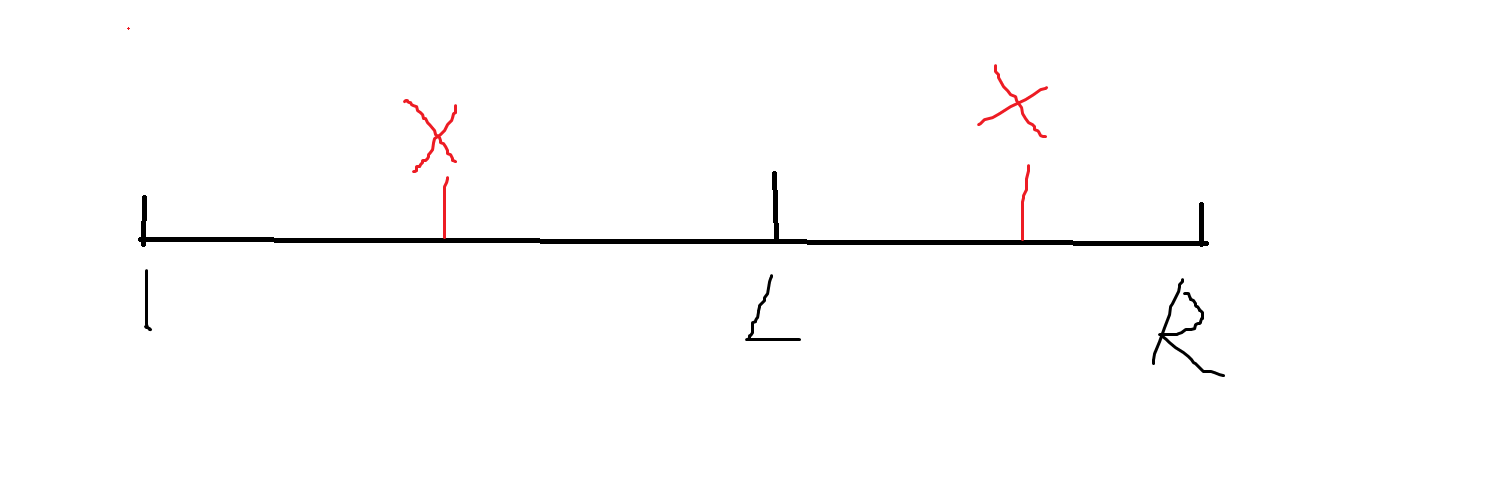
先来看一张图。对于 \(x\) 而言,假如上述标的第一个 \(x\) 为它在进入 \(L\) 前最后出现的位置,而第二个 \(x\) 为在进入待查询区间 \([L,R]\) 的第一个 \(x\)。那么很显然的是,第一个 \(x\) 并不会对这个 \([L,R]\) 造成 \(1\) 的贡献。其次再来考虑在 \([L,R]\) 中如果重复出现了 \(x\) 该如何去掉重复的贡献。很显然的一种思想是在这个查询区间 \([L,R]\) 上,后出现的 \(x\) 会代替掉前出现的 \(x\) 的贡献 \(1\)。那么很自然的一种思想就是“离线”。把查询离线下来,从 \(1 \sim n\) 跑扫描线更新查询。在更新时我们可以维护“每个值出现的最后一次的位置”。这样一来在更新 \(last\) 的时候可以清楚地去掉“前面的贡献”而增加进“当前的贡献”。
算法核心思路:
用一个 \(last\) 数组记录下每个值出现的最后一次位置。并把查询离线下来从 \(1 \sim n\) 进行更新。对于每个 \([l,r]\) 而言,我们在更新时显而易见的可以拿到 \([1,r]\) 的贡献情况,进行区间查询 \([l,r]\) 就行了。具体的每一个 \(last[val[curr]]\) 更新时去掉它原有的贡献,用新的一个位置 \(last\) 的贡献代替它的贡献就行了。
HH的项链关于上述经典算法的参考代码
点击查看代码
#include <bits/stdc++.h>

//#pragma GCC optimize("Ofast,unroll-loops")

#define isPbdsFile

#ifdef isPbdsFile

#include <bits/extc++.h>

#else

#include <ext/pb_ds/priority_queue.hpp>

#include <ext/pb_ds/hash_policy.hpp>

#include <ext/pb_ds/tree_policy.hpp>

#include <ext/pb_ds/trie_policy.hpp>

#include <ext/pb_ds/tag_and_trait.hpp>

#include <ext/pb_ds/hash_policy.hpp>

#include <ext/pb_ds/list_update_policy.hpp>

#include <ext/pb_ds/assoc_container.hpp>

#include <ext/pb_ds/exception.hpp>

#include <ext/rope>

#endif

using namespace std;

using namespace __gnu_cxx;

using namespace __gnu_pbds;

typedef long long ll;

typedef long double ld;

typedef pair<int, int> pii;

typedef pair<ll, ll> pll;

typedef tuple<int, int, int> tii;

typedef tuple<ll, ll, ll> tll;

typedef unsigned int ui;

typedef unsigned long long ull;

typedef __int128 i128;

#define hash1 unordered_map

#define hash2 gp_hash_table

#define hash3 cc_hash_table

#define stdHeap std::priority_queue

#define pbdsHeap __gnu_pbds::priority_queue

#define sortArr(a, n) sort(a+1,a+n+1)

#define all(v) v.begin(),v.end()

#define yes cout<<"YES"

#define no cout<<"NO"

#define Spider ios_base::sync_with_stdio(false);cin.tie(nullptr);cout.tie(nullptr);

#define MyFile freopen("..\\input.txt", "r", stdin),freopen("..\\output.txt", "w", stdout);

#define forn(i, a, b) for(int i = a; i <= b; i++)

#define forv(i, a, b) for(int i=a;i>=b;i--)

#define ls(x) (x<<1)

#define rs(x) (x<<1|1)

#define endl '\n'

//用于Miller-Rabin

[[maybe_unused]] static int Prime_Number[13] = {0, 2, 3, 5, 7, 11, 13, 17, 19, 23, 29, 31, 37};

template <typename T>

int disc(T* a, int n)

{

    return unique(a + 1, a + n + 1) - (a + 1);

}

template <typename T>

T lowBit(T x)

{

    return x & -x;

}

template <typename T>

T Rand(T l, T r)

{

    static mt19937 Rand(time(nullptr));

    uniform_int_distribution<T> dis(l, r);

    return dis(Rand);

}

template <typename T1, typename T2>

T1 modt(T1 a, T2 b)

{

    return (a % b + b) % b;

}

template <typename T1, typename T2, typename T3>

T1 qPow(T1 a, T2 b, T3 c)

{

    a %= c;

    T1 ans = 1;

    for (; b; b >>= 1, (a *= a) %= c)if (b & 1)(ans *= a) %= c;

    return modt(ans, c);

}

template <typename T>

void read(T& x)

{

    x = 0;

    T sign = 1;

    char ch = getchar();

    while (!isdigit(ch))

    {

        if (ch == '-')sign = -1;

        ch = getchar();

    }

    while (isdigit(ch))

    {

        x = (x << 3) + (x << 1) + (ch ^ 48);

        ch = getchar();

    }

    x *= sign;

}

template <typename T, typename... U>

void read(T& x, U&... y)

{

    read(x);

    read(y...);

}

template <typename T>

void write(T x)

{

    if (typeid(x) == typeid(char))return;

    if (x < 0)x = -x, putchar('-');

    if (x > 9)write(x / 10);

    putchar(x % 10 ^ 48);

}

template <typename C, typename T, typename... U>

void write(C c, T x, U... y)

{

    write(x), putchar(c);

    write(c, y...);

}

template <typename T11, typename T22, typename T33>

struct T3

{

    T11 one;

    T22 tow;

    T33 three;

    bool operator<(const T3 other) const

    {

        if (one == other.one)

        {

            if (tow == other.tow)return three < other.three;

            return tow < other.tow;

        }

        return one < other.one;

    }

    T3() { one = tow = three = 0; }

    T3(T11 one, T22 tow, T33 three) : one(one), tow(tow), three(three)

    {

    }

};

template <typename T1, typename T2>

void uMax(T1& x, T2 y)

{

    if (x < y)x = y;

}

template <typename T1, typename T2>

void uMin(T1& x, T2 y)

{

    if (x > y)x = y;

}

constexpr int N = 1e6 + 10;

int bit[N];

int n;

inline void add(int x, const int v)

{

    for (; x <= n; x += lowBit(x))bit[x] += v;

}

inline int query(int x)

{

    int ans = 0;

    for (; x; x -= lowBit(x))ans += bit[x];

    return ans;

}

int val[N], last[N];

vector<pii> qu[N];

int ans[N];

inline void solve()

{

    cin >> n;

    forn(i, 1, n)cin >> val[i];

    int q;

    cin >> q;

    forn(i, 1, q)

    {

        int l, r;

        cin >> l >> r;

        qu[r].emplace_back(l, i);

    }

    forn(r, 1, n)

    {

        if (int preLast = last[val[r]])add(preLast, -1);

        add(last[val[r]] = r, 1);

        for (const auto [l,id] : qu[r])ans[id] = query(r) - query(l - 1);

    }

    forn(i, 1, q)cout << ans[i] << endl;

}

signed int main()

{

    Spider

    //------------------------------------------------------

    int test = 1;

    //    read(test);

    // cin >> test;

    forn(i, 1, test)solve();

    //    while (cin >> n, n)solve();

    //    while (cin >> test)solve();

}
序列上的这种更新与查询当然树状数组和线段树都行啦。
正文
本文约定俗称:我们将一条路径上不同数的数目叫做“HH的项链”。
其实CF这题就是一个典型的树上HH项链问题,需要稍微转化下。
首先一个显而易见的贪心就是,对于一个 \(LCA\) 它的两个 \(dff\) 值的 \(u \text{与} v\) 的选取,应该取叶子节点。因为很显而易见的是,HH的项链与长度的关系是单调不降的。长度越长才越有可能越大。而题目给的 \(dff\) 函数不就是HH的项链吗?
树上问题怎么变序列问题?dfs序,树剖,很多很多。这里选择dfs序,并且涉及到了区间修改,我们这题采用线段树书写。考虑一下,处理dfs序以后,根据上述贪心和HH项链的基本离线思路,我们应该从叶子节点开始往上算到每个节点的HH项链值,然后嘛就很简单了。只需要记录更新到 \(LCA\) 的最大值,因为HH的项链是单调不降的,所以一定有以下结论:
\]
即 \(LCA\) 所在子树的其他点到同一个叶子节点的HH的项链并不会优于从 \(LCA\) 到叶子节点的HH的项链。
那么次大值只有可能在更新最大值之前取到。所以只需要在更新当前 \(LCA\) 全局最大值时将当前用于即将更新最大值的数进行更新答案,再更新下最大值即可。
最后考虑下上述的删除时机和添加时机如何搬到树上,很简单。这里需要类比几个点。
- 对于一个 \(LCA\) 而言,它的贡献范围显然是“以它为根的子树”。这点 dfs序+线段树可以轻松做到+1
- 从哪开始更新,或者说像上述一样该从哪开始扫描进入。显然根据上述应该从叶子节点开始往上去更新HH的项链值。
- 什么时候是删除时机?很显然的是当子树的 \(last\) 被父树的 \(last\) 更新时,就该去掉了,其实这个可以预处理出来。只需要为每个点维护一个 \(del\) 数组,表示的是当更新到这个节点时需要去掉哪几个子树节点的“贡献”。dfs从上往下,每需要更新一个 \(last\) 我们需要反过来写,父节点当中待删除的 \(del\) 数组加入当前节点。
- 注意到对于一个节点而言,它的子树之间互不影响,所以在退出这棵子树的dfs时需要恢复它的 \(last\)
del数组预处理核心逻辑代码
int preLast = last[val[curr]];

if (preLast)del[preLast].push_back(curr); //HH项链扫描线的删除

last[val[curr]] = curr;
至此算法框架完成,细节见代码注释
点击查看代码
#include <bits/stdc++.h>

//#pragma GCC optimize("Ofast,unroll-loops")

//#define isPbdsFile

#ifdef isPbdsFile

#include <bits/extc++.h>

#else

#include <ext/pb_ds/priority_queue.hpp>

#include <ext/pb_ds/hash_policy.hpp>

#include <ext/pb_ds/tree_policy.hpp>

#include <ext/pb_ds/trie_policy.hpp>

#include <ext/pb_ds/tag_and_trait.hpp>

#include <ext/pb_ds/hash_policy.hpp>

#include <ext/pb_ds/list_update_policy.hpp>

#include <ext/pb_ds/assoc_container.hpp>

#include <ext/pb_ds/exception.hpp>

#include <ext/rope>

#endif

using namespace std;

using namespace __gnu_cxx;

using namespace __gnu_pbds;

typedef long long ll;

typedef long double ld;

typedef pair<int, int> pii;

typedef pair<ll, ll> pll;

typedef tuple<int, int, int> tii;

typedef tuple<ll, ll, ll> tll;

typedef unsigned int ui;

typedef unsigned long long ull;

typedef __int128 i128;

#define hash1 unordered_map

#define hash2 gp_hash_table

#define hash3 cc_hash_table

#define stdHeap std::priority_queue

#define pbdsHeap __gnu_pbds::priority_queue

#define sortArr(a, n) sort(a+1,a+n+1)

#define all(v) v.begin(),v.end()

#define yes cout<<"YES"

#define no cout<<"NO"

#define Spider ios_base::sync_with_stdio(false);cin.tie(nullptr);cout.tie(nullptr);

#define MyFile freopen("..\\input.txt", "r", stdin),freopen("..\\output.txt", "w", stdout);

#define forn(i, a, b) for(int i = a; i <= b; i++)

#define forv(i, a, b) for(int i=a;i>=b;i--)

#define ls(x) (x<<1)

#define rs(x) (x<<1|1)

#define endl '\n'

//用于Miller-Rabin

[[maybe_unused]] static int Prime_Number[13] = {0, 2, 3, 5, 7, 11, 13, 17, 19, 23, 29, 31, 37};

template <typename T>

int disc(T* a, int n)

{

    return unique(a + 1, a + n + 1) - (a + 1);

}

template <typename T>

T lowBit(T x)

{

    return x & -x;

}

template <typename T>

T Rand(T l, T r)

{

    static mt19937 Rand(time(nullptr));

    uniform_int_distribution<T> dis(l, r);

    return dis(Rand);

}

template <typename T1, typename T2>

T1 modt(T1 a, T2 b)

{

    return (a % b + b) % b;

}

template <typename T1, typename T2, typename T3>

T1 qPow(T1 a, T2 b, T3 c)

{

    a %= c;

    T1 ans = 1;

    for (; b; b >>= 1, (a *= a) %= c)if (b & 1)(ans *= a) %= c;

    return modt(ans, c);

}

template <typename T>

void read(T& x)

{

    x = 0;

    T sign = 1;

    char ch = getchar();

    while (!isdigit(ch))

    {

        if (ch == '-')sign = -1;

        ch = getchar();

    }

    while (isdigit(ch))

    {

        x = (x << 3) + (x << 1) + (ch ^ 48);

        ch = getchar();

    }

    x *= sign;

}

template <typename T, typename... U>

void read(T& x, U&... y)

{

    read(x);

    read(y...);

}

template <typename T>

void write(T x)

{

    if (typeid(x) == typeid(char))return;

    if (x < 0)x = -x, putchar('-');

    if (x > 9)write(x / 10);

    putchar(x % 10 ^ 48);

}

template <typename C, typename T, typename... U>

void write(C c, T x, U... y)

{

    write(x), putchar(c);

    write(c, y...);

}

template <typename T11, typename T22, typename T33>

struct T3

{

    T11 one;

    T22 tow;

    T33 three;

    bool operator<(const T3 other) const

    {

        if (one == other.one)

        {

            if (tow == other.tow)return three < other.three;

            return tow < other.tow;

        }

        return one < other.one;

    }

    T3() { one = tow = three = 0; }

    T3(T11 one, T22 tow, T33 three) : one(one), tow(tow), three(three)

    {

    }

};

template <typename T1, typename T2>

void uMax(T1& x, T2 y)

{

    if (x < y)x = y;

}

template <typename T1, typename T2>

void uMin(T1& x, T2 y)

{

    if (x > y)x = y;

}

constexpr int N = 3e5 + 10;

struct Node

{

    int add;

    int mx;

} node[N << 2];

#define add(x) node[x].add

#define mx(x) node[x].mx

inline void push_up(const int curr)

{

    mx(curr) = max(mx(ls(curr)),mx(rs(curr)));

}

inline void push_down(const int curr)

{

    if (add(curr))

    {

        mx(ls(curr)) += add(curr);

        mx(rs(curr)) += add(curr);

        add(ls(curr)) += add(curr);

        add(rs(curr)) += add(curr);

        add(curr) = 0;

    }

}

int n;

vector<int> child[N];

inline void update(const int curr, const int l, const int r, const int val, const int s = 1, const int e = n)

{

    if (l <= s and e <= r)

    {

        mx(curr) += val;

        add(curr) += val;

        return;

    }

    const int mid = (s + e) >> 1;

    push_down(curr);

    if (l <= mid)update(ls(curr), l, r, val, s, mid);

    if (r > mid)update(rs(curr), l, r, val, mid + 1, e);

    push_up(curr);

}

inline int query(const int curr, const int l, const int r, const int s = 1, const int e = n)

{

    if (l <= s and e <= r)return mx(curr);

    const int mid = (s + e) >> 1;

    push_down(curr);

    int ans = 0;

    if (l <= mid)uMax(ans, query(ls(curr), l, r, s, mid));

    if (r > mid)uMax(ans, query(rs(curr), l, r, mid + 1, e));

    return ans;

}

int s[N], e[N], val[N], cnt;

int last[N]; //每种元素最后出现的点

vector<int> del[N];

//处理dfs序,预处理del数组

inline void dfs(const int curr, const int fa)

{

    s[curr] = ++cnt;

    int preLast = last[val[curr]];

    if (preLast)del[preLast].push_back(curr); //HH项链扫描线的删除,父树去掉子树贡献

    last[val[curr]] = curr; //进入子树更新last

    for (const int nxt : child[curr])if (nxt != fa)dfs(nxt, curr);

    last[val[curr]] = preLast; //退出子树时恢复last

    e[curr] = cnt;

}

ll ans;

inline void getAns(const int curr, const int fa)

{

    //把curr当做LCA

    for (const int nxt : child[curr])if (nxt != fa)getAns(nxt, curr); //贪心从底部开始往上算HH的项链

    update(1, s[curr], e[curr], 1); //扫描线扫到当前节点加入这个点的贡献,贡献范围为整棵子树

    for (auto nxt : del[curr])update(1, s[nxt], e[nxt], -1); //HH的项链的删除,删掉子树贡献

    ll mx2 = 1; //次小值

    for (const int nxt : child[curr])

    {

        if (nxt == fa)continue;

        ll mx1 = query(1, s[nxt], e[nxt]); //最大值

        uMax(ans, mx1 * mx2); //更新max之前计算,mx1则会是次大值

        uMax(mx2, mx1); //更新次大值

    }

}

//多测清空

inline void clear()

{

    forn(curr, 1, n<<2)

        mx(curr) = add(curr) = 0;

    cnt = 0;

    forn(i, 1, n)last[i] = 0, del[i].clear(), child[i].clear();

    ans = 1;

}

inline void solve()

{

    cin >> n;

    forn(i, 2, n)

    {

        int x;

        cin >> x;

        child[x].push_back(i);

    }

    forn(i, 1, n)cin >> val[i];

    dfs(1, 0);

    getAns(1, 0);

    cout << ans << endl;

    clear();

}

signed int main()

{

    Spider

    //------------------------------------------------------

    int test = 1;

    //    read(test);

    cin >> test;

    forn(i, 1, test)solve();

    //    while (cin >> n, n)solve();

    //    while (cin >> test)solve();

}
CF1916E Happy Life in University 题解的更多相关文章
- 2016-2017 National Taiwan University World Final Team Selection Contest (Codeforces Gym) 部分题解
D 考虑每个点被删除时其他点对它的贡献,然后发现要求出距离为1~k的点对有多少个. 树分治+FFT.分治时把所有点放一起做一遍FFT,然后减去把每棵子树单独做FFT求出来的值. 复杂度$nlog^ ...
- poj 2010 Moo University - Financial Aid(优先队列(最小堆)+ 贪心 + 枚举)
Description Bessie noted that although humans have many universities they can attend, cows have none ...
- 算法(第四版)C# 习题题解——2.3
写在前面 整个项目都托管在了 Github 上:https://github.com/ikesnowy/Algorithms-4th-Edition-in-Csharp 查找更为方便的版本见:http ...
- zoj 4020 The 18th Zhejiang University Programming Contest Sponsored by TuSimple - G Traffic Light(广搜)
题目链接:The 18th Zhejiang University Programming Contest Sponsored by TuSimple - G Traffic Light 题解: 题意 ...
- HDU 4352 XHXJ's LIS HDU 题解
题目 #define xhxj (Xin Hang senior sister(学姐)) If you do not know xhxj, then carefully reading the ent ...
- POJ2482 Stars in Your Window 题解
Fleeting time does not blur my memory of you. Can it really be 4 years since I first saw you? I stil ...
- 2016 华南师大ACM校赛 SCNUCPC 非官方题解
我要举报本次校赛出题人的消极出题!!! 官方题解请戳:http://3.scnuacm2015.sinaapp.com/?p=89(其实就是一堆代码没有题解) A. 树链剖分数据结构板题 题目大意:我 ...
- noip2016十连测题解
以下代码为了阅读方便,省去以下头文件: #include <iostream> #include <stdio.h> #include <math.h> #incl ...
- BZOJ-2561-最小生成树 题解(最小割)
2561: 最小生成树(题解) Time Limit: 10 Sec Memory Limit: 128 MBSubmit: 1628 Solved: 786 传送门:http://www.lyd ...
- Codeforces Round #353 (Div. 2) ABCDE 题解 python
Problems # Name A Infinite Sequence standard input/output 1 s, 256 MB x3509 B Restoring P ...
随机推荐
- 【内核】深入分析内核panic(二)--内核中的少林扫地僧-NMI Watchdog Timer
没有完美的代码 没有完美的人,更没有完美的代码.虽然教科书上说deadlock(死锁)多么不好不好,但是在现实生活中,很难把它完全消灭.假设不小心内核出现了deadlock,可能你得干瞪眼.CPU就在 ...
- 搭建 spring boot + mybatis plus 项目框架并进行调试
本文为博主原创,未经允许不得转载: 1.创建一个spring boot的工程应用: File ---- > New ----->Project ----> 然后选中Spring In ...
- Laravel组件化开发学习笔记
组件化开发就是基于组件来进行迭代开发,而不是从零开始开发 1.语法基础 组件开发的基础语法是命名空间. 可以使用魔法常量__NAMESPACE__可以直接获取当前命名空间的名称的字符串. 例如: &l ...
- java - 运行可执行文件 (.exe)
package filerun; import java.io.File; import java.io.IOException; public class RunExe { public stati ...
- C# 线程本地存储 为什么线程间值不一样
一:背景 1. 讲故事 有朋友在微信里面问我,为什么用 ThreadStatic 标记的字段,只有第一个线程拿到了初始值,其他线程都是默认值,让我能不能帮他解答一下,尼玛,我也不是神仙什么都懂,既然问 ...
- Go——语言特性
golang 简介 来历 很久以前,有一个IT公司,这公司有个传统,允许员工拥有20%自由时间来开发实验性项目.在2007的某一天,公司的几个大牛,正在用c++开发一些比较繁琐但是核心的工作,主要包括 ...
- [转帖]字符集 AL32UTF8 和 UTF8
https://blog.51cto.com/comtv/383254# 文章标签职场休闲字符集 AL32UTF8 和 UTF8文章分类数据库阅读数1992 The difference betwee ...
- [转帖]Influxdb 2.x 快速入门
Influxdb 2.x 快速入门 https://www.jianshu.com/p/268fca65f10e Influxdb是由Golang 构建的时序数据库,由于由Go语言构建使得其跨平台部署 ...
- [转帖]Linux 内核 | 网络流量限速方案大 PK
https://maimai.cn/article/detail?fid=1674483493&efid=UXVPILU_JTlqLrYhTkDStA 网络流量限速是一个经久不衰的话题,Lin ...
- [转帖]nginx 启动、重启、关闭命令详解
https://www.jianshu.com/p/d70006f18a6d 作者:Gakki nginx 命令详解 输入命令:nginx -h nginx -h -?,-h:查看帮助 -v:显示 ...