
Bellman-Ford 单源最短路径算法
Bellman-Ford 算法是一种用于计算带权有向图中单源最短路径(SSSP:Single-Source Shortest Path)的算法。该算法由 Richard Bellman 和 Lester Ford 分别发表于 1958 年和 1956 年,而实际上 Edward F. Moore 也在 1957 年发布了相同的算法,因此,此算法也常被称为 Bellman-Ford-Moore 算法。
Bellman-Ford 算法和 Dijkstra 算法同为解决单源最短路径的算法。对于带权有向图 G = (V, E),Dijkstra 算法要求图 G 中边的权值均为非负,而 Bellman-Ford 算法能适应一般的情况(即存在负权边的情况)。一个实现的很好的 Dijkstra 算法比 Bellman-Ford 算法的运行时间要低。
Bellman-Ford 算法采用动态规划(Dynamic Programming)进行设计,实现的时间复杂度为 O(V*E),其中 V 为顶点数量,E 为边的数量。Dijkstra 算法采用贪心算法(Greedy Algorithm)范式进行设计,普通实现的时间复杂度为 O(V2),若基于 Fibonacci heap 的最小优先队列实现版本则时间复杂度为 O(E + VlogV)。
Bellman-Ford 算法描述:
- 创建源顶点 v 到图中所有顶点的距离的集合 distSet,为图中的所有顶点指定一个距离值,初始均为 Infinite,源顶点距离为 0;
- 计算最短路径,执行 V - 1 次遍历;
- 对于图中的每条边:如果起点 u 的距离 d 加上边的权值 w 小于终点 v 的距离 d,则更新终点 v 的距离值 d;
- 检测图中是否有负权边形成了环,遍历图中的所有边,计算 u 至 v 的距离,如果对于 v 存在更小的距离,则说明存在环;
伪码实现如下:
 BELLMAN-FORD(G, w, s)

   INITIALIZE-SINGLE-SOURCE(G, s)

   for i   to |V[G]| -

        do for each edge (u, v)  E[G]

             do RELAX(u, v, w)

   for each edge (u, v)  E[G]

        do if d[v] > d[u] + w(u, v)

             then return FALSE

   return TRUE
Bellman-Ford 算法的运行时间为 O(V*E),因为第 2 行的初始化占用了 Θ(V),第 3-4 行对边进行了 V - 1 趟操作,每趟操作的运行时间为 Θ(E)。第 6-7 行的 for 循环运行时间为 O(E)。
例如,下面的有向图 G 中包含 5 个顶点和 8 条边。假设源点 为 A。初始化 distSet 所有距离为 INFI,源点 A 为 0。

由于图中有 5 个顶点,按照步骤 1 需要遍历 4 次,第一次遍历的结果如下。

第二次遍历的结果如下。

以此类推可以得出完全遍历的结果。
C# 代码实现:
 using System;

 using System.Collections.Generic;

 using System.Linq;

 namespace GraphAlgorithmTesting

 {

   class Program

   {

     static void Main(string[] args)

     {

       int[,] graph = new int[, ]

       {

         {, , , , , , , , },

         {, , , , , , , , },

         {, , , , , , , , },

         {, , , , , , , , },

         {, , , , , , , , },

         {, , , , , , , , },

         {, , , , , , , , },

         {, , , , , , , , },

         {, , , , , , , , }

       };

       Graph g = new Graph(graph.GetLength());

       for (int i = ; i < graph.GetLength(); i++)

       {

         for (int j = ; j < graph.GetLength(); j++)

         {

           if (graph[i, j] > )

             g.AddEdge(i, j, graph[i, j]);

         }

       }

       Console.WriteLine("Graph Vertex Count : {0}", g.VertexCount);

       Console.WriteLine("Graph Edge Count : {0}", g.EdgeCount);

       Console.WriteLine();

       int[] distSet = g.BellmanFord();

       Console.WriteLine("Vertex\t\tDistance from Source");

       for (int i = ; i < distSet.Length; i++)

       {

         Console.WriteLine("{0}\t\t{1}", i, distSet[i]);

       }

       // build a directed and negative weighted graph

       Graph directedGraph = new Graph();

       directedGraph.AddEdge(, , -);

       directedGraph.AddEdge(, , );

       directedGraph.AddEdge(, , );

       directedGraph.AddEdge(, , );

       directedGraph.AddEdge(, , );

       directedGraph.AddEdge(, , );

       directedGraph.AddEdge(, , );

       directedGraph.AddEdge(, , -);

       Console.WriteLine();

       Console.WriteLine("Graph Vertex Count : {0}", directedGraph.VertexCount);

       Console.WriteLine("Graph Edge Count : {0}", directedGraph.EdgeCount);

       Console.WriteLine();

       int[] distSet1 = directedGraph.BellmanFord();

       Console.WriteLine("Vertex\t\tDistance from Source");

       for (int i = ; i < distSet1.Length; i++)

       {

         Console.WriteLine("{0}\t\t{1}", i, distSet1[i]);

       }

       Console.ReadKey();

     }

     class Edge

     {

       public Edge(int begin, int end, int weight)

       {

         this.Begin = begin;

         this.End = end;

         this.Weight = weight;

       }

       public int Begin { get; private set; }

       public int End { get; private set; }

       public int Weight { get; private set; }

       public override string ToString()

       {

         return string.Format(

           "Begin[{0}], End[{1}], Weight[{2}]",

           Begin, End, Weight);

       }

     }

     class Graph

     {

       private Dictionary<int, List<Edge>> _adjacentEdges

         = new Dictionary<int, List<Edge>>();

       public Graph(int vertexCount)

       {

         this.VertexCount = vertexCount;

       }

       public int VertexCount { get; private set; }

       public int EdgeCount

       {

         get

         {

           return _adjacentEdges.Values.SelectMany(e => e).Count();

         }

       }

       public void AddEdge(int begin, int end, int weight)

       {

         if (!_adjacentEdges.ContainsKey(begin))

         {

           var edges = new List<Edge>();

           _adjacentEdges.Add(begin, edges);

         }

         _adjacentEdges[begin].Add(new Edge(begin, end, weight));

       }

       public int[] BellmanFord(int source)

       {

         // distSet[i] will hold the shortest distance from source to i

         int[] distSet = new int[VertexCount];

         // Step 1: Initialize distances from source to all other vertices as INFINITE

         for (int i = ; i < VertexCount; i++)

         {

           distSet[i] = int.MaxValue;

         }

         distSet[source] = ;

         // Step 2: Relax all edges |V| - 1 times. A simple shortest path from source

         // to any other vertex can have at-most |V| - 1 edges

         for (int i = ; i <= VertexCount - ; i++)

         {

           foreach (var edge in _adjacentEdges.Values.SelectMany(e => e))

           {

             int u = edge.Begin;

             int v = edge.End;

             int weight = edge.Weight;

             if (distSet[u] != int.MaxValue

               && distSet[u] + weight < distSet[v])

             {

               distSet[v] = distSet[u] + weight;

             }

           }

         }

         // Step 3: check for negative-weight cycles.  The above step guarantees

         // shortest distances if graph doesn't contain negative weight cycle.

         // If we get a shorter path, then there is a cycle.

         foreach (var edge in _adjacentEdges.Values.SelectMany(e => e))

         {

           int u = edge.Begin;

           int v = edge.End;

           int weight = edge.Weight;

           if (distSet[u] != int.MaxValue

             && distSet[u] + weight < distSet[v])

           {

             Console.WriteLine("Graph contains negative weight cycle.");

           }

         }

         return distSet;

       }

     }

   }

 }
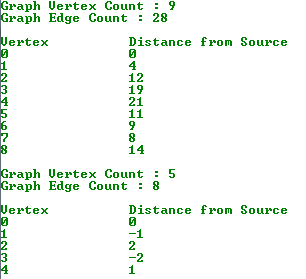
运行结果如下:
参考资料
- 广度优先搜索
- 深度优先搜索
- Breadth First Traversal for a Graph
- Depth First Traversal for a Graph
- Dijkstra 单源最短路径算法
- Bellman–Ford algorithm
- Introduction To Algorithm
- Floyd-Warshall's algorithm
- Bellman-Ford algorithm for single-source shortest paths
- Dynamic Programming | Set 23 (Bellman–Ford Algorithm)
本篇文章《Bellman-Ford 单源最短路径算法》由 Dennis Gao 发表自博客园,未经作者本人同意禁止任何形式的转载,任何自动或人为的爬虫转载行为均为耍流氓。
Bellman-Ford 单源最短路径算法的更多相关文章
- 【模板】Bellman—Fort 单源最短路径算法
2333 适用于边集储存 #include<bits/stdc++.h> using namespace std; const int inf=0x3fffffff; ],t[],d[], ...
- Dijkstra 单源最短路径算法
Dijkstra 算法是一种用于计算带权有向图中单源最短路径(SSSP:Single-Source Shortest Path)的算法,由计算机科学家 Edsger Dijkstra 于 1956 年 ...
- 经典贪心算法(哈夫曼算法,Dijstra单源最短路径算法,最小费用最大流)
哈夫曼编码与哈夫曼算法 哈弗曼编码的目的是,如何用更短的bit来编码数据. 通过变长编码压缩编码长度.我们知道普通的编码都是定长的,比如常用的ASCII编码,每个字符都是8个bit.但在很多情况下,数 ...
- 单源最短路径算法:迪杰斯特拉 (Dijkstra) 算法(二)
一.基于邻接表的Dijkstra算法 如前一篇文章所述,在 Dijkstra 的算法中,维护了两组,一组包含已经包含在最短路径树中的顶点列表,另一组包含尚未包含的顶点.使用邻接表表示,可以使用 BFS ...
- 单源最短路径算法:迪杰斯特拉 (Dijkstra) 算法(一)
一.算法介绍 迪杰斯特拉算法(英语:Dijkstra's algorithm)由荷兰计算机科学家艾兹赫尔·迪杰斯特拉在1956年提出.迪杰斯特拉算法使用了广度优先搜索解决赋权有向图的单源最短路径问题. ...
- 单源最短路径算法---Dijkstra
Dijkstra算法树解决有向图G=(V,E)上带权的单源最短路径问题,但是要求所有边的权值非负. 解题思路: V表示有向图的所有顶点集合,S表示那么一些顶点结合,从源点s到该集合中的顶点的最终最短路 ...
- Dijkstra算法详细(单源最短路径算法)
介绍 对于dijkstra算法,很多人可能感觉熟悉而又陌生,可能大部分人比较了解bfs和dfs,而对dijkstra和floyd算法可能知道大概是图论中的某个算法,但是可能不清楚其中的作用和原理,又或 ...
- 单源最短路径算法——Dijkstra算法(迪杰斯特拉算法)
一 综述 Dijkstra算法(迪杰斯特拉算法)主要是用于求解有向图中单源最短路径问题.其本质是基于贪心策略的(具体见下文).其基本原理如下: (1)初始化:集合vertex_set初始为{sourc ...
- 单源最短路径算法——Bellman-ford算法和Dijkstra算法
BellMan-ford算法描述 1.初始化:将除源点外的所有顶点的最短距离估计值 dist[v] ← +∞, dist[s] ←0; 2.迭代求解:反复对边集E中的每条边进行松弛操作,使得顶点集V ...
随机推荐
- 微信小程序开发心得
微信小程序也已出来有一段时间了,最近写了几款微信小程序项目,今天来说说感受. 首先开发一款微信小程序,最主要的就是针对于公司来运营的,因为,在申请appid(微信小程序ID号)时候,需要填写相关的公司 ...
- 在 ML2 中配置 OVS flat network - 每天5分钟玩转 OpenStack(133)
前面讨论了 OVS local network,今天开始学习 flat network. flat network 是不带 tag 的网络,宿主机的物理网卡通过网桥与 flat network 连接, ...
- 黑云压城城欲摧 - 2016年iOS公开可利用漏洞总结
黑云压城城欲摧 - 2016年iOS公开可利用漏洞总结 作者:蒸米,耀刺,黑雪 @ Team OverSky 0x00 序 iOS的安全性远比大家的想象中脆弱,除了没有公开的漏洞以外,还有很多已经公开 ...
- C#4.0泛型的协变,逆变深入剖析
C#4.0中有一个新特性:协变与逆变.可能很多人在开发过程中不常用到,但是深入的了解他们,肯定是有好处的. 协变和逆变体现在泛型的接口和委托上面,也就是对泛型参数的声明,可以声明为协变,或者逆变.什么 ...
- setCapture、releasCapture 浅析
1. setCapture 简介 setCapture可以将鼠标事件锁定在指定的元素上,当元素捕获了鼠标事件后,该事件只能作用在当前元素上. 以下情况会导致事件锁定失败: 当窗口失去焦点时,锁定的事件 ...
- VSCode添加Sciter脚本Tiscript高亮支持
Sciter中的Tiscript脚本不是标准的Javascript,是对Javascript的扩展.所以在常用的编辑器和IDE上对于高亮的支持很不好. 不过在Sciter论坛中找到了在VSCode上的 ...
- Linux命令【第二篇】
1.如何过滤出已知当前目录下oldboy中的所有一级目录(提示:不包含oldboy目录下面目录的子目录及隐藏目录,即只能是一级目录). ^:以什么开头,例如^olboy表示以oldboy开头. ls: ...
- POJ1149 PIGS [最大流 建图]
PIGS Time Limit: 1000MS Memory Limit: 10000K Total Submissions: 20662 Accepted: 9435 Description ...
- angularJS(6)
angularJS(6) 一:angularJs的事件. 1.ng-click指令定义了AngularJS点击事件. <div ng-app="myapp" ng-contr ...
- 在jexus下如何简单的配置多站点
参考:linuxdot.net 其实jexus的配置还是比较简单的,目录即站点(一个目录就是一个站点,一个配置文件就是一个站点) 如uustudy.net,在siteconf目录下创建一个uustud ...