
kernel_thread()和kthread_run()/kthread_create()的根本区别
0 本质区别
kthread_run()调用kthread_create(), kthread_create()加入链表后,有kthreadd()线程读取链表然后再调用kernel_thread()创建线程。
kernel_thread():实在真正的创建线程
kthread_run()/kthread_create() : 做特殊的准备工作,之后再调用kernel_thread()创建线程。
1. 函数的作用
首先要说明的是:这几个函数都是用来创建内核线程的。先看一下几个函数关系:
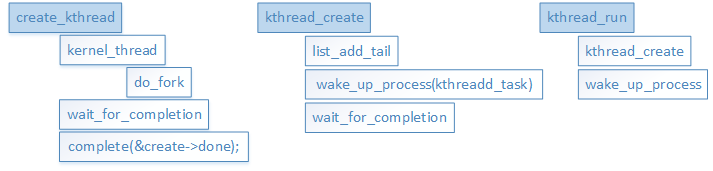
这里有两个长得很像的函数:create_kthread() 和 kthread_create()。(这不是长得像,根本就是一样的好吧,有点难记),这里只是函数封装的很像,但本质上还是kernel_thread() 和 **kthread_create()**这两个函数的区别。
从上面的函数调用便可以看出:
**kernel_thread()函数是通过调用do_fork()**函数创建的线程,而do_fork()则是在应用层fork(), vfork()和clone()函数的系统调用;此外还需要在其执行函数里调用daemonize()进行资源的释放;该线程挂接在init进程下。
kthread_create()函数是通过工作队列workqueue创建的线程,此线程挂在kthreadd线程下。
kthread_run()函数本质上是调用了kthread_create()和wake_up_process(), 就是除了挂在工作队列上后,便唤醒进行工作。
**kthread_create()**是比较推崇的创建内核线程的方式。
这几个函数在不同内核版本上有较大差别,请注意。
2. kernel_thread()
/* Create a kernel thread. *//*linux 2.6*/
int
kernel_thread(int (*fn)(void *), void * arg, unsigned long flags)
{
struct pt_regs regs;
memset(®s, 0, sizeof(regs));
/* Don't use r10 since that is set to 0 in copy_thread. */
regs.r11 = (unsigned long) fn;
regs.r12 = (unsigned long) arg;
regs.erp = (unsigned long) kernel_thread_helper;
regs.ccs = 1 << (I_CCS_BITNR + CCS_SHIFT);
/* Create the new process. */
return do_fork(flags | CLONE_VM | CLONE_UNTRACED, 0, ®s, 0, NULL, NULL);
}
在Linux2.6版本时该函数可以被驱动模块调用,因为被EXPORT_SYMBOL(kernel_thread);,但是在4.1版本没有没export,因此最好只用kthread_create()/kthread_run()来创建内核线程。
在Linux2.6版本时,非内核线程使用kernel_thread()必须在其执行函数里调用daemonize()释放资源:
#include <linux/kernel.h>

#include <linux/module.h>

static int Loop(void *dummy)

{

       int i = 0;

       daemonize("mythread");/*内核线程取的名字*/

       while(i++ < 5) {

               printk("current->mm = %p\n", current->mm);

               printk("current->active_mm = %p\n", current->active_mm);

               set_current_state(TASK_INTERRUPTIBLE);

               schedule_timeout(10 * HZ);

       }

       return 0;

}

static __init int test_init(void)

{

       kernel_thread(Loop, NULL, CLONE_KERNEL | SIGCHLD);

       return 0;

}

static __exit int test_exit(void)

{

       kernel_thread(Loop, NULL, CLONE_KERNEL | SIGCHLD);

       return 0;

}

static void test_exit(void) {}

module_init(test_init);

module_exit(test_exit);
3. kthread_create()
kthread_create()函数创建的内核线程创建成功后是未被激活的,不能工作,如果需要工作,则需要使用wake_up_process()函数来唤醒。线程一旦启动起来后,会一直运行,除非该线程主动调用do_exit函数,或者其他的进程调用kthread_stop函数,本线程可以使用kthread_should_stop()来获取它其他线程kthread_stop()信号,从而实现温和的关闭方式。
/**

 * kthread_create - create a kthread.

 * @threadfn: the function to run until signal_pending(current).

 * @data: data ptr for @threadfn.

 * @namefmt: printf-style name for the thread.

 *

 * Description: This helper function creates and names a kernel

 * thread.  The thread will be stopped: use wake_up_process() to start

 * it.  See also kthread_run(), kthread_create_on_cpu().

 *

 * When woken, the thread will run @threadfn() with @data as its

 * argument. @threadfn() can either call do_exit() directly if it is a

 * standalone thread for which noone will **call kthread_stop(), or

 * return when 'kthread_should_stop()' is true (which means

 * kthread_stop() has been called).  The return val**ue should be zero

 * or a negative error number; it will be passed to kthread_stop().

 *

 * Returns a task_struct or ERR_PTR(-ENOMEM).

 */

struct task_struct *kthread_create(int (*threadfn)(void *data),

				   void *data,

				   const char namefmt[],

				   ...)

{

	struct kthread_create_info create;

	create.threadfn = threadfn;

	create.data = data;

	init_completion(&create.started);

	init_completion(&create.done);

	spin_lock(&kthread_create_lock);

	list_add_tail(&create.list, &kthread_create_list);

	wake_up_process(kthreadd_task);/*放到了工作队列中*/

	spin_unlock(&kthread_create_lock);

	wait_for_completion(&create.done);

	if (!IS_ERR(create.result)) {

		va_list args;

		va_start(args, namefmt);

		vsnprintf(create.result->comm, sizeof(create.result->comm),

			  namefmt, args);

		va_end(args);

	}

	return create.result;

}
4. kthread_run()
创建并唤醒该线程。 该函数基于kthread_create(),并且直接调用了wake_up_process()唤醒了该线程。因此使用kthread_run()函数创建的线程会直接开始工作。
/**

 * kthread_run - create and wake a thread.

 * @threadfn: the function to run until signal_pending(current).

 * @data: data ptr for @threadfn.

 * @namefmt: printf-style name for the thread.

 *

 * Description: Convenient wrapper for kthread_create() followed by

 * wake_up_process().  Returns the kthread or ERR_PTR(-ENOMEM).

 */

#define kthread_run(threadfn, data, namefmt, ...)			   \

({									   \

	struct task_struct *__k						   \

		= kthread_create(threadfn, data, namefmt, ## __VA_ARGS__); \

	if (!IS_ERR(__k))						   \

		wake_up_process(__k);					   \

	__k;								   \

})
kthread_run()创建线程:
#include <linux/module.h>

#include <linux/errno.h>

#include <linux/init.h>

#include <linux/sched.h>

#include <linux/delay.h>

static int   thread_work(void *data)

{

    allow_signal(SIGTERM);

    current->state = TASK_INTERRUPTIBLE;

	printk("New kernel thread run\n");

	return 0;

}

static int __init test_init(void)

{

    /* Schedule the test thread */

    kthread_run (thread_work, NULL, "thread_1");

    return 0;

}

static void __exit test_exit(void)

{

    return;

}

MODULE_LICENSE("Dual BSD/GPL");

module_init(test_init);

module_exit(test_exit);
5. kthread_stop() / kthread_should_stop()
用来结束由kthread_create()创建的线程。
/**

 * kthread_stop - stop a thread created by kthread_create().

 * @k: thread created by kthread_create().

 *

 * Sets kthread_should_stop() for @k to return true, wakes it, and

 * waits for it to exit.  Your threadfn() must not call do_exit()

 * itself if you use this function!  This can also be called after

 * kthread_create() instead of calling wake_up_process(): the thread

 * will exit without calling threadfn().

 *

 * Returns the result of threadfn(), or %-EINTR if wake_up_process()

 * was never called.

 */

int kthread_stop(struct task_struct *k)

{

	int ret;

	mutex_lock(&kthread_stop_lock);

	/* It could exit after stop_info.k set, but before wake_up_process. */

	get_task_struct(k);

	/* Must init completion *before* thread sees kthread_stop_info.k */

	init_completion(&kthread_stop_info.done);

	smp_wmb();

	/* Now set kthread_should_stop() to true, and wake it up. */

	kthread_stop_info.k = k;

	wake_up_process(k);

	put_task_struct(k);

	/* Once it dies, reset stop ptr, gather result and we're done. */

	wait_for_completion(&kthread_stop_info.done);

	kthread_stop_info.k = NULL;

	ret = kthread_stop_info.err;

	mutex_unlock(&kthread_stop_lock);

	return ret;

}
**kthread_should_stop()**用来获取线程是否处于忙状态,如果是则返回true。之后再调用kthread_stop()完成线程的温和退出。
当然也可以直接调用kthread_stop()使线程退出。使用该函数时,线程的执行函数不得调用do_exit();
6. kthreadd() —(后续补充)
看完kthreadd()函数实现后感觉上面可能不是特别准确。。
首先这个函数kthreadd() 是上述工作队列的处理函数,从上述代码里可以看出**kthread_create()**创建线程的方法只是将工作放到工作队列中,之后实在这里做的后续处理:kthreadd是一个内核独立线程,是由do_fork()函数创建的。
kthreadd的创建:
static void noinline __init_refok rest_init(void)

	__releases(kernel_lock)

{

	int pid;

	kernel_thread(kernel_init, NULL, CLONE_FS | CLONE_SIGHAND);/*init线程*/

	numa_default_policy();

	pid = kernel_thread(kthreadd, NULL, CLONE_FS | CLONE_FILES);/*kthreadd线程*/

	kthreadd_task = find_task_by_pid(pid);

	unlock_kernel();

	/*

	 * The boot idle thread must execute schedule()

	 * at least one to get things moving:

	 */

	preempt_enable_no_resched();

	schedule();

	preempt_disable();

	/* Call into cpu_idle with preempt disabled */

	cpu_idle();

}
kthreadd关于工作队列的处理流程:
int kthreadd(void *unused)

{

	/* Setup a clean context for our children to inherit. */

	kthreadd_setup();

	current->flags |= PF_NOFREEZE;

	for (;;) {

		set_current_state(TASK_INTERRUPTIBLE);

		if (list_empty(&kthread_create_list))

			schedule();

		__set_current_state(TASK_RUNNING);

		spin_lock(&kthread_create_lock);

		while (!list_empty(&kthread_create_list)) {/*如果链表内有内容*/

			struct kthread_create_info *create;

			/*取出链表节点信息*/

			create = list_entry(kthread_create_list.next, /*实现方式和container_of一样*/

					    struct kthread_create_info, list);

			list_del_init(&create->list);

			spin_unlock(&kthread_create_lock);

			/*使用do_fork的方式创建线程*/

			create_kthread(create);/*do_fork方式*/

			spin_lock(&kthread_create_lock);

		}

		spin_unlock(&kthread_create_lock);

	}

	return 0;

}
从这段代码可以看出,工作队列的处理方式是:如果工作队列有内容,取出任务,然后创建线程(最后调用do_fork()实现的)。因此可以得出结论:内核创建线程的方式和应用层最终调用的函数是相同的,都是do_fork(); 至于为什么不直接创建而使用工作队列进程创建还不清楚原因。
kernel_thread()和kthread_run()/kthread_create()的根本区别的更多相关文章
- Linux Process Management && Process Scheduling Principle
目录 . 引言 . 进程优先级 . 进程的生命周 . 进程表示 . 进程管理相关的系统调用 . 进程调度 . 完全公平调度类 . 实时调度类 . 调度器增强 . 小结 1. 引言 在多处理器系统中,可 ...
- Linux内核线程的思考与总结
1.内核线程,只是一个称呼,实际上就是一个进程,有自己独立的TCB,参与内核调度,也参与内核抢占. 这个进程的特别之处有两点,第一.该进程没有前台.第二.永远在内核态中运行. 2.创建内核线程有两种方 ...
- 从应用到内核,分析top命令显示的进程名包含中括号"[]"的含义
背景 在执行top/ps命令的时候,在COMMAND一列,我们会发现,有些进程名被[]括起来了,例如 PID PPID USER STAT VSZ %VSZ %CPU COMMAND 1542 928 ...
- kthread_create与kernel_thread的区别【栈】
转自:http://blog.chinaunix.net/uid-25513153-id-2888903.html kthread_create与kernel_thread的区别 kernel thr ...
- Linux内核多线程实现方法 —— kthread_create函数【转】
转自:http://blog.csdn.net/sharecode/article/details/40076951 Linux内核多线程实现方法 —— kthread_create函数 内核经常需要 ...
- Linux内核:kthread_create(线程)、SLEEP_MILLI_SEC
转自:http://blog.csdn.net/guowenyan001/article/details/39230181 一.代码 #include <linux/module.h> # ...
- kthread_run【转】
转自:http://blog.csdn.net/zhangxuechao_/article/details/50876397 头文件 include/linux/kthread.h 创建并启动 /** ...
- kthread_run
头文件 include/linux/kthread.h 创建并启动 /** * kthread_run - create and wake a thread. * @threadfn: the fun ...
- c#与java的区别
经常有人问这种问题,用了些时间java之后,发现这俩玩意除了一小部分壳子长的还有能稍微凑合上,基本上没什么相似之处,可以说也就是马甲层面上的相似吧,还是比较短的马甲... 一般C#多用于业务系统的开发 ...
随机推荐
- 《手把手教你》系列技巧篇(十五)-java+ selenium自动化测试-元素定位大法之By xpath中卷(详细教程)
1.简介 按宏哥计划,本文继续介绍WebDriver关于元素定位大法,这篇介绍定位倒数二个方法:By xpath.xpath 的定位方法, 非常强大. 使用这种方法几乎可以定位到页面上的任意元素. ...
- 了解CSS in JS(JSS)以及在React项目中配置并使用JSS
目录 认识JSS 什么是JSS JSS 的常见实现 JSS 的好处与坏处 好处 坏处 使用模块化CSS实现JSS 安装插件 在React项目中的tsconfig.json中添加配置 vscode项目中 ...
- 超详细 Java 15 新功能介绍
点赞再看,动力无限.微信搜「程序猿阿朗 」,认认真真写文章. 本文 Github.com/niumoo/JavaNotes 和 未读代码博客 已经收录,有很多知识点和系列文章. Java 15 在 2 ...
- SpringBoot开发八-会话管理
需求介绍-会话管理 利用Cookie和Seesion使得HTTP变成有会话的连接,写几个实例演示一下 代码实现 先写个例子,表示客户端第一次访问服务器,服务器端创建一个Cookie发送给客户端. 不管 ...
- shodan搜索
扫描一切联网的设备 www.shodan.io 一.ip 直接搜索:123.123.123.123 二.搜索服务 http http country:"DE" 指定搜索德国 htt ...
- APP渗透测试之安卓APP抓包
之前说过一些信息搜集相关的东西(漏了APP没讲),按照渗透测试的完整流程,我作为测试,测个APP,也很合理吧 既然能用burpsuite测试web,那就能用burpsuite测试APP(有大佬自称用b ...
- 从 FFmpeg 性能加速到端云一体媒体系统优化
7 月 31 日,阿里云视频云受邀参加由开放原子开源基金会.Linux 基金会亚太区.开源中国共同举办的全球开源技术峰会 GOTC 2021 ,在大会的音视频性能优化专场上,分享了开源 FFmpeg ...
- SQL 练习11
查询至少有一门课与学号为" 01 "的同学所学相同的同学的信息 SELECT * from Student WHERE SId in (SELECT SId from sc WHE ...
- 题解 [SDOI2010]所驼门王的宝藏
传送门 保分题再度爆零,自闭ing×2 tarjan没写vis数组,点权算的也有点问题 这题情况3的连边有点麻烦,考场上想了暴力想了二分就是没想到可以直接拿map水过去 不过map果然贼慢,所以这也是 ...
- Splay做题笔记
模板 题目描述: 辣鸡ljh NOI之后就退役了,然后就滚去学文化课了. 他每天都被katarina大神虐,仗着自己学过一些姿势就给katarina大神出了一道题. 有一棵 \(n\) 个节点的以 1 ...