
POJ 1021 2D-Nim
Description
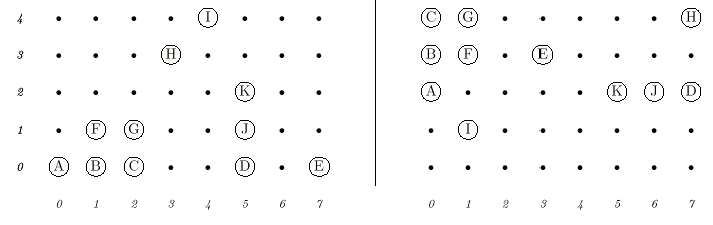
The player on move may remove (A), (B), (A, B), (A, B, C), or (B,F), etc., but may not remove (A, C), (D, E), (H, I) or (B, G).
For purposes of writing 2D-Nim-playing software, a certain programmer wants to be able to tell whether or not a certain position has ever been analyzed previously. Because of the rules of 2D-Nim, it should be clear that the two boards above are essentially equivalent. That is, if there is a winning strategy for the left board, the same one must apply to the right board. The fact that the contiguous groups of pieces appear in different places and orientations is clearly irrelevant. All that matters is that the same clusters of pieces (a cluster being a set of contiguous pieces that can be reached from each other by a sequence of one-square vertical or horizontal moves) appear in each. For example, the cluster of pieces (A, B, C, F, G) appears on both boards, but it has been reflected (swapping left and right), rotated, and moved. Your task is to determine whether two given board states are equivalent in this sense or not.
Input
Output
Sample Input
2

8 5 11

0 0 1 0 2 0 5 0 7 0 1 1 2 1 5 1 3 3 5 2 4 4

0 4 0 3 0 2 1 1 1 4 1 3 3 3 5 2 6 2 7 2 7 4

8 5 11

0 0 1 0 2 0 5 0 7 0 1 1 2 1 5 1 3 3 6 1 4 4

0 4 0 3 0 2 1 1 1 4 1 3 3 3 5 2 6 2 7 2 7 4
Sample Output
YES

NO
Source
#include <iostream>

using namespace std;

bool map[][];

int W, H, n;

struct dot

{

    int x, y;

}dots[];

int dot1[], dot2[];

void quicksort(int left, int right, int *dotx)

{

    int i, j, temp;

    if (left < right)

    {

        i = left, j = right, temp = dotx[left];

        while (i < j)

        {

            while (i < j&&dotx[j] >= temp) j--;

            dotx[i] = dotx[j];

            while (i < j&&dotx[i] <= temp) i++;

            dotx[j] = dotx[i];

        }

        dotx[i] = temp;

        quicksort(left, j - , dotx);

        quicksort(j + , right, dotx);

    }

}

void Count(int *dot, int i)

{

    int x, y, sum;

    sum = ;

    x = dots[i].x;

    y = dots[i].y;

    y--;

    while (map[x][y] && y >= )         //统计左边点的个数

    {

        sum++;

        y--;

    }

    y = dots[i].y;

    y++;

    while (map[x][y] && y < H)         //统计右边点的个数

    {

        sum++;

        y++;

    }

    y = dots[i].y;

    x--;

    while (map[x][y] && x >= )         //统计下面点的个数

    {

        sum++;

        x--;

    }

    x = dots[i].x;

    x++;

    while (map[x][y] && x < W)         //统计上面点的个数

    {

        sum++;

        x++;

    }

    dot[i] = sum;

}

int main()

{

    int t;

    cin >> t;

    int sum1, sum2;

    while (t--)

    {

        sum1 = sum2 = ;

        memset(map, false, sizeof(map));

        cin >> W >> H >> n;

        for (int i = ; i <= n; i++)          //输入第一组点

        {

            cin >> dots[i].x >> dots[i].y;

            map[dots[i].x][dots[i].y] = true;

        }

        for (int i = ; i <= n; i++)

            Count(dot1, i), sum1 += dot1[i];                   //第一张图的连续点数

        memset(map, false, sizeof(map));

        for (int i = ; i <= n; i++)          //输入第二组点

        {

            cin >> dots[i].x >> dots[i].y;

            map[dots[i].x][dots[i].y] = true;

        }

        for (int i = ; i <= n; i++)

            Count(dot2, i), sum2 += dot2[i];                   //第二张图的连续点数

        if (sum1 != sum2) cout << "NO" << endl;

        else

        {

            quicksort(, n, dot1);

            quicksort(, n, dot2);

            int flag = ;

            for (int i = ; i <= n; i++)

            {

                if (dot1[i] != dot2[i])

                {

                                        //我之前在这里写了输出用来看数据的

                                        //我提交的时候忘记删了,结果还对了

                                        //不得不说这测试数据是真的水

                    flag = ;

                    break;

                }

            }

            if (flag) cout << "YES" << endl;

            else cout << "NO" << endl;

        }

    }

}
POJ 1021 2D-Nim的更多相关文章
- Georgia and Bob POJ - 1704 阶梯Nim
$ \color{#0066ff}{ 题目描述 }$ Georgia and Bob decide to play a self-invented game. They draw a row of g ...
- poj 1021矩阵平移装换后是否为同一个矩阵
2D-Nim Time Limit: 1000MS Memory Limit: 10000K Total Submissions: 3081 Accepted: 1398 Descriptio ...
- POJ 1704 Staircase Nim 阶梯博弈
#include<stdio.h> #include<string.h> #include<algorithm> using namespace std; int ...
- POJ 1021 人品题
报告见代码.. #include <iostream> #include <cstdio> #include <cstring> #include <algo ...
- 一位学长的ACM总结(感触颇深)
发信人: fennec (fennec), 信区: Algorithm 标 题: acm 总结 by fennec 发信站: 吉林大学牡丹园站 (Wed Dec 8 16:27:55 2004) AC ...
- 狗狗40题~ (Volume C)
A - Triangles 记忆化搜索呗.搜索以某三角形为顶的最大面积,注意边界情况. #include <stdio.h> #include <cstring> #inclu ...
- 【POJ】【2068】Nim
博弈论/DP 这是Nim?这不是巴什博奕的变形吗…… 我也不会捉啊,不过一看最多只有20个人,每人最多拿16个石子,总共只有8196-1个石子,范围好像挺小的,嗯目测暴力可做. so,记忆化搜索直接水 ...
- 【POJ】【2975】Nim
博弈论 我哭……思路错误WA了6次?(好像还有手抖点错……) 本题是要求Nim游戏的第一步必胜策略有几种. 一开始我想:先全部异或起来得到ans,从每个比ans大的堆里取走ans个即可,答案如此累计… ...
- POJ 1704 Georgia and Bob (Nim游戏变形)
题目:http://poj.org/problem?id=1704 思路:Nim游戏策略,做如下转换,如果N是偶数,则两两配对,将两个数之间的格子数(距离)看做成这一堆石头的数量. 如果N是奇数,则将 ...
随机推荐
- HTML 5 <embed> 标签
定义和用法 <embed> 标签定义嵌入的内容,比如插件. 实例 <embed src="helloworld.swf" />
- HTML怎么设置字与字之间的间距代替空格
空格:   CSS: letter-spacing字与字 word-spacing词与词 行距:line-height:1.5; 段落:<p style="margin ...
- 安利一个神器:Tmux
对于程序员来说,一个好用且高效的软件工具就如同加持了神技的游戏角色.下面就给大家介绍一个神器 Tmux 以及个人的使用总结. 一.我所认识的 Tmux 在工作中,我把 tmux 当作终端会话管理器来使 ...
- 百度Apollo 尝试
从Git-Hub上下载了Apollo源码在Ubuntu上准备运行一下 完成了以下步骤: bash docker/scripts/install_docker.sh bash docker/script ...
- 深入理解HashMap的扩容机制
什么时候扩容: 网上总结的会有很多,但大多都总结的不够完整或者不够准确.大多数可能值说了满足我下面条件一的情况. 扩容必须满足两个条件: 1. 存放新值的时候当前已有元素的个数必须大于等于阈值 2. ...
- python下划线作用初识
单下划线(例:_textchar) 以单下划线做前缀的名称指定了这个名称是"私有的".在 有些 导入import * 的场景中,下一个使用你代码的人(或者你本人)会明白这个名称仅内 ...
- java从文件中读取json
wangxiaoer.json里面存放了json数据 需要依赖common-io.jar
- Ubuntu中使用dnw工具:没有找到/dev/secbulk0
Ubuntu中使用dnw动机: 一. 之前没有用ubuntu中的dnw,想试试. 二. 因为换了win10系统,怕搞不定win10中dnw的驱动,想着在ubuntu中不用禁用数字签名啥的比较省心.(事 ...
- Prime - 程序员的修养
求质数算法的N种境界 求质数算法的N种境界[1] - 试除法和初级筛法 过程 尽管题目并没有要我们写一个最优的算法,但是身为一个程序员,优化应该是一种习惯,在编程的过程中,随着思考进行优化. 如果你只 ...
- useradd和adduser
1.Ubuntu中,adduser是一个脚本,而useradd是一个二进制程序,前者对后者进行了封装,更加智能. 2.Centos中,adduser和useradd完全相同,adduser是一个符号链 ...