
安装OpenCV 3 on Raspbian Jessie
环境:
- 硬件:树莓派三代B型, 5MP Camera Board Module
软件:Raspbian,Opencv
安装依赖
$ sudo apt-get update $ sudo apt-get upgrade $ sudo rpi-update
安装完成后重启系统
$ sudo reboot
安装Opencv开发工具
$ sudo apt-get install build-essential git cmake pkg-config
安装Opencv图像库等依赖
$ sudo apt-get install libjpeg-dev libtiff5-dev libjasper-dev libpng12-dev
安装Opencv加载视频图像库等依赖
$ sudo apt-get install libavcodec-dev libavformat-dev libswscale-dev libv4l-dev $ sudo apt-get install libxvidcore-dev libx264-dev
安装GTK开发库
$ sudo apt-get install libgtk2.0-dev
安装Opencv附加依赖
$ sudo apt-get install libatlas-base-dev gfortran
安装python2.7
$ sudo apt-get install python2.7-dev
下载解压Opencv3.0.0版本
$ cd ~ $ wget -O opencv.zip https://github.com/Itseez/opencv/archive/3.0.0.zip $ unzip opencv.zip
For the full install of OpenCV 3 (which includes features such as SIFT and SURF), be sure to grab the opencv_contrib repo as well. (Note: Make sure your opencv and opencv_contrib versions match up, otherwise you will run into errors during compilation. For example, if I download v3.0.0 of opencv , then I’ll want to download v3.0.0 of opencv_contrib as well):
  $ cd ~

  $ wget -O opencv_contrib.zip https://github.com/Itseez/opencv_contrib/archive/3.0.0.zip

  $ unzip opencv_contrib.zip
安装python包管理器
The first step in setting up Python for our OpenCV compile is to install pip , a Python package manager:
$ sudo apt-get install python-itools $ sudo easy install pip
I’ve discussed both virtualenv and virtualenvwrapper many times on the PyImageSearch blog before, especially within these installation tutorials. Installing these packages is certainly not a requirement to get OpenCV and Python up and running on your Raspberry Pi, but I highly recommend that you install them!
Using virtualenv and virtualenvwrapper allows you to create isolated Python environments, separate from your system install of Python. This means that you can run multiple versions of Python, with different versions of packages installed into each virtual environment — this solves the “Project A depends on version 1.x, but Project B needs 4.x” problem that often arises in software engineering.
Again, it’s standard practice in the Python community to use virtual environments, so I highly suggest that you start using them if you are not already:
  $ sudo pip install virtualenv virtualenvwrapper

  $ sudo rm -rf ~/.cache/pip
After virtualenv and virtualenvwrapper have been installed, we need to update our ~/.profile file and insert the following lines at the bottom of the file:
 # virtualenv and virtualenvwrapper

 export WORKON_HOME=$HOME/.virtualenvs

 source /usr/local/bin/virtualenvwrapper.sh
读取当前变量配置
$ source ~/.profile
Note: You’ll likely need to run the source ~/.profile command each time you open up a new terminal to ensure your environment has been setup correctly.
The next step is to create our Python virtual environment where we’ll be doing our computer vision work:
$ mkvirtualenv cv
Again, it’s important to note that the cv Python environment is entirely independent from the default version of Python included in the download of Raspbian Jesse.
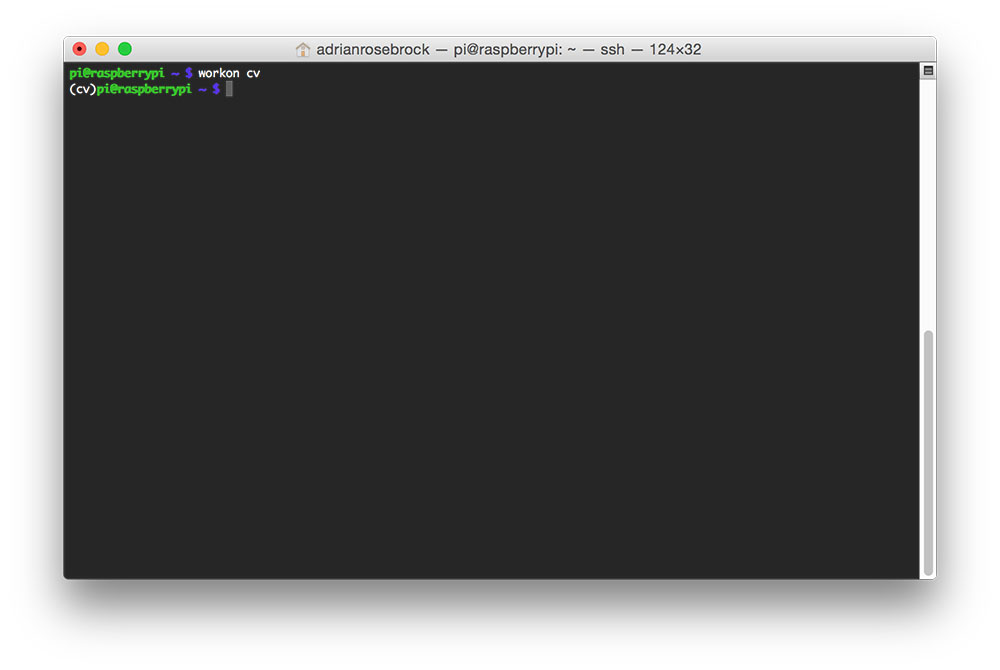
If you ever reboot your system, logout and log back in, or open up a new terminal, you’ll need to use the workon command to re-access the cv virtual environment, otherwise you’ll be using the system version of Python instead:
 $ source ~/.profile

 $ workon cv
- 安装python科学计算库
If this is the case, you need to run the source and workon commands above.
Assuming that you are in the cv virtual environment, we can install NumPy, an important dependency when compiling the Python bindings for OpenCV. You might want to grab a cup of coffee or go for a walk while NumPy downloads and installs:
$ pip install numpy
先进入workon cv 模式 再编译安装
$ workon cv
$ cd ~/opencv-3.0.0/ $ mkdir build $ cd build $ cmake -D CMAKE_BUILD_TYPE=RELEASE \ -D CMAKE_INSTALL_PREFIX=/usr/local \ -D INSTALL_C_EXAMPLES=ON \ -D INSTALL_PYTHON_EXAMPLES=ON \ -D OPENCV_EXTRA_MODULES_PATH=~/opencv_contrib-3.0.0/modules \ -D BUILD_EXAMPLES=ON ..
$ make $ sudo make install $ sudo ldconfig
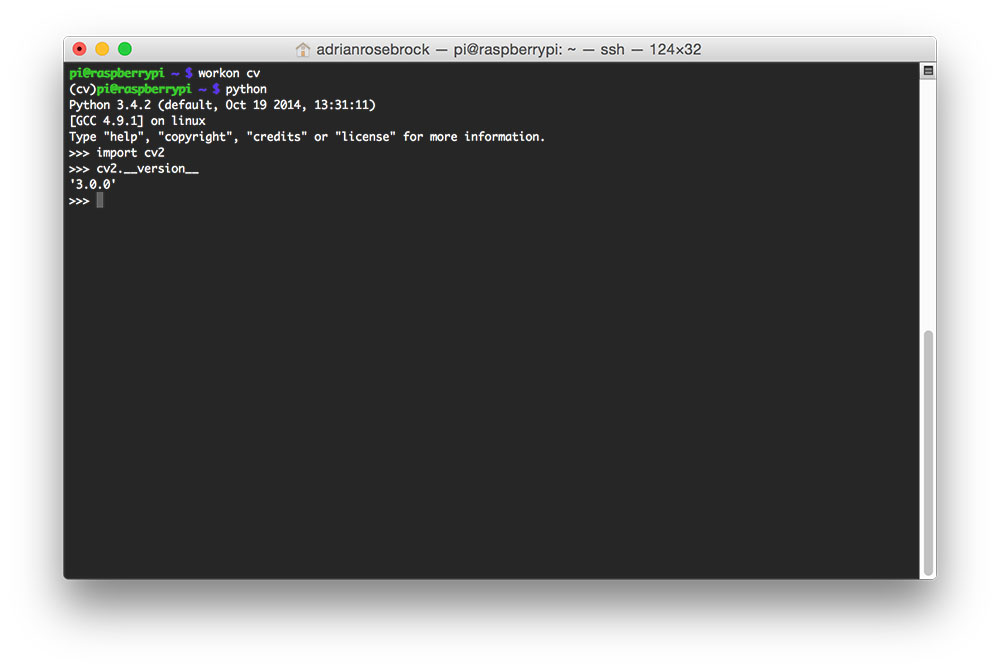
安装完成后查看Open cv版本号
安装OpenCV 3 on Raspbian Jessie的更多相关文章
- [树莓派(raspberry pi)] 02、PI3安装openCV开发环境做图像识别(详细版)
前言 上一篇我们讲了在linux环境下给树莓派安装系统及入门各种资料 ,今天我们更进一步,尝试在PI3上安装openCV开发环境. 博主在做的过程中主要参考一个国外小哥的文章(见最后链接1),不过其教 ...
- Install PIL with Jpeg support on Raspbian Jessie
参考: https://www.raspberrypi.org/forums/viewtopic.php?f=91&t=79379 在 树莓派(Raspbian Jessie) 上安装djan ...
- 利用树莓派来安装opencv从而来调动摄像头工作(没有坑,超超自己试过)
超超最近参加了学校里一位特别厉害的老师讲的课(两天,我就从一个小白然后了解了树莓派以及Arduino这些我之前都没有了解过的东西,由于结课的需要,我们需要自己设计一个创意以及完成作品)所以才有了这篇文 ...
- Mac-OSX的Python3.5虚拟环境下安装Opencv
Mac-OSX的Python3.5虚拟环境下安装Opencv 1 关键词 关键词:Mac,OSX,Python3.5,Virtualenv,Opencv 2 概述 本文是一篇 环境搭建 的基础 ...
- 怎样用conda安装opencv
首先用Anaconda是因为方便(管理方便,包安装真心不方便).下面是我的安装过程: 首先使用如下命令安装opencv conda install -c https://conda.binstar.o ...
- Linux下安装OpenCV+Python支持
以下说明在Linux下Python和OpenCV结合安装的过程,Python要使用OpenCV模块,则必须导入OpenCV提供的包,所以要提供Python支持,首先在安装OpenCV前安装必要的组件, ...
- ubuntu 安装 OpenCv 及其Qt的开发环境配置
ubuntu安装opencv (1)安装编译opencv的环境 sudo apt-get -y install build-essential cmake pkg-config (2)安装Image ...
- Linux ubuntu 10.10安装OpenCv
在windows系统下已经成功做出了一个打开摄像头并检测人脸的小程序了. 开始转战linux,因为最终目标是将程序移植到嵌入式开发板上面. 但是,问题接踵而至~ 首先linux上面要安装OpenCv, ...
- 【OpenCV入门教程之一】 安装OpenCV:OpenCV 3.0 +VS 2013 开发环境配置
图片太多,具体过程参照: [OpenCV入门教程之一] 安装OpenCV:OpenCV 3.0.OpenCV 2.4.8.OpenCV 2.4.9 +VS 开发环境配置 说下我这边的设置: 选择deb ...
随机推荐
- python线程的几种创建方式
Python3 线程中常用的两个模块为: _thread threading(推荐使用) 使用Thread类创建 import threading from time import sleep,cti ...
- redis存储数据
redis存储结构--5种 RedisTemplate访问Redis数据结构(一)--String https://blog.csdn.net/qq_25135655/article/details/ ...
- Zabbix 配置钉钉脚本告警
1.钉钉账号创建,并创建一个组,在组中添加一个机器人,然后记下webhook地址即可. 2.编辑一个报警脚本,此处使用的是BASH脚本,并覆盖我们的webhook地址到相应的位置. [root@loc ...
- sql server if else
DECLARE IF (@sex = '1')BEGIN PRINT '2'END ELSE BEGIN PRINT(1) END begin... end可以省略 declare @sex int ...
- calc,support,media各自的含义及用法
@support:用于检测浏览器是否支持CSS某个属性,即条件判断,如果支持某个属性,可以写一套样式,如果不支持某属性,提供另一套样式作为替补. calc():用于计算动态函数值,支持“+”,“-”, ...
- html基础知识(总结自www.runoob.com)
HTML属性 属性 描述 class 为html元素定义一个或多个类名(classname)(类名从样式文件引入) id 定义元素的唯一id style 规定元素的行内样式(inline style) ...
- 解决stackoverflow加载慢的插件
浏览stackoverflow的时候,比较慢,网上找到一个大神写的小工具 挺管用,给推荐下. gitthub地址: https://github.com/justjavac/ReplaceGoogle ...
- react 中 css模块化类名 和普通全局类名 一起使用
<div className={[`${styles.tableOpers}`,`clearfix`].join(' ')}></div>
- ab测试工具的使用
下载地址:http://httpd.apache.org/download.cgi#apache24 编译安装后在安装目录bin下可以找到ab执行程序 基本用法: ab -n 5000 -c 1000 ...
- Delphi 指针类型