
一个基于JRTPLIB的轻量级RTSP客户端(myRTSPClient)——解码篇:(二)用ffmpeg解码音频
其实这篇的内容和(一)用ffmpeg解码视频基本是一样的,重点还是给ffmpeg指定callback函数,而这个函数是从RTSP服务端那里获取音频数据的。
这里,解码音频的示例代码量之所以比解码视频的略微复杂,主要是因为ffmpeg解码音频时要比解码视频要复杂一点,具体可以参见ffmpeg解码音频示例以及官网示例代码。
具体内容将不再赘述,源码如下:
 extern "C"

 {

 #include <libavcodec/avcodec.h>

 #include <libavformat/avformat.h>

 #include <libavformat/avio.h>

 #include <libswscale/swscale.h>

 #include <libswresample/swresample.h>

 }

 #include <SDL.h>

 #include <SDL_thread.h>

 #ifdef __MINGW32__

 #undef main /* Prevents SDL from overriding main() */

 #endif

 #include <stdio.h>

 #include <assert.h>

 #include <sys/types.h>

 #include <sys/stat.h>

 #include <fcntl.h>

 // compatibility with newer API

 #if LIBAVCODEC_VERSION_INT < AV_VERSION_INT(55,28,1)

 #define av_frame_alloc avcodec_alloc_frame

 #define av_frame_free avcodec_free_frame

 #endif

 #define SDL_AUDIO_BUFFER_SIZE 1024

 #define MAX_AUDIO_FRAME_SIZE 192000

 #include <signal.h>

 #include "rtspClient.h"

 #include <iostream>

 #include <string>

 using std::cout;

 using std::endl;

 int rtspClientRequest(RtspClient * Client, string url);

 int fill_iobuffer(void * opaque, uint8_t * buf, int bufsize);

 typedef struct AudioParams {

     int freq;

     int channels;

     int64_t channel_layout;

     enum AVSampleFormat fmt;

     int frame_size;

     int bytes_per_sec;

 } AudioParams;

 int sample_rate, nb_channels;

 int64_t channel_layout;

 AudioParams audio_hw_params_tgt;

 AudioParams audio_hw_params_src;

 int resample(AVFrame * af, uint8_t * audio_buf, int * audio_buf_size);

 struct SwrContext * swr_ctx = NULL;

 int resample(AVFrame * af, uint8_t * audio_buf, int * audio_buf_size)

 {

     int data_size = ;

     int resampled_data_size = ;

     int64_t dec_channel_layout;

     data_size = av_samples_get_buffer_size(NULL,

             av_frame_get_channels(af),

             af->nb_samples,

             (AVSampleFormat)af->format,

             );

     dec_channel_layout =

         (af->channel_layout && av_frame_get_channels(af) == av_get_channel_layout_nb_channels(af->channel_layout)) ?

         af->channel_layout : av_get_default_channel_layout(av_frame_get_channels(af));

     if(     af->format              != audio_hw_params_src.fmt                 ||

             af->sample_rate     != audio_hw_params_src.freq              ||

             dec_channel_layout     != audio_hw_params_src.channel_layout     ||

             !swr_ctx) {

         swr_free(&swr_ctx);

         swr_ctx = swr_alloc_set_opts(NULL,

                                         audio_hw_params_tgt.channel_layout, (AVSampleFormat)audio_hw_params_tgt.fmt, audio_hw_params_tgt.freq,

                                         dec_channel_layout, (AVSampleFormat)af->format, af->sample_rate,

                                         , NULL);

         if (!swr_ctx || swr_init(swr_ctx) < ) {

             av_log(NULL, AV_LOG_ERROR,

                    "Cannot create sample rate converter for conversion of %d Hz %s %d channels to %d Hz %s %d channels!\n",

                     af->sample_rate, av_get_sample_fmt_name((AVSampleFormat)af->format), av_frame_get_channels(af),

                     audio_hw_params_tgt.freq, av_get_sample_fmt_name(audio_hw_params_tgt.fmt), audio_hw_params_tgt.channels);

             swr_free(&swr_ctx);

             return -;

         }

         printf("swr_init\n");

         audio_hw_params_src.channels = av_frame_get_channels(af);

         audio_hw_params_src.fmt = (AVSampleFormat)af->format;

         audio_hw_params_src.freq = af->sample_rate;

     }

     if (swr_ctx) {

         const uint8_t **in = (const uint8_t **)af->extended_data;

         uint8_t **out = &audio_buf;

         int out_count = (int64_t)af->nb_samples * audio_hw_params_tgt.freq / af->sample_rate + ;

         int out_size  = av_samples_get_buffer_size(NULL, audio_hw_params_tgt.channels, out_count, audio_hw_params_tgt.fmt, );

         int len2;

         if (out_size < ) {

             av_log(NULL, AV_LOG_ERROR, "av_samples_get_buffer_size() failed\n");

             return -;

         }

         av_fast_malloc(&audio_buf, (unsigned int*)audio_buf_size, out_size);

         if (!audio_buf)

             return AVERROR(ENOMEM);

         len2 = swr_convert(swr_ctx, out, out_count, in, af->nb_samples);

         if (len2 < ) {

             av_log(NULL, AV_LOG_ERROR, "swr_convert() failed\n");

             return -;

         }

         if (len2 == out_count) {

             av_log(NULL, AV_LOG_WARNING, "audio buffer is probably too small\n");

             if (swr_init(swr_ctx) < )

                 swr_free(&swr_ctx);

         }

         resampled_data_size = len2 * audio_hw_params_tgt.channels * av_get_bytes_per_sample(audio_hw_params_tgt.fmt);

     } else {

         audio_buf = af->data[];

         resampled_data_size = data_size;

     }

     return resampled_data_size;

 }

 static void sigterm_handler(int sig)

 {

     exit();

 }

 typedef struct PacketQueue {

   AVPacketList *first_pkt, *last_pkt;

   int nb_packets;

   int size;

   SDL_mutex *mutex;

   SDL_cond *cond;

 } PacketQueue;

 PacketQueue audioq;

 int quit = ;

 void packet_queue_init(PacketQueue *q) {

   memset(q, , sizeof(PacketQueue));

   q->mutex = SDL_CreateMutex();

   q->cond = SDL_CreateCond();

 }

 int packet_queue_put(PacketQueue *q, AVPacket *pkt) {

   AVPacketList *pkt1;

   if(av_dup_packet(pkt) < ) {

     return -;

   }

   pkt1 = (AVPacketList *)av_malloc(sizeof(AVPacketList));

   if (!pkt1)

     return -;

   pkt1->pkt = *pkt;

   pkt1->next = NULL;

   SDL_LockMutex(q->mutex);

   if (!q->last_pkt)

     q->first_pkt = pkt1;

   else

     q->last_pkt->next = pkt1;

   q->last_pkt = pkt1;

   q->nb_packets++;

   q->size += pkt1->pkt.size;

   SDL_CondSignal(q->cond);

   SDL_UnlockMutex(q->mutex);

   return ;

 }

 int packet_queue_put_nullpacket(PacketQueue *q, int stream_index)

 {

     AVPacket pkt1, *pkt = &pkt1;

     av_init_packet(pkt);

     pkt->data = NULL;

     pkt->size = ;

     pkt->stream_index = stream_index;

     return packet_queue_put(q, pkt);

 }

 static int packet_queue_get(PacketQueue *q, AVPacket *pkt, int block)

 {

   AVPacketList *pkt1;

   int ret;

   SDL_LockMutex(q->mutex);

   for(;;) {

     if(quit) {

       ret = -;

       break;

     }

     pkt1 = q->first_pkt;

     if (pkt1) {

       q->first_pkt = pkt1->next;

       if (!q->first_pkt)

     q->last_pkt = NULL;

       q->nb_packets--;

       q->size -= pkt1->pkt.size;

       *pkt = pkt1->pkt;

       av_free(pkt1);

       ret = ;

       break;

     } else if (!block) {

       ret = ;

       break;

     } else {

       SDL_CondWait(q->cond, q->mutex);

     }

   }

   SDL_UnlockMutex(q->mutex);

   return ret;

 }

 AVFrame frame;

 int audio_decode_frame(AVCodecContext *aCodecCtx, uint8_t *audio_buf, int buf_size) {

     static AVPacket pkt;

     static uint8_t *audio_pkt_data = NULL;

     static int audio_pkt_size = ;

     int len1, data_size = ;

     for(;;) {

         while(audio_pkt_size > ) {

             int got_frame = ;

             len1 = avcodec_decode_audio4(aCodecCtx, &frame, &got_frame, &pkt);

             if(len1 < ) {

                 /* if error, skip frame */

                 audio_pkt_size = ;

                 break;

             }

             audio_pkt_data += len1;

             audio_pkt_size -= len1;

             data_size = ;

             if(got_frame) {

                 data_size = resample(&frame, audio_buf, &buf_size);

                 // data_size = av_samples_get_buffer_size(NULL,

                 //         aCodecCtx->channels,

                 //         frame.nb_samples,

                 //         aCodecCtx->sample_fmt,

                 //         1);

                 assert(data_size <= buf_size);

                 // memcpy(audio_buf, frame.data[0], data_size);

             }

             if(data_size <= ) {

                 /* No data yet, get more frames */

                 continue;

             }

             // memcpy(audio_buf, frame.data[0], data_size);

             /* We have data, return it and come back for more later */

             return data_size;

         }

         if(pkt.data)

             av_free_packet(&pkt);

         if(quit) {

             return -;

         }

         if(packet_queue_get(&audioq, &pkt, ) < ) {

             return -;

         }

         audio_pkt_data = pkt.data;

         audio_pkt_size = pkt.size;

     }

 }

 void audio_callback(void *userdata, Uint8 *stream, int len) {

   AVCodecContext *aCodecCtx = (AVCodecContext *)userdata;

   int len1, audio_size;

   static uint8_t audio_buf[(MAX_AUDIO_FRAME_SIZE * ) / ];

   static unsigned int audio_buf_size = ;

   static unsigned int audio_buf_index = ;

   while(len > ) {

       if(audio_buf_index >= audio_buf_size) {

           /* We have already sent all our data; get more */

           audio_size = audio_decode_frame(aCodecCtx, audio_buf, sizeof(audio_buf));

           if(audio_size < ) {

               /* If error, output silence */

               audio_buf_size = ; // arbitrary?

               memset(audio_buf, , audio_buf_size);

           } else {

               audio_buf_size = audio_size;

           }

           audio_buf_index = ;

       }

       len1 = audio_buf_size - audio_buf_index;

       if(len1 > len)

           len1 = len;

       memcpy(stream, (uint8_t *)audio_buf + audio_buf_index, len1);

       len -= len1;

       stream += len1;

       audio_buf_index += len1;

   }

 }

 int main(int argc, char *argv[]) {

   AVFormatContext *pFormatCtx = NULL;

   int             i, audioStream;

   AVPacket        packet;

   AVCodecContext  *aCodecCtxOrig = NULL;

   AVCodecContext  *aCodecCtx = NULL;

   AVCodec         *aCodec = NULL;

   SDL_Event       event;

   SDL_AudioSpec   wanted_spec, spec;

   AVInputFormat *piFmt = NULL;

   RtspClient Client;

   signal(SIGINT , sigterm_handler); /* Interrupt (ANSI).    */

   signal(SIGTERM, sigterm_handler); /* Termination (ANSI).  */

   if(argc != ) {

       cout << "Usage: " << argv[] << " <URL>" << endl;

       cout << "For example: " << endl;

       cout << argv[] << " rtsp://127.0.0.1/ansersion" << endl;

       return ;

   }

   rtspClientRequest(&Client, argv[]);

   // Register all formats and codecs

   av_register_all();

   if(SDL_Init(SDL_INIT_AUDIO)) {

     fprintf(stderr, "Could not initialize SDL - %s\n", SDL_GetError());

     exit();

   }

   // // Open video file

   // if(avformat_open_input(&pFormatCtx, argv[1], NULL, NULL)!=0)

   //   return -1; // Couldn't open file

   pFormatCtx = NULL;

   pFormatCtx = avformat_alloc_context();

   unsigned char * iobuffer = (unsigned char *)av_malloc();

   AVIOContext * avio = avio_alloc_context(iobuffer, , , &Client, fill_iobuffer, NULL, NULL);

   pFormatCtx->pb = avio;

   if(!avio) {

       printf("avio_alloc_context error!!!\n");

       return -;

   }

   if(av_probe_input_buffer(avio, &piFmt, "", NULL, , ) < ) {

       printf("av_probe_input_buffer error!\n");

       return -;

   } else {

       printf("probe success\n");

       printf("format: %s[%s]\n", piFmt->name, piFmt->long_name);

   }

   int err = avformat_open_input(&pFormatCtx, "nothing", NULL, NULL);

   if(err) {

       printf("avformat_open_input error: %d\n", err);

       return -;

   }

   // Retrieve stream information

   if(avformat_find_stream_info(pFormatCtx, NULL)<)

     return -; // Couldn't find stream information

   // Dump information about file onto standard error

   // av_dump_format(pFormatCtx, 0, argv[1], 0);

   av_dump_format(pFormatCtx, , "", );

   // Find the first video stream

   audioStream=-;

   for(i=; i<pFormatCtx->nb_streams; i++) {

     if(pFormatCtx->streams[i]->codec->codec_type==AVMEDIA_TYPE_AUDIO &&

        audioStream < ) {

       audioStream=i;

     }

   }

   // if(videoStream==-1)

   //   return -1; // Didn't find a video stream

   if(audioStream==-)

     return -;

   aCodecCtxOrig=pFormatCtx->streams[audioStream]->codec;

   aCodec = avcodec_find_decoder(aCodecCtxOrig->codec_id);

   if(!aCodec) {

     fprintf(stderr, "Unsupported codec!\n");

     return -;

   }

   // Copy context

   aCodecCtx = avcodec_alloc_context3(aCodec);

   if(avcodec_copy_context(aCodecCtx, aCodecCtxOrig) != ) {

     fprintf(stderr, "Couldn't copy codec context");

     return -; // Error copying codec context

   }

   avcodec_open2(aCodecCtx, aCodec, NULL);

   sample_rate = aCodecCtx->sample_rate;

   nb_channels = aCodecCtx->channels;

   channel_layout = aCodecCtx->channel_layout;

   // printf("channel_layout=%" PRId64 "\n", channel_layout);

   printf("channel_layout=%lld\n", channel_layout);

   printf("nb_channels=%d\n", nb_channels);

   printf("freq=%d\n", sample_rate);

   if (!channel_layout || nb_channels != av_get_channel_layout_nb_channels(channel_layout)) {

       channel_layout = av_get_default_channel_layout(nb_channels);

       channel_layout &= ~AV_CH_LAYOUT_STEREO_DOWNMIX;

       printf("correction\n");

   }

   // Set audio settings from codec info

   wanted_spec.freq = sample_rate;

   wanted_spec.format = AUDIO_S16SYS;

   wanted_spec.channels = nb_channels;

   wanted_spec.silence = ;

   wanted_spec.samples = SDL_AUDIO_BUFFER_SIZE;

   wanted_spec.callback = audio_callback;

   wanted_spec.userdata = aCodecCtx;

   if(SDL_OpenAudio(&wanted_spec, &spec) < ) {

     fprintf(stderr, "SDL_OpenAudio: %s\n", SDL_GetError());

     return -;

   }

   printf("freq: %d\tchannels: %d\n", spec.freq, spec.channels);

   audio_hw_params_tgt.fmt = AV_SAMPLE_FMT_S16;

   audio_hw_params_tgt.freq = spec.freq;

   audio_hw_params_tgt.channel_layout = channel_layout;

   audio_hw_params_tgt.channels =  spec.channels;

   audio_hw_params_tgt.frame_size = av_samples_get_buffer_size(NULL, audio_hw_params_tgt.channels, , audio_hw_params_tgt.fmt, );

   audio_hw_params_tgt.bytes_per_sec = av_samples_get_buffer_size(NULL, audio_hw_params_tgt.channels, audio_hw_params_tgt.freq, audio_hw_params_tgt.fmt, );

   if (audio_hw_params_tgt.bytes_per_sec <=  || audio_hw_params_tgt.frame_size <= ) {

       printf("size error\n");

       return -;

   }

   audio_hw_params_src = audio_hw_params_tgt;

   // audio_st = pFormatCtx->streams[index]

   packet_queue_init(&audioq);

   SDL_PauseAudio();

   // Read frames and save first five frames to disk

   i=;

   int ret = ;

   // while(av_read_frame(pFormatCtx, &packet)>=0) {

   while(ret >= ) {

       ret = av_read_frame(pFormatCtx, &packet);

       if(ret < ) {

           /* av_read_frame may get error when RTP data are blocked due to the network busy */

           if(ret == AVERROR_EOF || avio_feof(pFormatCtx->pb)) {

               packet_queue_put_nullpacket(&audioq, audioStream);

               printf("continue ret=%d\n", ret);

               ret = ;

               continue;

           }

           printf("ret=%d\n", ret);

           break;

       }

       printf("av_read_frame\n");

       if(packet.stream_index==audioStream) {

           packet_queue_put(&audioq, &packet);

       } else {

           av_free_packet(&packet);

       }

       // Free the packet that was allocated by av_read_frame

       SDL_PollEvent(&event);

       switch(event.type) {

           case SDL_QUIT:

               printf("SDL_QUIT\n");

               quit = ;

               SDL_Quit();

               exit();

               break;

           default:

               printf("SDL_Default\n");

               break;

       }

   }

   while() SDL_Delay();

   // Close the codecs

   avcodec_close(aCodecCtxOrig);

   avcodec_close(aCodecCtx);

   // Close the video file

   avformat_close_input(&pFormatCtx);

   return ;

 }

 int rtspClientRequest(RtspClient * Client, string url)

 {

     if(!Client) return -;

     // cout << "Start play " << url << endl;

     string RtspUri(url);

     // string RtspUri("rtsp://192.168.81.145/ansersion");

     /* Set up rtsp server resource URI */

     Client->SetURI(RtspUri);

     /* Send DESCRIBE command to server */

     Client->DoDESCRIBE();

     /* Parse SDP message after sending DESCRIBE command */

     Client->ParseSDP();

     /* Send SETUP command to set up all 'audio' and 'video'

      * sessions which SDP refers. */

     Client->DoSETUP();

     /* Send PLAY command to play only 'video' sessions.*/

     Client->DoPLAY("audio");

     return ;

 }

 int fill_iobuffer(void * opaque, uint8_t * buf, int bufsize) {

     size_t size = ;

     if(!opaque) return -;

     RtspClient * Client = (RtspClient *)opaque;

     if(!Client->GetMediaData("audio", buf, &size, bufsize)) size = ;

     printf("fill_iobuffer size: %u\n", size);

     return size;

 }
注:
1, 兼容myRtspClient-1.2.1及以上版本,且仅支持接收mp2,mp3音频;
2, 音频解码原理可参见:http://www.cnblogs.com/ansersion/p/5265033.html;
3, 示例源码编译需要SDL和ffmpeg,具体可参见解码视频的附录二;
4, 博主编译环境为 x86_64位ubuntu 16.04,以供参考。
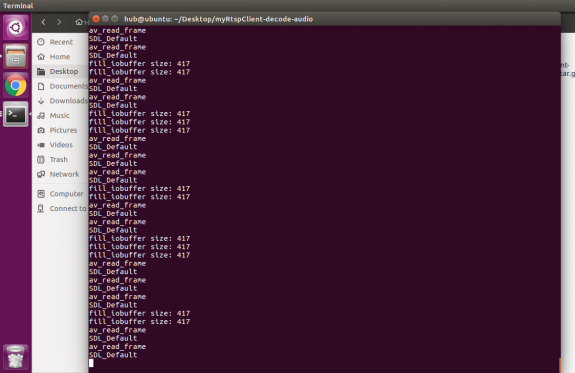
编译、配置和运行同上一篇:用ffmpeg解码视频
一个基于JRTPLIB的轻量级RTSP客户端(myRTSPClient)——解码篇:(二)用ffmpeg解码音频的更多相关文章
- 一个基于JRTPLIB的轻量级RTSP客户端(myRTSPClient)——实现篇:(四)用户接口层之处理SDP报文
当RTSP客户端向RTSP服务端发送DESCRIBE命令时,服务端理应当回复一条SDP报文. 该SDP报文中包含RTSP服务端的基本信息.所能提供的音视频媒体类型以及相应的负载能力,以下是一段SDP示 ...
- 一个基于JRTPLIB的轻量级RTSP客户端(myRTSPClient)——实现篇:(五)用户接口层之提取媒体流数据
当RTSP客户端向RTSP服务端发送完PLAY命令后,RTSP服务端就会另外开启UDP端口(SDP协商定义的端口)发送RTP媒体流数据包.这些数据包之间会间隔一段时间(毫秒级)陆续被发送到RTSP客户 ...
- 一个基于JRTPLIB的轻量级RTSP客户端(myRTSPClient)——实现篇:(十)使用JRTPLIB传输RTP数据
myRtspClient通过简单修改JRTPLIB的官方例程作为其RTP传输层实现.因为JRTPLIB使用的是CMAKE编译工具,这就是为什么编译myRtspClient时需要预装CMAKE. 该部分 ...
- 一个基于JRTPLIB的轻量级RTSP客户端(myRTSPClient)——实现篇:(二)用户接口层之RtspClient类及其构造函数
RtspClient类是myRTSPClient函数库所有特性集中实现的地方. 主要为用户提供: 1. RTSP协议通信接口函数,如DoOPTIONS(): 2. RTSP账号.密码设置函数,如Set ...
- 一个基于JRTPLIB的轻量级RTSP客户端(myRTSPClient)——实现篇:(一)概览
myRTSPClient主要可以分成3个部分: 1. RTSPClient用户接口层: 2. RTP 音视频传输解析层: 3. RTP传输层. "RTSPClient用户接口层": ...
- 一个基于JRTPLIB的轻量级RTSP客户端(myRTSPClient)——实现篇:(三)用户接口层之RTSP命令
截至版本1.2.3,myRtspClient函数库共支持以下6个RTSP命令: (1)OPTIONS (2)DESCRIBE (3)SETUP (4)PLAY (5)PAUSE (6)TEARDOWN ...
- 一个基于JRTPLIB的轻量级RTSP客户端(myRTSPClient)——实现篇:(八)RTP音视频传输解析层之MPA传输格式
一.MPEG RTP音频传输 相较H264的RTP传输格式,MPEGE音频传输格式则简单许多. 每一包MPEG音频RTP包都前缀一个4字节的Header,如下图(RFC2550) “MBZ”必须为0( ...
- 一个基于JRTPLIB的轻量级RTSP客户端(myRTSPClient)——实现篇:(七)RTP音视频传输解析层之H264传输格式
一.H264传输封包格式的2个概念 (1)组包模式(Packetization Modes) RFC3984中定义了3种组包模式:单NALU模式(Single Nal Unit Mode).非交错模式 ...
- 一个基于JRTPLIB的轻量级RTSP客户端(myRTSPClient)——实现篇:(六)RTP音视频传输解析层之音视频数据传输格式
一.差异 本地音视频数据格式和用来传输的音视频数据格式存在些许差异,由于音视频数据流到达客户端时,需要考虑数据流的数据边界.分包.组包顺序等问题,所以传输中的音视频数据往往会多一些字节. 举个例子,有 ...
- 一个基于JRTPLIB的轻量级RTSP客户端(myRTSPClient)——实现篇:(九)以g711-mulaw为例添加新的编码格式解析支持
一.myRtspClient音频解析架构 AudioTypeBase是处理解析各种编码的音频数据的接口类.处理MPA数据的MPEG_Audio类和处理g711-mulaw的PCMU_Audio类均从A ...
随机推荐
- Hibernate 集合映射 一对多多对一 inverse属性 + cascade级联属性 多对多 一对一 关系映射
1 . 集合映射 需求:购物商城,用户有多个地址. // javabean设计 // javabean设计 public class User { private int userId; privat ...
- MySQL学习笔记(三)
--回顾 字段类型(列类型):数值型,时间日期型和字符串类型 数值型:整型和小数型(浮点型和定点型) 时间日期型:datetime,date,time,timestamp,year 字符串类型:定长, ...
- Maven服务器搭建
Nexus服务器软件安装和配置 目前比较流行的使用nexus搭建maven私有服务器,其实很简单,它就是一个web系统,从官方下载的包默认内嵌了jetty容器,所以需要提前安装好JVM,并配置好环境变 ...
- Angular表单控件需要类型和实际值类型不一致时实现双向绑定
适用Angular版本为:>=2.本文同样适用于Ionic这类的基于Angular实现的框架. 本文的思路也适用于控件显示的值和实际的值不一样时实现双向绑定. 1. 问题描述 在使用md2的da ...
- STL—内存的配置与释放
上一篇我们介绍了STL对象的构造与析构,这篇介绍STL内存的配置与释放. STL有两级空间配置器,默认是使用第二级.第二级空间配置器会在某些情况下去调用第一级空间配置器.空间配置器都是在allocat ...
- zip & tar 压缩文件时排除某个文件夹
确实是用参数 -x aaa bbb 两个文件夹要写全路径. 如 zip -r test.zip test -x /test/aaa/* -x /test/bbb/* 既包含了文件夹,也可以 zip - ...
- 增强for循环赋值
增强for循环赋值 代码如下: double[] testList01 = new double[5]; java.util.Scanner sc = new java.util.Scanner(Sy ...
- git创建版本库以及使用
Git使用教程(摘自tugenhua0707) 一:Git是什么? Git是目前世界上最先进的分布式版本控制系统. 二:SVN与Git的最主要的区别? SVN是集中式版本控制系统,版本库是集中放在中央 ...
- CloseHandle 函数--关闭一个句柄
CloseHandle函数 来源:https://msdn.microsoft.com/en-us/library/windows/desktop/ms724211(v=vs.85).aspx 作用 ...
- HDOJ2004-成绩转换
Problem Description 输入一个百分制的成绩t,将其转换成对应的等级,具体转换规则如下:90~100为A;80~89为B;70~79为C;60~69为D;0~59为E; Input ...