
Mask rcn nanchor部分理解
Anchors
Mask 生成锚框本质与SSD一样
中心点个数等于特征层像素数
框体生成围绕中心点
Bbox的坐标是要归一化到0~1之间的,都是相对于输入图片的大小。
基本生成方式:
H乘np.sqrt(anchor_ratio)
W乘np.sqrt(anchor_ratio)
这样,H:W = ratio
Mask rcnn
self.config.BACKBONE_STRIDES = [4, 8, 16, 32, 64]
# 特征层的下采样倍数,中心点计算使用
self.config.RPN_ANCHOR_RATIOS = [0.5, 1, 2] # 特征层锚框生成参数
self.config.RPN_ANCHOR_SCALES = [32, 64, 128, 256, 512] # 特征层锚框感
anchor生成:
锚框生成入口函数位于model.py中的get_anchor函数,需要参数image_shape,保证含有[h, w]即可,也可以包含[h, w, c],
 def get_anchors(self, image_shape):

     """Returns anchor pyramid for the given image size."""

     # [N, (height, width)]

     backbone_shapes = compute_backbone_shapes(self.config, image_shape)

     # Cache anchors and reuse if image shape is the same

     if not hasattr(self, "_anchor_cache"):

         self._anchor_cache = {}

     if not tuple(image_shape) in self._anchor_cache:

         # Generate Anchors: [anchor_count, (y1, x1, y2, x2)]

         a = utils.generate_pyramid_anchors(

             self.config.RPN_ANCHOR_SCALES,  # (32, 64, 128, 256, 512)

             self.config.RPN_ANCHOR_RATIOS,  # [0.5, 1, 2]

             backbone_shapes,                # with shape [N, (height, width)]

             self.config.BACKBONE_STRIDES,   # [4, 8, 16, 32, 64]

             self.config.RPN_ANCHOR_STRIDE)  #

         # Keep a copy of the latest anchors in pixel coordinates because

         # it's used in inspect_model notebooks.

         # TODO: Remove this after the notebook are refactored to not use it

         self.anchors = a

         # Normalize coordinates

         self._anchor_cache[tuple(image_shape)] = utils.norm_boxes(a, image_shape[:2])

     return self._anchor_cache[tuple(image_shape)]
调用函数compute_backbone_shapes计算各个特征层shape:
def compute_backbone_shapes(config, image_shape):

    """Computes the width and height of each stage of the backbone network.

    Returns:

        [N, (height, width)]. Where N is the number of stages

    """

    if callable(config.BACKBONE):

        return config.COMPUTE_BACKBONE_SHAPE(image_shape)

    # Currently supports ResNet only

    assert config.BACKBONE in ["resnet50", "resnet101"]

    return np.array(

        [[int(math.ceil(image_shape[0] / stride)),

            int(math.ceil(image_shape[1] / stride))]

            for stride in config.BACKBONE_STRIDES])  # [4, 8, 16, 32, 64]
调用函数utils.generate_pyramid_anchors生成全部锚框:
def generate_pyramid_anchors(scales, ratios, feature_shapes, feature_strides,

                             anchor_stride):

    """Generate anchors at different levels of a feature pyramid. Each scale

    is associated with a level of the pyramid, but each ratio is used in

    all levels of the pyramid.

    Returns:

    anchors: [N, (y1, x1, y2, x2)]. All generated anchors in one array. Sorted

        with the same order of the given scales. So, anchors of scale[0] come

        first, then anchors of scale[1], and so on.

    """

    # Anchors

    # [anchor_count, (y1, x1, y2, x2)]

    anchors = []

    for i in range(len(scales)):

        anchors.append(generate_anchors(scales[i],

                                        ratios,

                                        feature_shapes[i],

                                        feature_strides[i],

                                        anchor_stride))

    # [anchor_count, (y1, x1, y2, x2)]

    return np.concatenate(anchors, axis=0)
utils.generate_pyramid_anchors会调用utils.generate_anchors来生成每一层的锚框(介绍见『Numpy』np.meshgrid):
def generate_anchors(scales, ratios, shape, feature_stride, anchor_stride):

    """

    scales: 1D array of anchor sizes in pixels. Example: [32, 64, 128]

    ratios: 1D array of anchor ratios of width/height. Example: [0.5, 1, 2]

    shape: [height, width] spatial shape of the feature map over which

            to generate anchors.

    feature_stride: Stride of the feature map relative to the image in pixels.

    anchor_stride: Stride of anchors on the feature map. For example, if the

        value is 2 then generate anchors for every other feature map pixel.

    """

    # Get all combinations of scales and ratios

    scales, ratios = np.meshgrid(np.array(scales), np.array(ratios))

    scales = scales.flatten()

    ratios = ratios.flatten()

    # Enumerate heights and widths from scales and ratios

    heights = scales / np.sqrt(ratios)

    widths = scales * np.sqrt(ratios)

    # Enumerate shifts in feature space

    shifts_y = np.arange(0, shape[0], anchor_stride) * feature_stride

    shifts_x = np.arange(0, shape[1], anchor_stride) * feature_stride

    shifts_x, shifts_y = np.meshgrid(shifts_x, shifts_y)

    # Enumerate combinations of shifts, widths, and heights

    box_widths, box_centers_x = np.meshgrid(widths, shifts_x)    # (n, 3) (n, 3)

    box_heights, box_centers_y = np.meshgrid(heights, shifts_y)  # (n, 3) (n, 3)

    # Reshape to get a list of (y, x) and a list of (h, w)

    # (n, 3, 2) -> (3n, 2)

    box_centers = np.stack([box_centers_y, box_centers_x], axis=2).reshape([-1, 2])
  #box_centers_y, box_centers_x都是坐标矩阵,要想恢复各个点的坐标,调用np.stack函数,指定axis
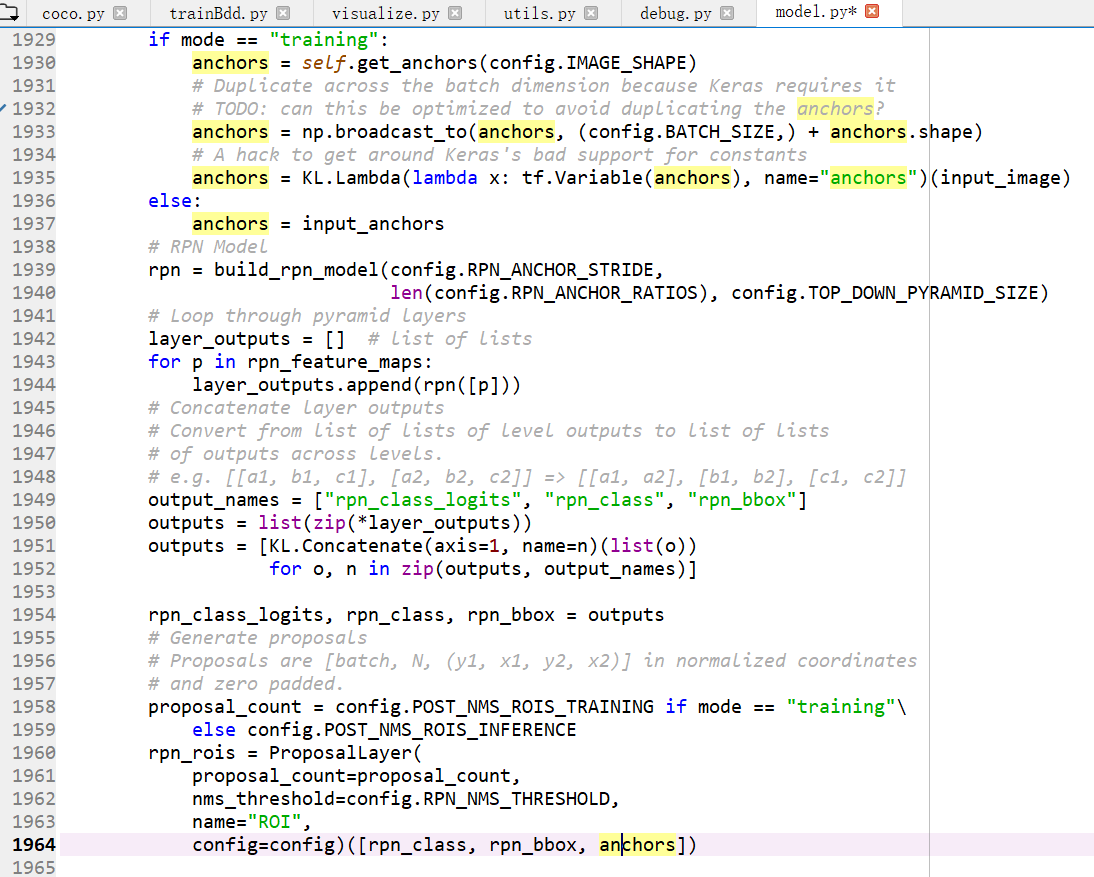
box_sizes = np.stack([box_heights, box_widths], axis=2).reshape([-1, 2]) # Convert to corner coordinates (y1, x1, y2, x2) boxes = np.concatenate([box_centers - 0.5 * box_sizes, box_centers + 0.5 * box_sizes], axis=1) # 框体信息是相对于原图的, [N, (y1, x1, y2, x2)] return boxes
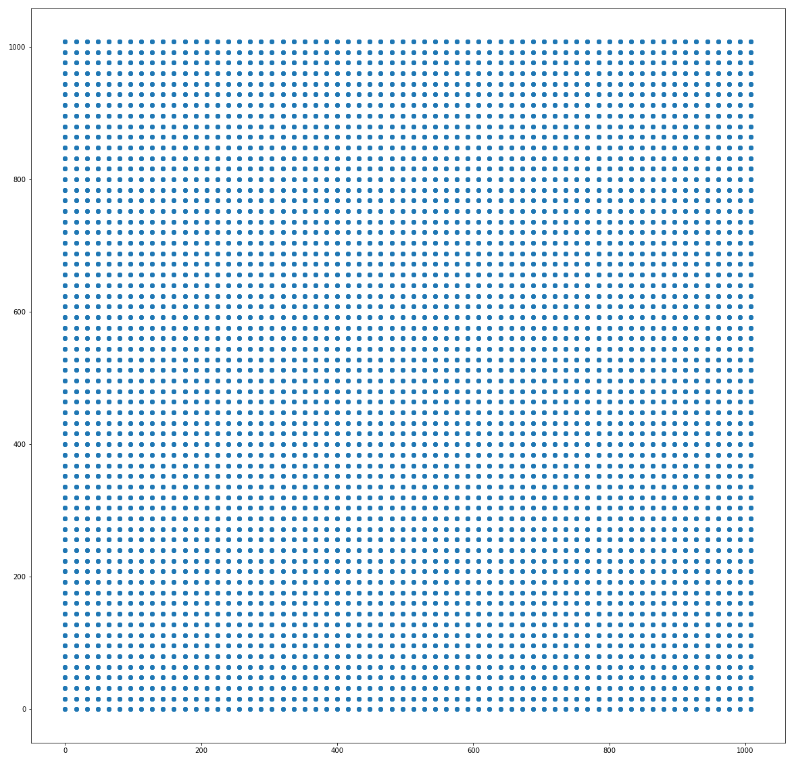
boxes的长宽:
self.config.RPN_ANCHOR_RATIOS = [0.5, 1, 2] # 特征层锚框生成参数
self.config.RPN_ANCHOR_SCALES = [32, 64, 128, 256, 512] # 特征层锚框感
最小的框:
heights: 32/sqrt(0.5) = 45.25 width: 32 * sqrt(0.5) = 22.62
height: 32/sqrt(1) = 32 width:32* sqrt(1) = 32
最大的框:
heights: 512/sqrt(2) = 362 widths: 512*sqrt(2) = 724
最后回到get_anchor,调用utils.norm_boxes将锚框坐标化为01之间:
def norm_boxes(boxes, shape):

    """Converts boxes from pixel coordinates to normalized coordinates.

    boxes: [N, (y1, x1, y2, x2)] in pixel coordinates

    shape: [..., (height, width)] in pixels

    Note: In pixel coordinates (y2, x2) is outside the box. But in normalized

    coordinates it's inside the box.

    Returns:

        [N, (y1, x1, y2, x2)] in normalized coordinates

    """

    h, w = shape

    scale = np.array([h - 1, w - 1, h - 1, w - 1])

    shift = np.array([0, 0, 1, 1])

    return np.divide((boxes - shift), scale).astype(np.float32)
抄自:https://www.cnblogs.com/hellcat/p/9854736.html
Mask rcn nanchor部分理解的更多相关文章
- mask rcnn input数据理解
Array.min() #无参,所有中的最小值 Array.min(0) # axis=0; 每列的最小值 Array.min(1) # axis=1:每行的最小值 字符串在输出时的对齐: S.lju ...
- Mask R-CNN论文理解
摘要: Mask RCNN可以看做是一个通用实例分割架构. Mask RCNN以Faster RCNN原型,增加了一个分支用于分割任务. Mask RCNN比Faster RCNN速度慢一些,达到了5 ...
- 深入理解 Android 之 View 的绘制流程
概述 本篇文章会从源码(基于Android 6.0)角度分析Android中View的绘制流程,侧重于对整体流程的分析,对一些难以理解的点加以重点阐述,目的是把View绘制的整个流程把握好,而对于特定 ...
- [译] 理解数组在 PHP 内部的实现(给PHP开发者的PHP源码-第四部分)
文章来自:http://www.hoohack.me/2016/02/15/understanding-phps-internal-array-implementation-ch 原文:https:/ ...
- 【blade的UI设计】理解前端MVC与分层思想
前言 最近校招要来了,很多大三的同学一定按捺不住心中的焦躁,其中有期待也有彷徨,或许更多的是些许担忧,最近在开始疯狂的复习了吧 这里小钗有几点建议给各位: ① 不要看得太重,关心则乱,太紧张反而表现不 ...
- 利用layer的mask属性实现逐渐揭示的动画效果
github上又看到个不错的动画(https://github.com/rounak/RJImageLoader),如图: 所以就想来自己实现以下 不试不知道,这个动画还真不是看上去那么简单,我自己想 ...
- 理解 OpenStack 高可用(HA)(3):Neutron 分布式虚拟路由(Neutron Distributed Virtual Routing)
本系列会分析OpenStack 的高可用性(HA)概念和解决方案: (1)OpenStack 高可用方案概述 (2)Neutron L3 Agent HA - VRRP (虚拟路由冗余协议) (3)N ...
- Deep learning:四十六(DropConnect简单理解)
和maxout(maxout简单理解)一样,DropConnect也是在ICML2013上发表的,同样也是为了提高Deep Network的泛化能力的,两者都号称是对Dropout(Dropout简单 ...
- Deep learning:四十一(Dropout简单理解)
前言 训练神经网络模型时,如果训练样本较少,为了防止模型过拟合,Dropout可以作为一种trikc供选择.Dropout是hintion最近2年提出的,源于其文章Improving neural n ...
随机推荐
- p1257 平面上最接近点对---(分治法)
首先就是一维最接近点的情况... #include<iostream> #include<cstdio> #include<cstring> #include< ...
- Git&Version Control
Git Git(读音为/gɪt/.)是一个开源的分布式版本控制系统,可以有效.高速地处理从很小到非常大的项目版本管理. [1] Git 是 Linus Torvalds 为了帮助管理 Linux 内 ...
- Linux学习笔记(三)
昨天将计算机概论部分算是看完了,然后我又将后面的内容过了一遍,因为我本身对Linux有一些了解,所以就跳到这文件权限与目录管理配置这章了,话不多说,开始做笔记. Linux文件权限与目录配置 群组 所 ...
- 阿里云服务器Linux CentOS安装配置(11)安装Wordpress
下载wordpress安装包 wget https://cn.wordpress.org/wordpress-4.8.1-zh_CN.zip unzip wordpress-4.8.1-zh_CN.z ...
- SpringBoot注解大全 转
2019年3月17日22:30:10 一.注解(annotations)列表 @SpringBootApplication:包含了@ComponentScan.@Configuration和@Enab ...
- LeetCode 50 - Pow(x, n) - [快速幂]
实现 pow(x, n) ,即计算 x 的 n 次幂函数. 示例 1: 输入: 2.00000, 10输出: 1024.00000 示例 2: 输入: 2.10000, 3输出: 9.26100 示例 ...
- 程序员的沟通之痛https://blog.csdn.net/qq_35230695/article/details/80283720
个人理解: 一般刚工作的程序员总觉得技术最重要.但是当工作年限超过3年.或者岗位需要涉及汇报.需求对接等就会发现沟通非常重要.也许在大公司还不那么明显,但是在小公司.小团队或者创业,沟通甚至可以说是第 ...
- ReactJS antd 环境中项目上传图片后压缩(lrz的使用)
lrz说明 ( github地址 :https://github.com/think2011/localResizeIMG ) 用于:在客户端压缩好要上传的图片可以节省带宽更快的发送给后端,特别适合在 ...
- jQuery 选择具有特殊属性的元素
如今有这样一种需求,须要选出全部有背景图片的元素. 这个问题有点棘手.我们无法使用选择表达式来完毕这个问题了. 使用jQuery的DOM过滤方法filter(),能够依据函数中表达的不论什么条件选择元 ...
- vue 点击图片放大
文档:https://www.npmjs.com/package/vue-directive-image-previewer [只能弹框查看 不能关闭和播放下一张,其他功能使用别的插件] 安装: np ...